
Article Summary
- This article provides a comprehensive explanation of private keys in the context of cryptocurrency and blockchain technology.
- It breaks down the technical aspects of private keys and how it functions within the cryptocurrency ecosystem.
- The guide explores best practices for managing and protecting private keys to ensure the security of your digital assets.
- It highlights common mistakes users make and how to avoid them.
- The article concludes with actionable advice for implementing proper security practices.
- Digital assets depend on access, and that access depends on cryptographic keys. In crypto, the private key is the credential that allows a wallet to authorize transactions on the blockchain, which makes it one of the most sensitive pieces of information a user can control.
- A private key is a secret cryptographic code that proves control over blockchain assets. It works with a public key and wallet address, but it must never be shared. If someone gets the private key, they can authorize transactions from the wallet. If the key is lost and there is no recovery method, the assets can become inaccessible.
- When using a crypto exchange like Bitunix, private key management differs from that in a self-custody wallet. Bitunix manages platform wallet infrastructure for deposits, withdrawals, and trading, while users protect their account access with tools such as strong passwords, two-factor authentication, and withdrawal controls.
- This guide explains how a private key works, why it matters for crypto security, and how better wallet management can reduce the risk of losing digital assets.
What Is a Private Key?
A private key answers the ownership question in crypto: who has the authority to approve a transaction from this wallet? It is a randomly generated secret value that signs blockchain transactions and proves control over the assets associated with that wallet, making it a core concept in cryptocurrency basics.
A private key uses cryptography to connect wallet control with blockchain transactions. The wallet generates the private key first, then derives the public key and wallet address from it. The public address receives funds, while the private key signs transactions to prove that the wallet owner approves the transfer without exposing the key itself.
This system gives users direct control over blockchain assets, but it also creates serious responsibility. If a private key is stolen, the attacker can move the funds, and if it is lost and no recovery phrase or backup exists, the user can permanently lose access. Usually, a private key cannot be changed or replaced once created, and losing it can permanently remove access to wallet assets.
Many users misunderstand what a crypto wallet actually holds. The assets stay recorded on the blockchain, while the wallet stores or manages the keys needed to access and move them. The wallet address can be shared to receive funds, but the private key must stay secret because it controls transaction authorization.
A complete explanation of a private key needs to show its role in wallet security. This secret credential controls transaction approval, so strong crypto security depends on keeping it private, storing reliable backups, and protecting it from phishing, malware, screenshots, cloud storage, and accidental sharing.
Best Practices and Security Measures
Private key security depends on how the key is created, stored, backed up, and used. Good security requires careful habits: keep the key offline when possible, reduce exposure to malware and phishing, and maintain reliable backups that only the owner can access.
Offline Storage and Backup Choices
Offline storage is one of the safest approaches for private key protection because it limits exposure to internet-connected devices. Hardware wallets are common because they store keys on a dedicated device and sign transactions without exposing the keys to a computer or phone. Paper backups and metal backup plates can also help, but they need secure physical storage.
A recovery phrase is often easier to back up than a raw private key because it uses a sequence of words that can restore the wallet. The phrase must still be treated with the same seriousness as the private key, because anyone who has the recovery phrase can restore the wallet and move funds.
Users with meaningful balances should avoid keeping their only backup in one location. Fire, water damage, theft, or simple misplacement can remove access. A safer approach uses secure backups in separate locations, with no digital photos, cloud copies, or unencrypted files.
Mistakes That Expose Private Keys
Most private key mistakes happen when users choose convenience over control. Screenshots, notes apps, email drafts, cloud drives, and messaging apps all create unnecessary exposure. These tools feel easy to use, but they are not built for long-term crypto security.
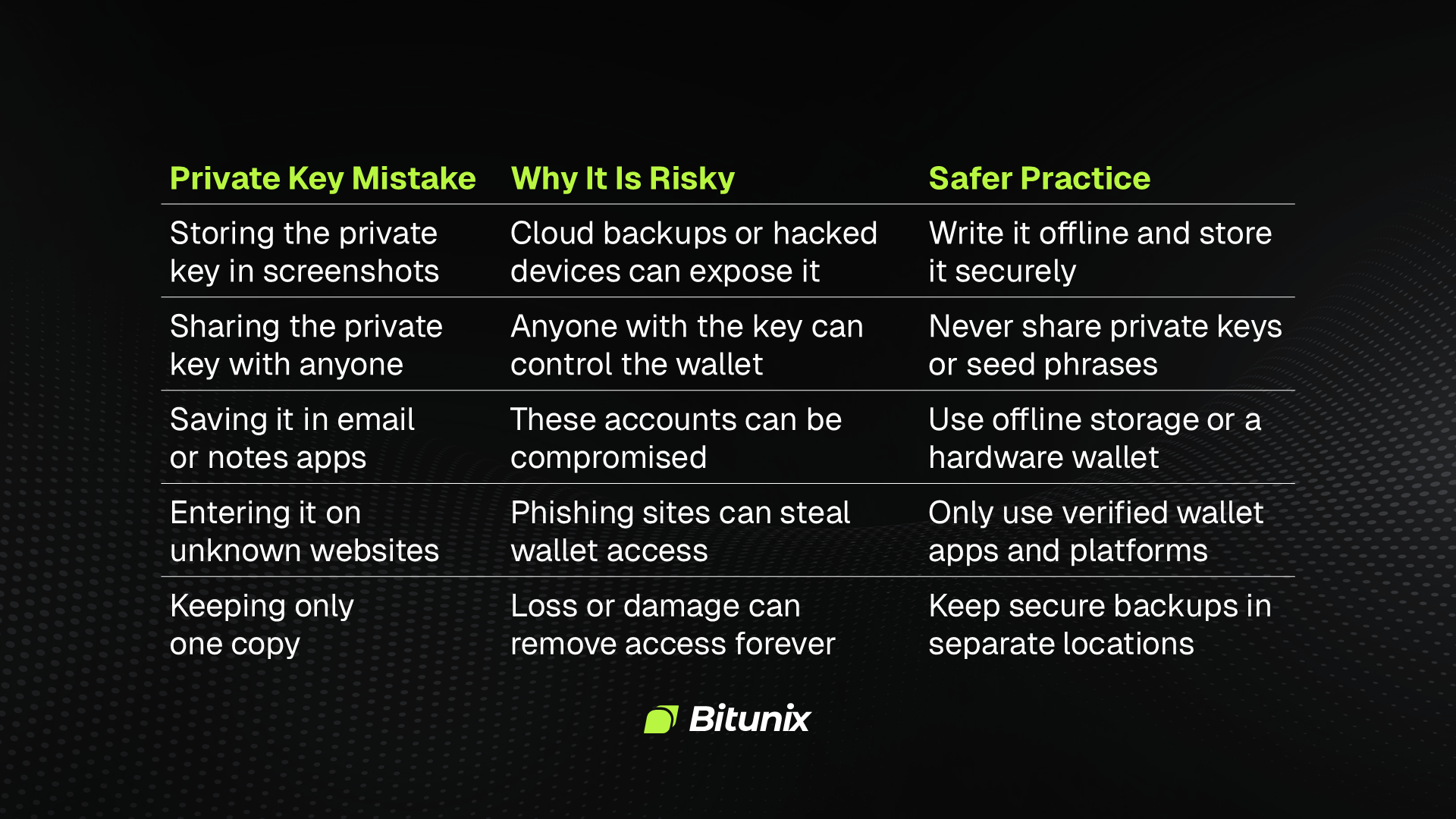
Common private key storage mistakes and safer ways to protect wallet access.
Kraken's 2025 crypto safety survey found that 48% of respondents were more concerned about losing crypto due to personal error than to fraud or theft. The same survey found that 24% had forgotten or misplaced private keys, while 21% had sent crypto to the wrong wallet address.
Tools That Add Layers of Protection
Security tools reduce the risk of exposing or misusing a private key by adding stronger controls around storage and transaction approval. Hardware wallets keep keys away from internet-connected devices, multi-signature wallets require multiple approvals before funds move, and password managers can help protect exchange logins. However, raw private keys should not be stored there casually.
Two-factor authentication helps protect exchange accounts, while withdrawal safelists limit where funds can be sent. Bitunix's 2025 security guide recommends combining platform security features, including 2FA and withdrawal safelists, with personal protections such as hardware wallets and careful network behavior.
Security tools are most effective when they support a clear review process. A hardware wallet can protect the private key, but it cannot stop a user from approving a fake transaction without checking the details. A withdrawal safelist can reduce withdrawal risk, but it only works well when the saved addresses have been verified first.
Security Reviews and Key Hygiene
Regular security reviews help users catch weak points before they become losses. Review wallet backups, device security, browser extensions, exchange login activity, saved addresses, and smart contract approvals. Also, remember to remove old wallet connections and revoke approvals that are no longer needed.
This is especially useful for users who interact with DeFi, NFTs, bridges, or several wallets. Remember always to research projects, check audits, use burner wallets, and revoke token approvals when interacting with smart contracts.
A simple quarterly routine works well for many users. Confirm that backups are readable, remove unused apps and extensions, update wallet software, rotate weak passwords, and check whether any wallet has unnecessary permissions.
Practical Applications and Use Cases
Private keys remain mostly hidden during normal wallet use, but they are involved whenever a transaction requires authorization. The wallet interface handles the cryptography, while the user sees actions such as sending crypto, signing a message, connecting to an app, or approving a transaction.
Day-to-Day Usage
During normal use, a wallet applies the private key to sign a transaction. The signature proves that the wallet owner approved the action, while the private key remains hidden. This is how users send crypto, approve token transfers, or interact with decentralized applications.
For everyday wallet use, you should not need to type your private key into a website. A request for your private key or recovery phrase is a major warning sign, because legitimate wallet activity should happen through a verified wallet app or hardware wallet interface. You should never enter a recovery phrase online, even if a site or message looks official.
Wallet Management
Wallet management means organizing keys, addresses, networks, and backups in a way that reduces risk. Many users benefit from separating wallets by purpose. A long-term storage wallet can stay mostly offline, while a smaller active wallet can handle routine DeFi, NFT, or payment activity.
This separation limits risk by keeping long-term storage away from higher-risk activity. If an active wallet connects to a risky app or approves a bad transaction, the long-term wallet remains separate and protected. No single wallet should handle storage, trading, DeFi activity, and experimental apps simultaneously.
Users who trade on centralized platforms also need to understand the difference between account security and self-custody. On an exchange, the platform manages wallet infrastructure, and the user secures login access, 2FA, withdrawal controls, and account settings. In self-custody, the user protects the private key or recovery phrase directly.
Recovery Procedures
Recovery depends on what was lost or compromised. If the private key is lost but the recovery phrase is safe, the user can usually restore the wallet in a verified wallet app or hardware wallet. If both the private key and recovery phrase are lost, the wallet usually cannot be recovered.
If the private key is compromised, the priority is moving assets to a new secure wallet as soon as possible. The new wallet should use a fresh private key and a fresh recovery phrase, since reusing the compromised wallet keeps the same risk alive.
If funds are already stolen, collect transaction hashes, wallet addresses, asset names, networks, amounts, dates, and any related messages or websites. Then contact the relevant exchange, wallet provider, or law enforcement reporting channel. Fast reporting can help if funds move through a centralized platform, but recovery is never guaranteed.
Integration with Exchanges
Private keys work differently on centralized exchanges and self-custody wallets. In a self-custody wallet, the user controls the private key directly. At the same time, on an exchange, the platform manages custody infrastructure, and the user controls account access through login credentials and security settings.
Exchange and self-custody wallets create different security responsibilities. Exchange users need to protect their accounts with strong passwords, 2FA, anti-phishing habits, and withdrawal controls, while self-custody users need to protect private keys, offline backups, and transaction approvals. Both models require discipline, but each exposes users to different weaknesses.
Many users combine both approaches by trading on an exchange and withdrawing long-term holdings to a wallet they control. Bitunix's withdrawal guide explains that on-chain withdrawals move funds to an external wallet via the blockchain, and it warns users to confirm that the withdrawal network matches the receiving wallet's network, as mismatches can lead to lost funds.
Risks and Considerations
Private key risk comes from theft, exposure, loss, poor storage, phishing, malware, social engineering, and weak operational habits. The blockchain can correctly validate signatures, yet the user still loses funds because the key was stolen or an incorrect transaction was approved.
Phishing, Malware, and Key Theft
Private key theft remains one of the most serious crypto security risks because attackers only need to steal the credential that controls the wallet. TRM Labs explains why private keys and seed phrases are such high-value targets:
"These compromises are common because private keys and seed phrases serve as the foundational access credentials for crypto wallets and platforms. Hackers exploit poor storage practices, conduct phishing campaigns, and deploy malware to gain access to these sensitive credentials."
TRM Labs also found that infrastructure attacks, mainly private key and seed phrase compromises, accounted for nearly 70% of stolen funds in 2024. Chainalysis reported in its 2025 crypto crime trends that stolen funds increased 21% year over year to $2.2 billion, and private key compromises accounted for the largest share of stolen crypto in 2024 at 43.8%.
Human Error and Poor Storage Habits
Human error creates major private key risk because users often store sensitive information in places designed for convenience. Screenshots, photo galleries, email drafts, cloud drives, and notes apps can expose keys through device theft, account compromise, or cloud sync.
Chainalysis estimated that personal wallet compromises accounted for 20% of all value stolen in 2025, based on lower-bound estimates from on-chain patterns, victim reporting, and industry partners. Users should treat private key storage like access to a vault: the key should never be sent in a message, typed into an unknown website, or stored alongside instructions that make theft easier.
Compliance and Custody Rules
Regulatory rules around private keys focus less on the key itself and more on custody, control, and transfer responsibilities. Under MiCA, custody and administration of crypto-assets includes safeguarding crypto-assets or the means of access to them, including private cryptographic keys.
This creates a clear distinction between self-custody, where users protect their own keys, and custodial services, where platforms manage access, governance, and client asset protection.
Transfer rules also affect how regulated platforms process crypto movements. ESMA's 2025 MiCA transfer services guidelines require crypto-asset service providers to maintain policies and procedures for transfer services, including compliance with the EU transfer-of-funds framework. These rules shape how exchanges and custodians handle withdrawals, required transfer information, and post-transaction communication.
Global compliance remains uneven, so users should not assume that every platform follows the same custody or transfer standards. For private key security, the practical takeaway is to know whether you are using self-custody or a custodian, what protections apply, and what recovery or support options exist before moving large balances.
Future Security Developments
Private key security is moving toward better user interfaces, hardware-backed signing, multi-signature controls, passkey-style authentication, account abstraction, and risk warnings before users approve dangerous transactions. The goal is to reduce single points of failure without removing user control.
Multi-signature wallets already help teams and larger holders avoid relying on one key, hardware wallets reduce exposure to malware, and smart contract wallets and account abstraction can support features such as spending limits, recovery contacts, and more flexible approval rules.
These tools can reduce mistakes, but users still need to verify what they sign, protect recovery information, and keep backups safe. The best security model combines safer tools with careful habits.
Conclusion: Protecting Your Cryptocurrency Assets
A private key is a fundamental part of cryptocurrency security because it controls the ability to authorize blockchain transactions. Anyone who controls the key controls the wallet, which makes private key protection one of the first lessons every crypto user should learn. By using offline backups, hardware wallets, multi-signature protection, strong exchange security, and regular wallet reviews, you can reduce the risk of losing digital assets.
Ready to secure your cryptocurrency? Download the Bitunix app and register to access wallet tools, deposit and withdrawal features, and account security options that can help you manage crypto more carefully.
FAQ Section
What exactly is a private key?
A private key is a secret cryptographic code that gives control over assets in a crypto wallet. It signs transactions and proves that the wallet owner authorized them. Anyone with the private key can move funds, so it must stay private and secure.
Why is the private key important in cryptocurrency?
A private key is important because it controls access to blockchain assets. Without it, the wallet cannot sign transactions. If someone steals it, they can transfer the funds. If it is lost without a backup, the assets can become inaccessible.
How is the private key generated?
A wallet generates a private key using cryptographic randomness. From that key, the wallet can derive a public key and wallet address. The public address receives funds, while the private key stays secret and signs transactions when the owner approves activity.
What are the risks associated with a private key?
The main risks include theft, phishing, malware, poor storage, accidental sharing, and permanent loss. A private key stored in screenshots, email, cloud drives, or notes apps can be exposed if the device or account is compromised.
How should I securely store a private key?
A private key should be stored offline or inside a trusted hardware wallet. If you use a recovery phrase, write it down and keep backups in secure physical locations. Avoid screenshots, cloud storage, email, messaging apps, and unknown websites.
What should I do if my private key is compromised?
If your private key is compromised, create a new wallet with a fresh key and transfer funds there immediately if the assets are still available. Then revoke risky approvals, stop using the old wallet, collect transaction details, and contact relevant platforms if funds were stolen.
Can the private key be recovered if lost?
A lost private key can only be recovered if you have the correct recovery phrase, backup, or wallet recovery method. If the key and recovery phrase are both lost, the wallet usually cannot be restored, and the assets may be permanently inaccessible.
How does a private key relate to wallet security?
Wallet security depends on protecting the private key and recovery phrase. The wallet interface helps manage assets, but the private key controls authorization. Strong wallet security includes offline backups, hardware wallets, safe signing habits, and regular reviews of wallet connections.
Are there different types of private keys?
Different blockchains and wallet systems use different cryptographic formats, but the purpose is to authorize transactions with private keys. Users usually do not need to manage raw formats directly because wallet software or hardware devices handle the technical details.
Where can I learn more about private key security?
Reliable sources include blockchain documentation, wallet provider security guides, and exchange help centers. Focus on private key storage, recovery phrase safety, phishing prevention, and transaction signing habits.
Glossary
- Private key: A secret cryptographic code that authorizes transactions from a crypto wallet.
- Public key: A cryptographic value derived from a private key and used to help verify signatures.
- Wallet address: A public blockchain destination used to receive cryptocurrency.
- Blockchain: A distributed record of transactions maintained across a network of computers.
- Crypto security: The practices and tools used to protect digital assets from theft, loss, and mistakes.
- Wallet management: The process of organizing wallets, keys, addresses, networks, backups, and permissions.
- Recovery phrase: A set of words that can restore access to a crypto wallet.
- Hardware wallet: A physical device that stores private keys offline and signs transactions securely.
- Self-custody: A wallet setup where the user controls private keys directly.
- Custody: The management of crypto assets or keys by a user, platform, or service provider.
- Multi-signature wallet: A wallet that requires more than one key or approval to move funds.
- Phishing: A scam that tricks users into revealing keys, recovery phrases, or account credentials.
- Malware: Malicious software designed to steal data, monitor activity, or compromise devices.
- Transaction signature: Cryptographic proof that the private key holder authorized a transaction.
- Smart contract approval: Permission granted to a blockchain application to interact with tokens or wallet assets.
About Bitunix
Bitunix is a global cryptocurrency derivatives exchange trusted by over 3 million users across more than 100 countries. At Bitunix, we are committed to providing a transparent, compliant, and secure trading environment for every user. Our platform features a fast registration process and a user-friendly verification system supported by mandatory KYC to ensure safety and compliance. With global standards of protection through Proof of Reserves (POR) and the Bitunix Care Fund, we prioritize user trust and fund security. The K-Line Ultra chart system delivers a seamless trading experience for both beginners and advanced traders, while leverage of up to 200x and deep liquidity make Bitunix one of the most dynamic platforms in the market.
Bitunix Global Accounts
X | Telegram Announcements | Telegram Global | CoinMarketCap | Instagram | Facebook | LinkedIn | Reddit | Medium