1. What is Pump.fun?
PUMP is the governance token of the Memecoin launchpad Pump.fun. Pump.fun is a phenomenon-level token issuance and trading platform within the Solana ecosystem. It is more than just a token issuance tool—it represents the first social experiment in cryptocurrency history to lower the “token issuance threshold” to near zero. Pump.fun was founded by Alon Cohen and his team in early 2024. After deeply exploring the Meme coin and altcoin market, Alon keenly identified the core pain point of retail investors: traditional token issuance processes are full of reserved allocations and VC sell-off pressure. For users, participating in early-stage projects in a fair environment was almost impossible.
To break this “opaque” monopoly, Alon led the team to develop Pump.fun. Their core vision is simple: anyone can issue a 100% fair, no-reserve, audited token in just a few seconds for under 0.02 SOL. The emergence of Pump.fun marks the beginning of the “mass launch” era for Meme coins, completely eliminating complex liquidity pool setups and high technical barriers.
2. Pump.fun — Leader in Meme Launchpad
In the decentralized launchpad arena, Pump.fun has established a near-monopoly position. While other launchpads have claimed “fair issuance,” very few have achieved both explosive user growth and trading volume dominance like Pump.fun. Since its launch in 2024, its highly simplified user experience and “internal/external market” mechanism quickly made it the traffic core of the crypto market.
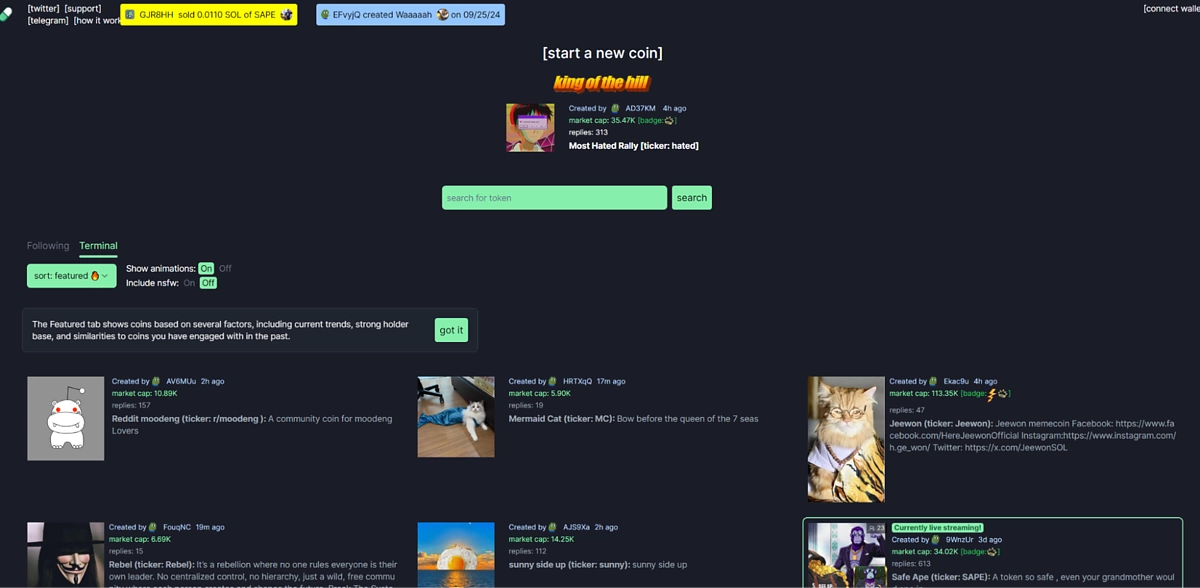
Pump.fun’s core advantage comes from its bonding curve pricing model, which allows token prices to be entirely driven by buying and selling behavior without requiring liquidity from creators. On this basis, Pump.fun has established a complete issuance loop: tokens initially trade internally, effectively avoiding liquidity pool exit risks; when market capitalization reaches around $69,000, liquidity is automatically injected into the external market and certificates are burned. The entire process is automatic, irreversible, and secures both asset safety and market trust.
Beyond the trading mechanism, Pump.fun further productizes “attention.” Built-in live streaming transforms token issuance into highly interactive content competition. Coupled with the “King of the Hill” mechanism, leading tokens get homepage visibility and traffic advantage, creating a classic winner-takes-more effect. Ultimately, price, liquidity, and attention integrate into a self-reinforcing cycle, making each token issuance a community and capital game.
3. Spotlight Tokens on Pump.fun: From Traffic Experiments to Wealth Machines
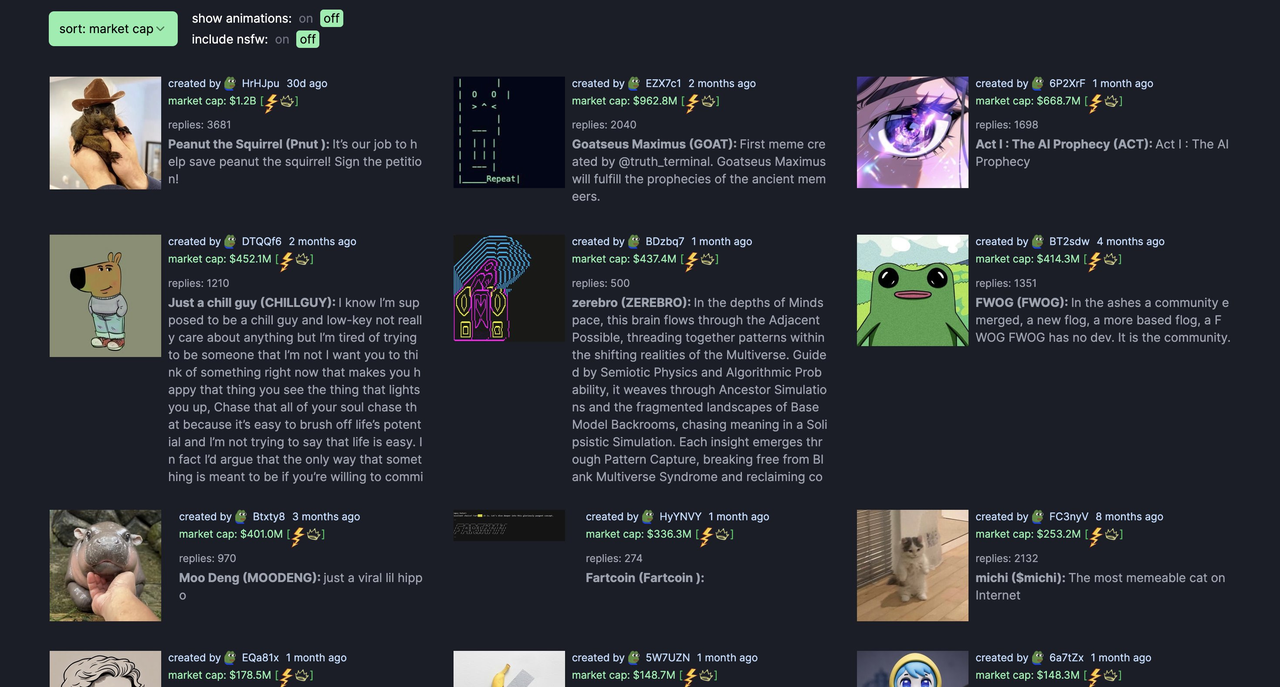
As the mechanism matured, Pump.fun evolved into a high-frequency incubator of “phenomenon-level tokens.” Notably, these tokens often start not from financial design but from a compelling “origin story.” The platform then amplifies attention, completing the conversion from content to capital.
- MOODENG: From a Thai Hippo to an Emotional Resonance Symbol
MOODENG is based on a small hippo that went viral from a Thai zoo. Its cute image and daily clips spread rapidly on social media, naturally carrying Meme genes. This “low threshold, high emotional value” content resonated quickly with users on Pump.fun, and live interactions amplified it into a capital asset from content IP.
- PNUT: From the “Executed Squirrel” to an Emotional and Political Symbol
PNUT represents a classic “event-driven” Meme coin. The original peanut, a social-media-famous pet squirrel, was taken by New York authorities in 2024 and euthanized due to rabies testing, sparking massive public controversy and emotional backlash.
- PIPPIN: From AI-Generated Character to Sustainable Meme Narrative
PIPPIN originated from an AI experiment by developer Yohei Nakajima, who used ChatGPT to generate a unicorn character named “Pippin,” gradually assigning it personality and behaviors. The character evolved into an AI Agent capable of ongoing social media interaction, becoming a digital character that “creates content” autonomously.
4. PUMP — Tokenomics
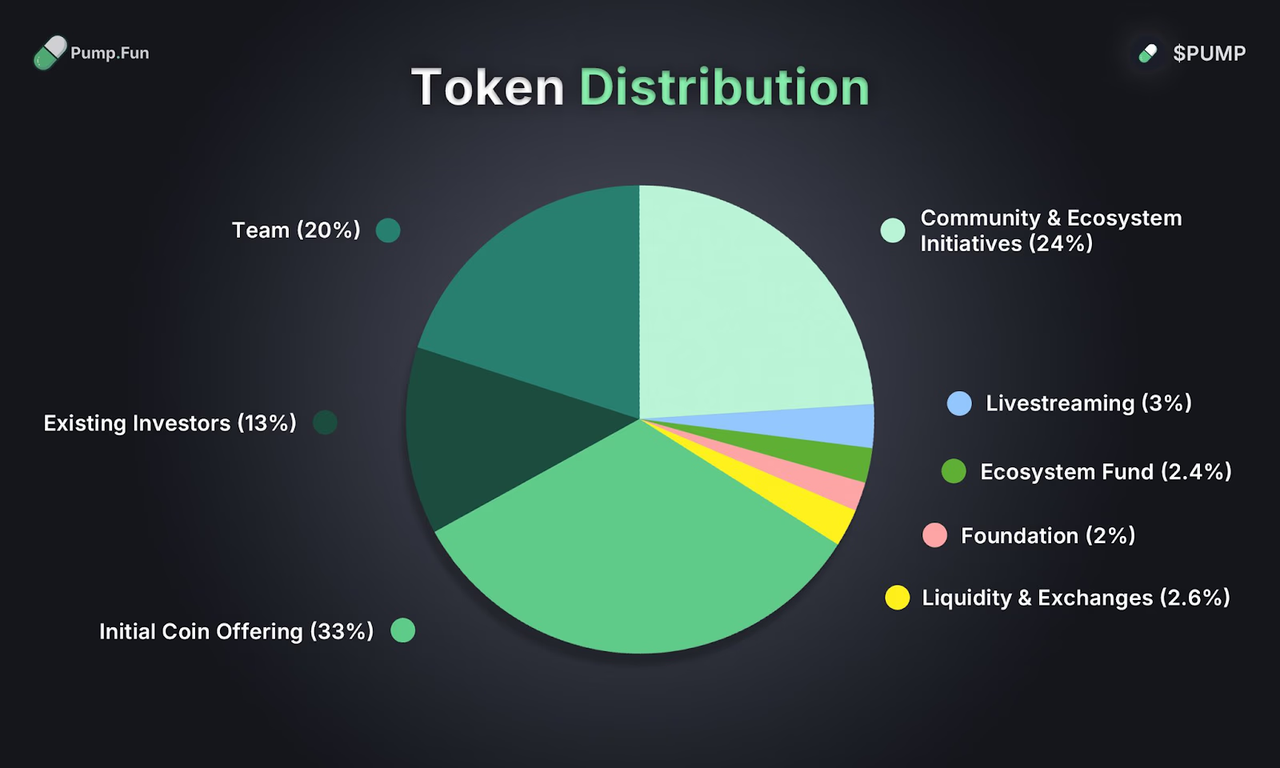
As the core driver of the Pump.fun ecosystem, the native token PUMP officially launched in 2025, designed to channel the platform’s massive traffic and fee revenue directly back to the community. Unlike most airdrop-driven tokens, PUMP introduces a new distribution logic: converting daily platform fees into intrinsic token value. This model elevates PUMP beyond a governance label, becoming a key link for holders to share in platform growth, achieving a transition from “token launchpad” to “profit-generating community ecosystem.”
PUMP continues the platform’s “fair launch” ethos with highly decentralized tokenomics. Similar to Hyperliquid, it avoids large-scale VC involvement in early stages, fundamentally sidestepping institutional unlock pressure and scheduled sell-off risks. With a highly dispersed and real-user-driven token structure, PUMP’s market performance depends on community consensus rather than institutional manipulation, providing a relatively fair and transparent environment for long-term holders.
Value capture is achieved via dual mechanisms of “revenue sharing” and “deflationary burning.” Holders receive a portion of platform transaction fees, effectively giving the token the function of a “digital ticket” to platform dividends. Additionally, the platform periodically repurchases PUMP from the secondary market and permanently burns it, ensuring continuous deflation. This closed-loop design binds platform profits with holder benefits, establishing PUMP as a benchmark “profit-generating protocol token” in Web3 and offering a sustainable economic paradigm for the Meme sector.
5. How to Acquire PUMP
Individual users can theoretically qualify for potential PUMP incentives by participating in internal market trading and accumulating platform activity on Pump.fun. However, this method carries high volatility and uncertainty, more suitable for experienced on-chain “hunters.”
Alternatively, users can purchase PUMP via centralized exchanges like Bitunix, which acts as a trusted intermediary, supporting purchases with fiat or stablecoins (e.g., USDT). Some platforms also allow instant credit card purchases, lowering the investment threshold. First-time users must register and complete identity verification (KYC) to comply with global anti-money laundering (AML) and counter-terrorism financing regulations. Bitunix employs industry-leading compliance and risk-control systems, including cold/hot asset separation, multi-signature, and real-time monitoring, offering above-average asset security.
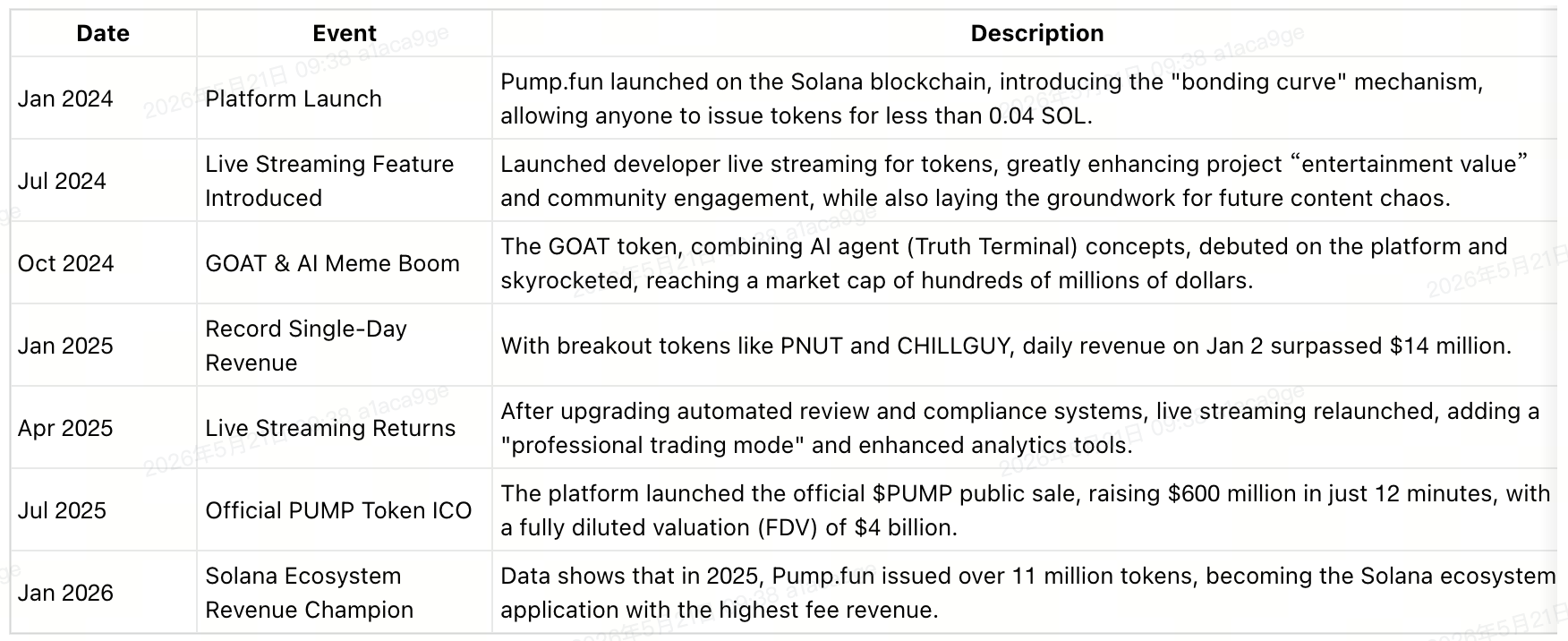
6. PUMP Major Events