
Article Summary
- This article provides a detailed price prediction and fundamental analysis for the Immutable X (IMX) token.
- It explains Immutable X as the first Layer-2 scaling solution on Ethereum built specifically for NFTs and Web3 gaming, offering zero gas fees and instant trade confirmation.
- The bull case focuses on its massive ecosystem of high-profile games (Illuvium, Gods Unchained), its partnership with Polygon (Immutable zkEVM), and the overall growth of the Web3 gaming sector.
- The bear case highlights the historical underperformance of blockchain games, intense competition from other gaming-focused chains (Ronin, Avalanche Subnets), and token inflation.
- It presents detailed price prediction scenarios (bearish, neutral, bullish) for both 2026 and 2030, based on gaming adoption and NFT trading volume.
Ethereum still gives game studios the strongest smart contract base, but it was never built for item trades, rapid marketplace actions, or mass-player onboarding at game speed. Immutable X set out to solve that gap by bringing NFT trading and game asset activity onto a Layer 2 that keeps Ethereum security while removing much of the cost and friction that usually scares players away. Bitunix already offers IMX/USDT markets on its crypto exchange, while the on-chain story keeps evolving.
At a technical level, Immutable started as a zk-based scaling network for gaming and NFTs, batching off-chain activity into proofs that settle back to Ethereum. The investment case now sits at the intersection of gaming infrastructure, token utility, and ecosystem execution. This analysis will examine Immutable X's technology, its strategic partnerships, and provide data-driven price predictions for 2026 and 2030.
The Technology and Ecosystem
The original Immutable X rollup was merged into Immutable Chain in early 2026, so the old brand still matters for investors, but the product stack has already moved forward. Official documentation says Immutable X was the first rollup, built with StarkWare as a customized deployment of StarkEx, and that it processed hundreds of millions of transactions and billions of dollars in game asset trading volume before the merger.
1. Zero-Knowledge Rollups
The original Immutable X Layer-2 uses a zk-Rollup design to move most activity off Ethereum, prove validity on-chain, and give studios a way to handle game economies without mainnet gas pain. Immutable X is capable of up to 9,000 TPS, with zero gas fees and instant confirmations for NFT activity. At the same time, Immutable's 2026 chain docs show the newer stack running with about two-second block times and about two-second finality on mainnet.
2. Zero Gas Fees and Instant Trades
Game studios do not want players stopping mid-session to think about wallet pop-ups or network costs. Immutable's 2026 documentation now states this plainly in its product overview, where it describes zero gas fees for players, automatic wallet creation, and real digital ownership as core platform features. On the orderbook side, current docs also show that creating listings is gasless, while buyers can transact in native IMX or ERC-20 tokens depending on the order structure. For players and developers, that means faster NFT minting, simpler marketplace use, and fewer chances for the user experience to fall apart.
3. The IMX Token
The IMX token is an ERC-20 asset with a maximum supply of 2 billion tokens, and it sits at the center of Immutable's economic model across Immutable X and the newer zkEVM-based chain. It is used for protocol fees, staking rewards, governance, and developer incentives, which means the token is tied to both network usage and ecosystem growth.
Immutable's tokenomics state that 20% of protocol fees must be paid in IMX, and if a user does not already hold IMX, the system can convert the transaction value into IMX on the open market. That design gives the token a direct link to the marketplace and network activity, rather than leaving it as a passive governance chip. Staking adds another layer, because users can lock IMX to earn rewards tied to protocol activity, and governance gives holders a say in network proposals. On top of that, Immutable explicitly uses IMX for developer grants and ecosystem incentives, which is good for growth but also means token distribution must be closely monitored, since adoption needs to keep pace with supply entering the market.
The Bull Case: The Gaming Hub
Current forecast models for IMX vary widely, which reflects both the size of the Web3 gaming opportunity and the uncertainty around how much of that market Immutable can actually capture.
CoinCodex's April 22, 2026 model is conservative, putting IMX at about $0.1739 by the end of 2026 and $0.05575 by 2030. Kraken's public calculator, using a 5% annual growth assumption, lands near $0.18 in 2026 and $0.21 in 2030, while Coinbase's projection tool points to about $0.22 by 2030 under the same growth setup. On the other end, Bitget's February 2026 outlook says IMX could hit $1.05 in 2026 and $11 by 2030, and Changelly's current 2030 range sits between $14.13 and $17.69. That spread looks chaotic, but it also tells you what the market is really saying: if Immutable becomes the default gaming infrastructure layer, upside exists, and if it stays niche, the conservative models will look smarter.
1. The Premier Gaming Ecosystem
Immutable's biggest bull argument is ecosystem depth. DappRadar reported in September 2025 that Immutable launched Immutable Play, added Ubisoft as its first major partner, and supported over 660 games across Immutable X and Immutable zkEVM before the two were merged into a single chain. Immutable's own blog now markets the platform around 700+ funded games, which shows how aggressively it has tried to become the home base for Web3 gaming studios. That lead is about a pipeline large enough that even if some games fail, the broader network can still keep shipping.
Another strength of the ecosystem is that it already includes recognizable game brands rather than a list of unknown experiments. DappRadar's Immutable gaming and NFT pages currently highlight Gods Unchained, Guild of Guardians, and Illuvium as active parts of the broader Immutable environment. In Q3 2025, DappRadar reported that Gods Unchained's NFT trading volume on Immutable zkEVM jumped 507% to $27.2 million after migration. That shows that established gaming collections can still generate meaningful activity on the network when the game, marketplace, and infrastructure work together.
2. The Polygon Partnership
The Polygon relationship remains one of the clearest reasons bulls keep IMX on their watchlist. Polygon Labs said in October 2025 that Immutable zkEVM would connect into Agglayer, giving the gaming chain access to shared network effects and broader interoperability. Immutable zkEVM is also an EVM-compatible rollup solution optimized for gaming. That matters because the original Immutable X design was excellent for straightforward NFT activity, but EVM compatibility opens the door to richer game economies, more flexible smart contracts, and easier developer tooling.
3. Developer Tooling
Immutable's developer tooling is one of the clearest reasons the network still has a strong position in blockchain gaming. The company has focused heavily on reducing the friction that usually scares off both studios and players. Its Passport product lets users sign in with familiar methods such as email, Google, or Apple, and then creates a wallet behind the scenes.
Immutable's current documentation shows that Passport provides players with a single wallet identity across games, supports pre-approved transactions for smoother in-game actions, and integrates with the broader SDK and marketplace stack. For developers, that makes it easier to build Web3 features without forcing every player to learn crypto basics first, and that is the real advantage here. Better onboarding does not guarantee a hit game, but it removes one of the biggest reasons players leave before they even start.
The Bear Case: The Web3 Gaming Struggle
Looking at the lower-end forecasts shows why the downside case is still very alive. CoinGecko currently places IMX at around $0.1789, with a market cap of about $150.7 million, a fully diluted valuation of about $357.8 million, and a circulating supply of about 842.4 million out of a 2 billion max supply. Against that backdrop, CoinCodex's 2030 model drops to $0.05575, Kraken stays near $0.21, and Coinbase stays near $0.22.
1. The Play to Earn Stigma
Mainstream players still treat crypto gaming with suspicion, and that baggage has not disappeared just because infrastructure has improved. DappRadar's Q2 2025 report described a rough quarter for the sector: gaming activity fell 17% quarter over quarter to 4.8 million daily unique active wallets, more than 300 gaming dApps went inactive, and investment dropped to $73 million, down 93% year over year. That is a reminder that better chain design does not automatically create better games or better retention. If players think the ownership layer exists to extract value rather than improve the experience, they will leave.
2. Fierce Competition
Competition around gaming infrastructure is much broader than a simple battle between a few NFT-focused chains. Immutable has to compete with gaming-first networks such as Ronin and Avalanche Subnets. Still, it also has to defend its position against general-purpose Layer-2s and other ecosystems that want the same studios, players, and marketplace activity.
That wider competitive pressure makes the bearish case easy to understand. Even if Immutable keeps strong tooling and a recognizable game pipeline, it still has to prove that developers will keep choosing its stack over larger or more flexible alternatives. In practice, that means competing on onboarding, liquidity, transaction costs, infrastructure quality, and the ability to keep successful games active over time.
3. Token Inflation
The tokenomics also carry a real overhang. A current 2025 Bitstamp guide says 51.74% of the total IMX supply was allocated to ecosystem development, including user rewards and developer grants, while 25% was allocated directly to Immutable for project development. CoinGecko's live tokenomics page shows that only about 842.4 million IMX are circulating out of a 2 billion max supply, with large balances still sitting in treasury and foundation wallets. In other words, the market still has plenty of supply to absorb.
Immutable X (IMX) Price Prediction Scenarios (2026 & 2030)
A useful Immutable X price prediction should sit somewhere between blind optimism and defeatism. The conservative camp includes CoinCodex, Kraken, and Coinbase, which cluster around the high teens or low twenties in cents by 2030. The aggressive camp includes Bitget and Changelly, which move into multi-dollar territory and assume the gaming thesis finally clicks at scale. CoinLore sits in between those camps with a $3.93 bullish 2030 case.
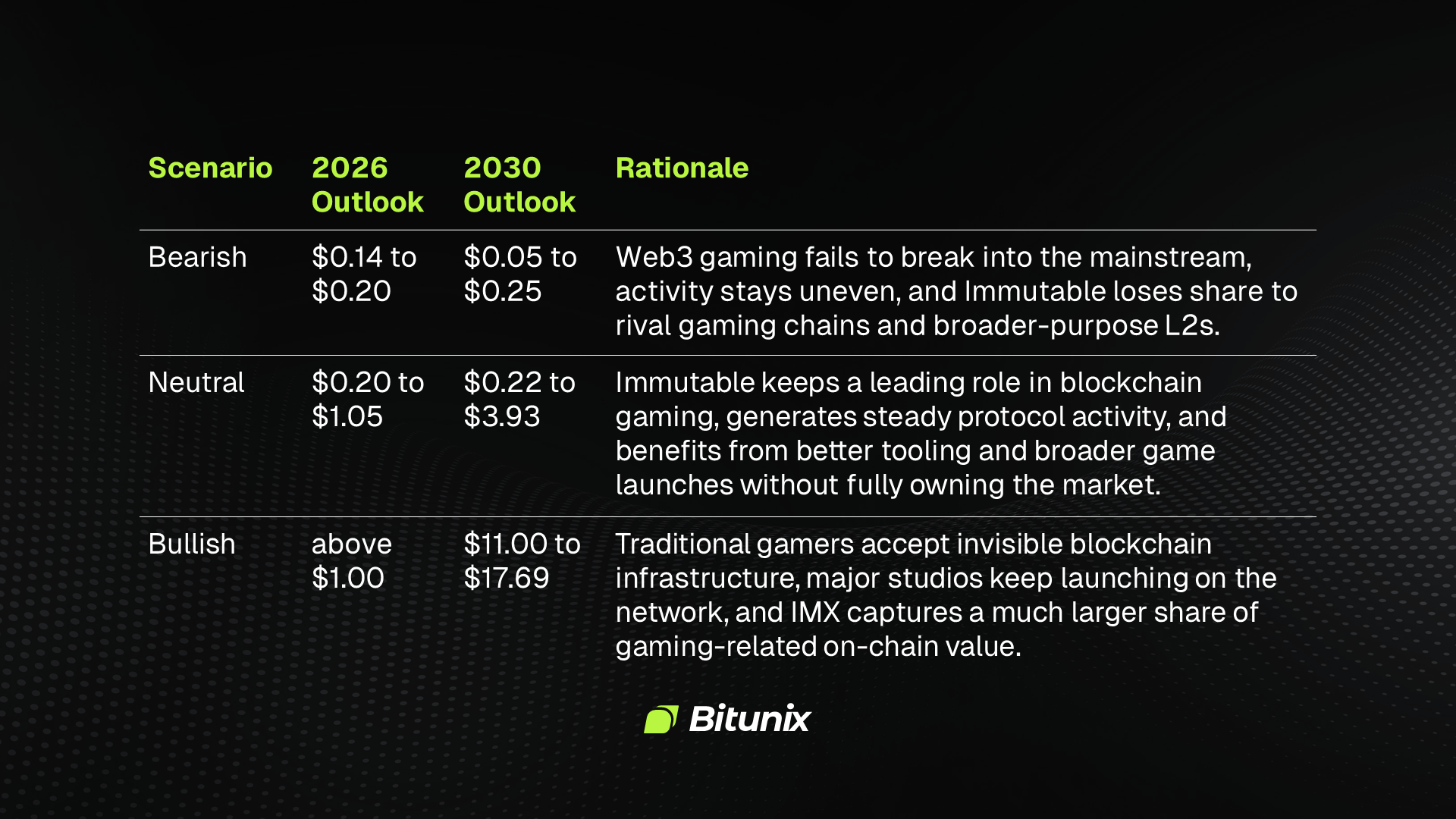
Immutable X scenario table comparing bearish, neutral, and bullish price outlooks for 2026 and 2030.
Conclusion: A Bet on the Future of Play
Immutable still offers one of the clearest infrastructure cases in gaming crypto. It has real technology roots in the original StarkEx-based Immutable X rollup, a broader chain architecture after the 2026 merger, strong onboarding tools through Passport, and a large studio pipeline that keeps it relevant even when the sector cools down. Few gaming tokens can point to that many moving parts and still claim they are building infrastructure first.
But the market is grading the network on whether Web3 gaming can retain users, whether token supply can be absorbed without crushing prices, and whether the company can stay ahead in a field where many rivals want the same developers and players. If you think digital ownership in games becomes normal, IMX has a credible long-term case. If you think gaming audiences keep rejecting crypto layers, the bearish models still look more realistic.
And if you want to follow the sector directly, follow the IMX/USDT trading pair, download the Bitunix app, and register to start trading while the next stage of the gaming stack takes shape.
FAQ
What is Immutable X (IMX)?
Immutable X began as a gaming-focused Ethereum Layer 2 for NFTs and marketplace activity. In early 2026, it was merged into Immutable Chain, but IMX still functions as the token connecting the broader gaming ecosystem, including trading, staking, and governance.
How does Immutable X achieve zero gas fees?
Immutable's current docs explain that gas sponsorship means players do not pay fees on supported game actions. The earlier Immutable X design handled NFT activity off-chain with zk proofs, and the newer chain keeps the same gaming-first goal of hiding fees from the player.
What is a zk-Rollup?
A zk-Rollup is a scaling system that batches many transactions off-chain and submits a proof back to Ethereum to verify that the batch is valid. That lets a network handle far more activity without asking Ethereum mainnet to process every action directly.
What is the difference between Immutable X and Immutable zkEVM?
Immutable X was the earlier StarkEx-based rollup focused on fast NFT trading. Immutable zkEVM, now part of Immutable Chain, adds EVM compatibility and more flexible smart contract support, which gives developers a much wider design space for games and marketplaces.
What is the utility of the IMX token?
IMX is used for protocol fees, staking, and governance. Current sources also say 20% of protocol fees must be paid in IMX, which helps tie token demand to actual marketplace and ecosystem usage rather than pure speculation alone.
How do protocol fees work on Immutable X?
Immutable X charges a 2% protocol fee on NFT trades, not on minting. Buyers pay it in the trade currency, and part of that value is converted into IMX, which supports staking rewards. Marketplace fees and creator royalties can be added on top of that.
What is Immutable Passport?
Passport is Immutable's login and wallet system for games. It lets players sign in with Google, Apple, or email, creates wallets automatically, and gives them one identity across the Immutable ecosystem without needing a seed phrase or browser extension.
Which popular games are built on Immutable X?
The best-known names tied to the Immutable ecosystem include Gods Unchained, Guild of Guardians, and Illuvium.
What are the risks of investing in IMX?
The main risks are slow mainstream gaming adoption, tough competition from other gaming chains, token supply pressure, and the possibility that better infrastructure still fails to produce games people want to keep playing.
Where can I buy IMX tokens?
You can buy IMX on major centralized exchanges, such as Bitunix, Binance, Bybit, and Coinbase Exchange.
Glossary
- IMX token: The native utility token used across the Immutable ecosystem for fees, staking, and governance.
- Immutable X Layer-2: The original StarkEx-based Layer 2 that focused on NFT trading and gaming asset activity before the 2026 merger into Immutable Chain.
- Immutable Chain: The unified chain structure created after Immutable X and Immutable zkEVM were merged in early 2026.
- zk-Rollup: A scaling system that batches transactions and posts validity proofs back to Ethereum.
- StarkEx: The StarkWare technology stack that powered the original Immutable X rollup.
- NFT minting: The process of creating NFTs on-chain or through a Layer 2 platform built for digital assets.
- Zero gas fees: A user experience model where players do not directly pay transaction costs on supported game actions.
- Gas sponsorship: Immutable's mechanism for covering gas costs so supported players do not pay them directly.
- Passport: Immutable's authentication and embedded wallet product for game users.
- Pre-approved transactions: A Passport feature that allows certain in-game actions to execute without repeated wallet pop-ups.
- EVM compatibility: Support for Ethereum-style smart contracts and developer tools such as Solidity, Hardhat, and Foundry.
- Protocol fees: Fees generated by network or marketplace activity, part of which must be paid in IMX.
- Staking: Locking IMX to earn a share of fee-based rewards and participate more directly in the ecosystem.
- Governance: The voting process through which IMX holders can weigh in on proposals and ecosystem decisions.
- Web3 gaming: Game ecosystems that combine gameplay with wallets, tokens, NFTs, or other blockchain-based ownership features.
Disclaimer
This article does not provide:
(i) investment advice or investment recommendations;
(ii) an offer or solicitation to buy, sell, or hold digital assets;
(iii) financial, accounting, legal, or tax advice.
Digital assets, including stablecoins and NFTs, involve high risk and may fluctuate significantly. Consider whether trading or holding digital assets is appropriate for you given your financial situation. Consult a qualified legal, tax, or investment professional when needed. You are responsible for understanding and complying with applicable local laws and regulations.
About Bitunix
Bitunix is a global cryptocurrency derivatives exchange trusted by over 3 million users across more than 100 countries. At Bitunix, we are committed to providing a transparent, compliant, and secure trading environment for every user. Our platform features a fast registration process and a user-friendly verification system supported by mandatory KYC to ensure safety and compliance. With global standards of protection through Proof of Reserves (POR) and the Bitunix Care Fund, we prioritize user trust and fund security. The K-Line Ultra chart system delivers a seamless trading experience for both beginners and advanced traders, while leverage of up to 200x and deep liquidity make Bitunix one of the most dynamic platforms in the market.
Bitunix Global Accounts
X | Telegram Announcements | Telegram Global | CoinMarketCap | Instagram | Facebook | LinkedIn | Reddit | Medium