

Article Summary
- This article provides a price prediction for JasmyCoin (JASMY), a Japanese cryptocurrency project focused on data sovereignty and the Internet of Things (IoT).
- It explains Jasmy's core mission: to create a "Data Democracy" where individuals can own and monetize their own data through a decentralized platform.
- The bullish case is built on its strong Japanese roots (often called "Japan's Bitcoin"), its experienced leadership from former Sony executives, and its focus on the massive, growing IoT market.
- A key focus is the Jasmy "lock-up" mechanism, where partner companies are required to hold a certain amount of JASMY tokens to use the platform, creating a potential long-term demand sink.
- The bearish case highlights the project's slow development progress, intense competition in the IoT and data privacy space, and the challenge of translating its vision into widespread, tangible adoption.
- JasmyCoin has one of the stickiest narratives in crypto. People call it Japan's Bitcoin, and the story starts with Sony executives, a big IoT vision, and the promise of getting control over your data again. The story is easy to repeat, which is exactly why it keeps resurfacing during every altcoin rotation.
- Jasmy sits at the intersection of two themes that never go away. First, the Internet of Things keeps adding devices, sensors, and data exhaust to everyday life. Second, the push for personal data sovereignty is growing louder as governments, enterprises, and users push back against the default model in which platforms collect data and you get nothing but targeted ads.
- If you mostly trade JASMY/USDT through a crypto exchange, you can still take a view on JASMY without touching any on-chain tooling. Bitunix is one venue where traders can access utility-focused altcoins, including JASMY. Trading access is the easy part; building a thesis that survives real-world adoption is the hard part.
- This article explains the tech and tokenomics behind Jasmy, weighs the catalysts and risks, and ends with three scenario-based price ranges for 2026 that you can update as new data arrives.
The Bullish Case for Jasmy
A bullish view on Jasmy depends on adoption that shows up in measurable usage, not just louder marketing. In 2025 and 2026, several trends moved in Jasmy's favor, including IoT device growth, rising data sovereignty pressure, and continued tightening of Japan's crypto regulatory framework.
1) A Focus on Data Sovereignty That is Getting More Concrete
Data sovereignty is no longer a niche term for compliance teams. In 2026, Megaport defined it as a jurisdiction and governance problem, which lines up with why enterprises care about control, access, and legal exposure.
Data sovereignty is the principle that data generated within a geographic area should be collected, managed, and stored in accordance with the laws and regulations of that area.
Jasmy's version of sovereignty focuses more on user consent and monetization, but the two ideas overlap. Phemex's 2026 explainer describes the Personal Data Locker model as storing IoT-generated data under user control and paying users in JASMY when businesses want access. That ties a real-world pain point to a token utility loop, which is what you want to see in a utility altcoin.
You can also see why the timing fits. IoT security and privacy risks keep growing, and a 2025 TechRadar write-up citing Palo Alto Networks telemetry said 48.2% of IoT-to-IT connections came from high-risk IoT devices, with another 4% from critical-risk components. If you assume IoT data becomes more valuable and more sensitive, those numbers support the trend.
2) The IoT Market Keeps Expanding, And The Numbers Are Still Climbing
Jasmy's TAM only looks big if IoT keeps growing, and 2025 data supports that. IoT Analytics projected connected IoT devices to grow 14% year over year to 21.1 billion by the end of 2025, with a forecast of 39 billion by 2030.
Cellular IoT is part of that story too, especially for logistics, automotive, industrial sensors, and anything that lives outside Wi-Fi coverage. Ericsson's IoT Connections Outlook expects cellular IoT connections to reach 4.5 billion by the end of 2025 and to approach 8 billion by 2031. When more devices go online, more data gets produced, and more value gets created around storage, access control, and consent.
Jasmy's bet is that this data should not default to corporate capture. Instead, it should sit in user-controlled lockers with explicit permissions and an audit trail, then businesses pay for access. It lays out this marketplace model directly, including the Personal Data Locker, permission management, and device authentication components.
3) Experienced Leadership Plus Japan's Regulatory Direction
If you are asking what is Jasmy Coin, the origin story is unusually corporate by crypto standards. CoinMarketCap lists Jasmy as founded in Tokyo by former Sony executives, including Kunitake Ando, Kazumasa Sato, Masanobu Yoshida, and Hiroshi Harada.
Japan's regulatory direction also became a clearer catalyst in 2025 and 2026. Reuters reported in March 2025 that Japan's FSA planned to revise the Financial Instruments and Exchange Act to give crypto assets legal status as financial products and subject them to insider trading restrictions, with a bill potentially submitted as early as 2026.
Reuters also reported in November 2025 that Japan was considering rules that would classify crypto as a financial product and reduce taxation on crypto profits to 20%, aligning with stock trading rates. However, it cited an Asahi report and noted the FSA had not immediately responded.
This matters for a Japan-centric project in a practical way. More formal classification and clearer investor protection rules usually reduce the wild west discount that keeps some institutions away, even if they do not remove risk.
4) The Lock-Up Mechanism as a Demand Sink
Jasmy has long talked about enterprise adoption, and the lock-up idea is central to the tokenomics story. Jasmy introduced a lock-up requirement for businesses using the data marketplace, where companies must buy and hold JASMY to access the ecosystem, temporarily removing tokens from circulation.
In 2025, the lock-up narrative also surfaced in market chatter about a 100 million-token lock-up event that drew attention to supply reduction. AMBCrypto covered the lock-up discussion and framed it as part of a strategy to shrink available supply as partnerships grow.
If enterprise use grows, lock-ups can create steady demand that does not depend on retail hype. That is the optimistic version. The realistic version is that lock-ups only matter when they scale enough to show up in circulating supply and liquidity conditions.
The Bearish Case and Challenges
The bearish case for Jasmy is the gap between vision and measurable adoption, plus the difficulty of building a two-sided data marketplace while competing against both crypto natives and Big Tech. In other words, execution is risky with a long time horizon.
Phemex's 2026 piece clearly makes the core criticism: it notes partnerships and a target of 100 enterprise partners by the end of 2026, while also pointing out that there are no publicly reported metrics for active marketplace users, data exchanged, or revenue generated. If you cannot measure usage, you cannot easily justify valuation expansion.
1) Slow Progress And Limited Visible Adoption
Jasmy has been around for years, so investors expect more than roadmap promises. Even Capital.com's November 2025 analysis describes JASMY as deep in a prolonged bear phase and highlights that concentration among top holders remained high, which often correlates with fragile liquidity and sharper downside in risk-off periods.
To be fair, long bear phases can happen to good projects, too. The point is that price needs new demand. Without proof of adoption, many market participants treat JASMY as narrative-driven rather than usage-driven, and that limits how far it runs.
2) Intense Competition From IoT and Data-Privacy Projects
Jasmy competes on two fronts. On the crypto side, it competes with other data-economy ideas and decentralized storage systems, such as Ocean Protocol, Filecoin, and others.
On the non-crypto side, it competes with cloud platforms, device manufacturers, and data brokers that already have distribution. A decentralized data marketplace has to convince both users and enterprises to change behavior, and incumbents rarely help you do that.
3) A Complex, Two-Sided Marketplace Problem
A data marketplace needs two groups to show up at the same time. Users need a reason to store data in lockers and grant permissions, and enterprises need a reason to buy that data at scale instead of using existing pipelines. If either side stalls, the marketplace fails to reach escape velocity.
Phemex's breakdown of the Personal Data Locker model makes it clear how many components must work together, including identity verification, permission tracking, and device authentication. That complexity is manageable in theory, but it increases the risk of slow rollouts and limited user growth.
4) Tokenomics Constraints And The Supply Reality
Tokenomics is where many optimistic takes fall apart. JASMY has a large capped supply, and most of it is already in circulation, which changes how you think about price. CoinMarketCap lists the total supply at 50B and the circulating supply at around 49.44B, which puts circulation near 99% of the max supply.
That has a good and a bad side. The good side is limited future dilution risk from massive unlocks, since the float is already large. The downside is that price appreciation requires strong demand because supply is not scarce on a per-unit basis.
The open question is whether new infrastructure can generate enough demand to overcome supply pressure, especially after years of decline from the 2021 peak.
Three Price Scenarios for JASMY in 2026
Any Jasmy price prediction should start with the current supply and market cap, then set ranges based on adoption milestones and market regime.
As of March 2026, CoinMarketCap shows a circulating supply of around 49.44B and a market cap of 279.6M, both fluctuating with price.CoinGecko also reports similar supply figures and lists the all-time high at $4.79 and the all-time low around $0.00275. For a model-based anchor, CoinCodex’s forecast projects an end-of-2026 price around $0.009188.
Here are three scenarios with simple assumptions and price ranges.
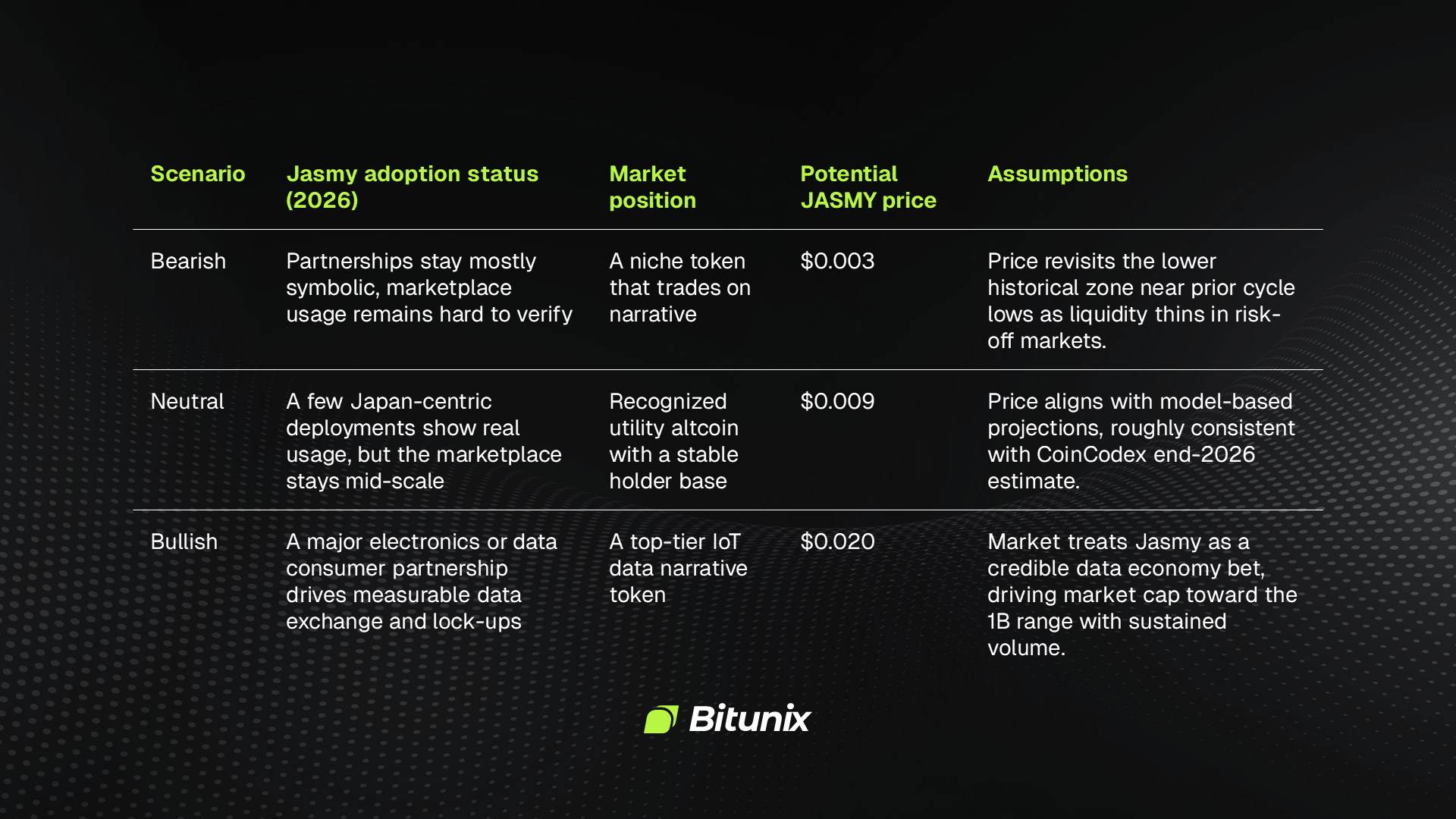
Scenario-based 2026 JASMY outlook linking price ranges to adoption evidence, enterprise partnerships, and whether token lock-ups and data marketplace usage become measurable.
If you want to update the table over time, track these signals monthly: measurable marketplace activity, enterprise lock-up disclosures that affect circulating supply, and real usage of PDL-like products outside the crypto-native bubble.
Conclusion: A High-Potential Vision Facing a Show-Me Market
Jasmy has a compelling vision that aligns with major trends in IoT growth and data control. The Personal Data Locker model is understandable, and the leadership background stands out in a space full of anonymous teams.
The market is still in show-me mode, and that is fair. Without clear public metrics on active users, data exchange volume, or enterprise spend, the token trades more on narrative than on fundamentals.
So, is Jasmy a good investment? It is a high-risk bet on execution, adoption, and the ability to turn a data marketplace into something enterprises actually pay for at scale. If you trade JASMY, treat it like a volatile utility altcoin, size accordingly, and avoid confusing a strong story with confirmed traction.
If you want a simple way to access JASMY markets, Bitunix is one option. Download the Bitunix app, register, and keep your risk controls tighter than your optimism.
FAQ
Who are the founders of Jasmy?
Jasmy was founded in Tokyo by former Sony executives, including Kunitake Ando, Kazumasa Sato, Masanobu Yoshida, and Hiroshi Harada, as key founders and early leaders.
Is Jasmy an ERC-20 token?
Yes. Major trackers describe JASMY as an ERC-20 token on Ethereum. Jasmy later expanded infrastructure, including a 2026 L2 effort, but ERC-20 remains the core token standard for JASMY markets.
What is the Personal Data Locker (PDL)?
PDL is Jasmy's user-controlled data vault concept, the starting point for identity and data control. PDL stores IoT-generated data under user control, with explicit permissions for access and compensation in JASMY when businesses want to use that data.
How does the Jasmy token lock-up work?
Jasmy's lock-up concept ties enterprise access to holding JASMY. Businesses using the data marketplace must buy and hold JASMY to access the ecosystem, temporarily reducing circulating supply.
Is Jasmy really the Bitcoin of Japan?
It is a nickname, not a technical equivalence. Traders use it to describe Jasmy's Japan-centric branding, former Sony leadership, and the idea of regulated legitimacy in a strict market. Unlike Bitcoin, Jasmy is an ERC-20 utility token designed for a data marketplace rather than a base-layer monetary network.
What is the total supply of JASMY?
JASMY has a capped supply of 50 billion. CoinMarketCap lists total supply at 50B and circulating supply around 49.44B in March 2026, which puts most tokens already in the market. That reduces future dilution surprises, but it also means demand must do more work for price appreciation.
What are some of Jasmy's official partners?
Reported official partners include Panasonic and Transcosmos in Japan’s electronics and enterprise data space, plus collaborations often cited with Toyota and Sony. On the Web3 side, Jasmy is reported to integrate Chainlink CCIP for cross-chain functionality and work with Cicada Market Making for liquidity support.
How does Jasmy compare to IOTA?
Both target IoT-related value, but they approach it differently. Jasmy focuses on user-controlled data lockers, permissions, and a marketplace where businesses pay for data access in JASMY. Competing projects like IOTA emphasize other architectures and integration paths.
Is Jasmy a good long-term investment?
Jasmy offers a long-term thesis tied to IoT growth and data control, but it requires real adoption. With most supply already circulating, price depends on sustained demand and measurable marketplace usage. If you invest long term, track enterprise deployments, user activity, and whether lock-ups scale meaningfully beyond headline events.
Where can I find the official Jasmy community?
Start from the official website's community links, which point to the project's X and Telegram channels. That reduces the risk of joining impersonator groups. When you follow links, verify handles match the official site and cross-check announcements against reputable trackers before acting on any claim.
Glossary
- Data sovereignty: Control over how data is governed, accessed, and regulated under specific jurisdictions.
- Internet of Things (IoT): Networks of connected devices that collect and transmit data from real-world environments.
- Personal Data Locker (PDL): A user-controlled vault concept for storing device data and managing access permissions.
- Secure Knowledge Communicator (SKC): A permission and identity layer described as managing access approvals and audit trails.
- Smart Guardian (SG): A device authentication layer that verifies IoT devices and helps prevent spoofed inputs.
- ERC-20: Ethereum token standard used for fungible tokens, including JASMY on major markets.
- Market cap: Token price multiplied by circulating supply, used to compare valuation scale across assets.
- Circulating supply: Tokens currently tradable in the market, excluding locked or inaccessible holdings.
- Max supply: The maximum number of tokens that can exist under the token's issuance rules.
- Lock-up: Requirement or mechanism that removes tokens from liquid circulation for a period of time.
- Two-sided marketplace: A system that must attract both suppliers and buyers, such as users and data purchasers.
- IoT device authentication: Methods that prove data originates from a real device rather than a forged source.
- Permissioned data access: Access control model where data use requires explicit approval and can be logged.
- All-time high (ATH): Highest recorded trading price in a token's history on tracked markets.
- All-time low (ATL): Lowest recorded trading price in a token's history on tracked markets.
About Bitunix
Bitunix is a global cryptocurrency derivatives exchange trusted by over 3 million users across more than 100 countries. At Bitunix, we are committed to providing a transparent, compliant, and secure trading environment for every user. Our platform features a fast registration process and a user-friendly verification system supported by mandatory KYC to ensure safety and compliance. With global standards of protection through Proof of Reserves (POR) and the Bitunix Care Fund, we prioritize user trust and fund security. The K-Line Ultra chart system delivers a seamless trading experience for both beginners and advanced traders. At the same time, leverage of up to 200x and deep liquidity make Bitunix one of the most dynamic platforms in the market.
Bitunix Global Accounts
X | Telegram Announcements | Telegram Global | CoinMarketCap | Instagram | Facebook | LinkedIn | Reddit | Medium