Ethereum is a decentralized, open source blockchain platform designed to support programmable applications on chain. Its native asset is ether (ETH), which is used to pay transaction fees (gas) and, under proof of stake, to secure the network via staking.
In late 2013, Vitalik Buterin drafted the Ethereum whitepaper, outlining a blockchain meant to be more flexible for developers than earlier systems. After becoming involved with Bitcoin, Buterin wrote extensively about decentralization and co-founded Bitcoin Magazine. Over time, he concluded that Bitcoin’s scripting capabilities were too limited for many types of applications. Ethereum was created to provide a more general-purpose platform where developers could build a broader range of projects using a more expressive programming environment.
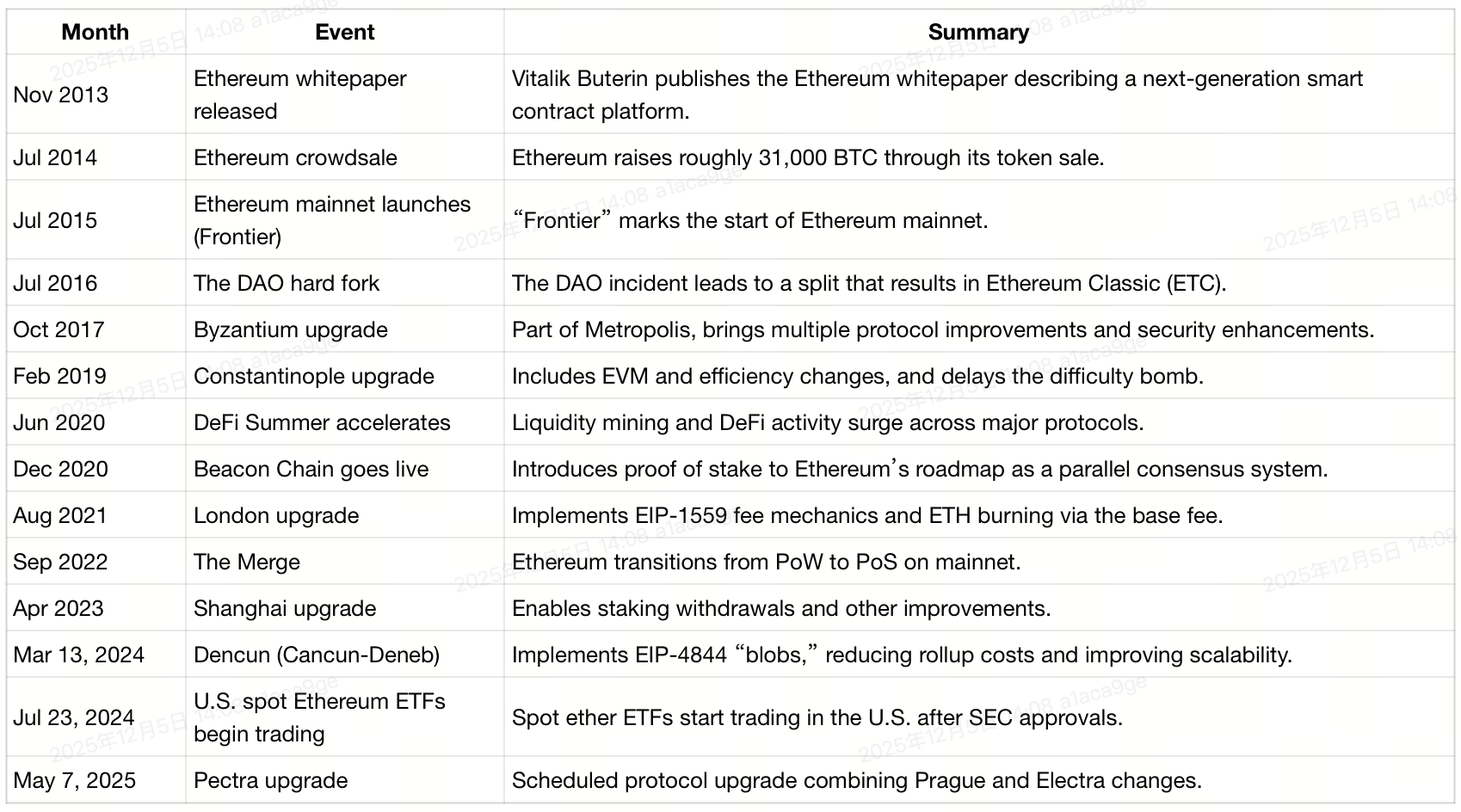
In July 2014, Ethereum held a crowdsale that raised roughly 31,000 BTC. In July 2015, Ethereum’s mainnet launched, beginning with the “Frontier” release. Co-founder Gavin Wood popularized the idea of Ethereum as a “world computer,” emphasizing decentralization, programmability, and an application-oriented ecosystem. Over the years, areas such as DeFi, NFTs, GameFi, and real-world assets (RWA) have expanded within the Ethereum ecosystem.

1.Ethereum and Smart Contracts
If Ethereum is described as a “world computer,” then it must be programmable. This is the core difference between Ethereum and Bitcoin. Ethereum’s key breakthrough was the introduction of smart contracts, code that can execute on chain and manage complex rules and state changes beyond simple balance transfers.
The EVM and on-chain execution
Smart contracts run on the Ethereum Virtual Machine (EVM). You can think of the EVM as a distributed runtime environment where every node executes the same contract bytecode according to the same rules. Developers typically write contracts in languages such as Solidity or Vyper, compile them into bytecode, and then deploy them to Ethereum, where they can be executed in a deterministic way across the network.
This “everyone runs the same code” model is what enables Ethereum to support applications without relying on a central operator.
Account model: EOA vs contract accounts
Ethereum has two major account types:
- EOA (Externally Owned Account): A standard wallet account controlled by a private key. EOAs can initiate transactions.
- Contract account: Controlled by smart contract code. Contract accounts cannot initiate transactions by themselves, but they can respond to calls and execute logic when triggered.
- This structure allows end users to drive interactions through EOAs while contracts handle automation, rules, and composability.
ERC-20 and token standardization
Smart contracts also make assets programmable. One major milestone was the ERC-20 token standard, which defined a common interface for tokens so they can be recognized and integrated more easily across wallets, exchanges, and DeFi protocols.
Many widely used Ethereum-based tokens, such as USDC, LINK, and UNI, follow the ERC-20 standard. This standardization helped accelerate interoperability and composability across the ecosystem.

2.Ethereum Proof of Stake (PoS)
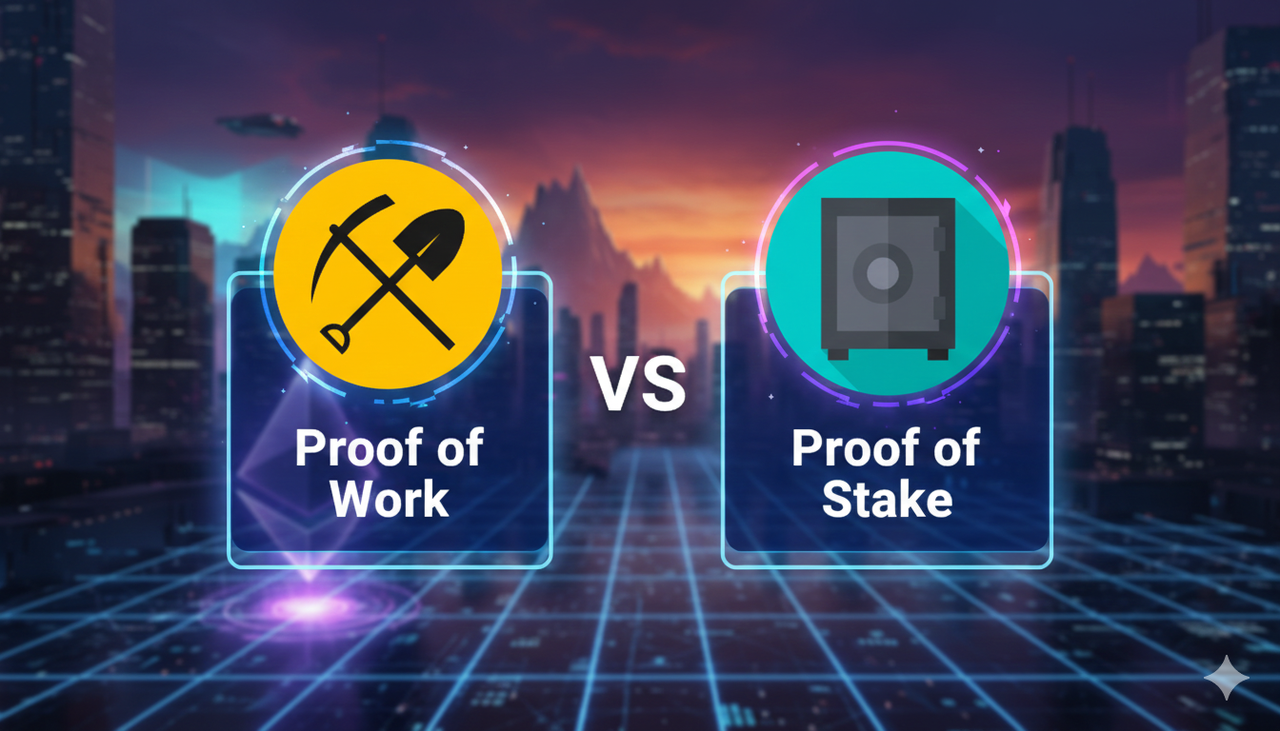
Ethereum currently uses proof of stake (PoS) as its consensus mechanism. Unlike proof of work (PoW), where miners compete using computational power, PoS relies on validators who stake ETH to participate in block production and validation.
Validators and staking
Under PoS, validators help secure the network by proposing and attesting to blocks. A common reference point is that running a full validator requires staking 32 ETH. Staking creates an economic incentive to follow the rules, since validators can be penalized for harmful behavior.
ETH also plays multiple roles in Ethereum’s design:
- Gas: ETH pays for transactions and smart contract execution.
- Security: ETH is staked to secure the network and incentives are paid to validators.
- PoS is also far more energy efficient than PoW, which is one reason Ethereum transitioned away from mining.
From PoW to PoS: Beacon Chain and The Merge
Ethereum began with PoW, but the PoS transition was part of the long-term roadmap. The Beacon Chain launched in December 2020 to introduce PoS to Ethereum’s architecture.
In September 2022, The Merge combined Ethereum’s execution layer with its PoS consensus layer, completing the switch from PoW to PoS.
EIP-1559 and ETH burning
Ethereum’s fee mechanics changed significantly with EIP-1559, which introduced a base fee that is burned. As a result, during periods of high network activity, the amount of ETH burned can be large enough that net issuance becomes negative for stretches of time. This is a meaningful difference from Bitcoin’s fixed supply cap model.
3.The Ethereum Ecosystem
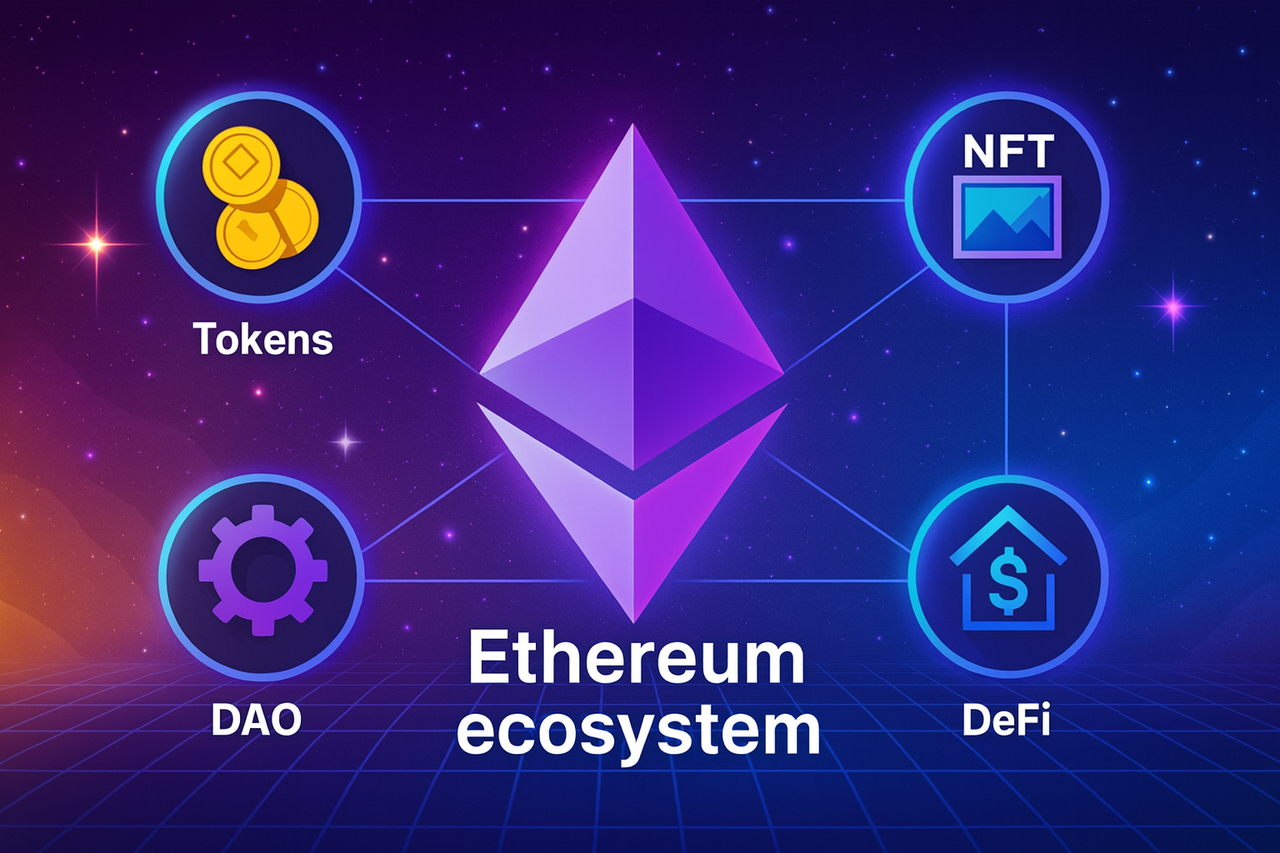
Ethereum’s ecosystem has evolved through multiple protocol upgrades that improved performance, security, and developer experience. Several major waves of adoption helped shape how the network is used today.
DeFi Summer and beyond
In 2020, “DeFi Summer” became a defining moment for Ethereum, with major protocols such as Uniswap, Aave, MakerDAO, and Compound drawing substantial activity and liquidity. In 2021, NFTs and GameFi became prominent themes, with projects such as Axie Infinity popularizing early play-to-earn narratives in certain markets.
Scaling: Layer 2
As demand increased, scalability became a central focus. Ethereum’s scaling strategy has increasingly emphasized Layer 2 networks, particularly rollups, which aim to reduce fees and increase throughput while still ultimately settling back to Ethereum. Well-known Layer 2 ecosystems include Arbitrum, Base, and Starknet.
Separately, many newer networks and app-specific chains often choose EVM compatibility, or add EVM-style execution environments, to leverage Ethereum tooling, developer familiarity, and liquidity pathways.
4.The Ethereum Foundation
Over the years, the Ethereum Foundation (EF) has played an important role in funding research, supporting ecosystem development, and helping organize long-term protocol roadmaps. Ethereum’s governance is still broadly community-driven through the Ethereum Improvement Proposal (EIP) process, client implementations, and community coordination, but EF has historically been influential in stewardship, grants, and research direction.
Early on, many major projects in the Ethereum ecosystem received some mix of funding, guidance, or community support that helped them grow. While EF has also faced criticism at times, it remains a major institution in Ethereum’s technical and ecosystem landscape.
5.How to Get ETH
In the PoS era, new ETH issuance flows primarily to validators (stakers) who participate in consensus. For individuals, becoming a validator typically requires technical operations and the 32 ETH stake requirement, which can be a significant barrier. For many users, buying ETH through a cryptocurrency exchange is the more straightforward route.
Bitunix is one example of a centralized exchange through which users can buy ETH using assets such as USDT, and in some regions, supported payment methods may include card purchases depending on availability. Before using an exchange, users generally need to register and complete KYC, which supports compliance practices such as AML and related controls. Bitunix also states that it applies platform security measures such as hot and cold wallet separation, multisignature controls, and monitoring mechanisms.
6.Major Ethereum Milestones (Timeline)