
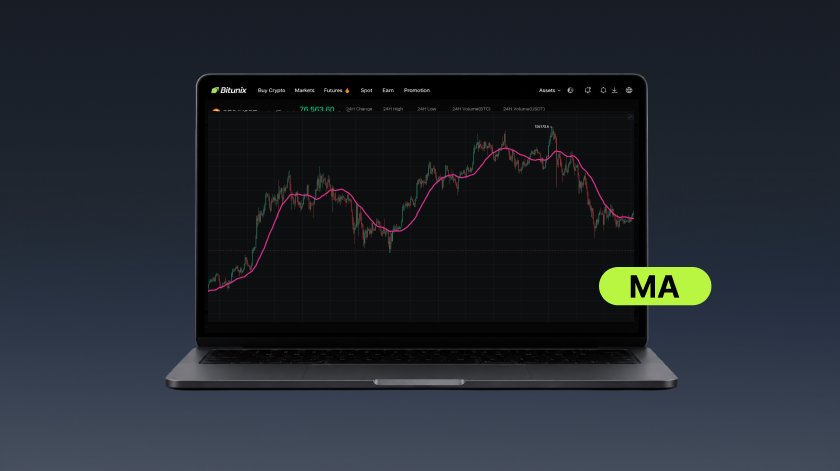
In cryptocurrency futures trading, trend is the core driver of profit, and the moving average, or MA, is one of the most practical and widely used trend-following tools. Because of its simplicity and clear signals, the MA strategy has become a go-to approach for both beginners and experienced traders. The MA strategy does not focus on bottom-fishing. Instead, it follows the trend, identifies long and short reversal signals, captures directional momentum, and helps traders manage leveraged futures trading risk more effectively. This article provides a comprehensive breakdown of the MA trading strategy in crypto futures, covering the basics of the MA indicator, core trading rules, real-market case studies, risk control, and key precautions, helping traders avoid false signals, find the right trend rhythm, and adapt the strategy to different leverage levels.
1、What Is the MA Indicator and What Is Its Core Function?
A Moving Average, or MA, is a smoothed line created by calculating the average price of a cryptocurrency over a specific period. Its core purpose is to filter out short-term price fluctuations and identify the direction of medium-term and long-term trends. In simple terms, it is a trend-following tool. When price moves along the MA line, the probability of trend continuation is generally higher. When price breaks above or below the MA line, it often signals a trend reversal or a correction.
In crypto futures trading, the most commonly used MA periods include the 5-day, 10-day, 20-day, 30-day, 60-day, and 120-day moving averages on the daily timeframe, as well as the 30-day, 60-day, and 120-day moving averages on the 4-hour timeframe. It is recommended to combine the MA indicator with Bollinger Bands, MACD, and trading volume for broader analysis. MA helps define the trend direction, Bollinger Bands help assess price volatility and breakout ranges, MACD helps confirm bullish or bearish momentum and identify golden crosses and death crosses, and trading volume, long-short ratios, and other capital flow indicators help confirm whether the breakout is valid. When multiple indicators align, trade decisions become more reliable and the risk of misjudgment in leveraged futures trading can be reduced.
Core Technical Features
- Trend alignment: If price is trading above the MA and the MA line is sloping upward, it indicates a bullish trend. If price is trading below the MA and the MA line is sloping downward, it indicates a bearish trend.
- Support and resistance: In a bullish trend, the MA often acts as a support level, and price usually rebounds after pulling back to the MA. In a bearish trend, the MA acts as a resistance level, and price often falls again after rebounding into the MA.
- Golden cross and death cross signals: When a short-term MA crosses above a long-term MA, it forms a golden cross, which is generally seen as the beginning of a bullish trend. When a short-term MA crosses below a long-term MA, it forms a death cross, which is generally seen as the beginning of a bearish trend.
- MA convergence and divergence: When multiple MAs are tightly clustered together, it usually signals a sideways market with no clear trend. This is generally not an ideal time to enter. When the MAs begin to separate from that clustered state, it often signals that a trend is becoming clearer, which can present a better entry opportunity.
2、MA Trading Strategy Rules for Crypto Futures
Crypto futures trading involves leverage, so the core of the MA strategy is simple: follow the trend, use light position sizing, and apply strict stop-loss rules. This means avoiding counter-trend trades and avoiding blind chasing of pumps or dips. By combining signals across multiple timeframes, the strategy aims to balance profit potential with risk control. The following rules can be applied to most major crypto futures pairs such as BTC, ETH, and SOL. There are two main trade setups: long and short. Beginners should focus on mastering the long strategy first.
2.1 Signal Validation Rules
- Multi-timeframe confirmation: Use the medium-term MA, such as the 30-day and 60-day MA, to determine the main trend direction. Use the 4-hour MA to confirm the signal, and use the 15-minute timeframe to refine the entry. The lower timeframe should follow the higher timeframe. For example, if the daily trend is bullish, a short-term pullback on the 4-hour chart is generally not a reason to open a short position.
- Volume confirmation: When a golden cross or breakout above the MA occurs, trading volume should increase significantly to confirm the signal. If there is no meaningful volume expansion, the breakout is more likely to be a false signal.
- Avoid ranging markets: When MAs from multiple timeframes are tightly clustered together, the market lacks a clear trend. Entering during this phase increases the risk of getting chopped up by repeated false moves. It is better to wait until the MAs begin to separate and the trend becomes clear.
- Use the closing price as the signal standard: A breakout above or below the MA should be confirmed by the closing price, not just by an intraday wick. For example, if price briefly trades above the MA but closes back below it, that should not be treated as a valid breakout.
2.2 Bullish Trading Strategy
Conservative Entry (For beginners and lower-leverage traders)
- On the daily chart, price holds above the 30-day MA, and the 30-day MA is sloping upward, confirming a medium-term bullish trend.
- On the 4-hour chart, the short-term MA, such as the 30-period MA, crosses above the long-term MA, such as the 120-period MA, forming a golden cross with rising volume.
- Entry point: Wait for price to pull back to the 30-day MA and stabilize, with lower volume during the retracement. This is generally the safer long entry and can help reduce the risk of a false breakout.
- At this stage, it is recommended to use Bitunix’s price alert function. When price breaks above the 30-day MA and stabilizes, traders can enter long positions more accurately and better capture trend-following opportunities.
Aggressive Entry (For experienced traders with stronger risk control)
- On the daily chart, the 30-day MA is sloping upward and price is clearly above the MA, confirming a bullish trend.
- On the 4-hour chart, price breaks above the previous high on strong volume, and the short-term MAs, such as the 10-period and 20-period MA, are in a bullish alignment.
- Entry point: Enter with a light position immediately after the breakout to catch the early phase of the uptrend, while strictly applying stop-loss control because pullback risk is higher.
- At this stage, it is also recommended to use Bitunix’s price alert function. When price breaks above the 30-day MA and stabilizes, traders can participate in the long setup more effectively.
2.3 Short Trading Strategy
The risk of shorting is generally higher than going long, so traders should strictly follow the rule of shorting with the trend and avoid bottom-fishing against the market.
- Entry timing: On the daily chart, price falls below the 30-day MA and the 30-day MA turns downward, confirming a medium-term bearish trend. On the 4-hour chart, the short-term MA crosses below the longer-term MA, forming a death cross, while trading volume increases. This is the short entry signal.
- Stop-loss setting: Set the stop loss 3% to 5% above the 30-day MA. If price rebounds and closes back above the 30-day MA, exit the position immediately.
- Take-profit target: Use a staged take-profit method. The first take-profit target can be placed near the recent low, and the second target near the previous major low, avoiding over-greed.
2.4 Stop-Loss Rules
- Conservative strategy: Set the stop loss 3% to 5% below the 30-day MA. If price falls below the 30-day MA and the closing price fails to recover, exit immediately to avoid larger losses from a trend reversal.
- Aggressive strategy: Set the stop loss 3% to 5% below the recent low. If price breaks below that recent low, it may signal the end of the short-term rally, and the loss should be cut decisively.
2.5 Take-Profit Rules
The MA strategy works well with ladder take-profit methods in futures swing trading, balancing short-term profits with the potential for longer trend continuation.
- First take-profit target: Near the previous swing high, with a profit range of around 5% to 10%. Lock in part of the gains early to reduce risk.
- Second take-profit target: Around 1 to 2 times the first target, suitable for stronger medium-term trends. At that stage, the stop loss can be moved up closer to the 30-day MA to protect open profits.
- Dynamic take profit: If the trend continues higher with strong volume, the position can be held while price remains above the 30-day MA, and fully exited once price closes below it.
2.6 Leverage and Position Sizing Rules
- Conservative trading: Leverage should not exceed 10x, and a single position should not exceed 10% of total capital. Priority should be given to medium-term MA signals to avoid being stopped out by short-term volatility.
- Aggressive trading: Leverage should not exceed 20x, and a single position should not exceed 10% of total capital. Entries should only be taken when signals align across multiple timeframes and volume confirms the move. Full-position trading and oversized high-leverage positions should be strictly avoided.
- Beginner recommendation: Start with 5x leverage and 5% position sizing. Once you become more familiar with MA signal behavior, you can gradually adjust leverage and exposure.
3、Practical Demonstration (Successful and Failed Cases)
At this stage, it is recommended to use the Bitunix indicator alert function. By setting and using indicator alerts effectively, traders can better track market rhythm and capture trend-following opportunities more accurately.
3.1 BTC/USDT Perpetual Futures (Daily + 4-Hour Timeframe) ✅ Bullish Successful Case
BTC/USDT perpetual futures (daily level)
BTC/USDT perpetual futures (4-hour line level)
Trend Confirmation
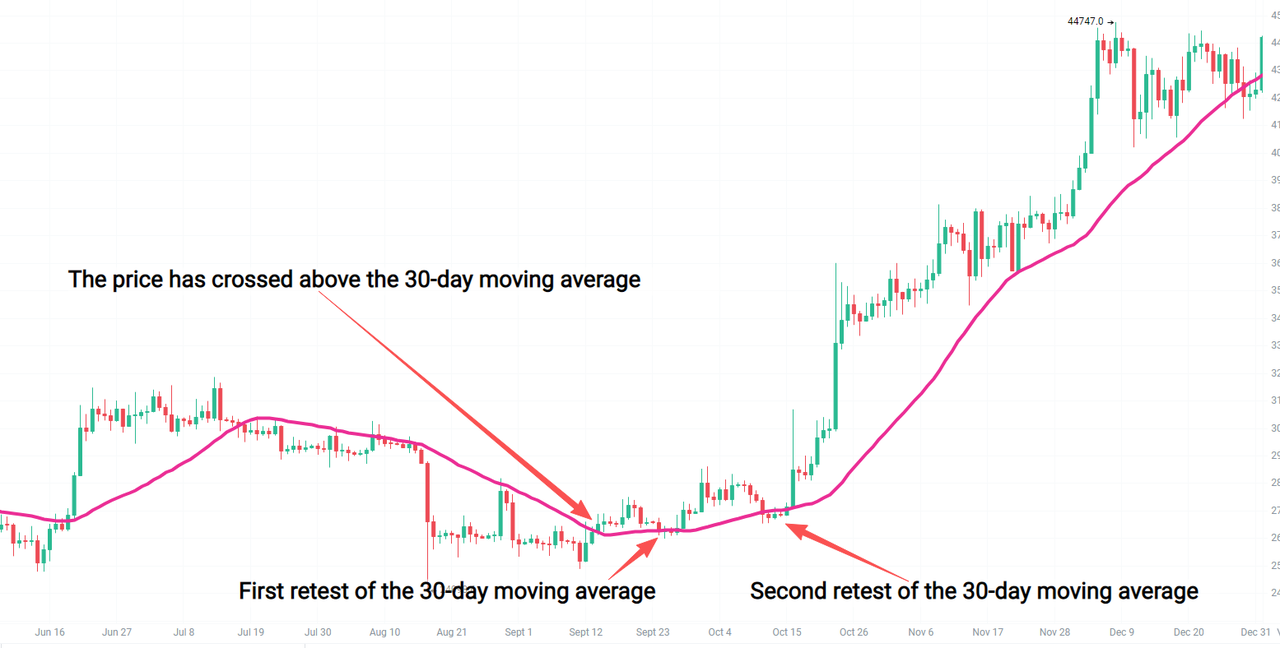
- After BTC declined in the earlier phase, the daily price stabilized above the 30-day MA, and the 30-day MA turned from a downward slope to an upward slope, officially confirming a medium-term bullish trend. Two separate pullbacks to the 30-day MA held successfully, confirming the strength of MA support.
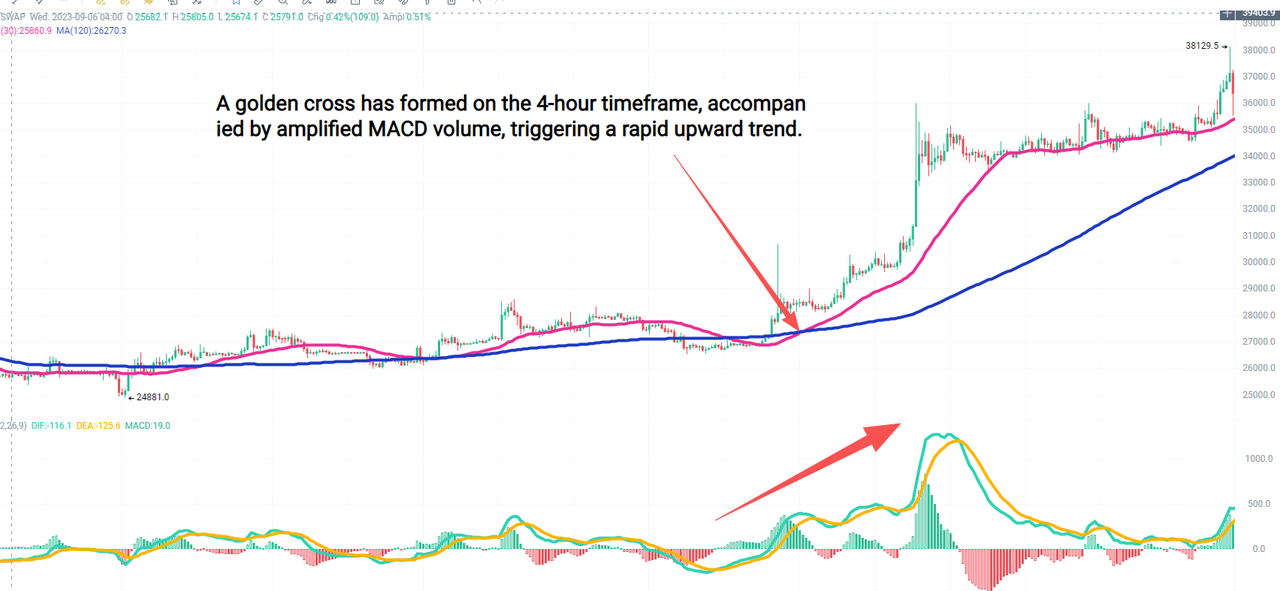
- At the same time, on the 4-hour chart, the 30-period MA crossed above the 120-period MA, forming a golden cross. MACD also formed a golden cross, and volume increased significantly. This created multi-timeframe confirmation with the daily trend and greatly improved the reliability of the bullish signal.
- At this stage, it is recommended to use the Bitunix indicator alert function to better capture trend-based trading opportunities.
Entry Timing
Use a conservative strategy. Wait for the second pullback of the daily price to the 30-day MA, with lower volume during the retracement, and enter long when the 4-hour golden cross and MACD volume expansion align. This approach uses support from both timeframes and helps reduce the risk of buying into an overextended move.
Take Profit and Stop Loss
- Set the stop loss 5% below the daily 30-day MA, while also making sure the 4-hour 120-period MA is not broken, so the dual-timeframe bullish structure remains intact.
- The first take-profit target is near the previous swing high.
- The second take-profit target is around 1 time the first take-profit distance, suitable for a strong trending market.
- For dynamic profit-taking, if the market continues to rise on strong volume, the position can be held while price stays above the 30-day MA, and exited once it closes below it.
Leverage Rules
- Conservative trading: Leverage should not exceed 10x, and a single position should not exceed 10% of total capital.
- Aggressive trading: Leverage should not exceed 20x, and a single position should not exceed 10% of total capital. Full-position and heavily leveraged trades should be strictly avoided.
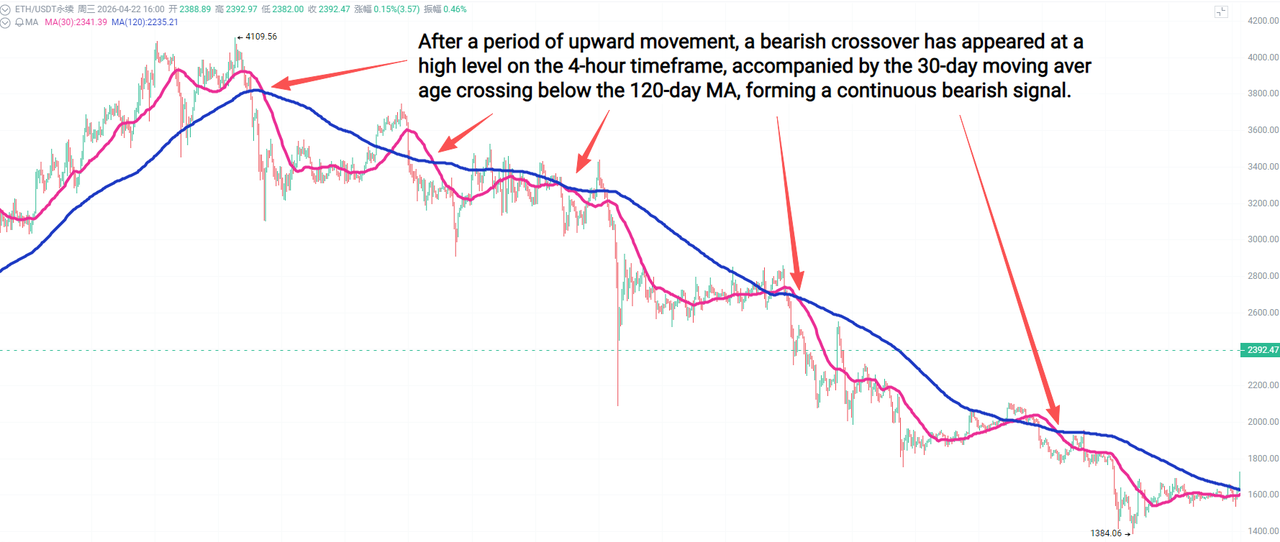
3.2 ETH/USDT Perpetual Futures (Daily + 4-Hour Timeframe) ✅ Bearish Successful Case
ETH/USDT perpetual futures (daily level)
ETH/USDT perpetual futures (4-hour line level)
Trend Confirmation
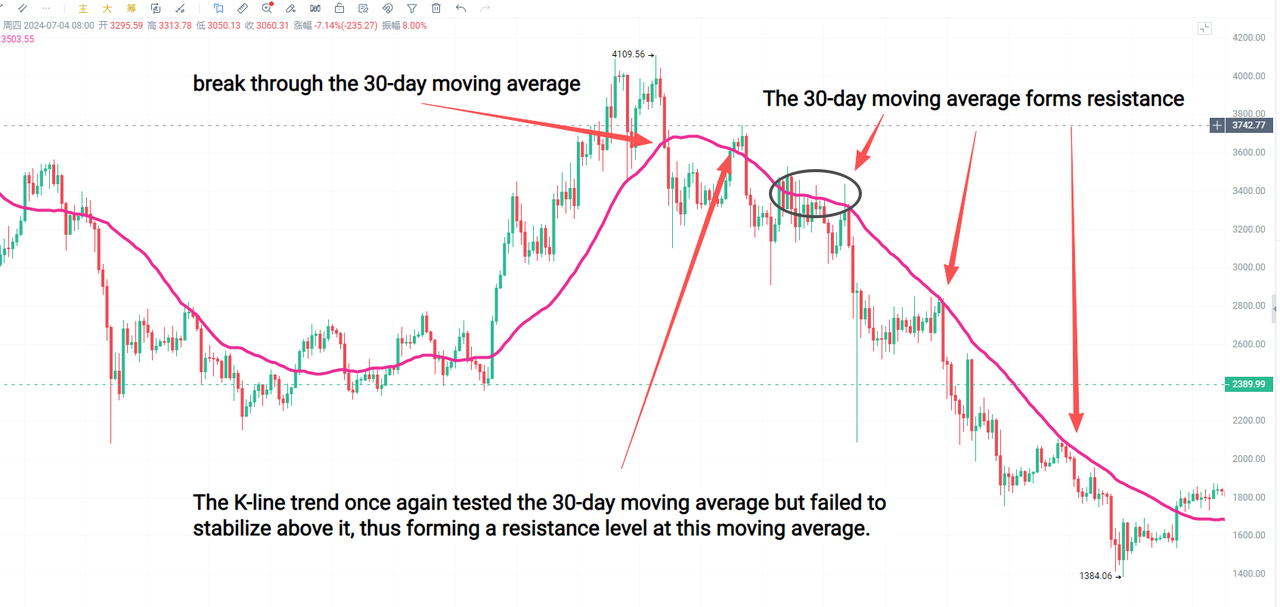
- After ETH completed an earlier upward cycle, the daily price fell below the 30-day MA, and the 30-day MA turned downward, officially confirming a medium-term bearish trend. Multiple retests of the 30-day MA failed to reclaim it, showing that the MA had shifted from support to resistance.
- At the same time, on the 4-hour chart, the 30-period MA crossed below the 120-period MA, forming a higher-timeframe death cross and creating a continuing bearish signal. This aligned with the daily trend and greatly improved the reliability of the short setup.
- At this stage, it is recommended to use the Bitunix indicator alert function to capture trend-following short opportunities more effectively.
Entry Timing
Use a conservative strategy. Wait for the second retest of the daily 30-day MA, and enter short when the 4-hour MA death cross confirms the bearish setup. By relying on resistance from both timeframes, traders can avoid the risk of chasing a move too late.
Take Profit and Stop Loss
- Set the stop loss 5% above the daily 30-day MA, while also ensuring that the 4-hour 120-period MA is not broken to preserve the dual-timeframe bearish structure.
- The first take-profit target is near the previous low.
- The second take-profit target is around an additional 1 times the first downside move, suitable for a weak market environment.
- For dynamic profit-taking, if the market continues to fall with strong volume, the position can be held while price remains below the 30-day MA, and fully closed once price breaks back above it.
Leverage Rules
- Conservative trading: Leverage should not exceed 10x, and a single position should not exceed 10% of total capital.
- Aggressive trading: Leverage should not exceed 20x, and a single position should not exceed 10% of total capital. Full-position and oversized high-leverage trades should be strictly avoided.
4. Core Risk Precautions for the MA Strategy
- Avoid using the MA strategy in sideways markets: The MA strategy is built for trend-following. In choppy or range-bound conditions, MA signals frequently fail, leading to repeated stop-outs. In these situations, it is better to stay patient and wait rather than force a trade.
- Do not rely on a single timeframe: A single-timeframe MA signal is less reliable. It should be confirmed using multiple timeframes, such as daily and 4-hour charts, and should also be supported by trading volume to reduce the risk of false signals.
- Strictly follow stop-loss rules: Leverage in futures trading magnifies losses, so stop loss is critical to survival. Once price hits the stop-loss level, the trade should be exited decisively. Do not hold onto losing positions out of hope.
- Choose suitable trading pairs: The MA strategy is better suited to major cryptocurrencies such as BTC and ETH, which usually have clearer trends and relatively more stable structure. Highly volatile smaller altcoins often lack clear trend behavior, making the MA strategy less reliable.
- Do not be greedy and do not fight the market: When a trend reverses, take profits in time rather than chasing the absolute maximum move. When a signal fails, cut losses decisively. Protect capital and wait for the next high-probability opportunity.
Disclaimer
This article is not intended to provide
(I) investment advice or investment recommendations;
(Ii) an offer or solicitation to buy, sell or hold digital assets;
(Iii) Financial, accounting, legal or tax advice. Digital assets held (including stablecoins and NFTs) involve a high level of risk and may fluctuate significantly. You should carefully consider whether trading or holding digital assets is appropriate for you based on your financial situation. Please consult your legal/tax/investment professional for your specific situation. Please be responsible for understanding and complying with relevant local applicable laws and regulations.
About Bitunix
Bitunix is a global cryptocurrency derivatives exchange trusted by over 3 million users from over 100 countries. Bitunix is committed to providing a transparent, compliance and secure trading environment for every user. The platform has a fast registration process and friendly verification system, and enforces KYC to ensure security and compliance.
Through global-level protection standards such as Proof of Reserve (PoR) and Bitunix Care Fund, Bitunix puts user trust and money security first.The K-Line Ultra charting system provides a seamless trading experience for both novice and advanced traders, with up to 200 times leverage and deep liquidity, making Bitunix one of the most dynamic platforms in the market.
Bitunix Global Account
X | Telegram Announcements | Telegram Global | CoinMarketCap | Instagram | Facebook | LinkedIn | Reddit | Medium