
Article Summary
- This article provides a speculative price prediction for the Solaxy (SAXY) token, analyzing it as a new and emerging project within the Solana ecosystem.
- It defines Solaxy as a platform aiming to provide a suite of tools for Solana users, potentially including a wallet, a DEX aggregator, or other DeFi-related utilities, all powered by its native token, SAXY.
- The bullish case is built on the potential for the Solaxy platform to deliver a unique and valuable product that attracts a significant user base within the fast-growing Solana ecosystem. A strong community and a clear, executed roadmap are key.
- The bearish case is significant: the project is new and unproven, faces immense competition from established players in the Solana ecosystem, and is subject to the extreme volatility and high failure rate of new, low-cap altcoins.
- It presents three price scenarios, acknowledging that for a project this new, the outcome is highly binary - it will either gain traction and see significant growth or fail to capture attention and fade into obscurity.
- The Solana ecosystem moves fast, and that speed creates both opportunity and wreckage. New projects can find users quickly, and they can also get ignored in a week when the next shiny token launches. Solaxy sits right in the middle of that reality, aiming to ship real products while still attracting the high-risk crowd that fuels early liquidity.
- If you trade through a crypto exchange, you can usually get exposure to low-cap tokens quickly on venues like Bitunix. That convenience does not change the fundamentals, though. You still need to understand what the project claims to build, what the token does, and how easily the market can move against you.
- This analysis explains what is Solaxy, lays out the strongest arguments on both sides, and then gives scenario-based price ranges for 2026. You should treat everything here as research, not a recommendation, because low-cap altcoins punish overconfidence with impressive consistency.
The Bullish Case for Solaxy (The Potential)
Before you even think about a price target, you need to know what you are betting on. Solaxy positions itself as a Solana scaling project that tries to reduce congestion and failed transactions with batching and off-chain processing, while settling for security.
A project like this wins only if it ships usable products that traders and teams return to repeatedly. Solana already has a crowded tool landscape, so "we're building a suite" isn't enough. The bullish case depends on whether Solaxy becomes a place users choose for launches, swaps, and day-to-day activity.
1) A Clear Product Suite, If Users Actually Show Up
Solaxy's best-case outcome depends on whether people use its products instead of only trading the token. The project's ecosystem pages describe two core pieces: Neptoon as a native DEX and Igniter as a token launchpad that routes successful launches into Neptoon liquidity.
Neptoon is framed as the liquidity hub for assets launched or bridged into the Solaxy environment, with swaps and liquidity provisioning as the basic user actions. Igniter adds an incentive loop where new tokens graduate into trading and liquidity, which can keep attention inside the same ecosystem rather than leaking back to larger venues.
If Solaxy delivers a smooth launch-and-trade path, it can attract the exact users who already spend hours chasing microcaps. That user behavior exists in huge numbers on Solana, and the only question is whether Solaxy captures a slice of it.
2) Solana's Scale Gives New Projects Oxygen
Solaxy benefits from building in a chain environment that already handles extreme retail activity. A 2025 Solana ecosystem report from Helius described active addresses ranging from 2.7 million to 5.2 million over the prior year, with daily transaction totals ranging from about 162.9 million to 416.9 million.
Messari's State of Solana reports also show that DeFi activity and stablecoin usage stayed meaningful through late 2025. In Q3 2025, Messari reported Solana DeFi TVL rising 32.7% quarter over quarter to $11.5B. In Q4 2025, Messari reported Solana stablecoin market cap hitting an all-time high of $14.9B.
Those numbers do not guarantee Solaxy adoption, but they explain why Solana ecosystem projects keep getting funded and shipped. A project does not need to create demand from zero when the chain already has millions of active wallets looking for the next trade.
3) Low-Cap Math Can Create Big Upside On Small Inflows
Low-market-cap tokens move hard when liquidity is thin. CoinGecko shows SOLX reaching an all-time high of around $0.001404 on July 2, 2025, and trading far below that peak in early 2026.
Coinbase's market data page for Solaxy shows a market cap of around $6.61M and a circulating supply of around 83B SOLX at the time captured. That combination creates a simple reality: if SOLX ever returns near its prior peak, the market cap multiples are large, even if the project never becomes a major chain standard.
This is why speculative traders care about early ecosystems. Small inflows can push prices far, and small outflows can erase you just as fast.
4) Community Loops Can Work If Token Creation Stays Sticky
Solana meme coin culture is built around fast launches and faster trading. Galaxy's 2025 memecoin infrastructure report said Solana had more than 32 million tokens, up from less than 8 million before Pump.fun launched, which shows how extreme token creation has become.
That environment can help Solaxy if it becomes a place where builders launch by default. Igniter's mechanics reference creator incentives, liquidity routing into Neptoon, and burn-related actions, which show Solaxy is trying to design for behavior that already exists on Solana.
If Solaxy wins a small but loyal community, the token can benefit from repeated usage instead of relying on one big hype cycle.
The Bearish Case Against Solaxy (The Reality)
Solaxy's downside case is simple and brutal. Most new projects do not reach durable product-market fit, and meme-driven ecosystems increase churn because users rotate attention constantly. You should assume failure is the base rate for low-cap tokens unless you can prove otherwise with sustained usage.
Another practical warning is that tokenomics clarity matters more than people admit. If supply, distribution, and contract references aren't easy to verify, you're taking extra risk before you even get to price volatility.
1) Extreme Risk and a High Failure Rate in Microcaps
Solana's token creation boom also means most tokens die quietly. Galaxy's report notes a median token hold time on Solana of roughly 100 seconds, which paints a pretty clear picture of trader behavior.
Compliance and fraud research backs up the risk. A Solidus Labs report focused on rug pulls and pump-and-dumps on Solana noted surges in fraudulent token launches around peak activity windows, which is exactly the environment Solaxy wants to serve with a launch product.
That does not mean Solaxy is fraudulent. It means the user base it targets attracts scammers, and any launch platform has to fight that reality every day.
2) Competition Is Already Brutal Across The Solana Ecosystem Projects
Even if Solaxy executes, it still competes with strong incumbents. Wallets like Phantom dominate user onboarding, aggregators like Jupiter dominate routing, and DEXs like Raydium and Orca have deep liquidity and integrations across the ecosystem.
Solaxy's angle looks more like vertical integration: a launchpad plus a DEX plus a scaling layer that tries to keep activity inside its own environment. That can work, but it requires users to change habits, and habits are sticky when people already have muscle memory on the main Solana stack.
So the bearish case here is not only about Solaxy. It's about whether users bother to switch tools when their current tools already work.
3) Unproven Execution Plus Tokenomics Verification Risk
If you want one clean reason to stay cautious, start with tokenomics clarity. Solaxy's whitepaper includes this statement:
"The total public supply of $SOLX is set at 138,046,000,000 tokens."
CoinGecko and Coinbase list supply figures around 83B and tie the tracked asset to a specific contract reference on their pages. Supply discrepancies can occur for legitimate reasons, but you should still verify the contract address and the supply before trusting any distribution claims.
Solaxy's whitepaper also says the token sale accepts Ethereum, USDT, BNB, and cards, indicating that many users will interact with SOLX through EVM rails and exchange listings rather than solely Solana-native rails.
This is where the phrase Solaxy token becomes practical. You are not just buying an idea. You are buying a specific on-chain asset and verifying that the asset is part of basic risk control.
4) Market Volatility Plus the Presale Hangover
Presales often create a tough post-launch chart because early buyers hold an overhead supply and sell into any pump. The Solaxy whitepaper described an expected launch in Q2 or Q3 2025 and listed a late-stage issue price of $0.00179.
Fast forward to early 2026, and SOLX trades around the ten-thousandths of a dollar range on major trackers, with an all-time high around $0.0014 and a large drawdown from that peak. CoinCodex's token sale page also summarizes the ROI as around 0.08x the initial token sale price, reflecting the same drawdown story from a different angle.
That kind of chart turns any forecast into a question of trust and follow-through. Traders will not believe again unless the product proves it deserves another cycle.
Solaxy Price Prediction: Three Scenarios
A good forecast starts with supply, market cap, and realistic adoption triggers. CoinGecko estimates SOLX's market cap at around the single-digit millions with roughly 83B circulating tokens, and it records an all-time high of around $0.001404 in 2025.
For external triangulation, CoinCodex's model forecasts a target of about $0.0002146 by the end of 2026, based on its own assumptions and historical patterns. Model forecasts are not guarantees, but they help anchor a neutral case away from pure guesswork.
Below, each scenario maps to a market cap range, then converts to price using the approximate 83B supply tracked by major sources.
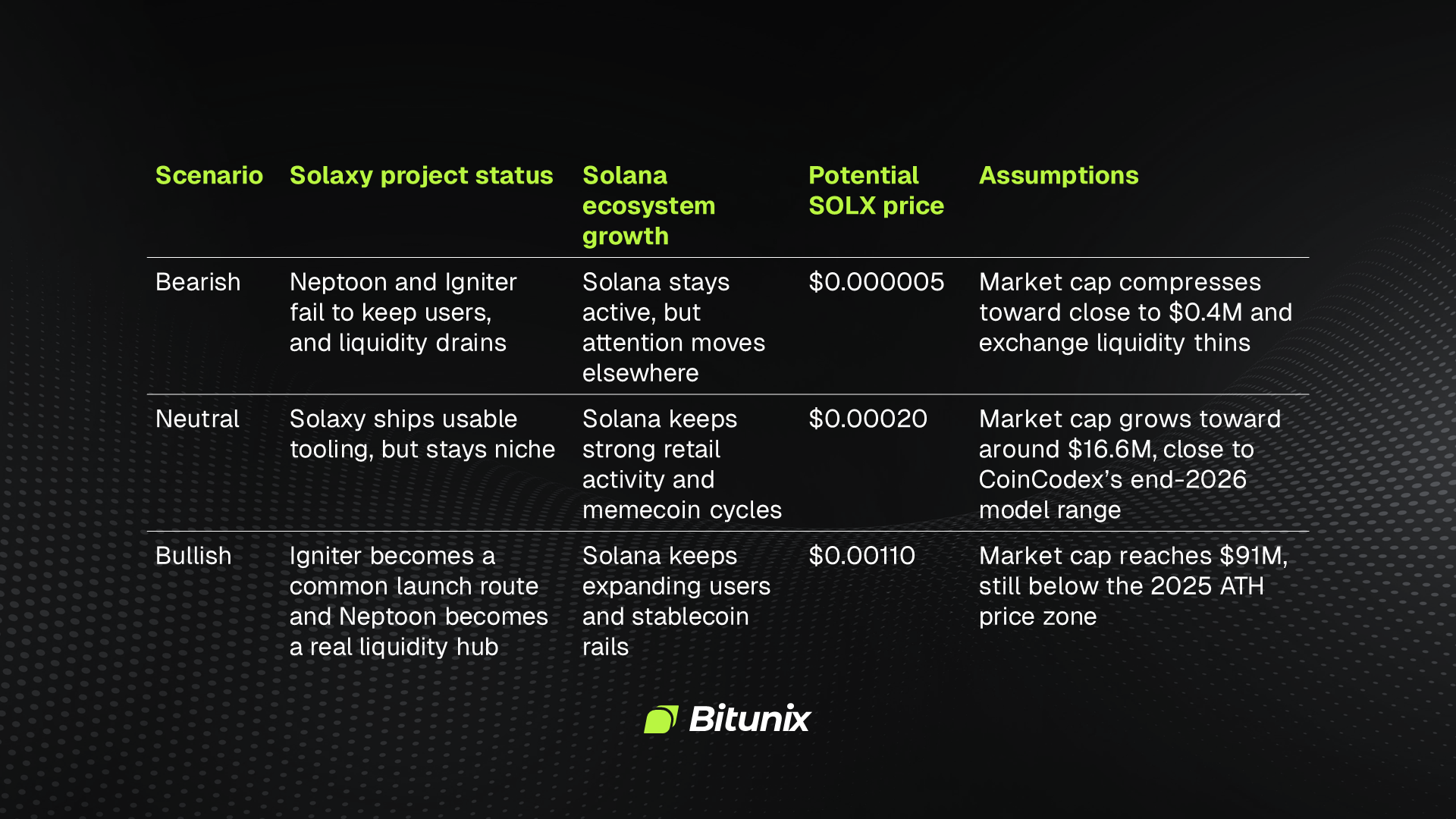
Scenario-based SOLX outlook linking possible 2026 price ranges to Solaxy product delivery (Neptoon and Igniter) and broader Solana activity and liquidity.
If you want a quick checklist to update your Solaxy price prediction over time, track three signals. Watch whether Igniter launches keep coming, whether Neptoon liquidity grows, and whether the tokenomics story stays consistent across official docs and major trackers.
Conclusion: A High-Risk Bet on a New Idea
Solaxy represents both the promise and the peril of new crypto projects on Solana. It aims to provide a scaling environment and a product suite, and it has described concrete components such as a native DEX and a launchpad.
The downside remains obvious. Token churn on Solana is extreme, and most low-cap projects fade when attention rotates, even if they look solid on day one. Solaxy also shows supply figures that require careful verification across sources, so you should confirm contract details and distribution before trusting any claims.
If you still want exposure, treat it as a speculative position with strict sizing. And if you prefer trading through an exchange rather than on-chain tooling, Bitunix can be one venue to monitor SOL and other emerging tokens, but download the Bitunix app and register only if you already understand the risk profile of low-cap assets.
FAQ Section
Who is the team behind Solaxy?
Solaxy (SOLX) is developed by Solaxy Tech Ltd., a British Virgin Islands–registered company. Bitcoinist names Manish Pillai as Managing Director and the only clearly identified public lead. The wider development group appears partially pseudonymous, described broadly as engineers and cryptography experts without full public profiles.
What products is Solaxy building?
Solaxy describes a suite centered on its network and core apps, including Neptoon as its native DEX and Igniter as a token launchpad that routes successful launches into Neptoon liquidity. Community documentation also references wallet compatibility and ecosystem tooling intended to support active traders.
Is Solaxy audited?
The Solaxy whitepaper claims an audit by Coinsult and points to a report location. Still, you should verify the audit directly on the auditor's site and confirm it matches the live contract address shown by reliable trackers. Never treat a whitepaper claim as final proof.
What is the total supply of the SOLX token?
Major market trackers list around 83B SOLX as circulating and max supply, while the whitepaper references a larger public supply number. Confirm which contract you are buying by checking the contract address on the tracker you trust, then reconciling it with official documentation.
How can I buy Solaxy (SOLX)?
Start by verifying the correct token contract address on a reputable tracker. Then you can buy through centralized exchanges listed by CoinGecko or use a DEX on the network where the tracked token contract exists. Avoid lookalike tokens with similar names during hype windows.
Is Solaxy related to Solana?
Solaxy positions itself as a scaling effort designed to settle back to Solana, and its documentation frames the project as addressing congestion and transaction reliability issues. Solana does not operate Solaxy, so treat it as an independent project building within Solana's orbit.
What are the risks of investing in a new project like Solaxy?
You face execution, liquidity, and attention risks. Solana's meme coin environment creates millions of tokens and short holding periods, making it hard for any new project to maintain mindshare. You also need to verify the token supply and the contract's authenticity before trading.
Where can I find the Solaxy community?
Use the official website links surfaced by reputable trackers like Coinbase and CoinGecko, then cross-check the project's verified social accounts before joining chats. Avoid random groups and copycat pages, since lookalike communities often promote fake contracts during volatile periods.
Does the SOLX token have any utility?
Solaxy materials describe SOLX as the ecosystem token used for transactions, incentives, and participation, with allocations for development, rewards, and exchange listings. Igniter's design also references burns and liquidity routing after launch milestones, linking token demand to ecosystem activity when adoption grows.
How does Solaxy plan to compete with established projects?
Solaxy's approach looks like vertical integration. Instead of competing only as another DEX or another launchpad, it pairs a launch platform with a native DEX and positions both inside its own execution environment. That can work if the user experience stays meaningfully better than existing defaults.
Glossary
- Market cap: Token price multiplied by circulating supply, used to compare scale across assets.
- Circulating supply: Tokens available for trading today, excluding locked or unissued tokens.
- Max supply: The maximum number of tokens expected to exist under the token's rules or contract.
- Low-cap: A token with a small market capitalization, often moving sharply on modest liquidity changes.
- Liquidity: How easily you can buy or sell without moving the price significantly.
- Slippage: The difference between expected and executed price, common in thin liquidity pools.
- DEX: A decentralized exchange that matches trades through smart contracts and liquidity pools.
- Launchpad: A platform that helps users create and launch new tokens, often with built-in trading paths.
- Bonding curve: A pricing mechanism where token price changes automatically based on supply bought or sold.
- Rollup: A scaling design that batches transactions off-chain and settles results on a base layer.
- Settlement: The final recording of state changes on a base chain, used to anchor security assumptions.
- Staking: Locking tokens to support network operations or incentives, often in exchange for rewards.
- Token burn: Permanent removal of tokens from circulation, usually by sending them to an unrecoverable address.
- Contract address: The on-chain identifier for a token's smart contract, used to verify authenticity.
- Rug pull: A fraud pattern where insiders drain liquidity or dump supply, leaving late buyers with losses.
About Bitunix
Bitunix is a global cryptocurrency derivatives exchange trusted by over 3 million users across more than 100 countries. At Bitunix, we are committed to providing a transparent, compliant, and secure trading environment for every user. Our platform features a fast registration process and a user-friendly verification system supported by mandatory KYC to ensure safety and compliance. With global standards of protection through Proof of Reserves (POR) and the Bitunix Care Fund, we prioritize user trust and fund security. The K-Line Ultra chart system delivers a seamless trading experience for both beginners and advanced traders. At the same time, leverage of up to 200x and deep liquidity make Bitunix one of the most dynamic platforms in the market.
Bitunix Global Accounts
X | Telegram Announcements | Telegram Global | CoinMarketCap | Instagram | Facebook | LinkedIn | Reddit | Medium