
Article Summary
- This article provides a detailed price prediction and fundamental analysis for the Gods Unchained (GODS) token.
- It explains Gods Unchained as a free-to-play, tactical trading card game (TCG) built on Ethereum and Immutable X, giving players true ownership of their in-game items.
- The bull case focuses on its established player base, high-quality gameplay directed by former Magic: The Gathering developers, and the zero-gas-fee trading environment of Immutable X.
- The bear case highlights the intense competition from traditional TCG giants (Hearthstone, Magic: Arena), the historical volatility of play-to-earn economies, and the challenge of attracting non-crypto gamers.
- It presents detailed price prediction scenarios (bearish, neutral, bullish) for both 2026 and 2030, based on player retention and the success of new card expansions.
In traditional digital card games, you spend time and money building decks, but the cards stay locked inside a publisher's walls. Gods Unchained takes a different route by turning key in-game assets into NFTs on Ethereum, giving players the option to own, trade, and sell them outside the game itself. If you follow gaming tokens on a crypto exchange, Bitunix is one place to watch the broader market, but the bigger question sits inside the game economy.
That setup is why Gods Unchained still gets attention from crypto investors and card-game players. The Gods Unchained game is a competitive Web3 TCG where you build decks, battle opponents, and collect NFT trading cards that live on Immutable X. This piece looks at the game design, the token economy, and the data that shape a realistic view of GODS in 2026 and 2030.
The Technology and Ecosystem
What keeps Gods Unchained relevant is that it tries to be a real card game first. The official Google Play listing, updated in November 2025, describes it as led by Daniel Paez and Chris Clay, the former Game Director of Magic: The Gathering Arena, and frames it as a skill-based card battler built for mastery. That matters because Web3 games often fail when token incentives outrun the actual fun. Gods Unchained has spent 2026 shipping balance work, new battle passes, and competitive-mode development, which tells you the studio is still treating game health like live infrastructure.
Immutable X is the machine under the hood. On the official Epic FAQ, Gods Unchained explains that Immutable X powers the blockchain parts of the game, including trading cards, handling GODS tokens, buying packs, and using The Forge. The same FAQ also makes the core pitch clear:
"Skill has to be the only axis that matters ... you have to actively strip away every variable that isn't player decision-making."
That design goal works better on a low-friction network. Immutable X lets the game support gas-free NFT activity and a simpler ownership model than Ethereum mainnet alone would offer. In practice, that makes card crafting and marketplace activity much more usable for regular players. It also gives the GODS token actual utility inside the ecosystem, since it is the native ERC-20 token used to craft new NFTs, buy card packs, and feed reward systems tied to The Forge and store activity.
For traders watching gaming assets on Bitunix or anywhere else, that connection is the whole story. GODS gets value when people keep opening packs, crafting cards, playing ranked matches, and caring enough about deck-building to keep the economy alive. March and April 2026 updates support that case. The team shipped a balance patch, launched Battle Pass 12, pushed the next expansion deeper into testing, and rolled out Season 13 with 18 battle-pass-exclusive cards, 60 progression levels, and a 28-day reward structure. That is the work of a live game still trying to keep its card pool, reward cadence, and player motivation in sync.
The Bull Case: The First-Mover Advantage
The optimistic side of the ledger rests on a narrower idea that a working game with real ownership can survive long enough to become the default Web3 card battler while the broader trading card game market grows. Outside models are not wildly euphoric, but they do show a path to steady upside. MEXC's long-term model points to about $0.03228 for 2026 and $0.039241 for 2030, while Bitget's fixed-growth model lands at $0.03322 in 2026 and $0.04037 in 2030. Those are not moon-shot numbers, but they support a case for slow recovery if the game keeps shipping and retaining players.
1. Established Player Base
Gods Unchained keeps showing the habits of a live-service game that still has an audience worth serving. In March 2026, the team reported strong engagement around Roots of Ruin, said all mythic cards had found a new home, and confirmed that the next expansion had already moved into system testing and balancing. One month later, Season 13 arrived with a fresh exclusive set and a defined rewards track.
The market backdrop helps too. Mordor Intelligence estimates the broader trading card game market will rise from $13.28 billion in 2025 to $15.11 billion in 2026 and then to $24.36 billion by 2031, with non-sports games holding 64.43% share in 2025, giving Gods Unchained a growing category to fight inside. According to the same report:
"Growth is fueled by digital distribution, rising adult investment demand, and expanding anime and sports licensing partnerships. Mobile-first platforms unlock high average revenue per user."
2. The Play-and-Earn Shift
The second bullish point is economic design. Earlier Web3 games often paid users simply for showing up, which worked until the reward token collapsed under its own weight. Gods Unchained has tried to move away from that trap. Official materials describe Daily Play & Earn as a system where GODS rewards are tied to playing and winning, and the new competitive-mode write-up goes even further by saying rank-gated entry, fixed costs, and exclusive rewards are being designed around skill. That is closer to a healthy card-game economy and farther from the old play-to-earn model that turned too many projects into token treadmills.
This is one reason a more constructive Gods Unchained price prediction can still exist even with the token near penny-stock territory. If rewards stay tied to mastery, the game has a better chance of keeping competitive players engaged without overpaying the ecosystem to exist.
3. Mainstream Accessibility
Late-2025 distribution expansion gave Gods Unchained a more credible path to mainstream visibility when the game launched on the Epic Games Store, putting it in front of a platform with more than 230 million PC users. That means the game no longer lives only inside crypto-native channels. It can now sit in front of traditional strategy and TCG players who care about gameplay first and blockchain second.
Accessibility also improves the investment case by lowering onboarding pain. The Epic FAQ stresses that players do not need to understand blockchain to play, and that blockchain tools matter mainly when players want to own or trade their cards.
The Bear Case: The TCG Titans
The downside case is easy to underestimate because the game's design pitch is strong. But the market still prices GODS like a small-cap token with limited conviction. CoinMarketCap shows GODS around $0.032233 with a market cap of $13.7 million and 24-hour volume near $505,143. CoinCodex's price forecast is even harsher, projecting about $0.02659 by the end of 2026 and only $0.008752 by 2030. That gap between the game's idea and the token's pricing tells you investors still see real execution risk.
1. The Hearthstone Monopoly
Competition remains brutal for Gods Unchained, since it is fighting for your time against Hearthstone, Magic: The Gathering Arena, and Marvel Snap, all of which benefit from larger brands, bigger marketing budgets, and player habits built over years. Even the 2025 Epic launch coverage framed Gods Unchained by placing it alongside those giants, which is both a compliment and a warning.
And there is a scale problem. The broader TCG market is growing, but growth also attracts more well-funded entrants and keeps dominant franchises strong. Research and Markets, via Business Wire, valued the trading card games market at $7.8 billion in 2025 and projected it to reach $11.8 billion by 2030. However, a rising market does not guarantee a rising token, but it shows that competition keeps growing.
2. Economic Balancing
Gods Unchained has to balance card scarcity, token rewards, entry friction, marketplace incentives, and player satisfaction at the same time. If cards get too cheap, ownership stops feeling valuable. If packs get too expensive, new players bounce. If GODS rewards fall too far, players stop caring about the ecosystem. If rewards rise too much, the token absorbs the damage. Small changes in one part of the economy can quickly create problems in the rest of the system.
The team clearly knows this. Its 2026 design posts talk about preserving balance, respecting player investment, and building rewards that feel earned. But knowing the problem and solving it are different jobs. A bearish Gods Unchained price prediction usually starts from that tension. Even a good game can end up with a weak token if the in-game economy never finds a stable footing.
3. The Web3 Stigma
The last bear point is cultural. Gods Unchained has done more than most blockchain games to hide technical friction, but the NFT label still turns off a lot of traditional players. The Epic Games Store helps with reach, yet the same launch coverage made clear that the strategy was about crossing into mainstream PC gaming because that bridge still needs building. Crypto ownership remains a selling point for some players and a red flag for others.
That stigma affects token value indirectly. If the game keeps getting filtered out by players who would otherwise love a competitive card battler, then the addressable audience stays narrower than the design deserves.
Gods Unchained Price Prediction Scenarios (2026 & 2030)
Taken together, the outside models sketch a narrow near-term range and a wider long-term debate. Current 2026 forecasts cluster from roughly $0.02659 on CoinCodex to about $0.03322 on Bitget and $0.03228 on MEXC. By 2030, the spread gets much wider, from CoinCodex's $0.008752 to Bitget's $0.04037 and MEXC's $0.039241. That tells you the market is pricing in survival, retention, and the chance that a real Web3 TCG can remain relevant long enough to matter.
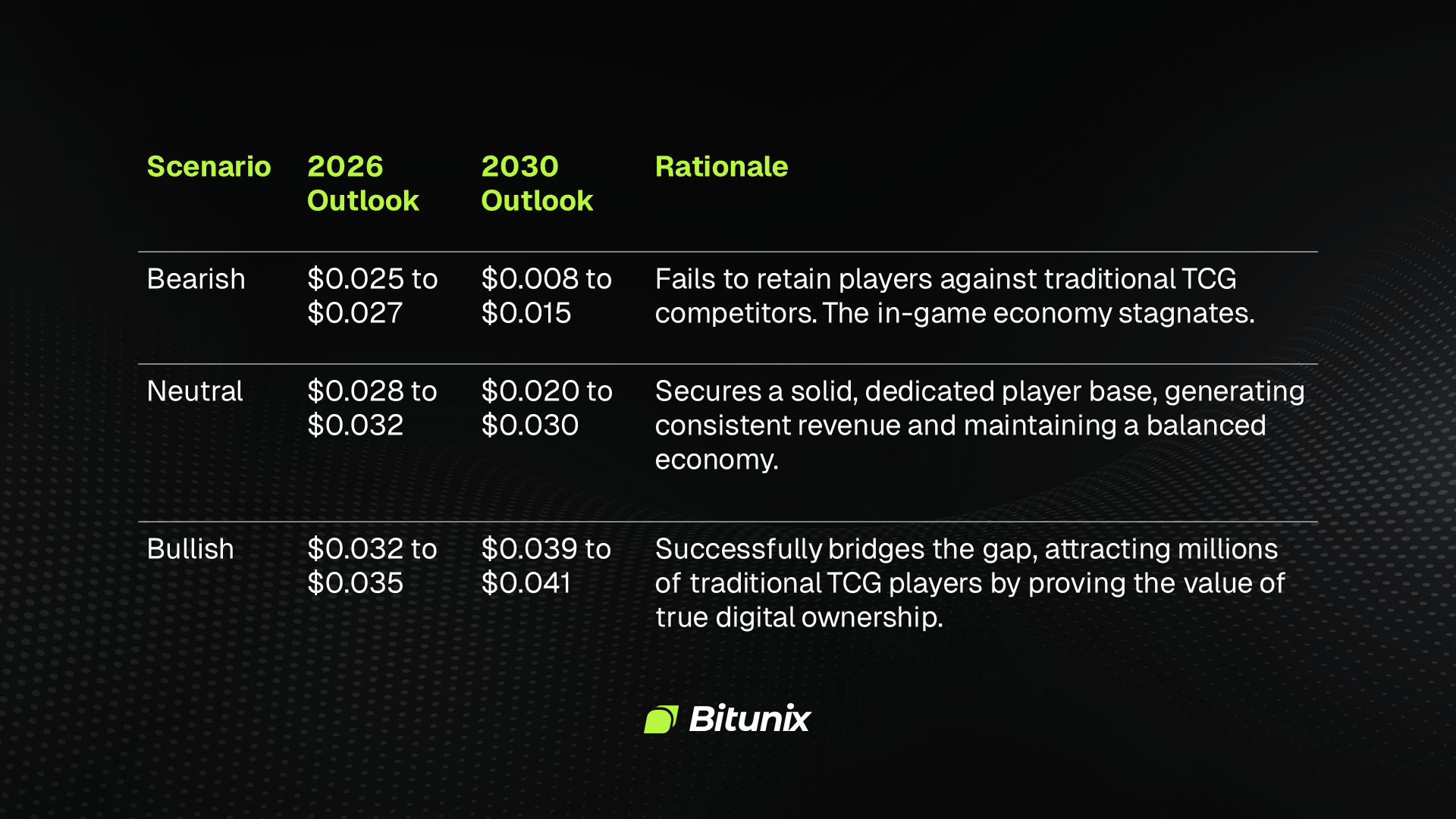
Gods Unchained price prediction scenario table comparing bearish, neutral, and bullish outlooks for 2026 and 2030.
Conclusion: A Bet on Digital Ownership
Gods Unchained remains one of the clearest examples of blockchain improving a digital card game instead of distracting from it. Ownership, trading, and crafting all make more sense here than they do in many Web3 projects because they plug into a genre where collecting already matters. Recent 2026 updates also show a team still balancing cards, testing expansions, and building a higher-stakes competitive layer.
The big picture is that investing in the GODS token is a long-term bet that Gods Unchained can keep a balanced economy, keep skill at the center, and persuade more traditional card players that owning their assets beats renting them. Ready to invest in the future of Web3 gaming? Download the app and create an account on Bitunix today to trade GODS with deep liquidity.
FAQ
What is Gods Unchained (GODS)?
Gods Unchained is a free-to-play tactical card game built on Ethereum and Immutable X. It lets players battle with decks, own certain cards as NFTs, trade them on secondary markets, and use the GODS token for crafting, purchases, and ecosystem participation.
How does Gods Unchained differ from Hearthstone?
The biggest difference is ownership. In Hearthstone, cards stay inside Blizzard's ecosystem. In Gods Unchained, players can own eligible NFT cards and trade them outside the game. The design goal still centers on competitive play, so the blockchain layer supports gameplay rather than replacing it.
What is the utility of the GODS token?
GODS is the native ERC-20 token of the ecosystem. Players use it to craft new NFTs, buy card packs, and support systems tied to staking and governance. It also plays a role in reward mechanics connected to gameplay and marketplace activity.
How do NFTs work in Gods Unchained?
NFTs represent player-owned digital cards and collectibles linked to a wallet on Immutable X. That lets players hold, trade, or sell certain assets outside the core game client. The main point is ownership with lower transaction friction than Ethereum mainnet alone would normally allow.
What is Immutable X and why does the game use it?
Immutable X is the Layer 2 network that powers the blockchain side of Gods Unchained. It handles trading cards, GODS-related actions, pack buying, and The Forge. The game uses it because ownership only works at scale when transactions are faster and cheaper.
Is Gods Unchained free to play?
Yes, it is a free-to-play tactical card game. Players can start without understanding blockchain, then connect a wallet later if they want full ownership features and access to certain GODS-based rewards and marketplace activity.
How can I earn GODS tokens?
Daily Play & Earn distributes GODS by playing and winning, and ranked matches can also reward players. The amount available each day depends on participation and reward structure, so earnings are tied to performance and active ecosystem use.
What is The Forge in Gods Unchained?
The Forge is Gods Unchained's card-fusing system. It lets players combine duplicate Core cards with Flux and GODS tokens to create tradable Meteorite NFT versions on Immutable X. That turns gameplay rewards into blockchain assets and supports the game's broader NFT economy.
What are the risks of investing in GODS?
The main risks are player-retention weakness, tough competition from giant card franchises, token-economy imbalance, and ongoing stigma toward NFT-based games.
Where can I buy GODS tokens?
GODS can be obtained through the Immutable ecosystem, including the IMX marketplace, and the token also trades on major third-party crypto data platforms that track exchange listings and live market data. Always check regional availability and liquidity before acting.
Glossary
- Battle Pass: A seasonal progression track that gives players rewards for completing matches, tasks, and other in-game objectives.
- Circulating Supply: The number of tokens currently available on the market and able to trade publicly.
- Competitive Mode: A higher-stakes game mode designed around rank, entry cost, and rewards tied more directly to skill.
- Daily Play & Earn: Gods Unchained's reward system that distributes GODS tokens based on active play and wins.
- Deckbuilding: The process of choosing and combining cards into a playable strategy deck before entering matches.
- ERC-20: A standard for fungible tokens on Ethereum, used here for the GODS token.
- FDV: Fully diluted valuation, a market-cap estimate assuming the maximum token supply is in circulation.
- Forge: The in-game crafting system that uses resources, including GODS, to create or upgrade blockchain-based cards.
- Governance: A system where token holders can participate in decisions about a project's future rules or direction.
- Immutable X: An Ethereum Layer 2 network built to support NFT minting and trading with lower friction.
- Market Capitalization: The total value of a token's circulating supply, calculated by multiplying price by supply.
- NFT Trading Cards: Digital cards stored on blockchain rails so players can own and trade them more freely.
- Play-and-Earn: A model where players earn rewards through skilled participation instead of being paid mainly for time spent grinding.
- Web3 TCG: A trading card game that uses blockchain features such as tokenized assets, wallets, or tradable digital ownership.
- zkRollup: A Layer 2 scaling design that bundles transactions off-chain and settles them on Ethereum more efficiently.
Disclaimer
This article does not provide:
(i) investment advice or investment recommendations;
(ii) an offer or solicitation to buy, sell, or hold digital assets;
(iii) financial, accounting, legal, or tax advice.
Digital assets, including stablecoins and NFTs, involve high risk and may fluctuate significantly. Consider whether trading or holding digital assets is appropriate for you given your financial situation. Consult a qualified legal, tax, or investment professional when needed. You are responsible for understanding and complying with applicable local laws and regulations.
About Bitunix
Bitunix is a global cryptocurrency derivatives exchange trusted by over 3 million users across more than 100 countries. At Bitunix, we are committed to providing a transparent, compliant, and secure trading environment for every user. Our platform features a fast registration process and a user-friendly verification system supported by mandatory KYC to ensure safety and compliance. With global standards of protection through Proof of Reserves (POR) and the Bitunix Care Fund, we prioritize user trust and fund security. The K-Line Ultra chart system delivers a seamless trading experience for both beginners and advanced traders, while leverage of up to 200x and deep liquidity make Bitunix one of the most dynamic platforms in the market.
Bitunix Global Accounts
X | Telegram Announcements | Telegram Global | CoinMarketCap | Instagram | Facebook | LinkedIn | Reddit | Medium