
Article Summary
- This article provides a comprehensive explanation of long squeeze in the context of cryptocurrency trading.
- It breaks down the core mechanics of how long squeeze functions and why it is a critical concept for traders to understand.
- The guide explores practical applications and strategies for using long squeeze to make more informed trading decisions.
- It highlights the risks and limitations associated with relying solely on long squeeze.
- The article concludes with actionable advice for integrating this knowledge into a broader trading plan.
- Successful crypto trading requires more than guessing whether the price goes up or down. You need to understand what happens behind the chart, especially when leverage, liquidity, and forced selling meet at the same time. A long squeeze is one of those moments that occur when traders holding long positions are pushed out of the market after a price drop, creating more sell pressure and often making the decline sharper.
- A long squeeze is common in leveraged markets because many traders borrow funds to increase position size. When prices move against them, exchanges can force those positions to close. For traders using a crypto exchange like Bitunix, understanding long squeezes helps with position sizing, stop-loss placement, and liquidation risk.
- This guide explains how a long squeeze works, why it matters, and how to include it in your broader trading strategies.
What Is a Long Squeeze in Crypto? Understanding the Mechanics
When traders ask what is a long squeeze, the simplest answer is that it is a chain reaction caused by falling prices and forced exits from long positions. A trader opens a long position when they expect the price to rise. If price drops instead, that trader may close the position manually, trigger a stop-loss order, or get liquidated if the trade uses leverage.
The basic sequence is that first, many traders enter long positions around the same price zone. Then, the price breaks below an important support level. That move triggers stop-losses and liquidations. Each forced sale adds more supply to the market. More selling pushes the price lower, which triggers even more exits.
Crypto markets are especially sensitive to this pattern because they trade 24/7, use high leverage, and often move through thin liquidity zones. Perpetual futures make this more intense because traders can hold leveraged positions without an expiry date. Funding rates also matter. When funding is strongly positive, many long traders are paying to stay in their positions, which can signal crowded bullish exposure.
Recent market data shows how large these events can become. Reuters reported that the October 10 to 11, 2025, crypto crash triggered more than $19 billion in liquidations, the largest crypto liquidation event in history. Bitcoin fell more than 14%, while ether dropped 12.2%, and some altcoins saw intraday losses of 20% or more.
CoinGlass also described the long-side imbalance during that event:
"Structurally, the liquidations on that day were heavily skewed toward the long side, with long liquidations accounting for approximately 85–90% of the total."
That quote shows the key point: the danger is the amount of crowded leverage sitting under the market before the drop begins.
Traders usually track long squeeze risk through open interest, funding rates, liquidation heatmaps, volume, support levels, and order book depth. High open interest with positive funding can show crowded long exposure. A sharp support break with rising sell volume can confirm that exits are accelerating. A drop in open interest often indicates leveraged positions are being closed or liquidated.
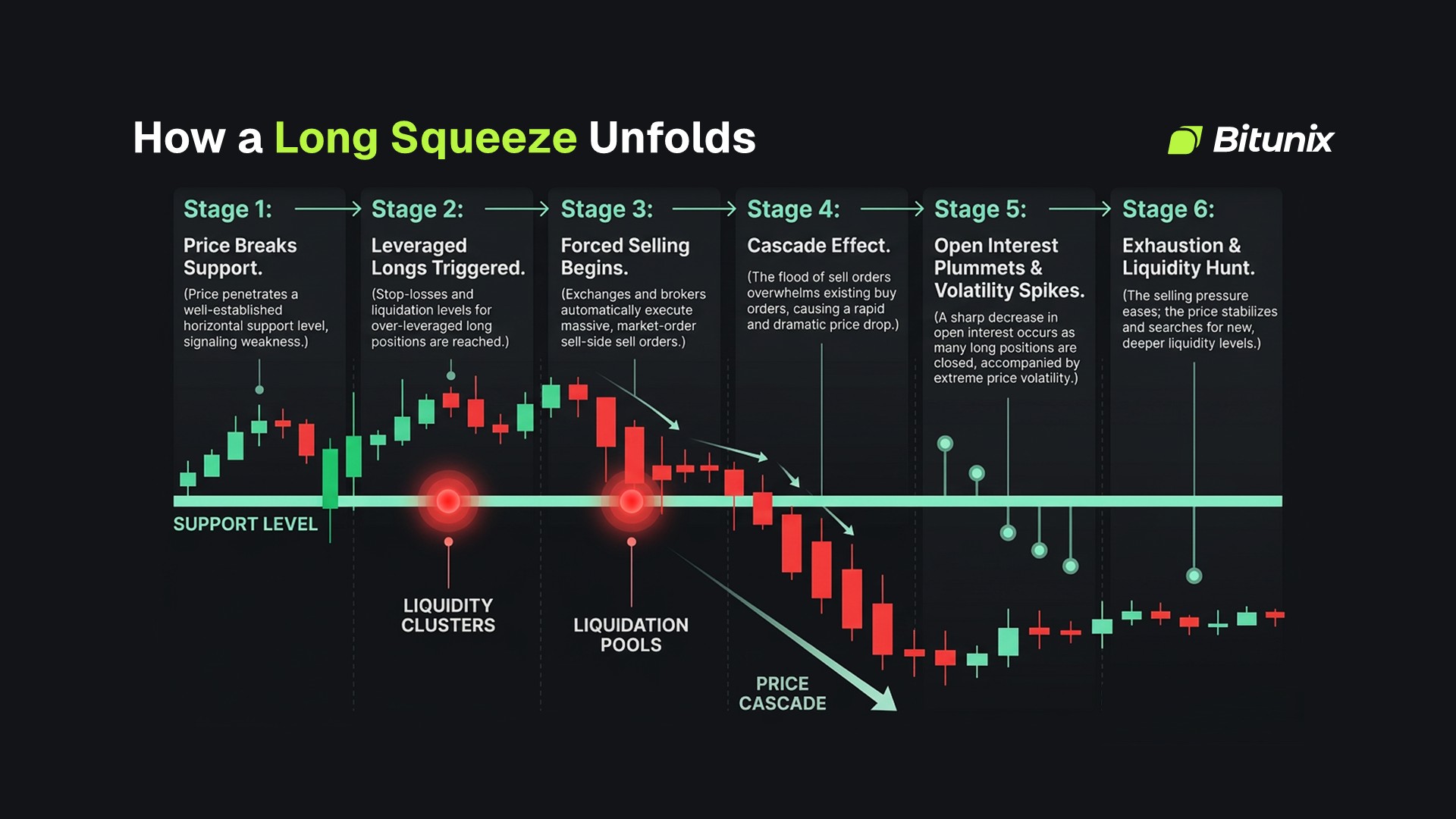
A long squeeze can unfold when price breaks support and pressures long traders to exit, adding forced selling and accelerating the move lower.
Why Long Squeeze Matters for Traders
For traders, a long squeeze matters because it can turn a normal pullback into a fast sell-off. When many leveraged long positions sit near the same support zone, a small break lower can trigger stop losses and liquidations. Those forced exits add more sell orders to the market, which can push the price down faster than expected.
Liquidity plays a major role in how severe the move becomes. In a deep market, buy orders can absorb forced selling with less price damage. In a thin market, the same sell pressure can cut through several price levels, creating sharp volatility. That is why altcoins often fall harder than Bitcoin during liquidation events. Their order books are usually thinner, so forced selling has more impact.
Understanding long squeeze risk also helps traders avoid mistaking panic for opportunity. A falling price may look attractive on the chart. However, if open interest remains high, funding remains positive, and liquidation clusters sit below the price, the market can keep falling before stabilizing. IG describes a long squeeze as a sudden price drop that can hurt traders holding long positions, and that pressure is stronger when many traders are positioned the same way.
Prepared traders can also use long squeeze signals to improve entries and exits. Short-term traders may wait for forced selling to slow before looking for a bounce, while cautious traders may avoid opening new longs when leverage looks crowded. Business Insider reported that a September 2025 crypto sell-off liquidated around $1.5 billion in positions and affected more than 407,000 traders, with overcrowded long exposure contributing to the move.
Practical Strategies and Applications
The best way to use long squeeze analysis is to combine it with technical analysis. Start with the price structure: mark support and resistance levels, then check open interest, funding rates, recent liquidation data, and volume. If price is sitting above support while funding is high and open interest is rising, the market may be vulnerable if that support fails.
Funding rates are especially useful in crypto trading because they show which side of the perpetual futures market is paying to keep positions open. Positive funding means long traders pay short traders, which often signals bullish pressure or crowded long positioning. Strong trends can stay crowded for a long time, so positive funding is not automatically bearish. The warning sign appears when the price stops rising while funding remains high.
Open interest adds another layer by showing how much active derivatives exposure remains in the market. Rising open interest during a rally means more leverage is entering the trade, while a sharp drop in open interest after price breaks lower often signals that positions are being closed or liquidated. Volume helps separate a weak dip from serious forced selling. A support break with heavy volume deserves attention because it can confirm that the move is gaining strength.
Risk management turns long squeeze analysis into something traders can actually use. Avoid placing stop-loss orders at the most obvious level if the chart already shows a crowded trade, because many traders place stops just below support, creating a liquidation magnet. A better approach is to size positions so normal volatility does not force you out. Use lower leverage, define invalidation clearly, and avoid entering late after a crowded move.
Common mistakes during long squeezes usually come from reacting too quickly. Many traders treat every sharp drop as a buying opportunity, ignore funding rates because the chart still looks bullish, or add to losing leveraged longs while hoping for a bounce.
A clearer version would break the checks into simple steps before making the trade decision:
- Check open interest: If open interest is rising quickly while price is also moving up, more traders are entering leveraged positions. That can make the move crowded.
- Check funding rates: Strongly positive funding means long traders are paying to keep positions open. When funding becomes stretched, the long side can be vulnerable if price starts falling.
- Check the nearest support level: A long setup is cleaner when price is near major support, not extended far above it after a fast move.
- Check liquidation clusters: Visible liquidation levels below price can increase downside risk, especially if the market starts moving toward those levels.
- Check volume on the move up: If price is rising while volume weakens, the rally may have less participation behind it.
- If several checks point to crowded leverage, reduce position size, wait for stronger confirmation, or skip the trade.
Limitations and Considerations
Long squeeze analysis can help you read pressure points in the market, but it should never become your whole trading plan. High funding, rising open interest, or visible liquidation clusters can show that leverage is crowded, but they do not guarantee an immediate drop. Markets can stay stretched for longer than expected, and a squeeze signal still needs confirmation from price structure, volume, liquidity, and broader market conditions.
Market manipulation is another risk because large players can pressure visible stop-loss and liquidation zones, especially when order books are thin. Aggressive selling, spoofing, wash trading, and other disruptive practices can distort price signals and trap retail traders. ESMA's 2025 MiCA guidelines focus on helping authorities prevent and detect market abuse in crypto-asset markets, while the CFTC identified market abuse and disruptive trading, including spoofing and wash trading, as enforcement priorities in 2026.
Different market conditions can also change how useful long squeeze signals are. In a strong bull market, a squeeze can be brief and followed by a fast recovery. In a bear market, the same type of forced selling can trigger a deeper breakdown. In a ranging market, price may sweep liquidity below support before moving back into the range.
Timeframe selection makes a big difference when interpreting squeeze signals. A five-minute liquidation flush may matter for scalpers, but it may mean little for swing traders or longer-term investors. A daily support break with high open interest, heavy sell volume, and large long liquidations carries more weight because it affects a wider group of market participants.
Spot traders should still pay attention to long squeezes even when they do not use leverage. A spot holder will not be liquidated, but forced selling in futures can pull spot prices lower through arbitrage, sentiment, and liquidity pressure. When derivatives unwind quickly, the spot market often feels the shock too.
Conclusion: Elevating Your Trading Game
Understanding a long squeeze is a useful step toward reading market dynamics with more confidence. It helps you see when a price move is supported by real demand and when it may be vulnerable because too many traders are leaning in the same direction. That distinction can protect you from weak entries and poorly placed stops.
The bigger lesson is risk control. Long squeeze analysis works best when combined with support and resistance, volume, funding rates, open interest, liquidation data, and disciplined position sizing, as it should help you ask better questions before entering a trade.
Before trading, check whether the market is crowded, where liquidation zones sit, and how much volatility your position can handle. Ready to put your knowledge to the test? Download the Bitunix app, register, and use its trading tools to practice reading price action, liquidity, and leverage conditions with more discipline.
FAQ
What exactly is long squeeze?
A long squeeze occurs when the price drops, forcing traders with long positions to exit. In leveraged crypto markets, this often means stop-loss orders and liquidations trigger more selling, which can push the price down faster than a normal pullback.
Why is long squeeze important in crypto trading?
A long squeeze helps explain why some price drops become sharp and sudden. It shows when crowded long positions, weak liquidity, and forced selling combine. Traders use this information to manage leverage, avoid poor entries, and understand market risk.
How does long squeeze affect price volatility?
A long squeeze increases volatility because forced selling adds more sell orders to an already falling market. When liquidity is thin, those sell orders can push price through several support levels quickly, creating fast candles and wider spreads.
Can long squeeze be manipulated?
Large traders can sometimes push price toward stop-loss or liquidation zones, especially in thin markets. They may use aggressive selling, spoofing, or liquidity pressure. Still, not every long squeeze is manipulation; many happen because the leverage is overcrowded.
How do I track or measure long squeeze?
You can track long squeeze risk with open interest, funding rates, liquidation heatmaps, volume spikes, support breaks, and order book depth. Crowded longs, positive funding, and price weakness near support can create a higher-risk setup.
Is long squeeze more important for day traders or long-term investors?
Day traders usually rely on long squeeze signals more often because they trade short-term volatility. Long-term investors can still benefit by understanding why sudden drops happen, especially when derivatives-driven selling affects spot prices.
How does long squeeze relate to liquidity?
A long squeeze becomes more severe when liquidity is thin. If there are not enough buy orders to absorb forced selling, the price moves lower quickly. Deep liquidity can soften the impact, while shallow liquidity can accelerate the drop.
What are the common mistakes traders make regarding long squeeze?
Common mistakes include using too much leverage, ignoring funding rates, buying every sharp dip, and placing stops at obvious levels. Traders also mistake every sell-off for a squeeze, even when open interest and liquidation data do not support such a claim.
Should I base my trades solely on long squeeze?
No. Long squeeze analysis should support a broader trading plan. Use it with price structure, volume, funding rates, liquidation data, trend analysis, and risk management.
Where can I practice trading using these concepts?
You can practice by watching live charts, open interest, funding rates, liquidation data, and support levels before placing trades. Bitunix provides crypto trading tools that allow users to monitor markets and apply these concepts with controlled position sizing.
Glossary
- Long Position: A trade that profits when the asset price rises.
- Long Squeeze: A forced selling event where falling prices pressure long traders to exit.
- Liquidation: An exchange-forced position closure when margin falls below required levels.
- Leverage: Borrowed exposure that increases both potential gains and losses.
- Open Interest: The total value or number of active derivatives contracts.
- Funding Rate: A periodic payment between long and short perpetual futures traders.
- Perpetual Futures: Derivative contracts with no expiry date, common in crypto trading.
- Stop-Loss: An order that exits a trade when price reaches a chosen level.
- Support: A price area where buyers have previously entered the market.
- Resistance: A price area where sellers have previously limited upward movement.
- Liquidation Heatmap: A visual tool showing price zones where liquidations may cluster.
- Volatility: The speed and size of price movements over time.
- Liquidity: The available buying and selling depth in a market.
- Market Dynamics: The forces that shape price movement, including liquidity, leverage, volume, and sentiment.
- Technical Analysis: A trading method that studies charts, price action, indicators, and market structure.
Disclaimer
This article does not provide:
(i) investment advice or investment recommendations;
(ii) an offer or solicitation to buy, sell, or hold digital assets;
(iii) financial, accounting, legal, or tax advice.
Digital assets, including stablecoins and NFTs, involve high risk and may fluctuate significantly. Consider whether trading or holding digital assets is appropriate for you given your financial situation. Consult a qualified legal, tax, or investment professional when needed. You are responsible for understanding and complying with applicable local laws and regulations.
About Bitunix
Bitunix is a global cryptocurrency derivatives exchange trusted by over 3 million users across more than 100 countries. At Bitunix, we are committed to providing a transparent, compliant, and secure trading environment for every user. Our platform features a fast registration process and a user-friendly verification system supported by mandatory KYC to ensure safety and compliance. With global standards of protection through Proof of Reserves (POR) and the Bitunix Care Fund, we prioritize user trust and fund security. The K-Line Ultra chart system delivers a seamless trading experience for both beginners and advanced traders, while leverage of up to 200x and deep liquidity make Bitunix one of the most dynamic platforms in the market.
Bitunix Global Accounts
X | Telegram Announcements | Telegram Global | CoinMarketCap | Instagram | Facebook | LinkedIn | Reddit | Medium