
Article Summary
- This article provides a detailed price prediction and fundamental analysis for the Manta Network token.
- It explains the core technology and use cases of the Manta Network ecosystem.
- The bull case focuses on network adoption, technological upgrades, and broader market trends.
- The bear case highlights potential regulatory challenges, competition, and market volatility.
- It presents detailed price prediction scenarios (bearish, neutral, bullish) for both 2026 and 2030.
Manta Network stands out as a Layer 2 project focused on modular infrastructure, zero-knowledge technology, staking, and Ethereum scalability. Its long-term appeal comes from helping developers build faster and more efficient Web3 applications while using blockchain technology to support on-chain execution, governance, and token-based network incentives.
Manta Network is best understood as a modular blockchain ecosystem built around Manta Pacific, an Ethereum Layer 2 designed for scalable applications. Traders following its native token can also use Bitunix, a crypto exchange that offers access to MANTA/USDT trading. This analysis looks at Manta Network's technology, market position, and data-based price scenarios for 2026 and 2030.
The Technology and Ecosystem
Manta Network has shifted from a broad privacy-focused identity into a more focused, modular Layer 2 ecosystem. That shift gives investors a clearer framework to evaluate. Instead of only asking whether privacy tech becomes popular, you also need to look at Manta Pacific adoption, staking, ecosystem applications, token utility, and whether developers keep building on the network.
Modular Infrastructure for ZK Applications
Manta Pacific is the core of the current Manta Network ecosystem. It is an Ethereum Layer 2 smart contract platform that uses modular infrastructure to support lower fees and higher throughput for decentralized applications. The network's own site describes it as a modular blockchain for ZK applications and lists more than 200 ecosystem projects, showing that the ecosystem now includes DeFi, infrastructure, gaming, AI, wallets, bridges, and other application categories.
Zero-knowledge technology is central to Manta's identity, but the project's investment case now depends on more than cryptography. Users and developers care about fees, speed, liquidity, integrations, and app quality. A technically strong chain still needs useful applications, and that is where many infrastructure projects get tested.
Fast Finality and the Atlantic Migration
Manta's 2025 and 2026 roadmap includes a major consolidation around Manta Pacific. Manta Atlantic, the project's Polkadot-based chain, is scheduled to sunset on August 1, 2026, and users are instructed to migrate their assets to Manta Pacific. That is a major operational event because it concentrates attention, liquidity, and development around the Ethereum Layer 2 side of the ecosystem.
Manta Pacific's fast finality roadmap is also important. The official staking documentation says:
"We're leveraging Symbiotic's restaking infrastructure and Babylon's shared security architecture to combine Ethereum's and Bitcoin's security with Manta Pacific's high-performance execution. This increases overall asset efficiency for MANTA and BTC token holders and helps enable fast finality on Manta Pacific."
That quote shows investors that Manta wants the network token to do more than sit inside wallets. Through staking and restaking infrastructure, MANTA can help secure faster finality on the network. If this system works at scale, the token gets a stronger utility story tied to network performance.
Token Supply, Staking, and Utility
The Manta Network token has several roles within the ecosystem, including governance across Manta Pacific and Manta Atlantic, staking on Manta Atlantic, collator delegation, transaction fees, and network security.
Current market data shows how far MANTA has fallen from its early cycle peak. CoinGecko listed MANTA near $0.067 in early May 2026, with a circulating supply of around 470 million tokens and a market cap of around $31.5 million. The project's all-time high was at $4.05 on March 13, 2024, showing how steep the drawdown has been.
For traders, MANTA now requires more than a simple price check. You need to watch the Atlantic migration, Manta Pacific staking, token emissions, application usage, liquidity, and market sentiment.
The Bull Case: Drivers of Growth
Any Manta price prediction with a strong upside case depends on execution. Manta already has a recognizable brand, a modular Layer 2, a token with staking and governance functions, and a clear plan to consolidate around Manta Pacific. The question is whether that turns into active users, developer traction, and stronger demand for MANTA.
Adoption Through Modular Layer 2 Infrastructure
Manta's adoption case is tied to a practical need in the Ethereum ecosystem: scalable Layer 2 networks that support lower fees, high throughput, and application-specific infrastructure. Manta Pacific fits that demand by positioning itself as a modular L2 for ZK applications, with support for developers building consumer apps, DeFi products, and infrastructure tools.
Manta's Q1 2025 data showed how difficult the market environment was. Messari reported that MANTA's market cap fell 70.3% during the quarter, from $308.3 million to $91.7 million, while the token price dropped 72.0%, from $0.80 to $0.22. Still, the same data gives context for upside. A recovery from depressed levels does not require a return to all-time highs, but it does require better usage and stronger market conditions.
Changelly's current forecast reflects a moderate recovery path, with a 2026 range of $0.114 to $0.131 and an average of $0.117. Compared with a price near $0.067, that implies room for improvement if Manta stabilizes and gains traction.
Ecosystem Consolidation Around Manta Pacific
The Atlantic sunset creates risk, but it also creates a cleaner long-term structure. Maintaining two separate networks can split liquidity, developer focus, and user attention. By moving activity toward Manta Pacific, the project can concentrate resources on the Ethereum Layer 2 ecosystem, where more liquidity and developer activity already exist.
Manta's website frames the current roadmap around fast finality on Manta Pacific through BTC and MANTA restaking. If Manta can use restaking to improve finality and asset efficiency, it gives developers and users a stronger reason to care about the network.
More aggressive forecasts price in a stronger version of that thesis. Cryptopolitan's April 2026 forecast lists a possible 2026 high of $0.80 and a 2032 high of $5.00. Those numbers are much more optimistic than the conservative models, so they should be treated as upside cases.
Market Recovery and Small-Cap Repricing
Broader crypto sentiment plays a major role in MANTA's price behavior because the token trades like a smaller infrastructure asset. When liquidity returns to altcoins, assets with recognizable brands and beaten-down charts can move quickly. When the market turns defensive, smaller tokens often lose bids first.
CoinCodex's 2026 forecast is more cautious, placing MANTA in a range of $0.04713 to $0.06888, keeping the token near current levels. Changelly gives a more positive 2030 estimate, with a range of $0.485 to $0.594 and an average of $0.503. The gap between those models shows how much the outcome depends on adoption and market recovery.
The Bear Case: Potential Risks
Manta Network still carries serious risks even with real technology and a clear ecosystem plan. The bear case comes from migration execution, regulation, competition, weak token demand, and macro pressure.
Regulatory Pressure on Infrastructure Tokens
Regulatory uncertainty affects Manta because the token combines governance, staking, transaction fees, security incentives, and exchange trading. That mix places the Manta Network token inside a regulatory environment where authorities pay attention to token promotion, staking rewards, investor expectations, and how access is provided across different markets.
European crypto regulation also matters for projects with exchange listings and user-facing access points. MiCA creates disclosure, authorization, supervision, and consumer protection rules for crypto asset issuers and service providers in the EU. For Manta, the practical concern is how exchanges, wallets, staking interfaces, and promotional materials describe the token's role without implying guarantees or investor protections that do not exist.
Manta's migration from Atlantic to Pacific adds another communication challenge. Users need clear instructions, safe migration tools, and accurate explanations of what happens after August 1, 2026. Poor communication around a chain sunset can create confusion, phishing risk, and market pressure, even when the technical plan is sound.
Competition From Other Layer 2 Networks
Manta Network competes with many Layer 2 and modular infrastructure projects. Developers can choose Arbitrum, Optimism, Base, zkSync, Starknet, Linea, Mantle, Polygon, Scroll, and other networks depending on grants, users, tooling, liquidity, and brand reach. Manta needs to give teams a clear reason to build there.
The competitive problem becomes harder because larger ecosystems often have stronger liquidity and more existing users. A developer building a DeFi app usually wants deep liquidity and easy onboarding. A game developer wants users and wallet support. An infrastructure team wants reliable tooling. Manta's modular and ZK positioning helps, but it does not make competition disappear.
CoinCodex's 2031 forecast range of $0.09414 to $0.2959 also reflects a cautious long-term view. Even when extending the forecast beyond 2030, the model does not price in a return anywhere near MANTA's 2024 peak. That suggests the market remains skeptical about whether Manta can convert infrastructure into token value.
Macro Pressure and Liquidity Risk
Macroeconomic pressure affects MANTA because small-cap crypto assets depend heavily on risk appetite. When liquidity tightens, traders usually move toward Bitcoin, Ethereum, stablecoins, or cash. Smaller tokens with lower daily volume face sharper drops because there are fewer buyers willing to absorb selling pressure.
MANTA's current market profile shows that risk clearly. According to CoinGecko's data, daily trading volume is around $4.46 million and a market cap is at nearly $31.5 million in early May 2026. Those numbers support tradability, but they also show that MANTA is much smaller than major Layer 2 assets. Smaller markets can rebound quickly, but they can also fall through the floor when sentiment weakens.
A careful crypto price prediction needs to treat liquidity as part of the investment case. Technology alone does not support price if the token lacks demand, exchange depth, and user activity.
Manta Price Prediction Scenarios 2026 and 2030
Forecasts for MANTA vary because each model makes different assumptions about adoption, liquidity, and execution. Conservative estimates keep the token close to today's range, while moderate scenarios expect a recovery as Manta Pacific becomes the center of the ecosystem. More aggressive forecasts assume that restaking, fast finality, and broader Layer 2 adoption can move MANTA into a much higher valuation range.
This Manta price prediction uses those forecasts as reference points, then groups the possible outcomes into bearish, neutral, and bullish scenarios.
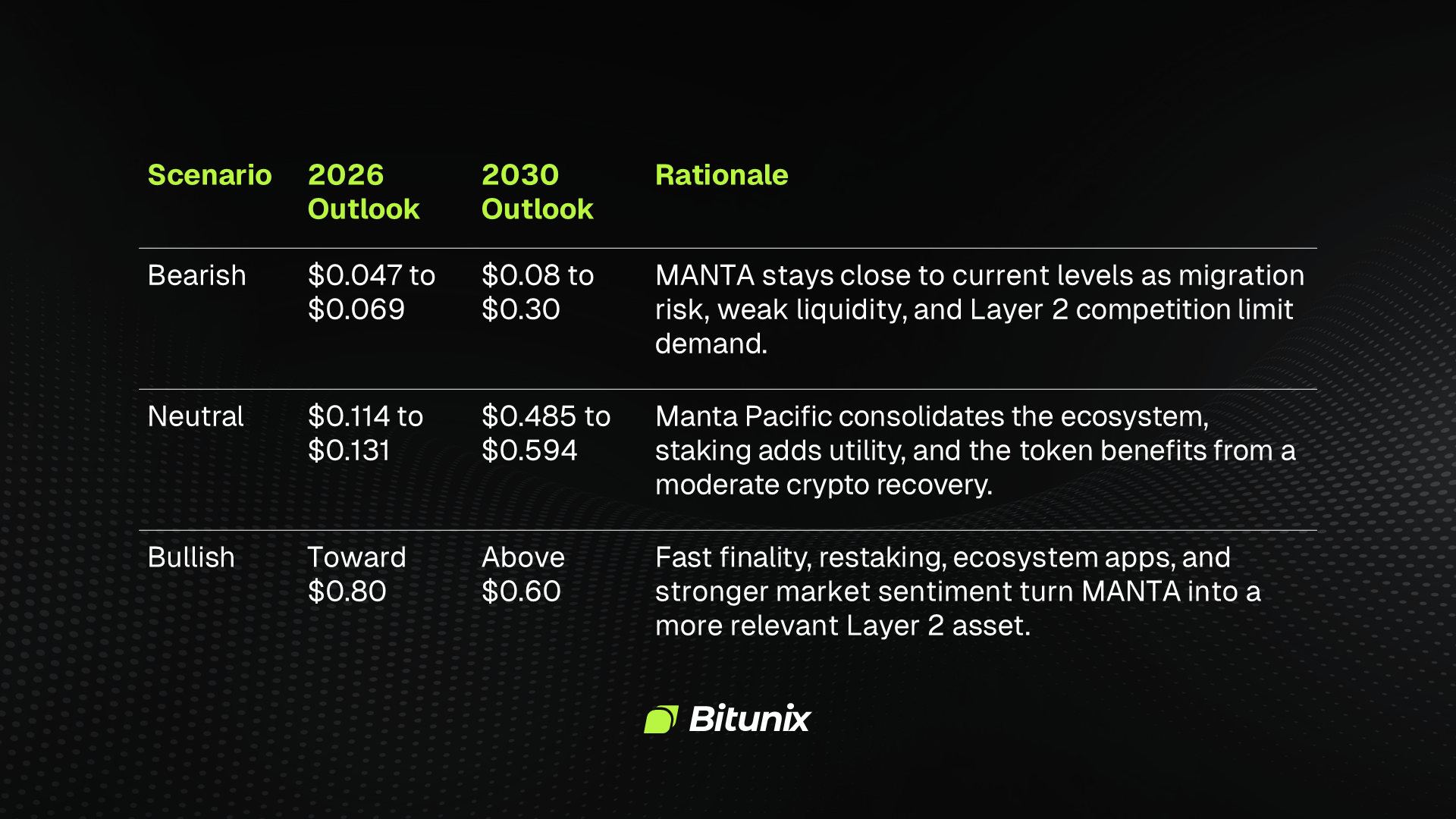
Manta Network price prediction scenarios compare possible outcomes based on migration risk, staking utility, Layer 2 adoption, liquidity, and market recovery.
Conclusion: The Future of Manta Network
Manta Network represents a compelling project with significant potential, but it is not without its risks. The project features a modular Layer 2, ZK-based positioning, staking utility, a consolidation plan for Manta Pacific, and more than 200 ecosystem projects listed on its site.
Investing in Manta Network requires a long-term perspective and an understanding of its unique value proposition. The upside case depends on fast finality, successful migration, developer adoption, staking demand, and stronger market conditions. The downside case is that competition is intense, liquidity is thin, and token demand needs to improve.
For traders, MANTA is best treated as a high-risk Layer 2 ecosystem token. Track the Atlantic sunset, Manta Pacific staking, ecosystem app usage, circulating supply, liquidity, and broader crypto sentiment before making decisions. Ready to trade Manta Network? Download the Bitunix app, register, and access MANTA/USDT markets with tools for active spot trading.
FAQ
What is Manta Network?
Manta Network is a modular blockchain ecosystem focused on zero-knowledge applications and scalable Web3 infrastructure. Its main network is Manta Pacific, an Ethereum Layer 2 designed to support decentralized applications with lower fees, faster execution, and developer-friendly infrastructure.
How does Manta Network work?
Manta Network uses modular blockchain infrastructure to separate key technical functions and improve scalability. Manta Pacific operates as an Ethereum Layer 2, while staking and restaking infrastructure provide faster finality and enhanced network security. Developers can build DeFi, gaming, AI, and consumer apps on the network.
What is the utility of the Manta Network token?
The Manta Network token supports governance, transaction fees, staking, collator delegation, and network security. Its role becomes stronger if Manta Pacific gains more applications, staking demand, and user activity. Token value depends on whether those utilities create sustained demand.
Who are the main competitors to Manta Network?
Manta competes with other Layer 2 and modular blockchain ecosystems, including Arbitrum, Optimism, Base, zkSync, Starknet, Linea, Mantle, Polygon, and Scroll. It also competes for developers, liquidity, users, grants, integrations, and wallet support across the wider Ethereum scaling market.
Is Manta Network a good long-term investment?
Manta Network is a high-risk long-term investment. It has real technology and a clear Layer 2 focus, but the token has suffered a deep drawdown. Investors should watch migration execution, staking adoption, app activity, liquidity, and competition before buying.
What factors could drive Manta Network's price up?
MANTA can rise if Manta Pacific gains more users, staking demand grows, fast finality improves network performance, and developers launch useful applications. A broader crypto market recovery, improved exchange liquidity, and stronger Layer 2 sentiment can also support price growth.
What are the main risks associated with Manta Network?
The main risks include weak token demand, migration problems, regulatory pressure, low liquidity, and strong competition from larger Layer 2 networks. MANTA also depends on market sentiment, so even good technical progress can struggle during a risk-off crypto market.
How does Manta Network differ from Bitcoin or Ethereum?
Bitcoin primarily serves as a decentralized store of value and a payment network. Ethereum supports smart contracts and decentralized applications. Manta Network is an application-focused Layer 2 ecosystem that builds on Ethereum's broader infrastructure to support scalable Web3 apps.
What is the all-time high of Manta Network?
MANTA reached an all-time high of $4.05 on March 13, 2024. By early May 2026, it traded near $0.067, indicating how much the token had corrected after its early market cycle and why recovery assumptions vary widely.
Where can I buy Manta Network?
You can buy MANTA on centralized exchanges that list the token, including Bitunix, through the MANTA/USDT spot market. You can also access Manta-related assets via supported wallets and DeFi tools, subject to network availability and liquidity.
Glossary
- Manta Pacific: Manta Pacific is Manta Network's Ethereum Layer 2, built to support scalable decentralized applications with lower fees and modular infrastructure.
- Manta Atlantic: Manta Atlantic is Manta's Polkadot-based chain, scheduled to sunset on August 1, 2026, as the project focuses on Manta Pacific.
- MANTA: MANTA is the native token used for governance, fees, staking, delegation, and network security across the Manta ecosystem.
- Zero-Knowledge Technology: Zero-knowledge technology lets one party prove information is valid without revealing the full underlying data.
- Modular Blockchain: A modular blockchain separates functions such as execution, settlement, consensus, and data availability to improve scalability and flexibility.
- Layer 2: A Layer 2 network processes transactions on top of a base blockchain to improve speed and reduce costs.
- Restaking: Restaking lets already staked assets secure additional systems, increasing capital efficiency and network security.
- Fast Finality: Fast finality reduces the time needed for transactions or state updates to become effectively settled.
- Staking: Staking locks or delegates tokens to support network security and earn rewards.
- Governance: Governance lets token holders participate in decisions about protocol upgrades, parameters, treasury use, or ecosystem direction.
- Collator: A collator helps produce and organize blocks in certain blockchain networks.
- TVL: Total value locked measures the value of crypto assets deposited in a network or protocol.
- Market Cap: Market cap equals token price multiplied by circulating supply.
- Circulating Supply: Circulating supply is the number of tokens currently available in the market.
- Crypto Price Prediction: A crypto price prediction estimates future token value using market data, adoption trends, technical models, and investor sentiment.
Disclaimer
This article does not provide:
(i) investment advice or investment recommendations;
(ii) an offer or solicitation to buy, sell, or hold digital assets;
(iii) financial, accounting, legal, or tax advice.
Digital assets, including stablecoins and NFTs, involve high risk and may fluctuate significantly. Consider whether trading or holding digital assets is appropriate for you given your financial situation. Consult a qualified legal, tax, or investment professional when needed. You are responsible for understanding and complying with applicable local laws and regulations.
About Bitunix
Bitunix is a global cryptocurrency derivatives exchange trusted by over 3 million users across more than 100 countries. At Bitunix, we are committed to providing a transparent, compliant, and secure trading environment for every user. Our platform features a fast registration process and a user-friendly verification system supported by mandatory KYC to ensure safety and compliance. With global standards of protection through Proof of Reserves (POR) and the Bitunix Care Fund, we prioritize user trust and fund security. The K-Line Ultra chart system delivers a seamless trading experience for both beginners and advanced traders, while leverage of up to 200x and deep liquidity make Bitunix one of the most dynamic platforms in the market.
Bitunix Global Accounts
X | Telegram Announcements | Telegram Global | CoinMarketCap | Instagram | Facebook | LinkedIn | Reddit | Medium