

Article Summary
- This article provides a price prediction for Toshi (TOSHI), a prominent meme coin on the Base blockchain, named after Brian Armstrong's cat and a nod to Satoshi Nakamoto.
- It frames Toshi's investment case as a project aiming to be more than just a meme. It is positioning itself as a key infrastructure and community hub for the entire Base ecosystem.
- The bullish case is built on its utility-focused roadmap, including a token launchpad (ToshiSwap) for new Base projects, a multi-sender tool, and its strong branding as the unofficial mascot of the Base chain.
- The bearish case highlights the intense competition from thousands of other meme coins, the early stage of the Base ecosystem, and the inherent volatility and risk associated with any meme-based asset.
- It presents three price scenarios for 2026, where the outcome depends on Toshi's ability to successfully deliver on its utility promises and the overall growth of the Base blockchain.
- Every chain that wins mindshare ends up with a mascot. It's not a law of physics, but it shows up often enough that you notice. On Coinbase's Layer 2 network Base, that mascot role has been claimed by a blue cat called Toshi, and the token tries to turn the meme into something users actually touch.
- Toshi also sits in an awkward spot that a lot of meme coins never escape. Traders want a chart and a story. Builders want tools that save time. If Toshi can serve both groups without tripping over security and execution, it has a clearer long-term path than a token that only lives on social posts.
- If you mainly trade through a crypto exchange, you'll see TOSHI/USDT listed alongside other Base assets on platforms like Bitunix. You can trade either way quickly, but the harder question is what you are buying and what would need to happen for demand to grow.
- This analysis breaks down the utility behind Toshi, the risks that can derail it, and three scenario-based price outcomes for 2026 that follow the token's actual market structure and Base's growth path.
The Bullish Case for Toshi (Utility Beyond the Meme)
Toshi's bullish case is not just a mascot narrative. The team markets it as a Base-native project with a product layer, plus an on-chain identity and governance story. That mix matters because Base grew fast in 2025 and kept scaling into 2026, so infrastructure plus culture is a real category on that chain. The official site defines what the token is and ties it directly to Base and Coinbase lore:
"$TOSHI is a memecoin named after Coinbase co-founder Brian Armstrong's cat and Satoshi Nakamoto."
1) The Unofficial Mascot Effect
In the meme coins sector, narratives create repeat attention, and attention creates liquidity. On Base, where new tokens launch constantly, the home-field meme has practical value because it keeps Toshi in the conversation whenever Base usage spikes.
A 2026 Phemex piece framed Toshi as one of the top Base meme coins alongside Brett and Degen, and it also called out concentration dynamics that matter for price shocks. That kind of positioning helps Toshi stay visible when Base rotates into the spotlight.
2) The Toshi Launchpad Angle
The biggest utility claim sits around launches. The official site promotes a launch and trading product under the Toshi umbrella, and it describes it like this:
"Toshi Mart is the 1-click social launch and trading platform and the premier memecoin launchpad on Base."
You will also see people refer to a ToshiSwap launchpad, mostly as shorthand for the wider toolkit. In practice, the public-facing launch product the project emphasizes today is Toshi Mart, because launchpads tend to become demand funnels when they win mindshare.
This is also where utility can become token demand. A launchpad can require the token for participation, fees, or access tiers. If that mechanism actually exists and sees usage, it creates a demand sink.
3) Ecosystem Tools That Developers and Communities Use
Toshi has also positioned itself as a toolkit for teams deploying on Base, which is the less glamorous but more durable lane. Several reputable exchange and data pages describe the suite as including developer utilities such as multisender and lockers, and they describe ToshiSwap as an aggregator-style tool in the ecosystem narrative.
The reason this matters is simple. If teams use the tools to launch and manage tokens, Toshi becomes part of the Base default stack for new projects. That supports steady usage even when the meme cycle cools.
4) First-Mover Advantage in a Fast-Growing Base Economy
Base's growth is the biggest external tailwind, and it showed up in 2025 numbers that continued into 2026. One January 2026 Base roundup reported daily transactions growing roughly 24x year over year, with 4.4B cumulative transactions and protocol fee run-rate figures cited for the network.
L2BEAT's TVS breakdown, timestamped March 11, 2026, gives a cleaner snapshot of what big looks like on Base. USDC alone shows over $4.29B in TVS-adjusted value, and the page lists TOSHI itself among native assets with roughly $87M TVS-adjusted value at that timestamp.
When the chain grows, the top recognizable tokens get a liquidity benefit. That does not guarantee price appreciation, but it explains why Base ecosystem meme coins can keep cycling back into relevance.
The Bearish Case Against Toshi
Toshi's bearish case starts with the same thing that makes it fun. Meme coins trade on attention, and attention has the life expectancy of a trending tab. If you plan around long-term utility, you still need to survive the short-term chaos, and that chaos is where most people blow up their sizing.
It also matters that Base is still a young ecosystem compared with older networks. Coinbase has made Base a strategic focus, but the chain's economic gravity can shift quickly as new apps, new tokens, and new incentives rotate.
1) Meme Coin Volatility and Reflexive Hype
Toshi has a clear volatility history. MetaMask's market page, on March 11, 2026, lists an all-time high of around $0.00226 and an all-time low of around $0.00000002, with the token trading near $0.000208 at the time shown.
Those numbers tell you two things at once. First, upside spikes are real. Second, drawdowns are normal. If you buy after a hype surge, the chart can punish you for weeks, even when nothing bad happened.
2) Execution and Security Risk Around the Product Layer
A launchpad and tool suite need more than branding. They need uptime, security reviews, and a reputation for not enabling scams. If low-quality launches dominate, users stop trusting the platform and liquidity moves elsewhere.
This is one reason people should treat Toshi as a high-variance bet. The project can win mindshare, but a single high-profile exploit or failed launch can erase months of momentum in one day.
3) Dependency on Base Adoption
Toshi's fate is tied to Base, even when the token trades on multiple venues. If Base activity slows, the meme coin layer often cools first because it is the most narrative-driven part of the ecosystem.
Coinbase's Q4 2025 shareholder letter, filed in February 2026, explicitly described continued efforts to drive transactions on Base and referenced increased revenue from Base tied to transaction growth while they reduced costs and scaled the network. That helps the Base outlook, but it also highlights how central Base performance is to tokens built on it.
4) Competition Inside Base Meme Trading
Base is crowded. Even in L2BEAT's March 2026 TVS breakdown, you can see other high-attention native tokens listed near Toshi, including other meme or culture-driven assets.
And competition does not only come from bigger projects. New tokens launch daily, and many exist purely to siphon attention for a week. That makes it harder for any single token to hold narrative dominance for long.
TOSHI Price Scenarios For 2026
Now for the part you actually came for: numbers. The cleanest way to do this is scenario pricing based on market cap and supply, then compare your scenarios with third-party model outputs from well-known market sites.
Supply is relatively easy to pin down. CoinMarketCap lists a circulating supply of around 420.67B TOSHI and a max supply of around 420.69B, alongside a market cap of around 87.4M at the time captured.
BaseScan and L2BEAT also reflect market cap scale from on-chain data. BaseScan shows a max total supply of 420.69B and a six-figure holder count figure on its token page.
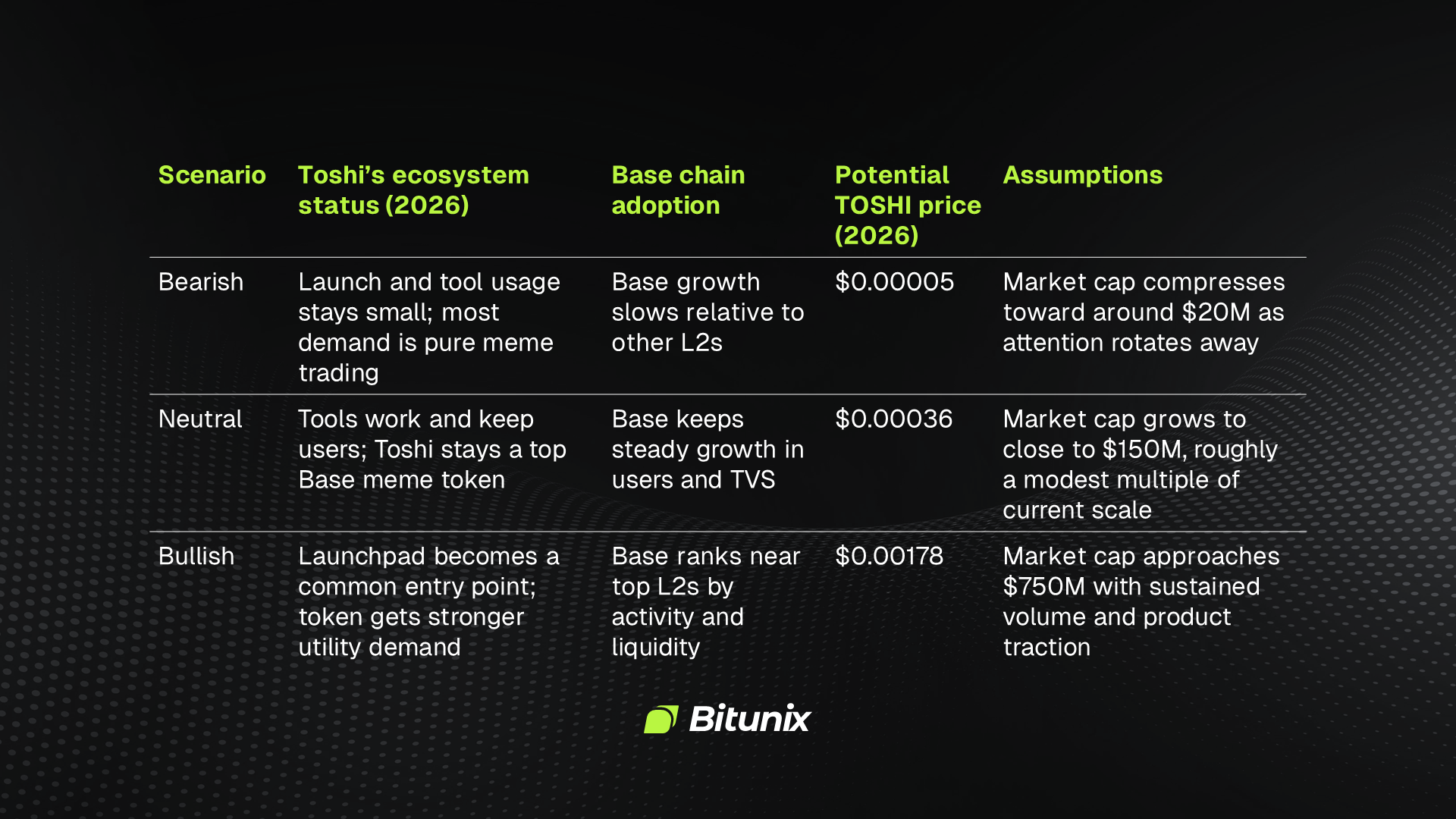
Scenario-based 2026 outlook for TOSHI, linking projected price ranges to Base adoption and whether Toshi’s tools and launchpad gain real usage.
These prices come straight from dividing the scenario market caps by roughly 420.69B, the max supply. The bullish case also sits below Toshi's reported all-time high zone, because it keeps the scenario within historical volatility boundaries.
Cross-Checking With Third-Party Forecasts
Forecast models still vary a lot, but together they give a useful range. CoinCodex's March 2026 model puts TOSHI in a 2026 band of about $0.0001420 to $0.0005663, with the upper end near $0.00056. Kraken's prediction tool is more conservative and points to roughly $0.00030 for 2026 under its sample growth assumptions.
Other models widen the picture further. Bitget projects about $0.0002143 for 2026, while Changelly estimates an average near $0.000538 and a possible high around $0.000636. Traders Union lands between those views with a 2026 target of around $0.0003036. Taken together, the forecast band sits roughly between $0.00021 and $0.00064.
Your job is to pick a range you can defend. If your thesis depends on the bullish scenario, you should also track whether the launchpad actually attracts quality launches and whether Base usage keeps compounding.
Conclusion: A Meme Coin with a Plan
Toshi has a clearer utility narrative than most meme coins because it ties itself to Base identity and points users to concrete products like a launch platform and community governance. The official site pushes MEOW DAO governance and positions the project as more than a token you stare at on a chart.
The risk remains obvious. Toshi trades like a meme coin, so it can move violently in both directions, and on-chain concentration can amplify that. Phemex noted the top wallets hold a large chunk of supply, which is a structural risk you should not ignore.
If you read any Toshi price prediction, translate it into supply, market cap, and Base adoption metrics, then decide if the assumptions match what you see on-chain.
Bitunix lets you trade TOSHI and other Base-related assets, so you can express a view without setting up on-chain tooling. Download the Bitunix app, register, and treat it like the high-risk asset it is when you size positions.
FAQ Section
Who is the team behind Toshi?
Toshi is a community-driven Base memecoin with no officially published, doxxed founder list. The project says Meow DAO governs it and holders own the supply. Branding references Brian Armstrong's cat, but Coinbase and Armstrong have not claimed to operate the token. Assume meme-coin team opacity.
Is Toshi affiliated with Coinbase or Brian Armstrong?
Toshi is not officially affiliated with Coinbase or Brian Armstrong. The project uses the cat name and Base lore, but is not issued, endorsed, or officially backed by Coinbase. Listings or Coinbase-related perks reflect exchange support features, not operational ownership or formal endorsement.
What is the Base blockchain?
Base is Coinbase's Ethereum Layer 2 built on the OP Stack, designed for cheaper and faster transactions than the Ethereum mainnet. Base is suitable for high-frequency trading activity, which helps explain why meme coins and launch platforms gained traction there.
What is a token launchpad?
A token launchpad is a platform that helps new tokens launch, distribute supply, and reach early users, often with built-in trading or listing paths. Toshi promotes Toshi Mart as a Base launch and trading platform, which puts it squarely in the launchpad category.
Is Toshi a safe investment?
No meme coin offers safe exposure. Toshi has real product ambitions, but it still experiences large volatility, and wallet concentration can amplify price swings. If you ask is Toshi a good investment, the honest answer depends on your risk tolerance and time horizon.
What is the total supply of TOSHI?
CoinMarketCap lists a max supply of around 420.69B TOSHI and a circulating supply of around 420.67B, meaning most supply is already in circulation. BaseScan and L2BEAT show similar scale from on-chain data for the token contract on Base.
How can I use the ToshiSwap launchpad?
Most users interact through the launch and trading product promoted as Toshi Mart, which the official site labels as a Base launchpad. You connect a wallet, browse launches, and trade through the interface. Treat new launches cautiously and verify contract details on BaseScan before participating.
How does Toshi compare to other cat-themed coins?
Most cat coins live on narrative alone. Toshi tries to pair the meme with Base-native tooling, such as launches, governance, and utility products.
Where can I find the Toshi community?
The official site lists the project's primary links, including X, Telegram, and Farcaster, plus Base-specific tools like BaseScan and DexScreener. Use those official links to avoid impersonators, and confirm the contract address matches the one published on the site before you trade.
What was the launch price of Toshi?
Toshi ($TOSHI on Base) launched on August 20, 2024, with an initial price of approximately $0.0001403 per token.
Glossary
- Market cap: Price multiplied by circulating supply; a fast way to compare token scale across projects.
- Circulating supply: Tokens currently available to trade, excluding locked or unissued amounts.
- Max supply: The maximum number of tokens expected to exist under the token's supply rules.
- Liquidity: How easily you can buy or sell without moving price significantly.
- Volatility: How sharply price moves over time, usually measured with percentage changes.
- Wallet concentration: When a small number of wallets control a large share of supply.
- Layer 2: A network built on top of Ethereum that reduces fees and increases throughput.
- OP Stack: A toolkit for building Ethereum L2 chains, used by Base.
- TVS: Total value secured on an L2, often tracked by L2BEAT as bridged and native assets.
- Stablecoins: Tokens pegged to fiat currencies, often used as settlement assets in trading and payments.
- Token contract address: The on-chain identifier for an ERC-20 token, used to verify you have the correct asset.
- Launchpad: A platform that helps projects launch tokens and reach early users and liquidity.
- DEX: A decentralized exchange where trading happens via smart contracts and liquidity pools.
- Multisender: A tool that sends tokens to many addresses in one action, often used for airdrops.
- DAO: A governance system where token holders vote on proposals and decisions on-chain or via linked tools.
About Bitunix
Bitunix is a global cryptocurrency derivatives exchange trusted by over 3 million users across more than 100 countries. At Bitunix, we are committed to providing a transparent, compliant, and secure trading environment for every user. Our platform features a fast registration process and a user-friendly verification system supported by mandatory KYC to ensure safety and compliance. With global standards of protection through Proof of Reserves (POR) and the Bitunix Care Fund, we prioritize user trust and fund security. The K-Line Ultra chart system delivers a seamless trading experience for both beginners and advanced traders. At the same time, leverage of up to 200x and deep liquidity make Bitunix one of the most dynamic platforms in the market.
Bitunix Global Accounts
X | Telegram Announcements | Telegram Global | CoinMarketCap | Instagram | Facebook | LinkedIn | Reddit | Medium