
Article Summary
- This article provides a comprehensive explanation of wallet addresses in the context of cryptocurrency and blockchain technology.
- It breaks down the technical aspects of wallet addresses and how it functions within the cryptocurrency ecosystem.
- The guide explores best practices for managing and protecting a wallet address to ensure the security of your digital assets.
- It highlights common mistakes users make and how to avoid them.
- The article concludes with actionable advice for implementing proper security practices.
- Owning cryptocurrency means taking responsibility for how assets are received, stored, and transferred. One of the first things every user needs to understand is the wallet address, because it is the destination for crypto moving from one wallet, exchange, or platform to another.
- A wallet address is a public string of letters and numbers that serves as a receiving address on a blockchain. You can share it to receive funds, but you must still protect the wallet itself, the private key, and the recovery phrase connected to it.
- When using a crypto exchange like Bitunix, you need wallet addresses for deposits and withdrawals. Users choose a coin and network, then use the deposit address to receive funds from another wallet or exchange, and they must select the correct network and paste the destination address before confirming an on-chain transfer.
- This guide explains how wallet addresses work, why they matter for crypto security, and how better wallet management can reduce common transaction mistakes.
What Is a Wallet Address?
When people search for what is wallet address, they usually want to know whether it is the same as a wallet, a username, or a bank account number. A wallet address is the public receiving address linked to a blockchain wallet, allowing other users or platforms to send crypto to a specific blockchain network.
At the most basic level, a public wallet address is generated from cryptographic keys. The private key controls access to funds, while the public address allows others to send assets to that wallet. The address does not usually reveal your private key, but it can reveal transaction history on public blockchains.
A wallet address works because blockchains track balances and transactions through distributed records. When someone sends Bitcoin, Ethereum, USDT, or another asset, the transaction points to a destination address. Once the network validates and records the transaction, the transfer becomes visible on the blockchain.
Different blockchains use different address formats. A Bitcoin address looks different from an Ethereum address, and a Solana address looks different again. Some assets, such as USDT, can exist on multiple networks, including Ethereum, Tron, and Solana. This is why the correct network matters as much as the correct address.
A common misconception is that a wallet address stores the crypto itself. The assets are recorded on the blockchain, while the wallet helps you manage access to them. The address is the public destination, and the private key or recovery phrase is what proves control.
Another misconception is that copying the first and last few characters is always enough. That habit helps, but it does not remove all risk. Address poisoning scams create fake addresses that look similar to real ones, hoping users will copy a malicious address from transaction history.
Security researchers continue to track these scams. TRM Labs explained in October 2025 that address poisoning on the Tron blockchain often uses small dust transactions to make a spoofed address appear in a user's history. Scammers rely on users copying the wrong address, especially when the fake address resembles a legitimate counterparty.
A useful answer to what is wallet address should also include what it is not. It is not your private key, your recovery phrase, or full ownership by itself. It is a public destination for receiving crypto, and it becomes safe to use only after you verify the address, network, and transaction details.
Best Practices and Security Measures
Wallet address safety is mostly about reducing avoidable mistakes. You cannot reverse most blockchain transfers after confirmation, so prevention matters more than recovery. Good habits include address verification, network matching, secure storage, test transactions, and careful wallet maintenance.
Storage Methods
A wallet address can be stored more openly than a private key because it is meant to be shared for receiving funds. Still, users should manage addresses carefully, especially for repeat transfers. Saving trusted addresses in a secure address book reduces the risk of copying from transaction history or chat messages.
For large transfers, many users keep a verified list of receiving addresses for each asset and network. For example, you might save separate addresses for Ethereum USDT, Tron USDT, and Solana USDT. This avoids one of the most common mistakes in cryptocurrency basics: assuming the same asset always uses the same network.
Hardware wallets, password managers, and exchange address books can help organize addresses, but they do not replace manual verification. Before sending funds, compare the full address when possible, or at least check more than the first and last characters. A small test transfer also helps confirm that the address and network are correct.
Avoiding Common Mistakes
Before sending crypto, users should treat every wallet address as something that needs verification. Most wallet address mistakes come from simple actions done too quickly, such as choosing the wrong network, trusting transaction history, or skipping a small test transfer.
Here are some of the most common mistakes you should avoid:
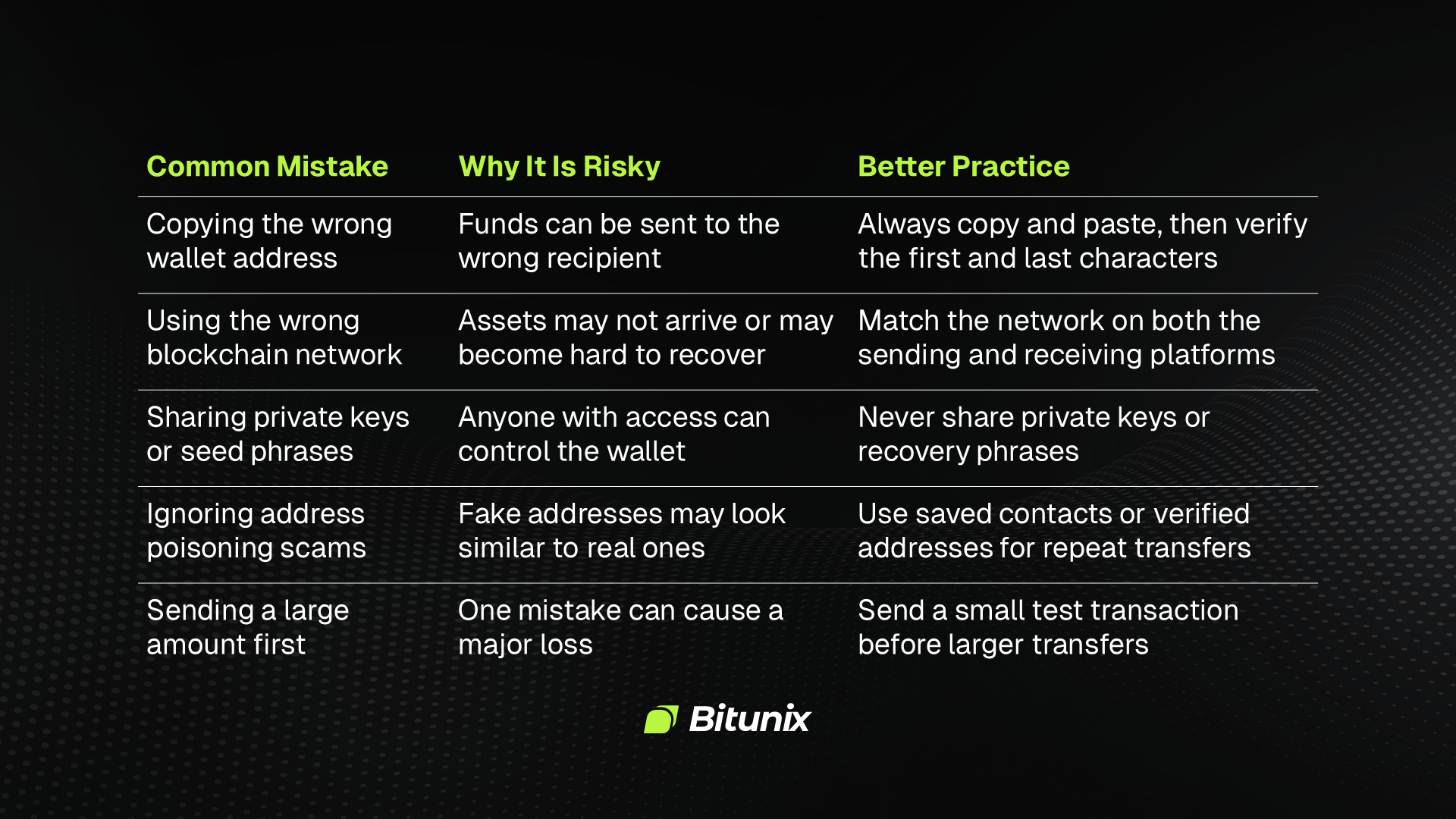
Common wallet address mistakes and simple checks that help reduce transfer risk.
Address poisoning shows why wallet address verification needs more than speed. Ledger's 2025 security guide explains the human side of this risk clearly: "And the truth is, even if the blockchain itself is secure, the biggest point of failure is often human error; like copying the wrong address or trusting what looks familiar without checking and verifying."
The blockchain can work correctly while the user still sends assets to the wrong destination. In crypto, correct execution matters as much as correct technology.
Security Tools
Security tools reduce wallet address risk by adding extra checks before a transfer is approved. Hardware wallets display the destination address on a trusted screen, address books help users save verified destinations, blockchain explorers let users review address activity, and scam-detection tools can flag addresses linked to suspicious behavior.
In 2025, wallet address-checking tools became more visible as scam activity increased. TechRadar reported that NordVPN introduced a crypto wallet address checker for Bitcoin and Ethereum addresses, designed to compare addresses against scam and phishing databases before users send funds.
Exchange security features also matter. Two-factor authentication, withdrawal safelists, anti-phishing codes, and confirmation emails can reduce unauthorized withdrawals.
Regular Maintenance
Regular maintenance means reviewing your wallets, saved addresses, exchange accounts, and security settings. Remove old addresses you no longer use, update wallet software, check device security, and confirm that your recovery details are stored safely offline.
A maintenance routine is especially useful when you manage assets across several networks, because multi-chain transfers can become confusing fast. Choosing the wrong network can turn a simple transfer into a support issue, and in some cases, the funds may be difficult or impossible to recover.
Chainalysis estimated in January 2026 that scams and fraud stole a record $17 billion in 2025, with impersonation and AI-enabled tactics becoming more prominent. That broader scam environment makes regular security reviews more important for anyone sending crypto.
Practical Applications and Use Cases
Wallet addresses appear in almost every normal crypto activity. Whether you deposit funds to an exchange, receive payment from another user, move assets between wallets, or interact with blockchain applications, the address tells the network where the assets should go.
Day-to-Day Usage
Your everyday wallet address use usually starts with receiving or sending crypto. To receive funds, you copy your address from the wallet or exchange, share it with the sender, and confirm that the asset and network match. To send funds, you paste the recipient address, choose the network, enter the amount, review the details, and approve the transfer.
A small test transaction is useful when the amount is large or the destination is new. It may incur an extra network fee, but it reduces the risk of sending the full balance to the wrong address.
Wallet Management
Wallet management connects addresses, assets, networks, and security controls. One wallet can hold multiple addresses across different blockchains, and one user may use several wallets for different purposes. A long-term storage wallet, a trading wallet, and a DeFi wallet should not all carry the same risk exposure.
Separating wallets by use case can improve crypto security. A user may keep long-term holdings in a hardware wallet, smaller active balances in a mobile wallet, and trading capital on an exchange, limiting how much one mistake can affect.
Recovery Procedures
A wallet address itself is public, so losing a copy of it is usually not the main problem. You can often find it again in your wallet app, your exchange account, or your previous transaction history. The bigger issue is losing access to the wallet that controls the address.
If you suspect that a destination address is malicious or compromised, do not send more funds to it. Check the address on a blockchain explorer, review transaction history, and contact the exchange or wallet provider if a platform is involved. If funds have already been sent, collect the transaction hash, addresses, date, asset, network, and amount.
Integration with Exchanges
Exchanges use wallet addresses for deposits and withdrawals. When you deposit to a platform, the exchange provides an address for the selected asset and network. When you withdraw, you provide the recipient address and choose the network.
For users, the main lesson is never to assume the platform will fix a wrong address or wrong network. Some mistakes can be recovered with support, but many blockchain transfers are final once confirmed.
Risks and Considerations
Wallet address risk comes from scams, user error, network confusion, malware, and weak account security. The address itself is public, but mistakes around addresses can still cause serious losses.
Address poisoning is one clear threat. Scammers send tiny transactions from lookalike addresses, hoping users will later copy the fake address from transaction history. Ledger's 2026 support article describes address poisoning as a scam where a fraudster sends a small amount of crypto or an NFT to create a poisoned transaction in the account history.
User mistakes often create more risk than the wallet address itself. People can paste the wrong address, choose the wrong network, skip test transfers, or trust screenshots from unverified sources. Clipboard malware can also replace a copied address with a scammer's address before the user pastes it, which makes final review essential before every transfer.
Regulatory rules governing wallet address transfers continue to evolve as crypto service providers face increasingly stringent compliance expectations. A wallet address alone is not the same as a legal identity, but regulated crypto service providers often need to collect and transmit originator and beneficiary information for certain transfers. ESMA's 2025 MiCA transfer services guidelines require crypto-asset service providers to maintain policies and procedures for transfer services, including compliance with the EU transfer-of-funds framework and the provision of information after execution.
International enforcement remains highly variable across jurisdictions, even as regulators increase pressure on crypto service providers. Reuters reported in June 2025 that FATF found only 40 of 138 assessed jurisdictions were largely compliant with its crypto standards as of April 2025, while illicit crypto wallet addresses may have received up to $51 billion in 2024, according to Chainalysis data cited in the report.
Future wallet address security will likely focus on clearer user interfaces, verified address books, wallet risk scoring, address labels, and safer multi-chain transfers. More wallets already warn users when a destination looks suspicious, when a network does not match, or when an address appears linked to scams.
Conclusion: Protecting Your Cryptocurrency Assets
Wallet address is a fundamental part of cryptocurrency security because every transfer depends on sending assets to the correct destination on the correct blockchain network. Understanding how addresses work helps you avoid common mistakes that can lead to lost funds. By using address books, test transactions, network checks, hardware wallets, two-factor authentication, and regular security reviews, you can reduce transaction risk.
Ready to secure your cryptocurrency? Download the Bitunix app and register to access wallet tools, deposit and withdrawal features, and account security options that help you manage crypto transfers more carefully.
FAQ Section
What exactly is a wallet address?
A wallet address is a public identifier on a blockchain used to receive cryptocurrency. It works like a transfer destination, but it does not give anyone control over the wallet. Control comes from the private key or recovery phrase, which must stay private.
Why is a wallet address important in cryptocurrency?
A wallet address is important because it tells the blockchain where funds should go. If you send crypto to the wrong address or network, the transfer may be irreversible.
How is the wallet address generated?
A wallet address is generated from the cryptographic keys it creates. The private key controls the assets, while the public address receives funds. Different blockchains use different address formats, so an address from one network may not work on another.
What are the risks associated with a wallet address?
The main risks include entering the wrong address, using the wrong network, falling for address-poisoning scams, or trusting a fake address from a compromised device. Public addresses are safe to share, but sending funds to the wrong one can cause permanent loss.
How should I securely store a wallet address?
You can store public wallet addresses in a trusted address book, a password manager, or an exchange's safelist. For repeat transfers, save verified addresses and label them by asset and network. Never store private keys or recovery phrases beside public addresses.
What should I do if the wallet address is compromised?
If an address appears linked to a scam, stop using it for transfers and review its activity on a blockchain explorer. If funds were sent, collect the transaction hash, addresses, asset, network, amount, and time, then contact the relevant platform or report the incident.
Can the wallet address be recovered if lost?
A public wallet address can usually be recovered from the wallet app, exchange account, or past transaction history. Losing the address is not usually the issue. Losing the private key or recovery phrase can remove access to the funds controlled by that wallet.
How does a wallet address relate to wallet security?
A wallet address is the public receiving point, while wallet security depends on protecting the private key, recovery phrase, device, and account access. Good wallet management means verifying addresses, using secure backups, enabling account protections, and avoiding suspicious links or fake apps.
Are there different types of wallet addresses?
Different blockchains use different wallet address formats. Bitcoin, Ethereum, Solana, and Tron addresses do not look the same and do not always support the same assets or networks. Some assets also exist on several chains, so users must match both asset and network.
Where can I learn more about wallet address security?
You can learn more from wallet provider security guides, blockchain documentation, exchange help centers, and law enforcement resources such as the FBI IC3 cryptocurrency guidance. Focus on address verification, network selection, private key protection, and common scams like address poisoning.
Glossary
- Wallet address: A public blockchain identifier used to receive cryptocurrency on a specific network.
- Blockchain: A distributed record of transactions maintained by a network of computers.
- Private key: A secret cryptographic key that controls access to funds in a wallet.
- Public key: A cryptographic key used to help generate receiving addresses and verify transactions.
- Recovery phrase: A set of words used to restore access to a crypto wallet.
- Transaction hash: A unique identifier that tracks a blockchain transaction.
- Network: The blockchain used for a transfer, such as Bitcoin, Ethereum, Tron, or Solana.
- On-chain transfer: A crypto transaction recorded directly on a blockchain.
- Exchange wallet: A wallet managed by a crypto exchange for user deposits and withdrawals.
- Self-custody wallet: A wallet where the user controls the private keys directly.
- Address poisoning: A scam using lookalike addresses to trick users into sending funds incorrectly.
- Test transaction: A small transfer sent before a larger transaction to confirm address and network accuracy.
- Blockchain explorer: A tool used to view addresses, transactions, balances, and network activity.
- Safelist: A saved list of approved withdrawal addresses used to reduce transfer risk.
- Crypto security: The practices and tools used to protect digital assets from loss, theft, and mistakes.
Disclaimer
This article does not provide:
(i) investment advice or investment recommendations;
(ii) an offer or solicitation to buy, sell, or hold digital assets;
(iii) financial, accounting, legal, or tax advice.
Digital assets, including stablecoins and NFTs, involve high risk and may fluctuate significantly. Consider whether trading or holding digital assets is appropriate for you given your financial situation. Consult a qualified legal, tax, or investment professional when needed. You are responsible for understanding and complying with applicable local laws and regulations.
About Bitunix
Bitunix is a global cryptocurrency derivatives exchange trusted by over 3 million users across more than 100 countries. At Bitunix, we are committed to providing a transparent, compliant, and secure trading environment for every user. Our platform features a fast registration process and a user-friendly verification system supported by mandatory KYC to ensure safety and compliance. With global standards of protection through Proof of Reserves (POR) and the Bitunix Care Fund, we prioritize user trust and fund security. The K-Line Ultra chart system delivers a seamless trading experience for both beginners and advanced traders, while leverage of up to 200x and deep liquidity make Bitunix one of the most dynamic platforms in the market.
Bitunix Global Accounts
X | Telegram Announcements | Telegram Global | CoinMarketCap | Instagram | Facebook | LinkedIn | Reddit | Medium