What is Stacks (STX)?
STX is the native governance and utility token of Stacks, the leading smart contract and programmability layer built directly on top of the Bitcoin blockchain. The creation of Stacks stemmed from a clear, long-standing bottleneck in Web3: while Bitcoin ($BTC) achieves absolute decentralization and cryptographic security, its core design intentionally limits complex smart contract capabilities. This ensures it operates perfectly as a global store of value rather than an application layer. Stacks introduces full programmability to Bitcoin without modifying its underlying code, allowing Bitcoin to be actively deployed in decentralized applications (dApps).
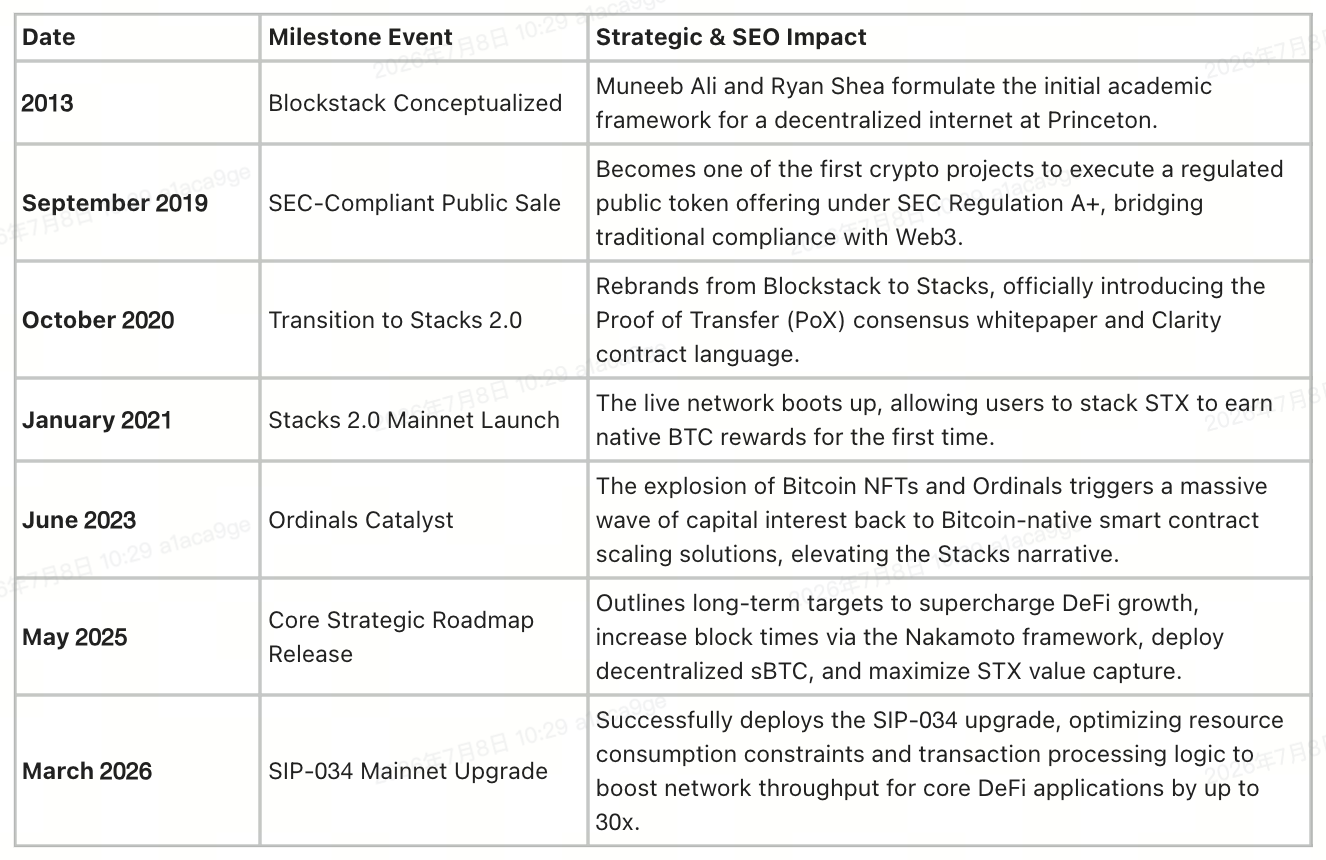
The founding team behind Stacks originated from Blockstack PBC, spearheaded by Muneeb Ali and Ryan Shea. While conducting distributed systems and networking research at Princeton University around 2013, the founders questioned whether a global internet could operate entirely independent of centralized corporate platforms. This original vision focused on decentralized identity (DID), encrypted data storage, and sovereign application infrastructure, which naturally gravitated toward the Bitcoin network, eventually evolving into the modern Stacks ecosystem.
By 2017, the team formally introduced the architectural blueprint of using Bitcoin as the ultimate settlement and security layer. Their guiding thesis was clear: Bitcoin had already won the race as the dominant digital asset layer, and the next massive Web3 frontier lay in expanding its functional utility without altering its time-tested core code. Consequently, Stacks was never positioned to compete directly with standalone Layer-1 blockchains like Ethereum; instead, it serves as a complementary, highly specialized application layer for Bitcoin.
Technical Architecture: How the Proof of Transfer (PoX) Consensus Works
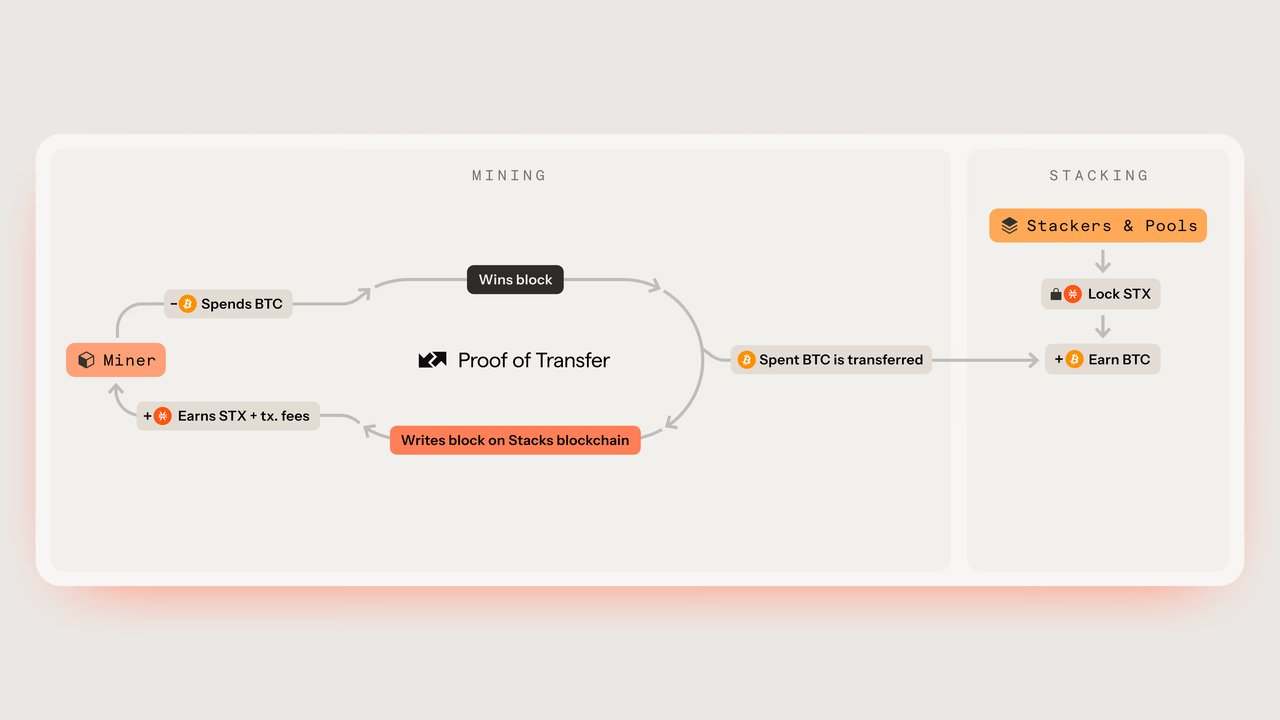
The defining innovation of Stacks is its Proof of Transfer (PoX) consensus mechanism—a system that directly binds the economic security of Stacks to the Bitcoin network.
Unlike traditional Proof of Work (PoW) or Proof of Stake (PoS) consensus models, PoX operates through an anchor-and-reward structure:
- Bitcoin Miners to Stacks Blocks: Instead of consuming electricity or computing power, Stacks miners transfer native BTC to buy computational chances. The protocol uses a verifiable random function to select the winning miner who gets to broadcast the latest Stacks block.
- STX Staking (Stacking) to BTC Rewards: In tandem, STX token holders can lock (or "Stack") their assets on-chain to validate network state transitions. In return for securing the extension layer, Stackers receive the native BTC forwarded by the miners as a programmatic yield.
This reciprocal architecture avoids the vulnerability of building an isolated security model from scratch. Instead, it natively inherits the economic finality and censorship resistance of Bitcoin. Rather than functioning as an unanchored sidechain, Stacks acts as a fully dependent execution environment anchored to Bitcoin’s settlement guarantees.
Stacks vs. Alternative Bitcoin Scaling Solutions
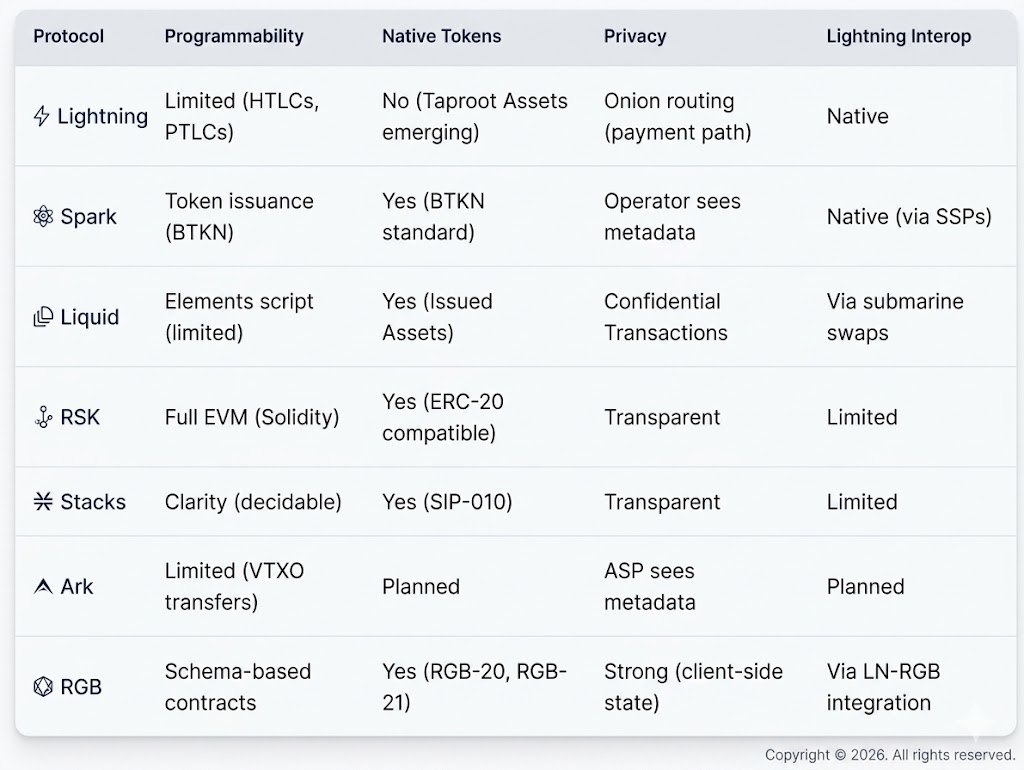
In the broader Bitcoin expansion narrative, competing platforms are not necessarily operating on the same technical track. Instead, they represent distinct philosophies regarding how Bitcoin should scale. Today, the Bitcoin ecosystem is divided into three primary categories: payment networks, rollups/computational environments, and economically coupled application layers.
1. Payment Channels (The Lightning Network)
The Lightning Network acts as a highly specialized state channel system designed to scale microtransactions. Its primary goal is to transform Bitcoin from a slow-settlement asset into a high-frequency daily currency. By executing transactions off-chain and only settling net balances to the Bitcoin mainnet, it slashes costs and increases speed but does not support expressive, multi-party smart contracts.
2. Verifiable Computing and Rollups (BitVM, Bitlayer, Merlin Chain)
Emerging alternatives like BitVM and new-generation Bitcoin Layer-2 networks (such as Bitlayer, Merlin Chain, and $$B^$$ Network) look to mimic Ethereum's rollup architecture. They process complex computations entirely off-chain and pass validation proofs back to Bitcoin. For instance, EVM-compatible systems like Bitlayer prioritize frictionless migration paths for Ethereum dApps onto Bitcoin-anchored networks.
3. Economically Coupled Layers (Stacks)
Stacks takes an independent path through economic coupling. It does not try to force complex execution computation directly into Bitcoin's restricted script language, nor does it rely entirely on external, unanchored validator sets. By running its execution environment on PoX, Bitcoin serves as both the entry cost for block production and the foundational asset for security rewards. While Stacks processes logic independently via its custom, non-custodial Clarity smart contract language, its structural finality is permanently anchored to the BTC mainnet.
How to Buy, Stake, and Earn STX Tokens
There are two primary paths to acquiring and deploying STX tokens: native on-chain participation or via top-tier centralized liquidity venues.
Through the native protocol architecture, users can accumulate STX and lock them inside active consensus cycles. By participating in "Stacking," users play a direct role in confirming network state changes, unlocking a unique passive income stream distributed directly in native Bitcoin ($$BT$$).
For retail investors and capital allocators looking to bypass the complexities of manual wallet configurations and network epochs, centralized cryptocurrency exchanges like Bitunix offer a streamlined alternative. These platforms enable users to acquire STX instantly using fiat currency corridors, standard credit cards, or high-liquidity stablecoin pairs like STX/USDT.
To buy STX safely through an exchange:
- Sign Up and Complete KYC: Register an account on a compliant trading platform and pass the Identity Verification (KYC) check to satisfy global Anti-Money Laundering (AML) and Counter-Terrorism Financing (CTF) rules.
- Fund Your Account: Transfer capital into your spot wallet via fiat banking rails, credit card integrations, or external cryptocurrency deposits.
- Execute Trade Order: Locate the STX spot market, choose your preferred trading pair, and complete your purchase.
Top-tier centralized trading platforms secure client capital through strict risk management parameters, including hot/cold wallet asset isolation, multi-signature authentication nodes, and 24/7 internal fraud monitoring. Once acquired, users can hold their tokens safely on-platform or withdraw them to specialized Solana or Bitcoin wallets to hook directly into live Stacks dApps.
Stacks (STX) Historical Development Timeline
Frequently Asked Questions
Is Stacks a sidechain or a Layer-2 network?
Stacks occupies a unique hybrid classification. While it operates its own ledger and executes contracts via the Clarity language, it is far more integrated than a standard sidechain. Because its block creation is powered by transferring real BTC and its blocks are cryptographically anchored to every Bitcoin block, it acts as an economic and security extension layer of Bitcoin.
What is the Clarity smart contract language?
Clarity is a predictable, decidable programming language developed specifically for Stacks. Unlike Solidity (used on Ethereum), Clarity is non-Turing complete and human-readable before execution. This intentional design eliminates entire classes of smart contract bugs, reentrancy exploits, and flash loan vulnerabilities common in the DeFi space.
How do you earn Bitcoin by holding STX?
By participating in the Stacks "Stacking" protocol, you lock up your STX tokens for a specified set of reward cycles. During these cycles, Stacks miners pay a BTC fee to compete for block production rights. This BTC is sent automatically by the protocol directly to the wallet addresses of active STX Stackers.
Disclaimer
This article is not intended to provide:
(i) investment advice or investment recommendations;
(ii) an offer or solicitation to buy, sell, or hold digital assets; or
(iii) financial, accounting, legal, or tax advice.
Digital assets (including stablecoins and NFTs) involve high risk and may be highly volatile. You should carefully consider whether trading or holding digital assets is suitable for you based on your financial situation. For your specific circumstances, consult your legal, tax, or investment professionals. You are responsible for understanding and complying with all applicable local laws and regulations.
About Bitunix
Bitunix is a global cryptocurrency derivatives exchange trusted by over 3 million users across more than 100 countries. At Bitunix, we are committed to providing a transparent, compliant, and secure trading environment for every user. Our platform features a fast registration process and a user-friendly verification system supported by mandatory KYC to ensure safety and compliance. With global standards of protection through Proof of Reserves (POR) and the Bitunix Care Fund, we prioritize user trust and fund security. The K-Line Ultra chart system delivers a seamless trading experience for both beginners and advanced traders, while leverage of up to 200x and deep liquidity make Bitunix one of the most dynamic platforms in the market.
Bitunix Global Accounts
X | Telegram Announcements | Telegram Global | CoinMarketCap | Instagram | Facebook | LinkedIn | Reddit | Medium