
1. Background of Ethereum Layer 2: The Urgent Need for Scaling
Ethereum, as the world’s largest smart contract platform, has long been known as the “world computer.” However, with the explosive growth of ecosystem applications, its mainnet, also known as Layer 1, has faced serious performance bottlenecks. Since the mainnet can only process around 15 transactions per second, or TPS, the network becomes extremely congested when a large number of users operate at the same time. This congestion has directly caused two major pain points. The first is high gas fees. During periods of active market activity, a simple token swap may require users to pay tens or even hundreds of dollars in transaction fees. The second is transaction delay. In order for transactions to be prioritized and included in a block, users are forced to bid higher fees. Otherwise, they may face a long waiting time.
In order to solve the scaling problem without sacrificing decentralization and security, the search for new solutions has become urgent. Layer 2 networks are a key solution proposed to address this challenge. Their core idea is to move heavy transaction processing, which was originally handled on the mainnet, to an external independent network. After the transactions are processed, the results are compressed and sent back to the mainnet for final confirmation.
This model can be understood through the relationship between a “main road and an elevated highway.” The mainnet is like a stable but congested core road, responsible for final settlement and security guarantees. Layer 2 networks are like elevated expressways built above it, responsible for carrying out high-frequency, low-latency execution tasks. Through this layered division of functions, the Ethereum ecosystem can greatly reduce the computational burden on the mainnet while allowing every transaction that occurs on Layer 2 networks to effectively inherit the security of the mainnet.
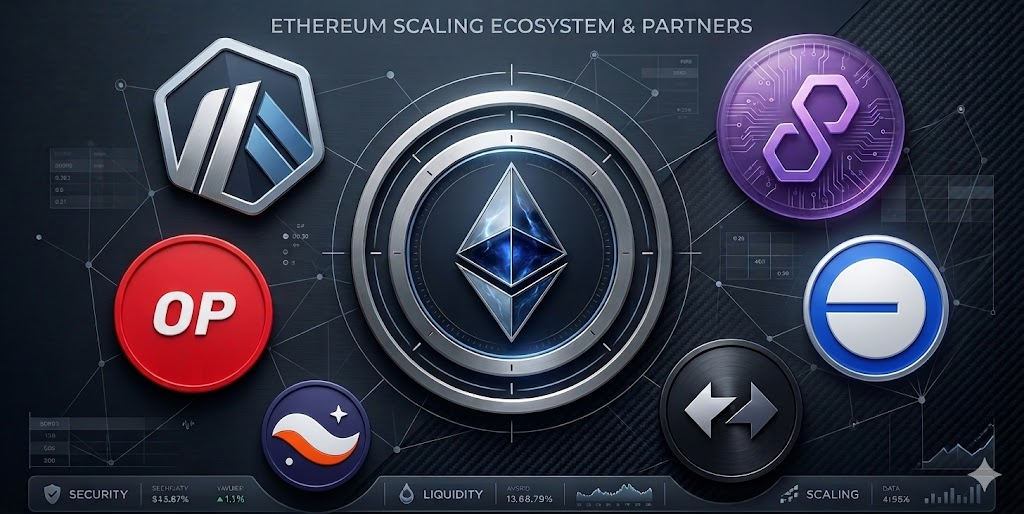
2. Comparison of Major Technical Solutions: OP Rollup and ZK Rollup
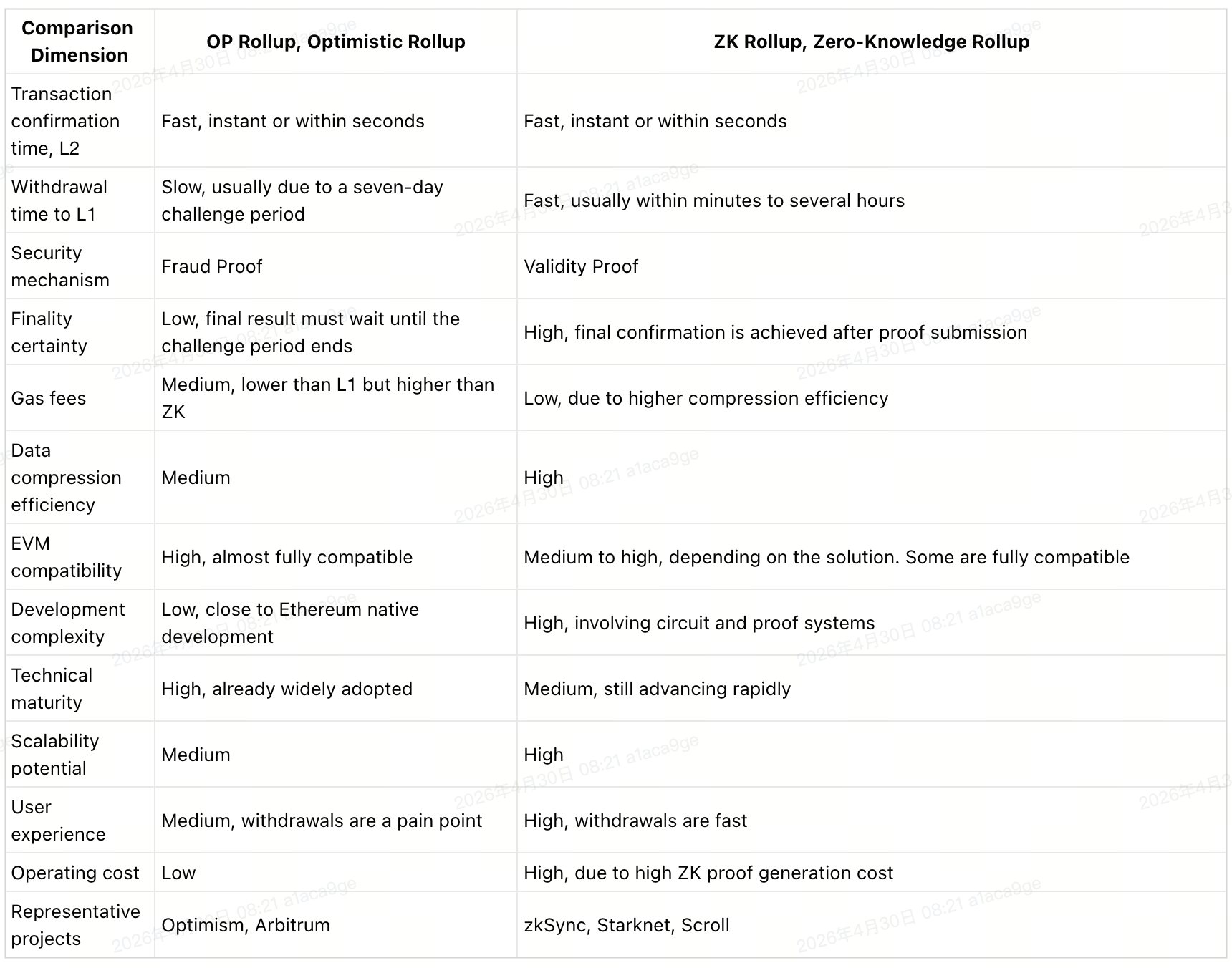
At present, the most mainstream technical architecture for Layer 2 is Rollup. The operating logic of Rollup is to “roll up” hundreds of transactions and package them into a single piece of data submitted to the Ethereum mainnet. Based on the different verification mechanisms used to ensure transaction validity, Rollups are mainly divided into two categories: OP Rollup and ZK Rollup.
OP Rollup, represented by Arbitrum, Optimism, and Base, adopts a “trust first, verify later” mechanism. It assumes that all transactions are valid by default, allowing for extremely fast processing. However, after the data is submitted, there is an approximately seven-day “challenge period.” If someone discovers fraudulent data, they can submit a fraud proof to overturn it. The biggest advantage of this solution is its high compatibility with the Ethereum Virtual Machine, or EVM, allowing developers to quickly migrate applications with almost no need to modify their code.
By comparison, ZK Rollup, represented by zkSync, Starknet, and Scroll, follows a more rigorous mathematical approach. It uses zero-knowledge proof technology and submits a validity proof together with the transaction data. The mainnet can immediately verify the validity of the transactions through mathematical logic without requiring a long challenge period. Although this solution is more difficult to develop, it has stronger advantages in terms of security. In addition, users can withdraw assets back to the mainnet almost instantly, which is why it is widely regarded within the industry as the ultimate solution for blockchain scaling.
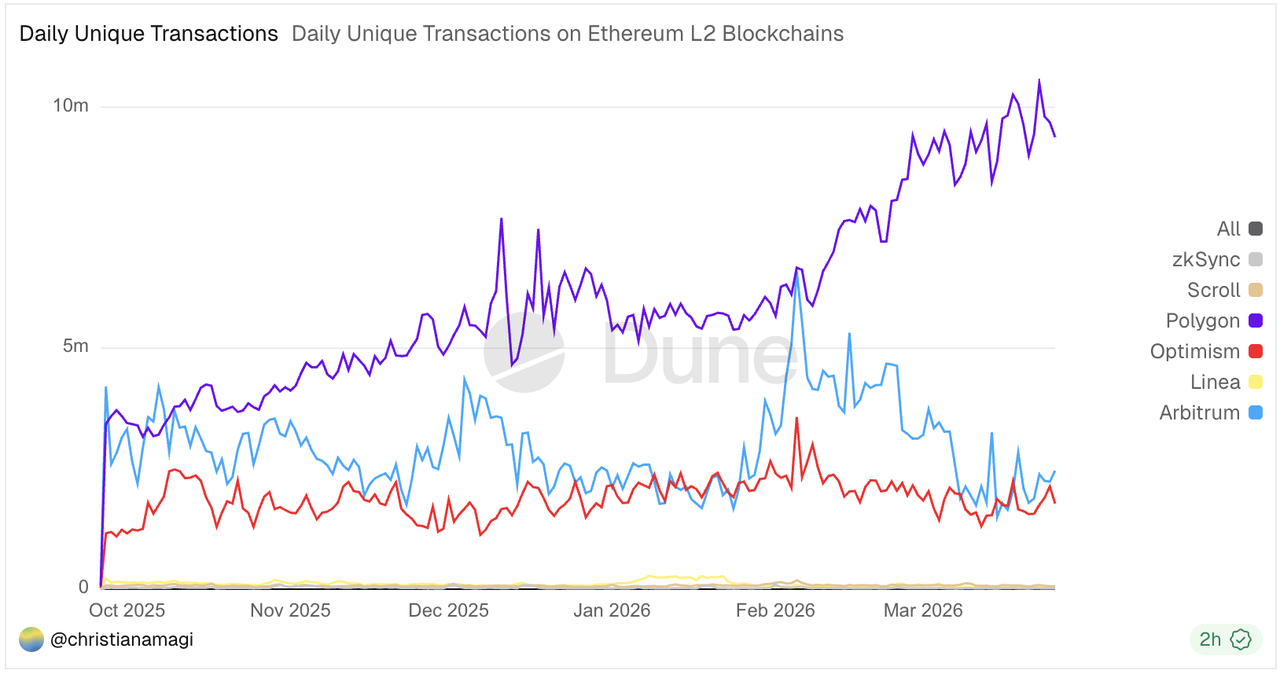
3. The Relationship Between the Mainnet and Layer 2: From “Auxiliary Role” to “Main Character”
At first, Layer 2 was regarded as an auxiliary tool for the Ethereum mainnet. However, as the technology matured, the relationship between the two has changed in a subtle way. The most direct evidence is the shift in transaction activity. Data shows that leading Layer 2 networks such as Arbitrum and Base have already far exceeded the Ethereum mainnet in total daily transaction volume. This means that ordinary users’ daily activities, such as token trading, lending, and NFT minting, have migrated to Layer 2 networks on a large scale. The Ethereum mainnet is gradually transforming into an “infrastructure layer” for settlement and security guarantees between Layer 2 networks, rather than remaining the preferred direct entry point for user interaction.
This structural shift has also triggered discussions about “rent” and value. After the Dencun Upgrade introduced Blob data space, the data availability fees paid by Layer 2 networks to the mainnet, often referred to as “rent,” dropped significantly. While this has reduced Layer 2 transaction fees to an almost negligible level, it has also raised market concerns about reduced mainnet gas consumption and slower ETH burn rates. In other words, while Layer 2 networks enjoy the strong security of the mainnet, they only need to pay extremely low costs. This has transformed Ethereum’s ecosystem structure from a single high-performance network into a layered architecture, with the mainnet serving as the core security foundation and Layer 2 networks serving as low-cost execution environments.
Although Layer 2 networks have independent operating mechanisms, transaction fees, or gas fees, are still paid in ETH on most mainstream Layer 2 networks today. This design ensures a high level of alignment between Layer 2 networks and the Ethereum mainnet in terms of value system, while also maintaining ETH’s position as the core asset of the ecosystem. When users operate on Arbitrum, Optimism, or Base, they still experience the familiar Ethereum interaction logic, except that transaction costs are greatly reduced to the cent level. By comparison, the native tokens issued by each Layer 2 network, such as ARB, OP, and MNT, are currently positioned mostly as “governance tokens” rather than gas tokens. This means that holders’ main rights lie in participating in governance decisions, such as network upgrade proposals, DAO treasury budget allocation, or node elections, rather than directly using these tokens to pay transfer fees.
This division of assets allows each Layer 2 network to flexibly guide the development direction of its own ecosystem while sharing Ethereum’s security. For example, Arbitrum has attracted deep liquidity in DeFi derivatives through governance incentives, while Base has developed social and consumer applications through its unique user access channels. The governance function of native tokens and the settlement role of ETH do not conflict with each other. Together, they support Layer 2 networks as the frontline where blockchain applications are truly implemented and tested at scale.
4. Modular Blockchain: RaaS Brings Layer 2 into the Era of Rapid Production
The evolution of Ethereum Layer 2 networks is leading blockchain into the era of “modularity.” This marks the shift of blockchain architecture from an all-in-one model toward specialized division of labor. In the traditional monolithic blockchain structure, one chain must simultaneously handle four tasks: execution, meaning transaction processing; settlement, meaning dispute resolution; consensus, meaning ensuring node agreement; and data availability, or DA. This inevitably results in performance bottlenecks.
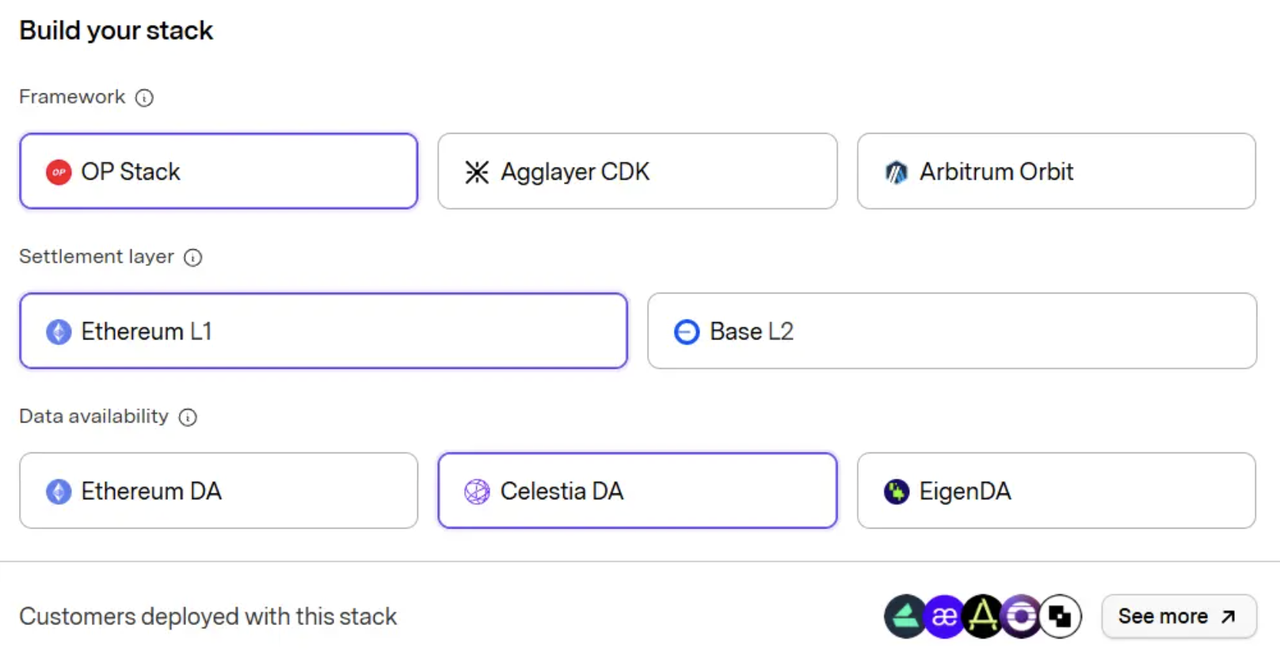
Under the modular approach, these functions are subdivided and separated. Layer 2 networks mainly serve as the “execution layer,” responsible for processing computational tasks at high speed and low cost. The Ethereum mainnet moves into the background, serving as the core “settlement layer” and “consensus layer” to guarantee security. The most important technological change lies in the flexible selection of the “data availability layer.” Through independent DA solutions such as Celestia and EigenDA, Layer 2 networks can store data in a more cost-effective way, thoroughly solving the long-standing problem of high data storage costs in previous scaling solutions.
The maturity of this functional modularity has directly given rise to Rollup as a Service, or RaaS, platforms, bringing the construction of Layer 2 networks into an era of “industrialized production.” Developers today no longer need to write everything from the underlying code. Instead, they can configure a blockchain in a similar way to configuring a server. Through RaaS platforms, they can flexibly choose mature technology stacks such as OP Stack, ZK Stack, Polygon CDK, or Arbitrum Orbit, and connect different DA solutions according to business needs. This “one-click chain deployment” model greatly lowers the technical barrier to entering the Web3 ecosystem.
5. Future Development of Layer 2 Networks
Looking ahead, the evolution of Layer 2 networks is no longer simply a race for higher speed. Instead, it is becoming deeply integrated with Ethereum’s three core strategies: scaling, user experience, and hardness. This means that future Layer 2 networks will continue to expand rapidly while preserving the protocol-level foundations of censorship resistance, privacy, and permissionlessness. By strengthening network resilience and security protection, Layer 2 networks are evolving from simple scaling tools into global, neutral infrastructure for value exchange.
Disclaimer
This article is not intended to provide:
(i) investment advice or investment recommendations;
(ii) an offer or solicitation to buy, sell, or hold digital assets;
(iii) financial, accounting, legal, or tax advice.
Digital assets held, including stablecoins and NFTs, involve a high level of risk and may fluctuate significantly in value. You should carefully consider whether trading or holding digital assets is suitable for you based on your financial situation. For your specific circumstances, please consult your legal, tax, investment, or other professional adviser. You are responsible for understanding and complying with all applicable local laws and regulations.
About Bitunix
Bitunix is a global cryptocurrency derivatives exchange trusted by over 5 million users across more than 100 countries. The platform is committed to providing a transparent, compliant, and secure trading environment for every user. Bitunix offers a fast registration process and a user-friendly verification system supported by mandatory KYC to ensure safety and compliance. With global standards of protection through Proof of Reserves (POR) and the Bitunix Care Fund, Bitunix prioritizes user trust and fund security. The K-Line Ultra chart system delivers a seamless trading experience for both beginners and advanced traders, while leverage of up to 200x and deep liquidity make Bitunix one of the most dynamic platforms in the market.
Bitunix Global Accounts
X | Telegram Announcements | Telegram Global | CoinMarketCap | Instagram | Facebook | LinkedIn | Reddit | Medium