
1. Introduction to XRP
XRP is a cryptocurrency designed to improve the speed and efficiency of global cross-border payments. It was introduced in 2012 together with the founding of Ripple, with the goal of solving the high costs, slow settlement times, and inefficiencies of traditional financial systems.
Ripple founders Chris Larsen, Jed McCaleb, and Arthur Britto envisioned a “value network” where money could move across the internet as easily as information. Unlike Bitcoin, XRP was not created through mining. Its total supply of 100 billion XRP was issued at the network’s launch. This one-time issuance allows XRP to process transactions quickly and at extremely low cost without relying on energy-intensive mining.
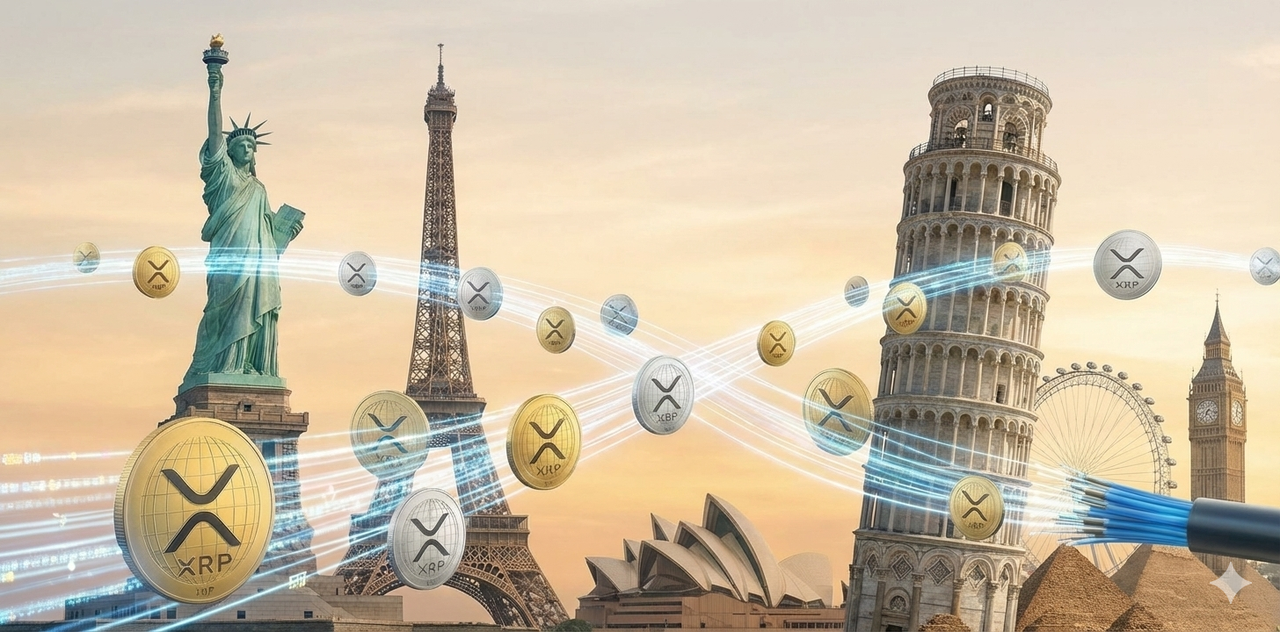
Because of this design, XRP is commonly used as a bridge asset between different fiat currencies. It helps reduce settlement time and lowers liquidity requirements in international transfers. XRP is therefore positioned as a connection between traditional financial infrastructure and blockchain-based payment systems.
2. How XRP works
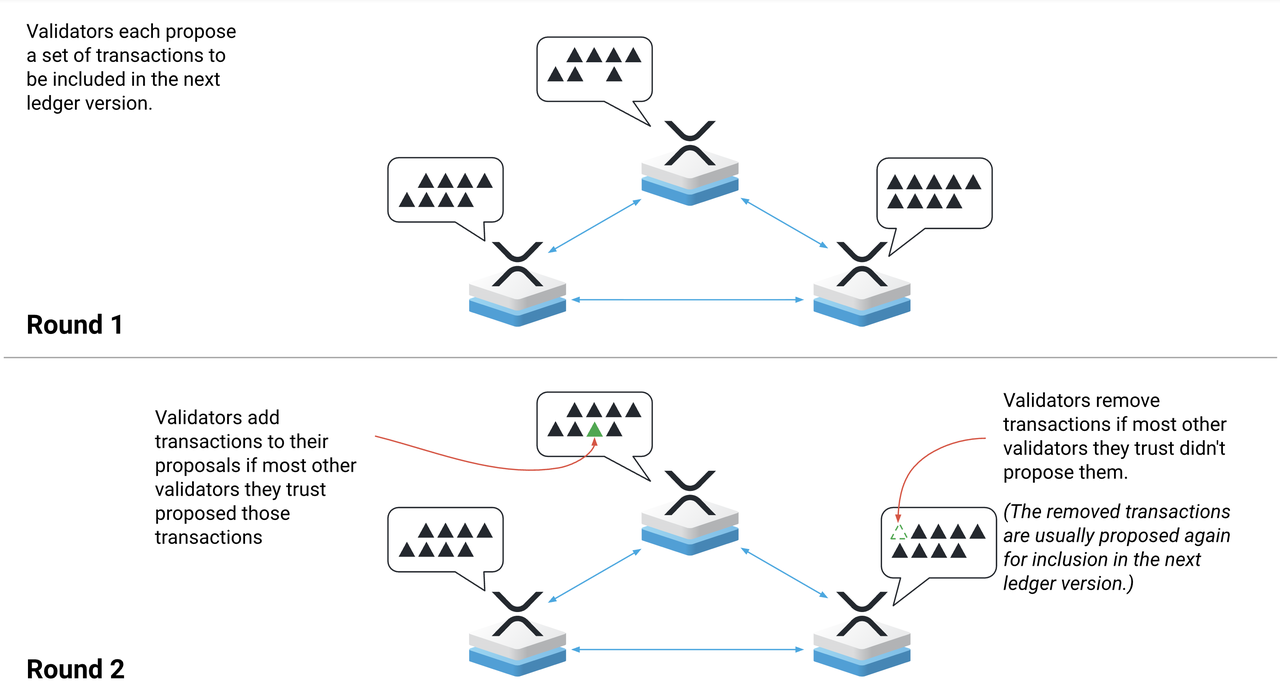
XRP operates on the XRP Ledger (XRPL), a distributed ledger that does not use Proof of Work or Proof of Stake. Instead, it uses the Ripple Protocol Consensus Algorithm (RPCA).
Under RPCA, independent validators across the world vote on the validity of transactions. When a strong majority agrees, the ledger is updated. Because XRP does not rely on mining, transactions usually confirm within 3 to 5 seconds, can process over 1,500 transactions per second, and have extremely low fees.
XRP Supply and Fees
XRP uses an escrow-based release system rather than a halving model. Ripple locked a large portion of its XRP holdings into cryptographic escrow accounts. Each month, 1 billion XRP is released for ecosystem development and liquidity. Any unused XRP is re-locked, making supply changes predictable and transparent.
XRP is also naturally deflationary. A very small amount of XRP is burned as a transaction fee for every transaction, gradually reducing the total supply over time.
Unlike Ethereum, validators on the XRP Ledger do not receive block rewards or transaction fee income. XRPL has no reward mechanism for validators, and all transaction fees are permanently destroyed. Most major validators are operated by Ripple, banks, payment institutions, and liquidity providers. Their incentive is faster, cheaper, and more reliable cross-border settlement, not token rewards.
3. XRP Compared With Other Blockchains
XRP is fundamentally different from Bitcoin, Ethereum, and Solana because it is not designed as a general smart contract platform.
The XRP Ledger’s core software, rippled, handles ledger maintenance, transaction validation, and consensus. Instead of using a Turing-complete smart contract environment like Ethereum’s EVM, XRP integrates key financial functions directly into the protocol, including:
- Payments
- On-ledger order books
- Escrow
- Multi-signature accounts
- This design reduces system complexity and avoids risks related to smart contract execution. While XRP sacrifices some programmability, it gains faster confirmation, lower transaction costs, and more predictable network behavior. As a result, XRP is optimized for payments and settlements rather than decentralized application development.
4. How Investors Can Obtain XRP
XRP cannot be mined, staked, or earned through airdrops. Its entire supply was created at network launch, and no new XRP is issued through user participation.
For most individual investors, the practical way to obtain XRP is through a centralized cryptocurrency exchange. These platforms allow users to buy XRP using fiat currencies or stablecoins such as USDT. Some exchanges also support credit card purchases, making access easier for new users.
Before trading, users must complete identity verification (KYC) to comply with global anti-money laundering regulations. Reputable exchanges use security systems such as cold and hot wallet separation, multi-signature protection, and real-time monitoring to safeguard user assets.
5. Ripple’s Strategic Focus
Unlike many public blockchains that focus on building large decentralized application ecosystems, Ripple concentrates on global cross-border payments and institutional settlement.
Through RippleNet and its On-Demand Liquidity (ODL) solution, Ripple uses XRP as a bridge asset to enable near-instant international transfers. This removes the need for financial institutions to pre-fund foreign accounts, reducing idle capital and improving liquidity efficiency.
Ripple has partnered with major financial institutions such as:
- Standard Chartered
- Santander
- SBI Group
- In these partnerships, XRP enables international fiat conversions to complete within seconds instead of days.
- Ripple has also expanded collaborations with payment companies, fintech firms, and stablecoin platforms worldwide. Partnerships with financial infrastructure providers allow businesses to access multi-currency payment rails, virtual IBAN accounts, and compliant global fund management tools. Some banks have adopted Ripple Payments to connect blockchain settlement with traditional banking systems, strengthening XRP’s role in real-world financial operations.
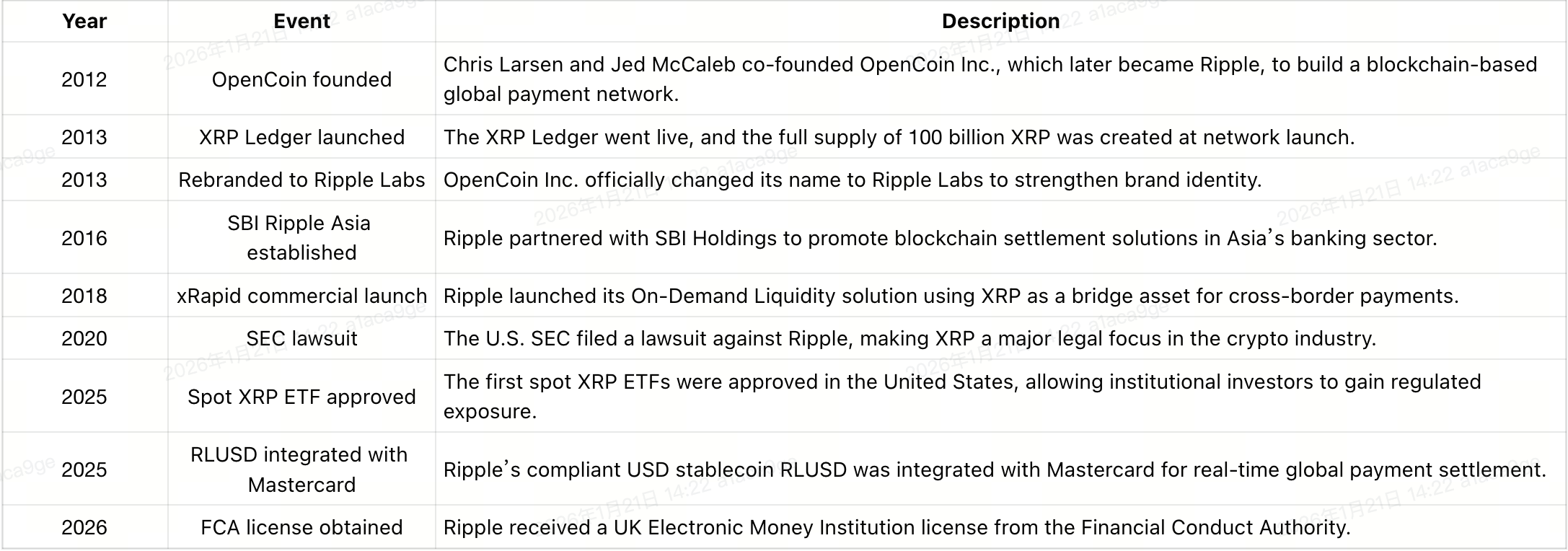
6. Major XRP Timeline
Glossary
- XRP: The digital asset used for fast and low-cost value transfers on the XRP Ledger.
- Ripple: The company building payment and settlement solutions using XRP and XRPL.
- XRP Ledger (XRPL): The distributed ledger that records and validates XRP transactions.
- RPCA: Ripple’s consensus algorithm used to confirm transactions.
- Validator: A node that participates in transaction validation on XRPL.
- Escrow: A system that locks XRP and releases it on a fixed schedule.
- Burn: The permanent destruction of XRP through transaction fees.
- Bridge Asset: An asset used to convert between two fiat currencies efficiently.
- RippleNet: Ripple’s global network for institutional payment processing.
- On-Demand Liquidity (ODL): Ripple’s system that uses XRP to eliminate pre-funding in cross-border transfers.
- KYC: Identity verification required by regulated exchanges.
- AML: Anti-money laundering compliance standards.
Disclaimer
This article is not intended to provide: (i) investment advice or investment recommendations; (ii) an offer or solicitation to buy, sell, or hold digital assets; or (iii) financial, accounting, legal, or tax advice. Digital assets (including stablecoins and NFTs) involve high risk and may be highly volatile. You should carefully consider whether trading or holding digital assets is suitable for you based on your financial situation. For your specific circumstances, consult your legal, tax, or investment professionals. You are responsible for understanding and complying with all applicable local laws and regulations.
About Bitunix
Bitunix is a global cryptocurrency derivatives exchange trusted by over 3 million users across more than 100 countries. At Bitunix, we are committed to providing a transparent, compliant, and secure trading environment for every user. Our platform features a fast registration process and a user-friendly verification system supported by mandatory KYC to ensure safety and compliance. With global standards of protection through Proof of Reserves (POR) and the Bitunix Care Fund, we prioritize user trust and fund security. The K-Line Ultra chart system delivers a seamless trading experience for both beginners and advanced traders, while leverage of up to 200x and deep liquidity make Bitunix one of the most dynamic platforms in the market.
Bitunix Global Accounts
X | Telegram Announcements | Telegram Global | CoinMarketCap | Instagram | Facebook | LinkedIn | Reddit | Medium