
Article Summary
- This article provides a comprehensive explanation of delta in the context of cryptocurrency trading.
- It breaks down the technical and conceptual aspects of delta and how it influences market dynamics.
- The guide explores practical applications for traders and how to use delta to identify trading opportunities.
- It highlights common pitfalls and how to avoid them when trading based on delta.
- The article concludes with actionable advice for incorporating delta into your trading strategy.
- Advanced traders understand that cryptocurrency markets are driven by complex dynamics that go beyond simple price movements. One of these dynamics is delta. But what exactly is it, and how can traders use it to their advantage?
- Delta measures how much an option's price changes when the underlying asset moves. In crypto, that underlying asset is usually BTC, ETH, SOL, or another digital asset with an options market. A call option usually has a positive delta, meaning it gains value as the asset rises. A put option usually has a negative delta because it gains value when the asset falls.
- For traders using a crypto exchange like Bitunix, this concept connects directly to risk, exposure, and timing. Bitunix offers spot and futures markets, allowing traders to compare directional exposure across products before building a trading strategy.
This guide explains delta, how it works, how to measure it, and how to use it with market analysis, technical analysis, and risk controls.
Understanding Delta
Delta is one of the option Greeks, a set of measurements that help traders understand how an option reacts to different market inputs. Delta measures price movement and indicates how sensitive an option is to a change in the underlying asset.
A useful answer to what delta in options trading starts with sensitivity. If a BTC call option has a delta of 0.50, it should gain about $0.50 for every $1 increase in its price, assuming other factors remain constant. If a BTC put option has a delta of -0.40, the option should gain value when BTC falls and lose value when BTC rises.
For crypto traders, delta helps answer four practical questions:
- How much directional exposure does this option position carry?
- How much will the position react if BTC or ETH moves now?
- Does the trade behave more like spot, more like insurance, or more like a leveraged bet?
- How should the trader hedge, size, or exit the position?
- Delta changes with the option's price, time to expiration, and volatility. At-the-money options often sit near 0.50 Delta for calls and -0.50 for puts, while deep in-the-money options tend to move more like the underlying asset. Far out-of-the-money options usually have lower delta because small price moves have less impact on their value.
- CME gives a simple example from traditional options markets: "The 50-delta call and put will increase, or decrease, respectively, in value by 0.50 index points. Given the dense strike listing range."
- In crypto options, the same logic applies when traders compare how strongly different contracts react to BTC price changes. A BTC option with higher delta responds more sharply when the BTC price moves, while an option with lower delta usually needs a larger price move before its value changes in a meaningful way.
- Options dealers and market makers also use delta to manage their own risk, which can affect short-term market behavior. They often hedge by buying or selling the underlying asset or related futures, especially when many contracts cluster around the same strike.
- Delta helps explain why some price zones attract heavier trading and stronger reactions.
- The scale of today's crypto derivatives market makes delta more relevant for short-term price analysis. CME's crypto futures and options suite handled nearly $3 trillion in notional volume in 2025, while average daily volume more than doubled to 280,000 contracts, and average daily open interest rose to 313,000 contracts. That level of activity gives options greater influence in the crypto market structure.
- A clear example came during the Bitcoin sell-off between October 6, 2025, and February 6, 2026. CME noted that Bitcoin corrected about 50%, while 25-delta implied volatility for puts reached 95% on February 5, 2026, the highest level since 2022. That showed traders paying heavily for downside protection during stress.
Reading Delta Through Data and Charts
Delta does not appear on a basic candlestick chart by default. You need options data, derivatives dashboards, or an exchange interface that shows Greeks. Still, you can combine delta readings with chart behavior to build a stronger view.
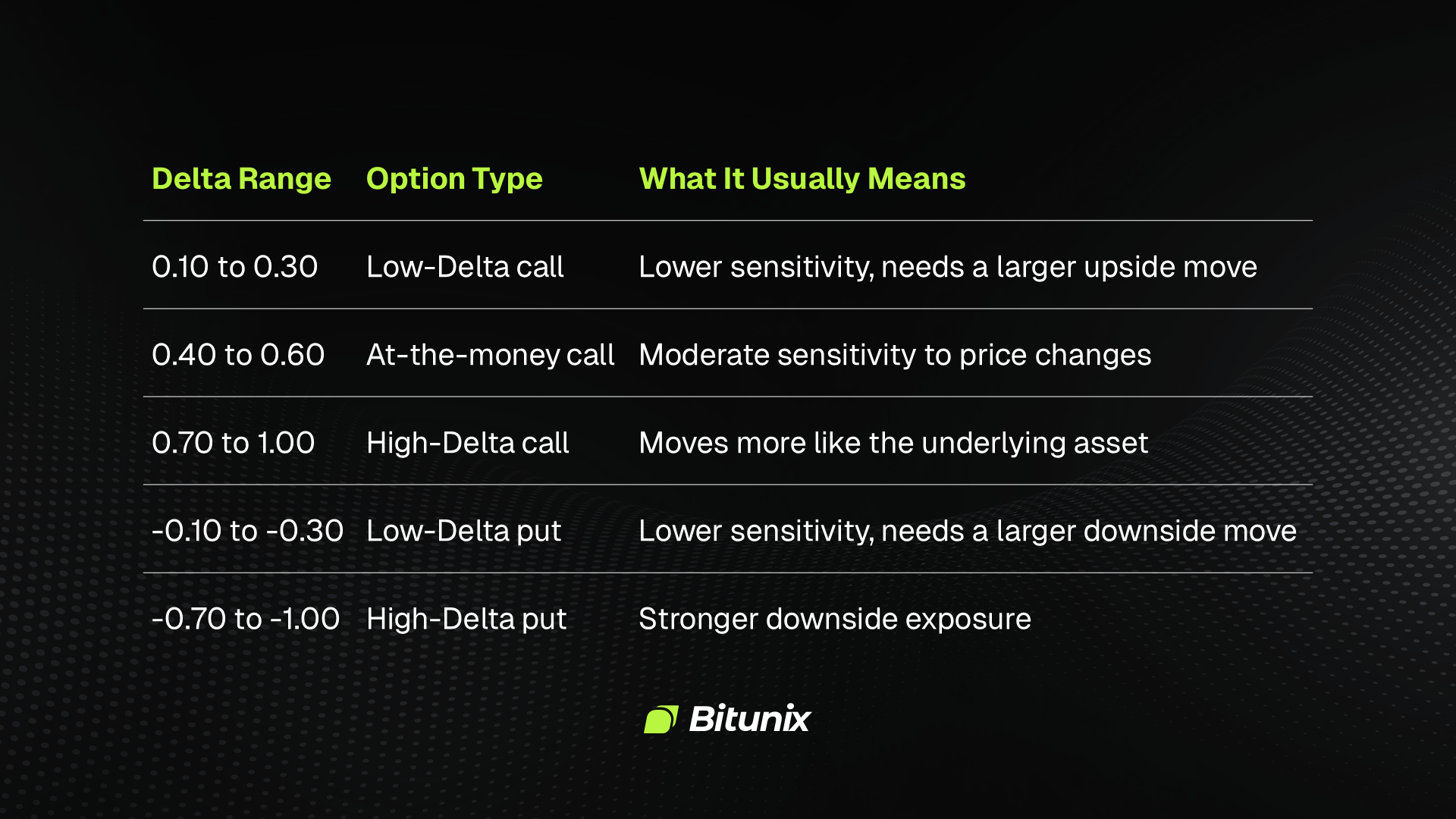
Delta range table showing how different call and put options react to price changes in the underlying asset.
Finding Delta in the Market
The most direct way to measure delta is through an options chain that lists available strikes, expiries, premiums, implied volatility, open interest, and Greeks. Look for the Delta column, then compare strikes around the current spot price.
A BTC call with 0.20 delta sits further out of the money than a 0.60 delta call. The 0.20 option needs a larger move to become highly reactive, while the 0.60 option already behaves closer to BTC spot exposure.
You can also track portfolio delta, which shows the net directional exposure across all options in the account. A portfolio with positive delta benefits from upside moves, while a portfolio with negative delta benefits from downside moves. A near-zero delta portfolio is closer to neutral, although Gamma and volatility risk still matter.
Metrics That Add Context
Delta becomes more useful when traders read it alongside other options metrics. Open interest shows where contracts remain active, implied volatility reflects expected price movement, volume captures current trading activity, and skew shows whether traders are paying more for calls or puts. Among these metrics, open interest is especially useful because it helps show where participation and liquidity are concentrated.
In crypto options, traders often watch 25-delta risk reversals to compare implied volatility between 25-delta calls and 25-delta puts. When the reading is negative, puts are more expensive than calls, which usually points to stronger demand for downside protection. In February 2026, Bitcoin's 25-delta risk reversal fell to -19.34, its lowest level since 2022, showing that traders strongly favored puts during that period.
Choosing the Right Timeframe
Delta behaves differently depending on the option's timeframe. Short-dated options react faster because there is less time left before expiration, so even a small move near the strike price can change delta quickly. Longer-dated options usually move more gradually because traders have more time for the expected price move to develop.
Cboe's 2025 options industry review showed how popular short-term options became in traditional markets, with 0DTE SPX options averaging 2.3 million contracts daily and making up 59% of that product’s volume. Crypto options have a different market structure, but the timing risk is that the shorter the expiry, the less room traders have to be wrong.
Confirming the Signal
Delta should be confirmed with other market signals before you act on it. A rising call delta near resistance only shows that the option is becoming more sensitive to upside price movement, so traders still need confirmation from spot price action, volume, open interest, implied volatility, and funding rates.
A stronger setup appears when several signals point in the same direction. For example, a BTC call option with a high delta near a breakout level becomes more valuable when spot volume rises, open interest builds around nearby strikes, and the broader market supports the move.
Practical Trading Strategies
Delta becomes useful when it helps you make decisions before the market forces your hand, using it for entries, exits, risk management, and sizing.
1. Entry Strategies
When traders use delta for entries, the goal is to match the option contract to the market's strength and timing. A higher-Delta option gives more direct exposure to the underlying asset, so it can work better when you expect a strong directional move. A lower-Delta option costs less in many cases, but it usually needs a larger price move before the trade starts to respond meaningfully.
For bullish setups, traders can compare call options across different strikes to find the right balance between cost, sensitivity, and probability. A 0.60 delta call gives stronger exposure to an upward move, but it also comes with a higher premium. A 0.25 delta call is cheaper, though it carries more risk because the market needs to move further before the option becomes highly responsive.
Bearish setups follow the same logic with put options. A -0.60 delta put reacts more strongly when the underlying asset falls, while a -0.20 delta put offers cheaper downside exposure but needs a larger move to become effective. The right choice depends on your conviction, timeframe, and risk limit.
Before entering a trade, the delta should always be checked against the chart. A delta-based entry is stronger when the price is near a clear level, such as support, resistance, a breakout area, or a failed retest.
2. Exit Strategies
Delta can also help you decide when to close or reduce a trade. If your option's delta rises sharply after a favorable move, the position becomes more exposed to reversals, so taking partial profits can protect gains.
If delta collapses, the market is telling you the option has lost directional power. This often happens when the price moves away from the strike, implied volatility falls, or time decay speeds up near expiry.
A practical exit plan can include three rules:
- Take profit when the delta reaches the target sensitivity
- Reduce exposure if the spot chart rejects the expected direction
- Exit when time decay starts working harder than price movement
3. Risk Management
Delta helps traders turn options exposure into a clearer risk number. If your portfolio has a net delta of 1.0 BTC, it behaves roughly like one BTC of directional exposure. That means a $1,000 drop in BTC would create about $1,000 in delta-related losses before Gamma, Vega, Theta, and liquidity are considered.
This estimate is not perfect, but it gives traders a useful starting point for managing exposure. Gamma can change delta quickly, Vega can affect pricing when implied volatility shifts, Theta can reduce the option's value as time passes, and poor liquidity can make exits more expensive. Even with those limits, tracking delta helps traders avoid taking on more directional risk than they intended.
Crypto derivatives are large and fast-moving, so loose risk control can become expensive quickly. CoinGlass estimated that crypto derivatives trading volume reached about $85.70 trillion in 2025, with average daily turnover near $264.5 billion. In a market that active, delta should be part of every risk check, especially before adding leverage, holding through major events, or trading near expiration.
4. Position Sizing
Position sizing should reflect delta exposure, since a cheap option can still create meaningful risk when it is short-dated, highly volatile, or placed in a crowded part of the market. A more expensive option can sometimes offer cleaner exposure if it has better liquidity, a more realistic strike, and a delta that matches your trading plan.
One practical method is to size each position based on the maximum loss you are willing to accept. Before entering the trade, decide how much of your account you can risk, then check whether the option premium, delta exposure, and exit plan fit that limit.
Delta-adjusted exposure gives traders another way to keep sizing under control. For example, if your options position creates 0.50 BTC of net delta, you can treat it as roughly half a BTC of directional exposure. This keeps the trade aligned with actual market movement rather than the premium alone.
Where Delta Falls Short
Delta gives traders useful information, but it should not be treated as a guaranteed signal. It changes as price, time, volatility, and liquidity change, so a position that looks balanced at entry can become much more aggressive after a sharp move. This is especially true near expiration, when Gamma can push delta higher or lower very quickly.
The broader market context also affects how reliable delta readings are. In calm markets, delta changes often look more orderly, but liquidation events, macro news, ETF-driven moves, and liquidity gaps can make options pricing move fast. During periods of stress, such as the early 2026 Bitcoin drawdown, rising put demand and higher implied volatility made delta useful for reading downside pressure, but harder to trade without strict risk limits.
False signals are one of the main risks traders need to watch when using the delta. A rise in the call delta can signal stronger bullish positioning, but it can also result from short-term hedging, thin liquidity, or a sudden volatility adjustment. A negative risk reversal can signal fear, though it can also reflect portfolio protection instead of outright bearish conviction.
The most useful delta readings usually come from combining them with other tools. Support and resistance, trend structure, volume, implied volatility, open interest, funding rates, and fundamental news can all help confirm or challenge the signal.
Conclusion: Mastering Delta for Trading Success
Delta is an important concept that advanced traders use to identify trading opportunities. It helps you understand how much an option reacts to price movement, how much directional exposure your position carries, and when a trade becomes too sensitive for your risk plan.
When you understand what is delta in options trading, you stop treating options as simple up-or-down bets. You start reading them with adjustable exposure, which improves your market analysis and helps you build a more controlled trading strategy. By using delta with technical analysis, open interest, implied volatility, and clear position sizing, you can improve your trading accuracy and risk management.
Ready to apply delta to your trading strategy? Download the Bitunix app and register to access crypto trading tools, spot and futures markets, real-time data, and mobile charting features.
FAQ Section
What exactly is delta?
Delta measures how much an option's price changes when the underlying asset moves. A call option usually has positive delta, while a put option usually has negative delta. It helps traders estimate directional exposure and understand how reactive an options position is.
How does delta affect cryptocurrency prices?
Delta affects crypto prices indirectly when market makers hedge their options exposure by buying or selling spot or futures contracts. Heavy open interest around certain strikes can add short-term pressure, especially near expiry, because hedging activity tends to cluster around those levels. Still, delta does not control price on its own; it only helps explain why some areas elicit stronger market reactions.
How can I identify delta in the market?
You can identify delta using an options chain, a derivatives analytics platform, or a trading interface that shows Greeks. Look at the delta by strike and expiry, then compare it with open interest, implied volatility, spot price levels, and current volume before making any trade decision.
Is delta a reliable trading signal?
Delta is useful, but it is not reliable as a standalone signal, since it measures sensitivity. You should confirm delta with price structure, volume, volatility, open interest, and broader market context before using it to enter or exit a trade.
How should I use delta in my trading strategy?
Use delta to match your option choice with your market view. Higher-Delta options suit stronger directional trades, while lower-delta options cost less but need larger moves. Combine delta with chart levels, expiry timing, risk limits, and a clear exit plan.
What are the risks of trading based on delta?
The main risks include fast delta changes, time decay, volatility shifts, poor liquidity, and false confirmation. Near expiry, small price moves can change exposure quickly. Traders also lose money when they size positions based only on premium cost and ignore total delta exposure.
Can delta be predicted in advance?
You can estimate how delta changes using options models, but you cannot predict it with certainty. Price movement, implied volatility, time to expiry, and liquidity all affect delta.
How does delta differ across different cryptocurrencies?
Delta behaves differently across cryptocurrencies because liquidity, volatility, and options market depth vary. BTC and ETH usually have deeper options markets than smaller assets. Lower-liquidity coins can show wider spreads, faster repricing, and less stable delta readings during sharp moves.
Should I combine delta with other indicators?
Yes, delta works best with other tools. Use it with support and resistance, moving averages, volume, open interest, implied volatility, funding rates, and market news. This creates a fuller picture and helps reduce trades based on one weak signal.
Where can I learn more about delta?
Start with options education resources from exchanges, options industry groups, and derivatives analytics providers. Then study real options chains and compare delta with price action. Practice with small position sizes or demo tools before risking capital in live crypto options markets.
Glossary
- Delta: Measures how much an option's price changes when the underlying asset moves.
- Option: A contract that gives the buyer the right to buy or sell an asset at a set price.
- Call option: An option that gains value when the underlying asset rises.
- Put option: An option that gains value when the underlying asset falls.
- Strike price: The price at which an option can be exercised.
- Expiry: The date when an option contract ends.
- Premium: The price paid to buy an option.
- Open interest: The number of active option contracts that remain open.
- Implied volatility: The market's estimate of future price movement.
- Gamma: Measures how quickly delta changes when the underlying asset moves.
- Theta: Measures how much value an option loses as time passes.
- Vega: Measures how much an option reacts to changes in implied volatility.
- Risk reversal: A comparison between call and put implied volatility, often used to read sentiment.
- Market maker: A participant that provides liquidity by quoting buy and sell prices.
- Hedging: A risk management method used to reduce exposure to unwanted price movement.
Disclaimer
This article does not provide:
(i) investment advice or investment recommendations;
(ii) an offer or solicitation to buy, sell, or hold digital assets;
(iii) financial, accounting, legal, or tax advice.
Digital assets, including stablecoins and NFTs, involve high risk and may fluctuate significantly. Consider whether trading or holding digital assets is appropriate for you given your financial situation. Consult a qualified legal, tax, or investment professional when needed. You are responsible for understanding and complying with applicable local laws and regulations.
About Bitunix
Bitunix is a global cryptocurrency derivatives exchange trusted by over 3 million users across more than 100 countries. At Bitunix, we are committed to providing a transparent, compliant, and secure trading environment for every user. Our platform features a fast registration process and a user-friendly verification system supported by mandatory KYC to ensure safety and compliance. With global standards of protection through Proof of Reserves (POR) and the Bitunix Care Fund, we prioritize user trust and fund security. The K-Line Ultra chart system delivers a seamless trading experience for both beginners and advanced traders, while leverage of up to 200x and deep liquidity make Bitunix one of the most dynamic platforms in the market.
Bitunix Global Accounts
X | Telegram Announcements | Telegram Global | CoinMarketCap | Instagram | Facebook | LinkedIn | Reddit | Medium