

Futures trading means trading a derivative contract whose value follows an underlying asset’s price, like Bitcoin or Ethereum. You do not need to own BTC or ETH to trade their futures contracts. Your profit or loss depends on how the contract price moves after you enter.
You may also see people ask what is trading futures. In everyday crypto language, it usually refers to the same activity: opening and managing futures positions to benefit from price movement up or down.
For beginners, the most important difference is this: futures can move faster than spot because they often involve margin and leverage. That is why futures trading for beginners must focus on mechanics and risk controls before “strategy.”
How Crypto Futures Trading Works on the Bitunix Exchange
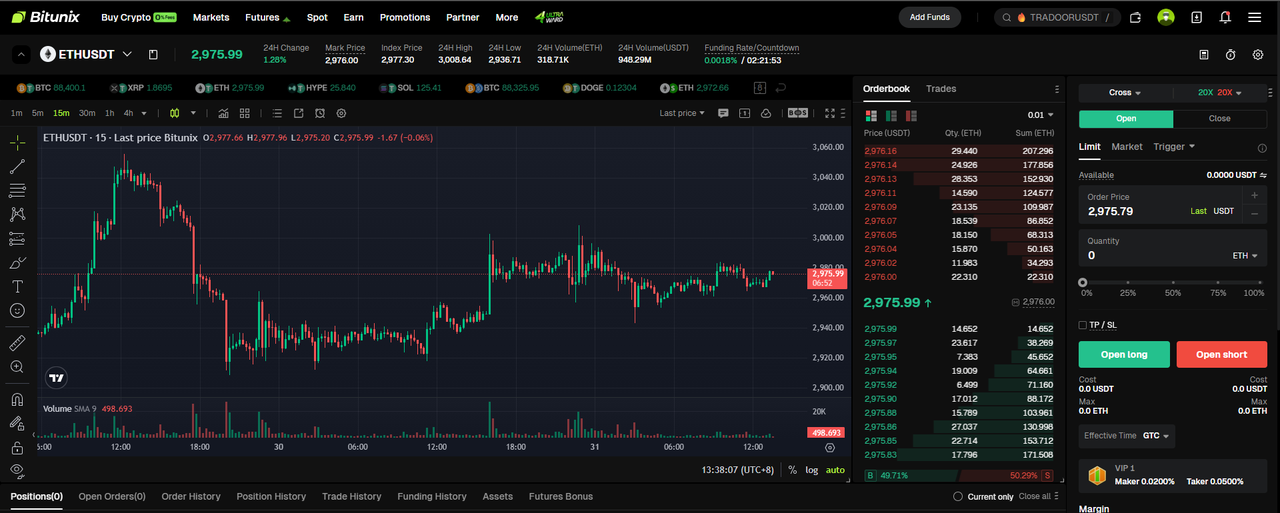
Spot vs futures trading
- Spot trading: You buy or sell the asset itself.
- Crypto futures trading: You trade a contract linked to the asset’s price, which allows both long and short positions.
Long and short positions
- Long: You benefit if price rises.
- Short: You benefit if price falls.
Perpetual futures
Most crypto futures products are perpetual futures, meaning they typically do not have a fixed expiry date. You can explore our futures education and related tutorials in the Bitunix Help Center’s Futures Trading section.
USDT-M and Coin-M futures on Bitunix
Bitunix supports multiple futures formats, including Coin-M perpetual futures, where collateral and settlement are in crypto rather than USDT. If you want to learn how Coin-M works, start with Frequently Asked Questions About Coin-M Perpetual Futures and the Guide to Bitunix Coin-M Futures Trading.
Futures Trading for Beginners: The Four Concepts That Decide Outcomes
If you want real educational value, this is the section to read twice. Most beginner losses in futures come from not understanding these fundamentals.
Margin
Margin is the collateral you allocate to open and maintain a futures position. If the market moves against you, your margin buffer shrinks.
Beginner takeaway: margin is not “extra money.” It is the risk buffer your position depends on.
Leverage
Leverage increases exposure relative to your margin. This is what most beginners notice first, but it is not the first thing you should optimize.
On Bitunix, we provide adjustable Bitunix leverage on supported futures markets. We have also increased maximum leverage up to Bitunix 200x leverage for BTC/USDT and ETH/USDT perpetual futures.
Beginner takeaway: maximum leverage is a capability for advanced traders, not a requirement for beginners. Beginners should start low and focus on building execution discipline.
Margin modes: isolated vs cross
Margin mode changes how collateral supports your position.
- Cross margin: your available balance can support positions together.
- Isolated margin: margin is isolated per position (simpler for many beginners to reason about).
We explain this in our guide: What is Margin Mode in Perpetual Futures Trading.
Beginner takeaway: when you are learning, isolated margin is often easier to manage because it encourages contained risk per trade.
Liquidation
Liquidation is a forced position close that can occur if your margin becomes insufficient under margin requirements. Leverage generally reduces the distance between your entry and liquidation level, especially in volatile conditions.
Beginner takeaway: your goal is not to “avoid stops.” Your goal is to use stop-loss rules, so liquidation does not become the way your trade ends.
The Beginner Rule That Changes Everything: Position Size First, Leverage Second
Most new traders believe leverage is the risk control. In practice, position size is the risk control.
A clean learning process looks like this:
- Decide how much you are willing to lose if the trade is wrong.
- Decide where your stop-loss must be (the level that invalidates your idea).
- Size your position so that hitting the stop equals your acceptable loss.
- Only then choose leverage that matches your position sizing plan.
If you want a fast-start curriculum that matches this approach, our Bitunix Academy course 3-Minute Quick Start to Futures Trading walks through the operational steps in a compact format.
Bitunix Futures Trading: Step by Step for Beginners
This workflow is designed for trading futures for beginners who want to learn correctly, not randomly click buttons.
Step 1: Transfer funds from Spot to Futures
On Bitunix, Spot and Futures are distinct account areas, and we provide a dedicated transfer process to move funds into Futures when you are ready to trade.
Follow our official guide: How to transfer funds from Spot to Futures on Bitunix.
What we mean by “allocate only what you can afford to risk” is simple: by transferring a specific amount into Futures, you create a clear boundary for how much capital is exposed to futures risk at that moment.
Step 2: Choose a market (start with majors)
For most beginners, majors are the cleanest place to learn execution:
- BTC futures
- ETH futures
Majors generally have deeper liquidity and more predictable behavior than smaller tokens, which makes early learning smoother.
Step 3: Set margin mode and leverage
Choose your margin mode (isolated or cross) and set leverage based on your risk plan. If you are brand new, start with low leverage and small size. The goal is consistent execution.
If you want a conceptual refresher while you set this up, review What is Margin Mode in Perpetual Futures Trading.
Step 4: Place your order
You can use:
- Limit orders for planned entries
- Market orders when immediate execution matters
- If you are learning, limit orders often reduce impulsive entries and help you stick to a plan.
Step 5: Set take-profit and stop-loss immediately
On Bitunix, we explain how to set take-profit and stop-loss in detail:
App guide: How to set take-profit and stop-loss for Futures trading on Bitunix (App)
Web guide: How to Set Up Take Profit and Stop Loss for Futures Trading on Bitunix (Web)
Beginner rule: if you are not willing to place a stop-loss, your position size is too large or your leverage is too high.
Step 6: Learn the full transaction flow
If you want the complete operational walkthrough, use:
Practical Beginner Examples: BTC Futures and ETH Futures
These examples are educational and focus on process, not prediction.
Example 1: BTC futures, structured long with clear invalidation
Goal: Learn disciplined entries and exits.
- Market: BTC futures
- Entry: a planned level using a limit order
- Stop-loss: below the level that proves your setup is wrong
- Take-profit: a planned target level before you enter
What you are learning: futures trading is not about always being right. It is about keeping losses small when you are wrong.
Example 2: ETH futures, controlled short in a downtrend
Goal: Understand shorts with the same discipline as longs.
- Market: ETH futures
- Entry: after confirmation at a resistance zone
- Stop-loss: above the resistance zone
- Take-profit: at a support zone, with partial profit if you want to reduce risk
What you are learning: shorting is simply direction. Risk discipline stays the same.
Best Futures Trading Platform for Beginners: A Practical Checklist
If you are looking for the best futures trading platform for beginners, do not start by chasing maximum leverage. Start with safety, clarity, and risk tools that help you learn correctly.
A beginner-focused platform should offer:
Clear visibility into risk
You should be able to understand margin, leverage, and trade parameters before you confirm.
Risk tools that are easy to use
Take-profit and stop-loss should be straightforward to set and manage. On Bitunix, you can follow our official TP/SL tutorials for App and Web.
Flexible margin modes
Being able to choose cross vs isolated margin supports different experience levels. Our explainer is here: What is Margin Mode in Perpetual Futures Trading.
Adjustable leverage for different traders
On Bitunix, we provide adjustable Bitunix leverage and we have increased maximum leverage up to 200x for BTC/USDT and ETH/USDT perpetual futures.
When people say best crypto futures trading platform, they often mean “the platform with the most leverage.” For beginners, the better definition is: the platform that helps you trade safely, learn faster, and avoid avoidable mistakes using clear tools and a structured workflow.
FAQ
What is futures trading in simple terms?
Futures trading is trading a contract that follows an asset’s price, allowing you to go long or short without owning the asset directly.
What is trading futures, and is it different from futures trading?
In most crypto contexts, “trading futures” and “futures trading” refer to the same activity: opening and managing futures contract positions.
Is crypto futures trading suitable for beginners?
It can be, if you trade small, use low leverage, and consistently use stop-loss rules. Without risk controls, futures can lead to fast losses.
How do we set take-profit and stop-loss on Bitunix?
Use our step-by-step guides for App and Web.
Why do we transfer funds from Spot to Futures on Bitunix?
Because Spot and Futures are separate account areas on the Bitunix exchange, and transferring funds helps you control exactly how much capital is allocated to futures trading. Start here: How to transfer funds from Spot to Futures.
Glossary
- Futures trading: Trading contracts that track an asset’s price rather than buying the asset directly.
- Crypto futures trading: Futures trading where the underlying asset is a cryptocurrency.
- Perpetual futures: Futures contracts that typically do not expire.
- Long: A position that benefits if price rises.
- Short: A position that benefits if price falls.
- Margin: Collateral used to open and maintain a position.
- Leverage: A multiplier that increases exposure relative to margin.
- Margin mode: How margin is allocated to positions, commonly cross or isolated.
- Liquidation: Forced position closure when margin is insufficient.
- Take-profit: An order that locks gains at a pre-set level.
- Stop-loss: An order that limits losses at a pre-set level.
Conclusion
If you started this guide asking what is futures trading, you now have the beginner foundation: futures are contracts, not coins; crypto futures trading lets you go long or short; and leverage amplifies outcomes while increasing liquidation risk if misused. For futures trading for beginners, the safest approach is a repeatable process: controlled position size, sensible Bitunix leverage, and consistent use of take-profit and stop-loss.
When you are ready to practice, start small on Bitunix futures, focus on majors like BTC futures and ETH futures, and follow our step-by-step tutorials to build skill with discipline, not impulse.
About Bitunix
Bitunix is a global cryptocurrency derivatives exchange trusted by over 3 million users across more than 100 countries. At Bitunix, we are committed to providing a transparent, compliant, and secure trading environment for every user. Our platform features a fast registration process and a user-friendly verification system supported by mandatory KYC to ensure safety and compliance. With global standards of protection through Proof of Reserves (POR) and the Bitunix Care Fund, we prioritize user trust and fund security. The K-Line Ultra chart system delivers a seamless trading experience for both beginners and advanced traders, while leverage of up to 200x and deep liquidity make Bitunix one of the most dynamic platforms in the market.
Bitunix Global Accounts
X | Telegram Announcements | Telegram Global | CoinMarketCap | Instagram | Facebook | LinkedIn | Reddit | Medium