

Article Summary
- This article provides a comprehensive explanation of IDO in the context of cryptocurrency investing.
- It breaks down what IDO is, how it functions, and why it matters for investors.
- The guide explores how to identify and evaluate IDO opportunities and assess their potential returns and risks.
- It highlights best practices for participating in IDO and avoiding common pitfalls.
- The article concludes with actionable advice for making informed investment decisions regarding IDO.
The cryptocurrency market keeps creating new ways for projects to raise capital and for investors to access early-stage tokens. An Initial DEX Offering (IDO) is one of those models, giving investors a way to join a token launch through a decentralized exchange or launchpad.
An IDO is a fundraising method in which a crypto project sells tokens through a decentralized exchange or launchpad. Instead of raising funds only from venture investors or launching first on a centralized exchange, the project opens early token access to a wider group of participants.
For investors, the appeal is to get a chance to buy into a token launch before broader trading begins. However, the risk is that early access does not guarantee quality, liquidity, or returns.
Bitunix gives traders access to spot and futures markets, helping you monitor listed assets, track market reactions, and manage exposure after a token reaches secondary markets. A crypto exchange also helps investors compare price action, liquidity, and volatility once early-stage tokens begin trading more widely.
This guide explains how IDOs work, how to evaluate them, how to participate, and how to avoid the traps that catch investors who treat every new token as a golden ticket.
How IDOs Work in Crypto Fundraising
Initial DEX Offerings give crypto projects a way to raise capital, distribute tokens, and build an early user base through a decentralized exchange or launchpad. A strong IDO can support project funding and create early liquidity, while a weak one can leave investors exposed to hype, poor tokenomics, and heavy selling after launch.
What IDOs Are Built to Do
An IDO allows a crypto project to sell tokens through a decentralized venue, usually with help from a launchpad. The project raises funds, early investors receive token allocations, and the token is normally listed on a DEX after the sale.
The purpose differs from a typical market listing. In a standard listing, the token is already trading, and investors buy at market prices, whereas in an IDO, investors participate before or during the first public distribution stage. That makes it a potential investment opportunity, but also a higher-risk crypto investment.
What Is an Initial DEX Offering and How Does It Work?
The answer to what is an initial DEX offering starts with the sale process. A project applies to a launchpad, passes review, sets token sale terms, and opens registration. Investors then connect wallets, complete any required steps, and commit accepted assets such as stablecoins or chain-native tokens.
After the sale closes, investors receive tokens based on allocation rules. Some receive tokens immediately, while others receive part at listing and the rest through a vesting schedule. The token then lists on a DEX, where market pricing begins.
Who Participates in an IDO?
An IDO depends on several groups working around the same token launch. The project team builds the token, product plan, fundraising target, and community strategy, while the launchpad reviews the project, hosts the sale, and sets participation rules. Investors provide capital and assume the risk of holding the token after launch.
Market makers, liquidity providers, auditors, advisors, and community managers also influence the outcome. A token launch needs more than a smart contract and a Telegram group; it needs liquidity, clear communication, working technology, and realistic incentives.
How IDOs Evolved
Early crypto fundraising moved through several phases. ICOs dominated the 2017 cycle, then many projects shifted toward IEOs, private rounds, launchpads, and DEX-based sales after regulators raised concerns about investor protection and disclosure.
Early token access became more relevant again in 2025 as large platforms revisited public token sale models. Reuters covered Coinbase's November 2025 token sale platform launch. They noted that it created the first broad opportunity for U.S. users to participate in public token sales through that type of venue since 2018.
The 2025 and 2026 market, however, is more selective than the 2021 cycle. CryptoRank's Q1 2026 fundraising report showed that later-stage capital grew sharply, while seed and pre-seed funding represented only $304.9 million, or 5.2% of total VC capital. That tighter funding environment makes token-sale quality more important for early-stage projects.
Evaluating IDO Opportunities
A serious IDO review should start with the project's quality, since a token that looks cheap can still be risky if the supply is too large, the unlock schedule creates heavy selling pressure, or the product has no clear users. Recent token launch analysis also shows why this matters: many 2025 tokens lost value after issuance when market demand failed to support their initial valuations.
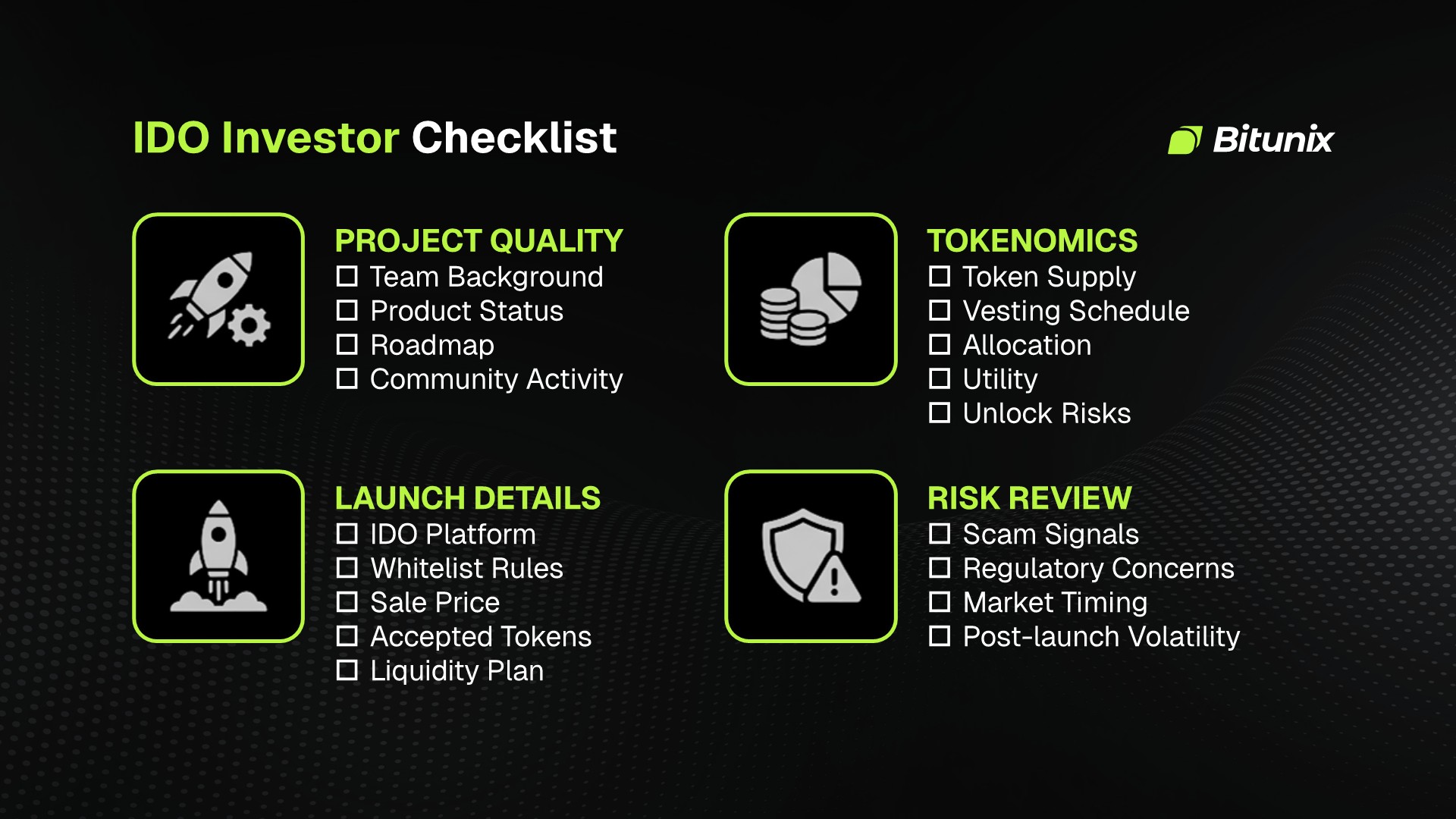
IDO investor checklist outlining the key factors to review before joining a token sale, including project quality, tokenomics, launch details, and risks.
1. Project Assessment
The first step is checking whether the project solves a real problem. Look at the product status, public documentation, active users, testnet data, partnerships, audits, and ecosystem fit.
Recent DEX growth gives IDOs a stronger market backdrop, but it does not make every launch good. CoinGecko found that DEXs accounted for 24.5% of spot trading volume at their June 2025 peak, while DEX spot share stayed above 10% from January 2025 onward. That shows on-chain trading has matured, but project quality still varies widely.
2. Tokenomics Analysis
Tokenomics shows how the token is designed, distributed, and released into the market. Before joining an IDO, investors should review the total supply, circulating supply at launch, team allocation, investor allocation, treasury share, vesting schedule, token utility, and emission rate. These details explain who controls the supply, when new tokens enter circulation, and whether the token has a clear purpose after the sale.
A healthy token launch avoids flooding the market with too much supply too quickly. Large insider allocations, short vesting periods, or aggressive unlock schedules can create selling pressure after listing, even when the project looks strong on paper. Tokenomist estimated that 2025 saw $97.43 billion in total token unlocks across major sectors, underscoring the importance of supply release schedules for investors reviewing early-stage opportunities.
A strong tokenomics review should answer three questions before you commit capital:
- How many tokens enter circulation at launch?
- When do the largest unlocks begin?
- What creates real demand for the token after the IDO?
- If the project cannot answer those questions clearly, the sale deserves caution, no matter how cheap the token looks.
3. Team and Roadmap
A strong IDO project should make it easy for investors to understand who is building it and what they plan to deliver. The team should have relevant experience, public profiles, clear responsibilities, and a track record that matches the project's goals. Anonymous teams are common in crypto, but they require more caution because investors have fewer ways to verify credibility.
The roadmap should also give investors something concrete to measure after the token launch. Clear milestones, product releases, ecosystem plans, and development timelines are more useful than vague promises about growth or adoption. A good roadmap should outline what the team will build, when they expect to build it, and how progress will be tracked.
4. Risk Assessment
Every IDO carries risk, even when the project looks strong on paper. Investors need to review the market, liquidity, smart contract, execution, and token unlock risks, as well as the chance that the project fails to attract real users after launch.
The scam risk also deserves serious attention, as early-stage crypto investing remains a common target for fraud. Chainalysis estimated that crypto scams and fraud took in at least $14 billion on-chain in 2025, with the figure projected to exceed $17 billion as more illicit wallet addresses are identified, underscoring the need for strict filtering before connecting a wallet or committing funds.
How to Take Part in an IDO
Participating in an IDO seems simple at first because the basic steps usually involve researching the project, preparing a compatible wallet, registering for the sale, buying tokens, and claiming them after the launch. The risk sits in the details, including eligibility rules, wallet security, vesting schedules, accepted tokens, gas fees, and post-listing liquidity.
Step-by-Step Participation
Most IDOs follow a clear process, but each launchpad can set different rules for registration, allocation, wallet support, and token claims. Before joining a sale, read the full terms to understand which chain to use, which assets are accepted, whether whitelist or KYC steps apply, and how the vesting schedule works.
Here is a basic step-by-step on this process:
- Find the project: Look for IDOs through launchpads, DEX ecosystem pages, official project announcements, or token sale trackers.
- Review the sale terms: Check the supported chain, accepted tokens, sale price, allocation rules, eligibility limits, and vesting schedule.
- Prepare your wallet: Use a compatible wallet, fund it with the required asset, and leave enough balance for network fees.
- Complete registration: Follow the whitelist, staking, social task, or KYC requirements, if applicable.
- Join the sale window: Commit funds during the IDO period and confirm the transaction through your wallet.
- Claim your tokens: After the sale ends, claim tokens through the launchpad according to the project's distribution or vesting schedule.
- Track the project after listing: Monitor liquidity, price behavior, unlock dates, product updates, and community communication because the market starts judging the project once trading begins.
Research Before You Commit
Good due diligence protects you from weak deals and obvious scams. Read the whitepaper, tokenomics page, audit report, vesting schedule, launchpad profile, team background, and community channels, then compare the project's claims with on-chain activity.
ESMA explains how useful it is to understand why disclosure has become more important in crypto markets: "The new legal framework supports market integrity and financial stability by regulating public offers of crypto-assets and by ensuring consumers are better informed about their associated risks."
That statement refers to MiCA in the European Union, but the principle applies broadly. Investors need clear risk information before buying early-stage crypto assets.
Position Sizing
A smart IDO allocation should be small enough that a full loss will not damage your portfolio. Early token sales can move sharply after listing, and liquidity can disappear faster than you expect.
Many investors size IDOs as speculative positions rather than core holdings. That means setting a maximum allocation before the sale, avoiding borrowed funds, and never increasing size because of a community chat.
A practical rule is to separate your long-term portfolio from early-stage bets. BTC, ETH, stablecoins, and higher-liquidity assets serve different purposes than IDO allocations, so mixing them without rules usually leads to poor decisions.
Post-Investment Management
After participating in an IDO, investors need to manage their positions rather than just wait for price movement. Start by checking the token distribution schedule, including when tokens become claimable, how much unlocks at listing, and when future vesting releases happen.
Large unlocks can create selling pressure, especially when early investors, advisors, or team members receive tokens around the same time. Post-launch liquidity is also important because a token can list successfully but still trade with thin liquidity, wide spreads, and sharp price swings.
Project updates should guide your next decisions. Track roadmap progress, product releases, partnerships, governance proposals, audit updates, and community communication. A team that keeps delivering and explains delays clearly gives investors more information to work with, while silence, missed deadlines, or unanswered complaints are warning signs. A clear exit plan also helps you avoid emotional decisions after listing, whether that means selling part of your allocation to recover your initial investment or holding through vesting if the project continues to meet milestones.
Risks Investors Need to Review Before Joining an IDO
Before joining an IDO, investors need to review the risks with the same care they use to evaluate the opportunity. Early token sales can offer access before broader market listing, but they also expose buyers to sharp volatility, thin liquidity, weak project execution, regulatory uncertainty, and scams.
Market Risk
Market conditions can change between IDO registration, token sale, and listing, which makes timing one of the biggest risks for early investors. A project can raise funds during strong sentiment and still list into a weaker market, where buyers disappear, and early participants rush to sell. This risk is higher when the token launches with low DEX liquidity, limited exchange access, or a large gap between the sale price and the expected listing price.
Project Risk
Project risk comes from the chance that the team fails to deliver the product, attract users, secure integrations, or manage the token economy after launch. A strong IDO campaign can generate attention, but it fades quickly if the project misses roadmap milestones, delays product releases, or cannot demonstrate real usage. Investors should check whether the project already has working technology, public documentation, audited contracts, and measurable traction before treating the sale as a serious opportunity.
Execution also matters after the token starts trading. A project with weak communication, unclear priorities, or constant roadmap changes can lose investor trust even when the original idea is useful. Before joining an IDO, review the team's background, previous work, development updates, GitHub activity when relevant, partnerships, and community management. A project that cannot explain what it is building, who it serves, and how the token supports the product deserves caution.
Regulatory Risk
Regulatory risk depends on where the investor lives, where the project operates, how the token is structured, and how the sale is marketed. In the EU, MiCA regulates public offers of crypto assets and aims to enhance market integrity, financial stability, and consumer risk disclosure. That makes documentation, issuer responsibility, and platform authorization more important for token sales targeting European users.
U.S. rules are still developing, and token fundraising remains a sensitive area. Reuters reported in May 2026 that the U.S. Senate's crypto market structure bill included a fundraising exemption that would allow crypto companies to raise up to $50 million annually without SEC registration. However, the broader bill was still part of an active legislative process. Investors should check whether the IDO excludes their jurisdiction, whether KYC is required, and whether the project provides clear sale disclosures before participating.
Scam Risk
Scam risk is high in early-stage crypto because fraudsters can copy the appearance of real projects, launchpads, and token sale pages. Fake websites, cloned social media accounts, phishing links, malicious wallet approvals, fake airdrops, and impersonator admins often target investors during IDO campaigns. Before connecting a wallet, verify links across multiple official sources, check the contract address, read wallet approval prompts, and avoid any sales that pressure you to act immediately.
Conclusion: Making Informed IDO Investment Decisions
IDO represents a significant investment opportunity in the cryptocurrency market, but it requires careful evaluation. Early access can be valuable when the project has strong fundamentals, fair tokenomics, transparent sale rules, and enough liquidity to support trading after launch.
By conducting thorough due diligence and understanding the risks, you can make informed decisions about IDO investments. You should review the team, product, roadmap, token supply, vesting schedule, launchpad history, smart contract risks, and regulatory limits before committing capital.
Ready to track new listings, monitor listed tokens, and manage your crypto investment strategy? Download the Bitunix app and register to access spot and futures markets, real-time charts, and market tools.
FAQ Section
What exactly is an IDO?
An IDO is a token sale hosted through a decentralized exchange or launchpad. A crypto project sells tokens to early participants before or during public market listing, giving investors early access while helping the project raise funds and build its first user base.
How does an IDO work?
An IDO usually starts with project review, launchpad selection, registration, and sale terms. Investors connect a compatible wallet, complete any required eligibility steps, commit accepted assets during the sale window, and claim tokens after launch based on the project's distribution or vesting schedule.
What are the potential returns from an IDO?
IDO returns depend on the sale price, listing price, liquidity, market conditions, token utility, and project execution after launch. Some tokens rise quickly if demand is strong, but others fall after listing when early buyers sell, liquidity is thin, or the project fails to attract users.
What are the risks of IDO investing?
IDO investing carries market, liquidity, project execution, smart contract, regulatory, and scam risks. Chainalysis estimated that crypto scams and fraud stole about $17 billion in 2025, underscoring the need for careful verification of early-stage token sales.
How do I evaluate an IDO opportunity?
A strong IDO review starts with the project's product, team, roadmap, tokenomics, launchpad reputation, audit status, and community quality. You should also check vesting schedules, liquidity plans, eligibility rules, and market timing before connecting a wallet or committing funds.
What should I look for in an IDO project?
Look for a working product, a clear token utility, an experienced team, a realistic roadmap, transparent token allocation, audited smart contracts, and active communication. A strong project should explain what it is building, who it serves, and why the token has a role beyond speculation.
How much should I invest in an IDO?
Your IDO allocation should be small enough that a full loss does not hurt your portfolio or daily finances. Early token sales are speculative, so many investors treat them as high-risk positions and set a fixed limit before the sale begins.
What happens after I participate in an IDO?
After joining an IDO, you usually claim tokens at listing or receive them through a vesting schedule. From there, you need to monitor liquidity, price action, token unlocks, project updates, exchange listings, and community communication before deciding whether to hold, sell, or reduce exposure.
Are there regulatory risks with IDOs?
Yes. Regulatory risk depends on your jurisdiction, the token's design, the sale structure, and platform access rules. In the EU, MiCA regulates public offers of crypto assets and aims to improve disclosure and consumer protection, so eligibility and documentation matter.
Where can I find IDO opportunities?
You can find IDO opportunities through launchpads, DEX ecosystem pages, project announcements, and token sale trackers. These sources are only starting points. Before participating, verify official links, read the sale terms, check the contract address, and review the project's risks carefully.
Glossary
- IDO: A token sale held through a decentralized exchange or launchpad.
- Initial DEX Offering: A fundraising method where a crypto project sells tokens through a decentralized venue.
- DEX: A decentralized exchange that allows users to trade crypto assets through smart contracts.
- Launchpad: A platform that hosts early-stage token sales for crypto projects.
- Token launch: The process of releasing a new crypto token to investors and markets.
- Fundraising: The process of raising capital to finance project development and operations.
- Tokenomics: The economic design of a token, including supply, allocation, utility, and unlocks.
- Vesting: A schedule that releases tokens gradually instead of all at once.
- Whitelist: A list of approved wallets or users allowed to join a token sale.
- Liquidity: The amount of available buying and selling depth in a market.
- Smart contract: Blockchain-based code that executes transactions or rules automatically.
- Token generation event: The moment a project creates or distributes its token.
- Allocation: The amount of tokens assigned to an investor, team, treasury, or sale group.
- Market risk: The risk that price falls due to broader market conditions.
- Scam risk: The risk of losing funds to fraudulent projects, phishing, or fake sale pages.
Disclaimer
This article does not provide:
(i) investment advice or investment recommendations;
(ii) an offer or solicitation to buy, sell, or hold digital assets;
(iii) financial, accounting, legal, or tax advice.
Digital assets, including stablecoins and NFTs, involve high risk and may fluctuate significantly. Consider whether trading or holding digital assets is appropriate for you given your financial situation. Consult a qualified legal, tax, or investment professional when needed. You are responsible for understanding and complying with applicable local laws and regulations.
About Bitunix
Bitunix is a global cryptocurrency derivatives exchange trusted by over 3 million users across more than 100 countries. At Bitunix, we are committed to providing a transparent, compliant, and secure trading environment for every user. Our platform features a fast registration process and a user-friendly verification system supported by mandatory KYC to ensure safety and compliance. With global standards of protection through Proof of Reserves (POR) and the Bitunix Care Fund, we prioritize user trust and fund security. The K-Line Ultra chart system delivers a seamless trading experience for both beginners and advanced traders, while leverage of up to 200x and deep liquidity make Bitunix one of the most dynamic platforms in the market.
Bitunix Global Accounts
X | Telegram Announcements | Telegram Global | CoinMarketCap | Instagram | Facebook | LinkedIn | Reddit | Medium