

Article Summary
- This article provides a comprehensive explanation of recovery phrases in the context of cryptocurrency and blockchain technology.
- It breaks down the technical aspects of recovery phrases and how it functions within the cryptocurrency ecosystem.
- The guide explores best practices for managing and protecting the recovery phrase to ensure the security of your digital assets.
- It highlights common mistakes users make and how to avoid them.
- The article concludes with actionable advice for implementing proper security practices.
- Digital assets depend on access, and that access often depends on a small set of wallet credentials. A recovery phrase is one of the most important of those credentials because it can restore access to a crypto wallet if the device, app, or browser extension is lost.
- A recovery phrase is a set of words, usually 12 or 24, generated when a self-custody wallet is created. It acts as the backup for the wallet's private keys. If the phrase is safe, the wallet can usually be restored on another verified device. If someone else gets it, they can rebuild the wallet and move the funds.
- When using a crypto exchange like Bitunix, recovery phrase management differs from that in a self-custody wallet. Bitunix manages platform wallet infrastructure for deposits, withdrawals, and trading, while users protect their exchange accounts with security tools such as strong passwords, two-factor authentication, and withdrawal controls. A seed phrase, also called a recovery phrase, can regenerate a wallet's private keys in a self-custody wallet.
- This guide explains how a recovery phrase works, why it matters for crypto security, and how better wallet management can reduce the risk of losing access to digital assets.
What Is a Recovery Phrase?
A recovery phrase explains how a self-custody wallet can be restored when the original device, app, or browser extension is no longer available. It is a human-readable backup, usually made of 12 or 24 words, that can recreate the private keys linked to a crypto wallet and restore access on a compatible wallet app or hardware wallet.
A recovery phrase works through deterministic wallet generation. The wallet creates a random phrase, and that phrase can recreate the wallet's private keys through a standard key-generation process. This is why one phrase can restore the same wallet on a new phone, laptop, or hardware wallet when entered into a compatible wallet app.
A recovery phrase is not stored directly on the blockchain, because the blockchain records transactions and balances while the wallet uses cryptographic keys to prove control over assets. The phrase helps recreate those keys when the original wallet app, device, or browser extension is no longer available.
A common misconception is that a recovery phrase is only needed when a user forgets a password. In self-custody wallets, a password usually protects the local wallet app, while the recovery phrase restores the wallet itself. If you forget the app password but still have the phrase, recovery is often possible, but if you lose the phrase and the wallet access, recovery usually becomes impossible.
A legitimate wallet provider, exchange, or decentralized app should not need your recovery phrase to provide support. Anyone who has the phrase can restore the wallet on another device and control the funds, so sharing it gives away full wallet access. Be aware that any request to share a 24-word secret recovery phrase is a scam.
A complete answer to what is a recovery phrase should also explain what it is not. It is not a public wallet address, a normal account password, or something to type into random websites. It is a backup credential for wallet control and should be treated as highly sensitive information.
Securing Your Recovery Phrase
Recovery phrase security starts with the principle that the phrase should be easy for you to recover and almost impossible for anyone else to access. That balance depends on how you store it, who knows where it is, and how often you expose it during wallet setup or recovery.
A safe backup should stay offline, private, readable, and protected from theft, fire, water damage, and accidental disposal.
Offline Backup Methods
Offline storage is the safest starting point for a recovery phrase because it keeps the phrase away from internet-connected devices. Many users write the words on paper and store them in a secure physical location, while others use metal backup plates because they are more resistant to fire, water, and physical damage.
A single backup can create a different kind of risk. If that one copy is lost, destroyed, or thrown away by mistake, the wallet may become unrecoverable. For larger balances, users often keep secure backups in more than one location, while avoiding obvious places that other people can access.
Digital storage creates unnecessary exposure because screenshots, email drafts, cloud notes, shared folders, and photo galleries can be reached through hacked accounts, malware, stolen devices, or automatic cloud syncing. Recovery phrase backups should remain offline, as wallet security guidance from Trust Wallet advises users to avoid screenshots and storing the phrase on a device.
Mistakes That Put Wallets at Risk
Most recovery phrase losses come from simple mistakes made quickly. Users store the phrase online, enter it into fake support pages, keep only one copy, or share it with someone who claims to be helping. These actions can turn a backup tool into the easiest way for an attacker to drain a wallet.
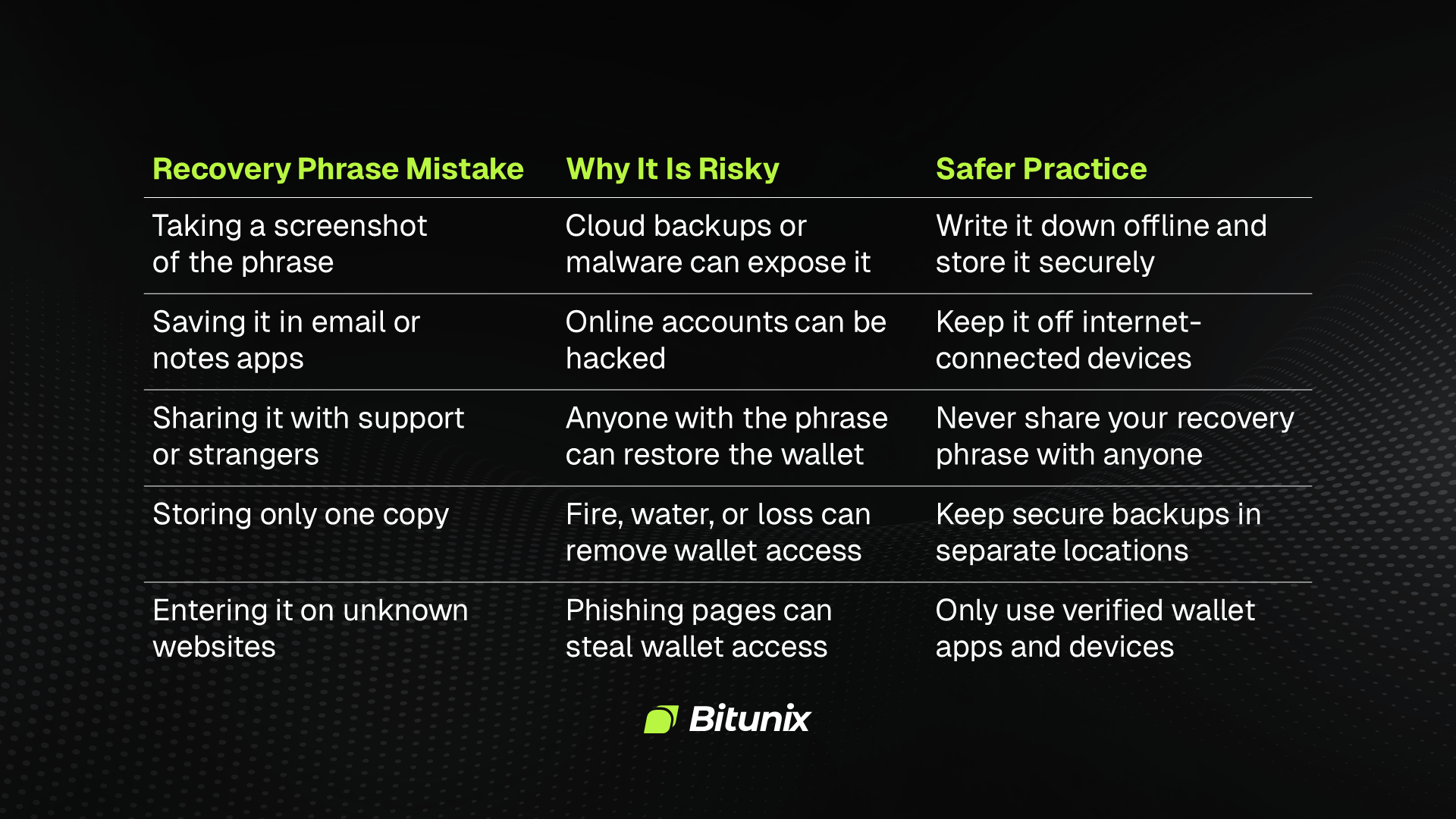
Common recovery phrase mistakes and safer backup habits that help protect wallet access from theft, loss, and accidental exposure.
Recent user-behavior research shows why offline storage habits matter. A 2025 ACM study on seed phrase security found that 31% of surveyed crypto users chose cloud storage to back up their seed phrases, even though online storage can expose recovery data through hacked accounts, malware, or device compromise.
Tools That Reduce Exposure
Recovery phrase protection works best when users limit how often the phrase is seen, typed, copied, or moved. The phrase should usually appear only during wallet setup or wallet restoration. After that, everyday activity should happen through the wallet interface, hardware wallet, or exchange account controls, not by re-entering the phrase.
Hardware wallets help reduce exposure by keeping sensitive wallet data away from ordinary internet-connected devices. They provide offline storage for private keys, keeping them local on the device rather than sending them over the internet, protecting users even when a computer is compromised.
Spending limits and approval reviews also matter. When a user connects a wallet to a smart contract, unlimited token approvals can create avoidable risk. It's important not to set unlimited spend limits and to approve only the amount needed for the transaction. That is not the same as recovery phrase protection, but it belongs in the same security routine because many wallet losses start with careless approvals.
A practical recovery phrase setup can use several layers:
- Offline backup
- Hardware wallet for signing
- Separate an active wallet for routine activity
- Regular approval reviews
- But remember that none of these tools makes a user invincible. They simply reduce the number of moments when a single mistake can expose the entire wallet.
Routine Security Checks
Recovery phrase security needs occasional review because wallets, devices, apps, and personal circumstances change over time. A phrase written years ago may fade, get damaged, or become difficult to find. A storage location that once felt private may no longer be so after a move, a change in shared living, or a device upgrade.
A useful routine should confirm that the phrase is still readable, stored offline, and protected from both theft and damage. Users should also check that wallet apps come from official sources, browser extensions are still needed, and any old wallet connections or smart contract approvals are removed. It is also recommended to double-check transactions before sending and to read transaction messages before signing smart contract interactions.
Practical Applications and Use Cases
A recovery phrase is not part of every normal transaction. Most users do not need it when sending crypto, receiving funds, swapping tokens, or checking balances. The wallet handles signing in the background, while the recovery phrase serves as a backup that can restore access if the wallet device or app is lost.
Day-to-Day Usage
Every day wallet use should not involve typing a recovery phrase into websites, chat windows, forms, or support pages. A typical wallet transaction prompts the user to review and approve an action within a wallet app or a hardware wallet interface. The recovery phrase should stay out of that process.
Requests for the phrase during routine activity are a major warning sign. Ethereum.org puts the rule directly: "Never, for any reason, share your recovery phrase or private keys! Your recovery phrase is the master key to your wallet."
That rule applies even when the message looks urgent or professional. Scam pages often copy the language and design of real wallet brands. A legitimate support agent does not need the phrase to check a transaction, explain a wallet error, or help with an account issue.
Wallet Management
Good wallet management starts with separating access levels. A wallet that holds long-term savings should not be the same wallet used to test new apps, claim random airdrops, or connect to unfamiliar sites. A smaller active wallet can handle routine activity, while a long-term wallet remains isolated.
This setup protects users from turning one bad interaction into a full portfolio loss. If an active wallet signs a bad approval, only the funds and permissions connected to that wallet are exposed. The long-term wallet stays separate because its recovery phrase, addresses, and approvals are not mixed with higher-risk activity.
Recovery phrase backups also need to fit the user's real life. A phrase stored somewhere too obvious can be stolen, while a phrase hidden too well can be lost. The best backup plan is private, durable, and findable by the owner when recovery is needed.
Recovery Procedures
A safe recovery process starts with verifying the wallet software before entering the phrase. Users should download wallet apps from official sources, check device security, and avoid restoring wallets on shared or infected computers. Entering a phrase into the wrong app can expose the entire wallet in seconds.
If the original device is lost but the phrase is safe, the user can restore the wallet using a verified wallet app or hardware wallet. After restoration, the wallet should show the same addresses once the correct blockchain networks are added. If balances do not appear immediately, the issue may be a missing network, a token display setting, or a missing derivation path.
If the recovery phrase is exposed, the old wallet should be treated as compromised. The safest response is to create a new wallet with a new phrase and move the remaining funds there quickly. Users should also stop using the old wallet for deposits, revoke risky approvals where possible, and collect transaction details if funds were moved without permission.
Integration with Exchanges
Recovery phrases are mainly a self-custody concept. A centralized exchange account typically uses login credentials, account security settings, and withdrawal controls rather than providing each user with a personal recovery phrase.
Exchange users need to protect their passwords, enable 2FA, configure anti-phishing settings, and enable withdrawal confirmations. Self-custody users need to protect the recovery phrase directly. One model gives more direct control, while the other relies more on platform security and account protection.
Many users move between exchanges and self-custody wallets depending on what they need to do. They may buy or trade on an exchange, then withdraw assets to a self-custody wallet for long-term storage or blockchain app access. Before making that transfer, users should confirm that the publicly added address photo shows the blockchain network and the wallet's backup status, because allowing on-chain withdrawals involves transferring to an external wallet via the blockchain. Securing the recovery phrase before receiving funds should come first, since sending assets to a wallet with an unprotected backup exposes them to risk from the start.
Recovery Phrase Risks and the Changing Security Landscape
A recovery phrase is designed to solve the problem of losing wallet access. The tradeoff is that the phrase becomes a powerful target. Theft, phishing, accidental exposure, weak backups, and confusing recovery steps can all turn this backup tool into a point of failure.
Phishing and Fake Recovery Pages
Phishing attacks often target recovery phrases because stealing them gives attackers direct wallet access. Fake wallet websites, cloned browser extensions, malicious ads, and fake support accounts can all push users toward the trap of entering the phrase to fix an urgent problem.
Ledger's 2026 scam guidance warns users that Ledger will not ask them to scan QR codes, visit websites, or share a 24-word recovery phrase. That warning followed a data-related incident where scammers could use order information to send more targeted messages. The broader lesson is that recovery phrase scams often look personal, timely, and believable.
Users should slow down whenever a message creates a sense of urgency. Claims about locked funds, failed updates, wallet verification, or emergency recovery should be checked through official sources only. The more urgent the request feels, the more important it is to pause.
Accidental Exposure and Poor Handling
Recovery phrase losses do not always involve advanced hacking. Sometimes the phrase is exposed through a photo, a shared file, a desk drawer, or a public document. A 2026 report described a case where South Korea's National Tax Service lost more than $4.8 million in crypto after a public photo showed a hardware wallet and a handwritten mnemonic recovery phrase. The exposed phrase allowed an unknown actor to move the tokens, showing how one visible backup can defeat otherwise secure wallet hardware.
This kind of incident is useful because it shows that recovery phrase security is operational. People need rules for where phrases can be written, photographed, stored, printed, moved, and destroyed. Without those rules, even experienced organizations can make avoidable mistakes.
Custody, Compliance, and User Responsibility
Recovery phrases sit inside the broader question of custody. In self-custody, the user holds the recovery method and is responsible for backups, secrecy, and recovery. With a custodian or exchange, the platform manages wallet infrastructure, while the user manages account access and verification steps.
Global transfer rules are still developing. FATF's 2025 update found that 73% of surveyed jurisdictions, or 85 of 117, had passed Travel Rule legislation for virtual asset service providers. FATF also noted that implementation gaps remain, meaning users should still pay attention to where a platform is regulated and which protections apply before sending large balances.
Future Wallet Recovery Models
Wallet recovery is moving toward systems that reduce reliance on a single piece of paper. Social recovery, multisig wallets, account abstraction, hardware-backed recovery, and passkey-based access can all reduce the chance that one lost phrase causes permanent loss.
These models still require a clear setup and careful maintenance. A multisig wallet needs multiple signer devices or accounts to stay secure, social recovery needs trusted contacts who understand their role, and account abstraction can add recovery features. However, users still need to understand what they are approving.
The direction is that a better wallet design can make recovery safer and less intimidating, especially for new users. But the basic principle remains the same: any recovery method that can restore a wallet must be protected as much as the wallet itself.
Conclusion: Protecting Your Cryptocurrency Assets
The recovery phrase is a core part of cryptocurrency security because it can rebuild access to a self-custody wallet. It is useful when a device is lost, but dangerous when it is exposed, photographed, uploaded, or shared.
A strong recovery phrase plan keeps the phrase offline, private, durable, and available only to the rightful owner. Users should avoid screenshots and cloud storage, use verified wallet apps, separate long-term storage from active wallets, and review backups before problems happen.
Ready to secure your cryptocurrency? Download the Bitunix app and register to access wallet tools, deposit and withdrawal features, and account security options that can help you manage crypto transfers and account access more carefully.
FAQ Section
What exactly is a recovery phrase?
A recovery phrase is a set of words that restores access to a self-custody crypto wallet. It can recreate the wallet's private keys, so anyone with the phrase can control the wallet. For that reason, it should stay offline, private, and securely backed up.
Why is the recovery phrase important in cryptocurrency?
A recovery phrase is important because it protects against loss of wallet access. If your phone, laptop, browser extension, or hardware wallet is lost, the phrase can restore the wallet. If the phrase is stolen, the wallet can be taken over.
How is a recovery phrase generated?
A wallet usually generates a recovery phrase during setup using cryptographic randomness. That phrase is then used to derive the wallet's private keys and addresses. Users should write it down offline during setup and confirm it before transferring meaningful funds.
What are the risks associated with a recovery phrase?
The main risks include phishing, screenshots, cloud storage, fake wallet apps, physical theft, fire, water damage, and accidental disposal. Because the phrase can restore full wallet access, exposure should be treated as a serious compromise.
How should I store my recovery phrase securely?
A recovery phrase should be stored offline on paper or metal, then kept in a secure physical location. Larger balances justify more durable backups and separate storage locations. Avoid photos, emails, notes apps, cloud drives, and chat messages.
What should I do if my recovery phrase is compromised?
If your recovery phrase is compromised, create a new wallet with a new phrase and move remaining assets there immediately. Stop using the old wallet, revoke approvals where possible, and review transaction history to see whether any funds were moved.
Can a recovery phrase be recovered if lost?
A lost recovery phrase cannot usually be recovered unless another copy exists. If the wallet is still accessible, move the assets to a new wallet with a new phrase. If both wallet access and the phrase are gone, the assets are usually inaccessible.
How does a recovery phrase relate to wallet security?
The recovery phrase serves as a backup for the wallet's private keys, making it one of the most sensitive parts of wallet security. Safe wallet management depends on protecting the phrase, using verified apps, reviewing transaction approvals, and separating risky activity from long-term storage.
Are there different types of recovery phrases?
Most recovery phrases contain 12 or 24 words, although some wallets use different lengths or recovery systems. Many wallets follow common standards, but users should confirm compatibility before restoring a wallet in a different app or on a different hardware device.
Where can I learn more about the security of recovery phrases?
Reliable sources include wallet provider security pages, Ethereum.org security guidance, academic research on seed phrase behavior, and regulator education on custody risks. Focus on offline backups, phishing prevention, transaction approval safety, and the difference between self-custody and exchange accounts.
Glossary
- Recovery phrase: A set of words used to restore access to a crypto wallet.
- Seed phrase: Another common name for a recovery phrase.
- Private key: A secret cryptographic key that authorizes wallet transactions.
- Public key: A cryptographic value derived from a private key and used in transaction verification.
- Wallet address: A public blockchain address used to receive cryptocurrency.
- Blockchain: A distributed record of transactions maintained by a network of computers.
- Self-custody: A wallet setup where the user controls recovery phrases and private keys directly.
- Custodial account: An exchange or platform account where the provider manages wallet infrastructure.
- Hardware wallet: A physical device that keeps wallet keys offline and signs transactions securely.
- Multisig wallet: A wallet that requires multiple approvals before funds can move.
- Social recovery: A wallet recovery method that uses trusted contacts or guardians.
- Wallet drainer: Malicious software or smart contract behavior designed to steal wallet assets.
- Phishing: A scam that tricks users into revealing sensitive credentials or approving harmful actions.
- Account abstraction: Smart wallet technology that can support flexible recovery and security rules.
- Wallet management: The process of organizing wallets, backups, networks, approvals, and security habits.
Disclaimer
This article does not provide:
(i) investment advice or investment recommendations;
(ii) an offer or solicitation to buy, sell, or hold digital assets;
(iii) financial, accounting, legal, or tax advice.
Digital assets, including stablecoins and NFTs, involve high risk and may fluctuate significantly. Consider whether trading or holding digital assets is appropriate for you given your financial situation. Consult a qualified legal, tax, or investment professional when needed. You are responsible for understanding and complying with applicable local laws and regulations.
About Bitunix
Bitunix is a global cryptocurrency derivatives exchange trusted by over 3 million users across more than 100 countries. At Bitunix, we are committed to providing a transparent, compliant, and secure trading environment for every user. Our platform features a fast registration process and a user-friendly verification system supported by mandatory KYC to ensure safety and compliance. With global standards of protection through Proof of Reserves (POR) and the Bitunix Care Fund, we prioritize user trust and fund security. The K-Line Ultra chart system delivers a seamless trading experience for both beginners and advanced traders, while leverage of up to 200x and deep liquidity make Bitunix one of the most dynamic platforms in the market.
Bitunix Global Accounts
X | Telegram Announcements | Telegram Global | CoinMarketCap | Instagram | Facebook | LinkedIn | Reddit | Medium