
Article Summary
- This article provides a detailed price prediction and fundamental analysis for the Terra Luna Classic (LUNC) token.
- It explains Luna Classic (LUNC) as the original Luna token that remained after the catastrophic Terra ecosystem collapse in May 2022.
- The bull case focuses on community-driven revival efforts, ongoing token burn initiatives to reduce the massive supply, and the speculative appeal of a low-priced asset.
- The bear case highlights the astronomical token supply dilution, ongoing regulatory scrutiny, completely destroyed investor trust, and competition from the new Luna 2.0 network.
- It presents detailed price prediction scenarios (bearish, neutral, bullish) for both 2026 and 2030, based on community efforts and market sentiment.
Few crypto stories still carry as much emotional baggage as Terra Luna Classic. The chain that survives today as LUNC is the remnant of the original Terra network, which unraveled when UST lost its peg, and the stabilization mechanism broke under pressure. Since then, Terra Classic has become a community-run recovery project focused on survival, token burning, and the hope that enough utility will return to justify a second act. For anyone using a crypto exchange to trade, LUNC remains one of the clearest examples of a market driven as much by memory and community revival as by fundamentals. Bitunix also gives traders direct access to it through LUNC/USDT, which keeps the asset easy to reach.
What you are looking at with LUNC is the original blockchain and token that survived the Terra ecosystem collapse. At the same time, the replacement chain moved on as Luna 2.0 without the failed algorithmic stablecoin design. The investment case today is about asking whether a damaged chain with a passionate community, a huge token supply problem, and a slow but visible burn program can still produce enough scarcity and utility to matter by 2030.
This analysis will examine the aftermath of the Terra collapse, the community's revival strategies, and provide data-driven price predictions for 2026 and 2030.
The Terra Ecosystem Collapse
The original Terra design linked LUNA and UST via a burn-and-mint mechanism rather than traditional collateral reserves. When demand for UST rose, LUNA could be burned to mint more stablecoins. When UST demand fell, UST could be burned to mint more LUNA. That structure looked clever until confidence broke. A 2026 MEXC guide explains that Terra relied on this burn-and-mint relationship to maintain the peg, and that once UST failed in May 2022, the stabilization mechanism issued huge amounts of new LUNA, pushing the token from triple-digit prices to near zero and wiping out about $45 billion in value within a week.
The fork that followed split the story in two. The Terra community approved a revival plan to launch Terra 2.0 as a separate network without the algorithmic stablecoin, while the original chain was renamed Terra Classic and its old token became Terra Luna Classic, or LUNC.
However, there were some legal issues involving this procedure. Reuters reported in August 2025 that Do Kwon pleaded guilty in New York to conspiracy to defraud and wire fraud tied to the roughly $40 billion collapse, and the same reporting noted that he and Terraform had already reached a $4.55 billion SEC settlement that included an $80 million civil fine and a ban from crypto transactions. Reuters later reported in December 2025 that Kwon received a 15-year prison sentence. So even if LUNC trades today as a community asset, the shadow of the Terra ecosystem collapse still hangs over the brand.
Current market data also shows how far the chain sits from its former scale. CoinMarketCap lists LUNC at around $0.000043, with a market cap of $233.3 million, 24-hour trading volume of $12.0 million, and a circulating supply of roughly 5.47 trillion tokens. CoinGecko puts the market cap in the same range and notes that about 5.5 trillion LUNC remain tradable.
The Bull Case: Community Revival and Token Burns
A bullish Terra Luna Classic price prediction 2026 has to work around the problem that public forecasts still point in very different directions from here.
CoinCodex's price prediction models a weak path, with an end-2026 price near $0.00003146 and an end-2030 price near $0.00002333. Kraken's model and MEXC's forecast stay much closer to current levels, clustering around $0.000043 in 2026 and roughly $0.000051 to $0.000052 by 2030. From there, the upside estimates become much more aggressive. TradersUnion's price prediction places 2026 around $0.00004153 to $0.00004323 and sees 2030 near $0.00014184 by year-end, while Cryptopolitan's forecast projects a 2026 range of $0.000127 to $0.000153 and a 2030 range of $0.000282 to $0.000319. That widespread shows the bullish case depends on meaningful burn progress and renewed network activity.
1. The Burn Initiative
The heart of the bull case is still token burning. Burn trackers clearly show the effort, even as they also reveal their limits.
LuncScan burn tracker shows 443,244,278,585 LUNC burned to date as of April 16, 2026, or 6.42% of total supply. LuncMetrics reports almost the same total, about 443.24 billion burned, with roughly 575.6 million burned over the previous seven days, and total supply still around 6.46 trillion. So the burn program is real, verifiable, and still active. It just is not moving quickly enough to make the supply problem disappear anytime soon.
Exchange participation helps keep the narrative alive. Binance Square posts in early 2026 said that a single January burn removed 5.33 billion LUNC and pushed total burns above 441 billion, while recent Binance commentary also highlighted more than 7.49 billion LUNC burned in 2026 so far. Those figures matter because centralized exchange support keeps the deflation story visible and gives the community something measurable to rally around each month.
2. Community Resilience
Community resilience is the second bullish pillar, and unlike token burning, it is harder to measure. Terra Classic community channels remained active through late 2025 and early 2026, with governance posts on stablecoin redesigns, cross-chain connectivity, and DEX development still coming through. One governance proposal on the Terra Classic forum framed the mood in blunt terms:
"MM 3.0 is our rebellion: restore USTC peg to $1.00, revive legacy protocols as fully decentralized with DAO ownership, and build a self-sustaining ecosystem."
That does not prove the plan will work, but it does show the mentality behind LUNC today. This is a community still trying to write code, reopen use cases, and argue its way back to relevance. Community sites also pointed to visible activity in 2025 and 2026, including Terra Classic appearances at ETHWarsaw 2025 and a February 2026 IDEV gaming integration tied to a platform with more than 2.8 million plays.
3. Speculative Appeal
LUNC still attracts traders because the token looks cheap. At around $0.000043, even a small move upward can look like a huge percentage gain, which keeps retail interest alive. But that low unit price can be misleading because the circulating supply is still about 5.47 trillion tokens, so the market cap has to rise sharply for price gains to be meaningful. In practice, LUNC trades more like a high-volatility speculation on burn progress, community momentum, and short bursts of market attention.
The Bear Case: An Insurmountable Mountain
A weaker outlook for LUNC becomes easier to understand when you stop looking at isolated burn headlines and start looking at the full scale of the supply problem. Forecast models from CoinCodex, Kraken, and MEXC all cluster around the idea that Terra Classic can keep operating without becoming meaningfully more valuable. Even TradersUnion's higher 2030 number remains tiny in absolute terms, and the more aggressive models still fall miles short of anything resembling a return to old Terra levels.
1. Supply Dilution
Supply dilution remains the first and biggest problem. CoinMarketCap shows about 5.47 trillion LUNC in circulation, while LuncMetrics still lists roughly 6.46 trillion total supply despite more than 443 billion burned. That means years of token burning have removed only a modest share of the total overhang. Even if burns continue, reducing trillions of tokens to a level that fundamentally changes token economics is a long, slow grind.
2. Destroyed Trust
Investor trust also remains deeply broken. Reuters' 2025 and 2025-end reporting on Do Kwon's guilty plea, SEC settlement, and prison sentence keeps the Terra story tied to fraud, manipulation, and one of crypto's worst collapses. That legal stain does not disappear because a separate community now governs the Classic chain. It still affects how developers, institutions, and more cautious investors view anything carrying the Terra name.
3. Competition and Utility
Competition makes the recovery story even harder. Terra Classic no longer has the vibrant DeFi environment it once used to justify demand. It competes against stronger Layer 1 chains, against newer ecosystems that never suffered the same reputational damage, and against Luna 2.0, which was built specifically to leave the failed algorithmic stablecoin behind.
CoinGecko currently values Luna 2.0 at roughly $40.6 million with around 710 million tokens in circulation. While that chain is much smaller than LUNC by market cap, it still represents the cleaner successor network for anyone who wants a Terra-related bet without the same supply mountain. By late 2025, Capital.com also described developer activity on Luna 2.0 as moderating, which shows another problem for LUNC: even the replacement chain is struggling to regain serious momentum.
Terra Luna Classic Price Prediction 2026 and 2030 Scenarios
A realistic Terra Luna Classic price prediction 2026 framework has to separate slow-burn survival from full-blown recovery fantasy. The conservative end comes from CoinCodex, Kraken, and MEXC. The middle ground comes from TradersUnion and Cryptopolitan. The extreme upside comes from CoinLore. Those models do not agree on much, but they do agree that LUNC needs much more than community enthusiasm to earn a materially higher valuation.
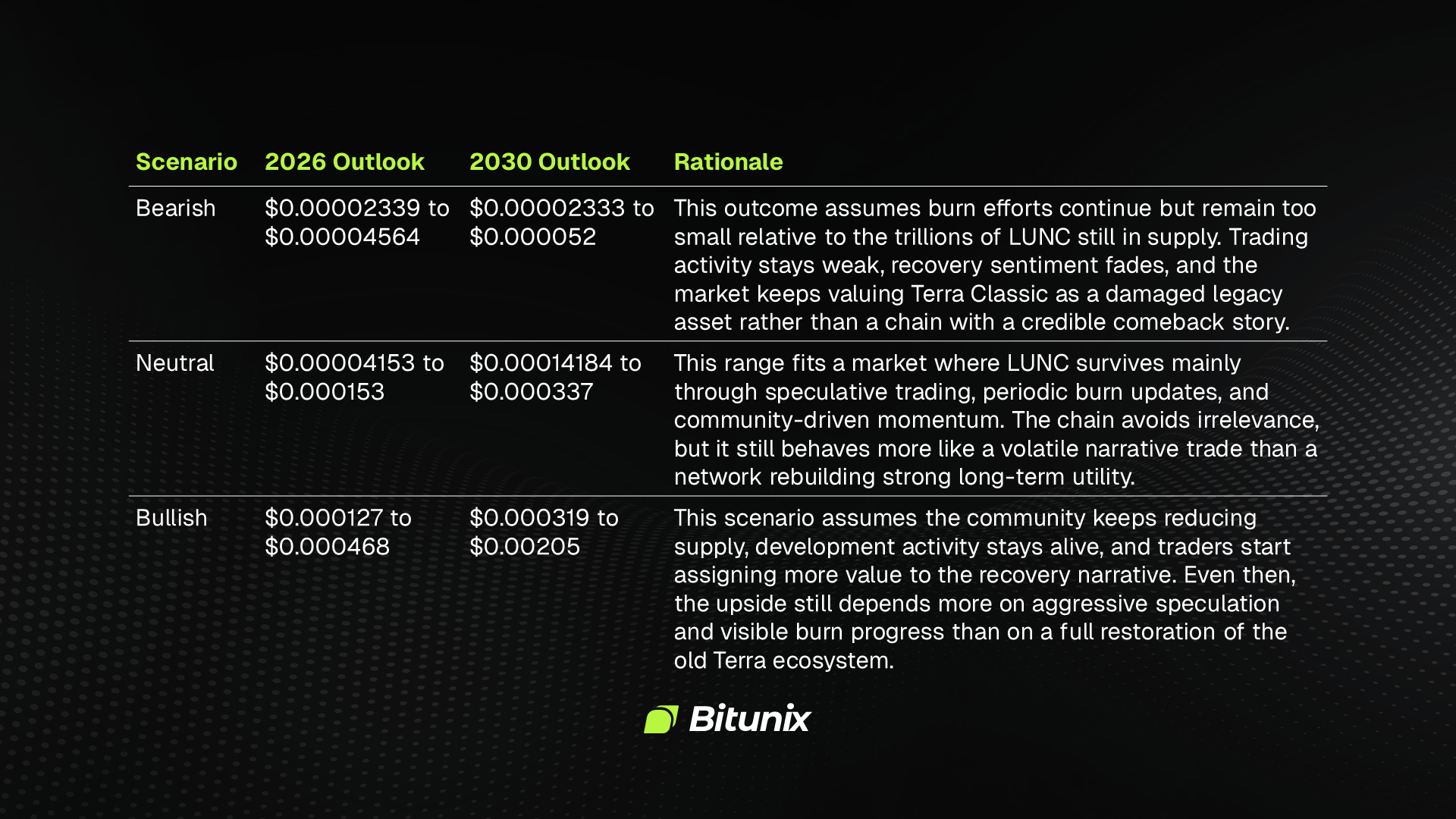
Terra Luna Classic price prediction scenarios for 2026 and 2030, comparing bearish, neutral, and bullish outcomes based on burn progress, speculative trading, and recovery expectations.
Conclusion: A Speculative Recovery Play
Terra Luna Classic remains one of crypto's strangest survival stories. The chain still has a dedicated community, an active burn narrative, live governance, and enough exchange access to stay relevant to traders. But it also carries trillions of tokens, damaged trust, and a brand forever tied to the Terra ecosystem collapse. That mix makes LUNC interesting, but it also makes it deeply unstable as an investment thesis.
Investing in LUNC is still a high-risk bet on token burning, community revival, and the possibility that enough utility can return to make the network feel alive again. Traders who want exposure can use Bitunix for the LUNC/USDT trading pair, so downloading the Bitunix app and registering is the easy part. Figuring out whether the recovery narrative is strong enough to deserve your capital is the hard part.
FAQ
What is Terra Luna Classic (LUNC)?
Terra Luna Classic is the original Terra blockchain token that remained after the 2022 collapse and subsequent fork. It now runs as a community-governed chain, separate from the newer Luna 2.0 network, with recovery efforts focused on burns, upgrades, and limited ecosystem rebuilding.
What caused the Terra ecosystem to collapse in 2022?
The collapse came from the failure of the algorithmic link between UST and LUNA. When UST lost its peg, the system minted huge amounts of LUNA to try to restore it, causing hyperinflation and a crash that erased tens of billions in value.
What is the difference between LUNC and the new LUNA (Luna 2.0)?
LUNC is the original chain and token that survived the collapse. Luna 2.0 is the separate replacement network launched after the fork, and it operates without the failed algorithmic stablecoin model that defined the old Terra design.
How does the LUNC token burn mechanism work?
LUNC burns work by permanently removing tokens from circulation through on-chain taxes and burn transactions, with burn trackers recording the totals publicly. The goal is to reduce supply over time, though the remaining token count is still measured in trillions.
Can LUNC ever reach $1 again?
At current supply levels, a $1 LUNC price would imply an unrealistic market cap. Even optimistic 2030 forecasts from current public models stay far below that mark, which is why most serious outlooks treat a one-dollar target as extremely unlikely.
Who controls the Terra Classic network now?
Terraform Labs no longer runs Terra Classic. The network is now governed by validators and the community through proposals, voting, and technical roadmap debates, which is why governance forums still play a major role in shaping burn and utility plans.
What is the current circulating supply of LUNC?
CoinMarketCap lists about 5.47 trillion LUNC in circulation, while burn trackers such as LuncMetrics still show a total supply of around 6.46 trillion, even after more than 443 billion tokens have been burned.
Are developers still building on Terra Classic?
Yes, though the pace is limited and highly community-driven. Late 2025 and early 2026 updates included governance proposals, network upgrades, and integrations such as an IDEV gaming link, plus exchange support for upgrades like v3.6.1.
What are the risks of investing in LUNC?
The biggest risks are massive supply dilution, damaged trust after the Terra collapse, limited ecosystem utility, and a market that still treats LUNC mostly as a speculative trade. Forecast models vary widely, which shows how uncertain long-term outcomes remain.
Where can I buy LUNC tokens?
You can buy LUNC on major centralized exchanges such as Binance, Bitunix, MEXC, OKX, KuCoin, and Kraken, with options for card payments, bank transfers, or crypto swaps. It is also available through Terra Classic-native DEXs and wrapped versions on PancakeSwap.
Glossary
- LUNC token: The native token of the Terra Classic blockchain, created from the original Terra chain after the fork.
- Terra ecosystem collapse: The 2022 implosion of the UST and LUNA system that triggered hyperinflation and destroyed market value.
- UST stablecoin: Terra's original algorithmic stablecoin that was designed to hold a one-dollar peg.
- Algorithmic stablecoin: A stablecoin that tries to maintain its peg through code-based supply adjustments rather than traditional asset backing.
- Death spiral: A feedback loop where a stablecoin depegs, more tokens get minted, and prices collapse even faster.
- Token burning: The permanent removal of tokens from circulation to reduce supply.
- Burn address: An unrecoverable address used to send tokens out of circulation permanently.
- Community revival: The effort by Terra Classic supporters to rebuild utility, reduce supply, and restore relevance after the collapse.
- Luna 2.0: The separate Terra chain launched after the fork, without the original algorithmic stablecoin design.
- Governance proposal: A formal on-chain or community vote used to approve upgrades, funding, or policy changes.
- Circulating supply: The number of tokens currently available to the market and tradable by the public.
- Market cap: The total market value of a token's circulating supply.
- Perpetual futures: Derivative contracts that track an asset's price without a fixed expiration date.
- Validator: A network participant that helps secure the blockchain and processes transactions.
- Hyperinflation: Extreme supply expansion that sharply reduces a token's value.
Disclaimer
This article does not provide:
(i) investment advice or investment recommendations;
(ii) an offer or solicitation to buy, sell, or hold digital assets;
(iii) financial, accounting, legal, or tax advice.
Digital assets, including stablecoins and NFTs, involve high risk and may fluctuate significantly. Consider whether trading or holding digital assets is appropriate for you given your financial situation. Consult a qualified legal, tax, or investment professional when needed. You are responsible for understanding and complying with applicable local laws and regulations.
About Bitunix
Bitunix is a global cryptocurrency derivatives exchange trusted by over 3 million users across more than 100 countries. At Bitunix, we are committed to providing a transparent, compliant, and secure trading environment for every user. Our platform features a fast registration process and a user-friendly verification system supported by mandatory KYC to ensure safety and compliance. With global standards of protection through Proof of Reserves (POR) and the Bitunix Care Fund, we prioritize user trust and fund security. The K-Line Ultra chart system delivers a seamless trading experience for both beginners and advanced traders, while leverage of up to 200x and deep liquidity make Bitunix one of the most dynamic platforms in the market.
Bitunix Global Accounts
X | Telegram Announcements | Telegram Global | CoinMarketCap | Instagram | Facebook | LinkedIn | Reddit | Medium