
Article Summary
- This article provides a detailed price prediction and fundamental analysis for the StepN (GMT) token.
- It explains the core technology and use cases of the StepN (GMT) ecosystem.
- The bull case focuses on network adoption, technological upgrades, and broader market trends.
- The bear case highlights potential regulatory challenges, competition, and market volatility.
- It presents detailed price prediction scenarios (bearish, neutral, bullish) for both 2026 and 2030.
Crypto investors are always looking for projects with real staying power, and StepN (GMT) is now a more complicated case than it was during the move-to-earn boom. The app still connects fitness, NFT sneakers, and token rewards, but GMT trades almost 99.7% below its all-time high, and STEPN sneaker NFTs now sit near a very low floor price with thin trading activity. That means that StepN is no longer a hype-cycle fitness app chasing easy growth. It is a test of whether a move-to-earn model can keep users, utility, and token demand alive after the incentives cool down.
For readers who track tokens across spot and derivatives venues, Bitunix can be a useful tool as a crypto exchange where GMT/USDT markets are available for active traders. This analysis examines StepN's technology, market position, and data-based price scenarios for 2026 and 2030.
The Technology and Ecosystem
StepN sits at the intersection of fitness, gaming, and crypto. That mix sounds simple, but the model depends on several moving parts working together. Users need a reason to move, the app needs anti-cheat systems and digital assets, and the token economy needs enough utility to survive after the first wave of attention fades. That is where the StepN (GMT) ecosystem becomes interesting for investors.
Movement, Sneakers, and On-Chain Rewards
StepN’s core product is built around NFT sneakers. Users need these digital sneakers to take part in the app and earn rewards. Once equipped, the app tracks outdoor movement, such as walking, jogging, or running, and uses that activity to calculate rewards. The official whitepaper explains the earning model this way:
"Users are encouraged to walk, jog, or run outdoors, where they can potentially receive game Tokens GST/GMT and other NFTs in the process."
StepN's move-to-earn design uses blockchain technology to connect digital ownership with real-world behavior. Users equip NFT sneakers and earn tokens by walking, jogging, or running outdoors, while those assets can also support upgrades, trading, and in-app activity.
User engagement is the problem StepN tries to solve. Many crypto apps struggle to give people a daily reason to return, but StepN links that habit to movement. That does not guarantee long-term token demand, but it gives GMT a more tangible use case than tokens built mainly around speculation.
Ecosystem Growth Beyond the Original App
StepN's growth case now depends on whether it can move beyond the early move-to-earn cycle. The broader FSL ecosystem includes STEPN, STEPN GO, MOOAR, and payment-related products, which gives GMT more places to circulate than the original app alone. In 2025, FSL launched GMT Pay, a payment solution designed to let users convert GMT and GGT earnings from STEPN, STEPN GO, and other FSL products into real-world purchases.
That development matters for the GMT token because payments add a use case beyond in-app gameplay. Sneaker upgrades still support activity inside StepN, but GMT Pay gives users a way to connect earned GMT and GGT with real-world purchases through Mastercard gift cards, with Apple Pay and Google Pay compatibility.
The investment thesis becomes easier to understand when movement, rewards, and spending sit in the same ecosystem. If users can move, earn, and spend without treating GMT only as a trading asset, StepN becomes less dependent on speculative demand alone.
Bitunix also connects to this ecosystem from the trading side. GMT/USDT spot and perpetual futures markets give traders a way to react to ecosystem news, token unlocks, price volatility, and broader market changes. That is useful for traders, but it does not replace project fundamentals. A market can be liquid and still face weak demand if the app does not keep users engaged.
Token Supply, Utility, and Emissions
The GMT token is StepN's governance token. According to the official tokenomics page, GMT is capped at 6 billion tokens and can be earned by walking, jogging, or running in STEPN with eligible sneakers. The same documentation notes that GMT is used inside and outside StepN, including marketplace purchases and MOOAR auctions.
Supply management sits at the center of the GMT investment case. StepN's vesting documentation shows that 6 billion GMT were minted at the token generation event on March 9, 2022, while the governance and ecosystem fund unlocks 0.3% of the total GMT supply each month, equal to 18 million GMT, to support ecosystem development.
GMT earnings also changed in 2026 after StepN's official earnings documentation confirmed that the GMT halving began on January 1, 2026. The same documentation explains that the Classic Pool represents 40% of daily released GMT, and that Classic Sneakers must reach level 30 before users can switch between GST and GMT earnings.
For investors, GMT tokenomics create a clear push and pull. Lower emissions can reduce selling pressure and support the bull case, but monthly ecosystem unlocks still matter when user demand is weak. That balance between reduced rewards and ongoing unlocks is one reason GMT forecasts vary so widely.
The Bull Case: Drivers of Growth
Optimistic GMT forecasts depend on the assumption that StepN must prove that move-to-earn can become part of a wider lifestyle and payments ecosystem. That is not impossible, but it requires more than a good app store description and a few loyal runners. The strongest bull case combines user activity, GMT Pay adoption, token burns, and a stronger crypto market.
Retail Adoption Through Fitness and Payments
A strong StepN price prediction starts with the idea that fitness gives crypto a more familiar entry point. Many people do not understand liquidity pools or governance forums on day one, however, they do understand walking with an app. That simplicity gives StepN a cleaner onboarding story than many blockchain projects.
The 2025 GMT Pay launch added a practical layer to that story. Instead of treating earned tokens as assets that matter only within the app, GMT Pay aims to make them usable for purchases, improving the utility argument.
Some 2026 forecasts build aggressive upside around this idea. CoinPedia's February 2026 forecast placed GMT in a 2026 range from $0.0085 to $0.58, with an average estimate of $0.22 if adoption, burns, and GMT Pay usage improve. The same forecast placed its 2030 range between $1.27 and $8.50 under a much stronger long-term adoption scenario.
Ecosystem Expansion and Supply Reduction
The strongest ecosystem argument comes from the combination of product expansion and supply discipline. The official documents show a fixed 6 billion GMT cap, a 2026 halving, and a monthly ecosystem fund unlock designed to support global growth.
Burn narratives also appear in bullish 2026 forecasts. CoinPedia links its upside case to token burns, DAO governance, GMT Pay usage, and the possibility that real utility replaces the older move-to-earn hype cycle.
A practical way to read this is that if StepN only remains a niche fitness app, GMT has limited upside. If StepN becomes a wider lifestyle, payments, and rewards network, the StepN (GMT) ecosystem has more room to grow.
A Broader Crypto Recovery Would Help GMT
Broader market sentiment still plays a major role in GMT’s price behavior. Because GMT trades like a smaller, application-specific crypto asset, it reacts to liquidity cycles, Bitcoin strength, risk appetite, and altcoin rotations. CoinGecko data also shows GMT recently underperforming the wider crypto market, which reinforces how sensitive it can be when traders move away from smaller tokens. When sentiment improves, recognizable assets like GMT can rebound quickly, but when the market turns defensive, they often feel the pressure first.
CoinGecko data on May 4, 2026, showed GMT trading far below its all-time high of $4.11, with a market cap of around $33.8 million and about 3.1 billion tokens circulating. That distance from the peak is part of the bull argument and part of the warning label. Upside looks large because the drawdown has been severe.
Kraken's model offers a more modest reference point. Based on a 5% annual growth assumption, its table projects GMT at $0.011 in 2026 and $0.013 in 2030, reflecting slow compounding from a depressed base.
The Bear Case: Potential Risks
GMT still carries significant risks, even though StepN has a real product, an established history, and a recognizable brand. The bear case stems from regulatory uncertainty, stronger competition, weak token demand, and macro pressures, all of which can limit recovery even as the app continues to operate. Recent market commentary has also pointed to token unlocks, competitive pressure, and regulation as risks for GMT specifically.
Regulatory Pressure on Token Utility and Rewards
Regulatory uncertainty remains relevant for app-linked tokens, reward systems, payments, and exchange access. There is no specific public finding in the sources reviewed here that classifies GMT as a security in the United States. Still, the broader regulatory environment affects how projects promote tokens, structure rewards, handle payments, and list assets.
In March 2026, the SEC published guidance addressing categories such as digital commodities, digital collectibles, digital tools, stablecoins, and digital securities. The same release also covered how certain crypto assets can become subject to or cease being subject to investment contract analysis.
For StepN, the key issue is also how move-to-earn rewards, payments, user incentives, and marketplace activity are presented. Marketing that sounds like guaranteed income creates risk, and the safer long-term path is utility-first communication, clear disclosures, and no promises of returns.
Competition From Fitness, Gaming, and Web3 Apps
StepN competes across multiple categories at once, making its market position harder to defend. The app competes with fitness platforms for attention, mobile games for retention, NFT marketplaces for digital asset activity, and crypto projects for investor capital. A user can like StepN and still stop using it when rewards fall, sneakers lose value, or another app feels easier.
The competitive problem also arises in token design, as move-to-earn models require balanced incentives. Overly generous rewards can increase emissions and selling pressure, while rewards that feel too low can reduce user interest. StepN's 2026 GMT halving helps slow new emissions, but it also tests whether users value the app beyond earnings.
CoinCodex's price prediction reflects a much more cautious view than the aggressive 2026 forecasts. Its May 4, 2026 model listed GMT at a current price of about $0.01086 and projected $0.009365 by the end of 2026, then $0.002065 by 2030. That forecast implies continued weakness rather than a comeback.
Macro Pressure and Thin Small-Cap Liquidity
Macroeconomic pressure affects GMT because smaller crypto assets rely on market liquidity. When interest rates, recession fears, or risk-off sentiment hit the market, traders often move away from small-cap tokens first. GMT's market cap around early May 2026 was small compared to major crypto assets, making it more sensitive to volatility, exchange liquidity, and sudden shifts in sentiment.
A careful crypto price prediction should also separate trading access from investment quality. Bitunix gives traders access to the GMT/USDT spot and perpetual markets, which support execution and strategy, but it does not remove token risk. Futures can also increase losses when leverage is used without care.
Changelly's forecast sits on the opposite end of the forecast spectrum from CoinCodex. Its 2030 estimate shows an average GMT price of $1.87, with a minimum of $1.82 and a maximum of $2.21. That is far more optimistic than the conservative models, but it still depends on a major recovery in demand and market structure.
StepN Price Prediction Scenarios (2026 & 2030)
GMT forecasts vary widely because analysts disagree on how much value StepN can rebuild after its first major market cycle. Conservative models keep GMT near one cent or lower, with CoinCodex projecting a 2026 range of about $0.008707 to $0.01135 and Kraken's 5% annual growth model placing GMT near $0.013 by 2030.
More optimistic forecasts assume that supply reductions, GMT Pay adoption, community engagement, and a broader crypto recovery can push the token into a higher range. CoinPedia, for example, lists a much wider 2026 range of $0.0085 to $0.58 and a 2030 high case of $8.50. This StepN price prediction uses those outside forecasts as reference points, then groups the outcomes into bearish, neutral, and bullish scenarios.
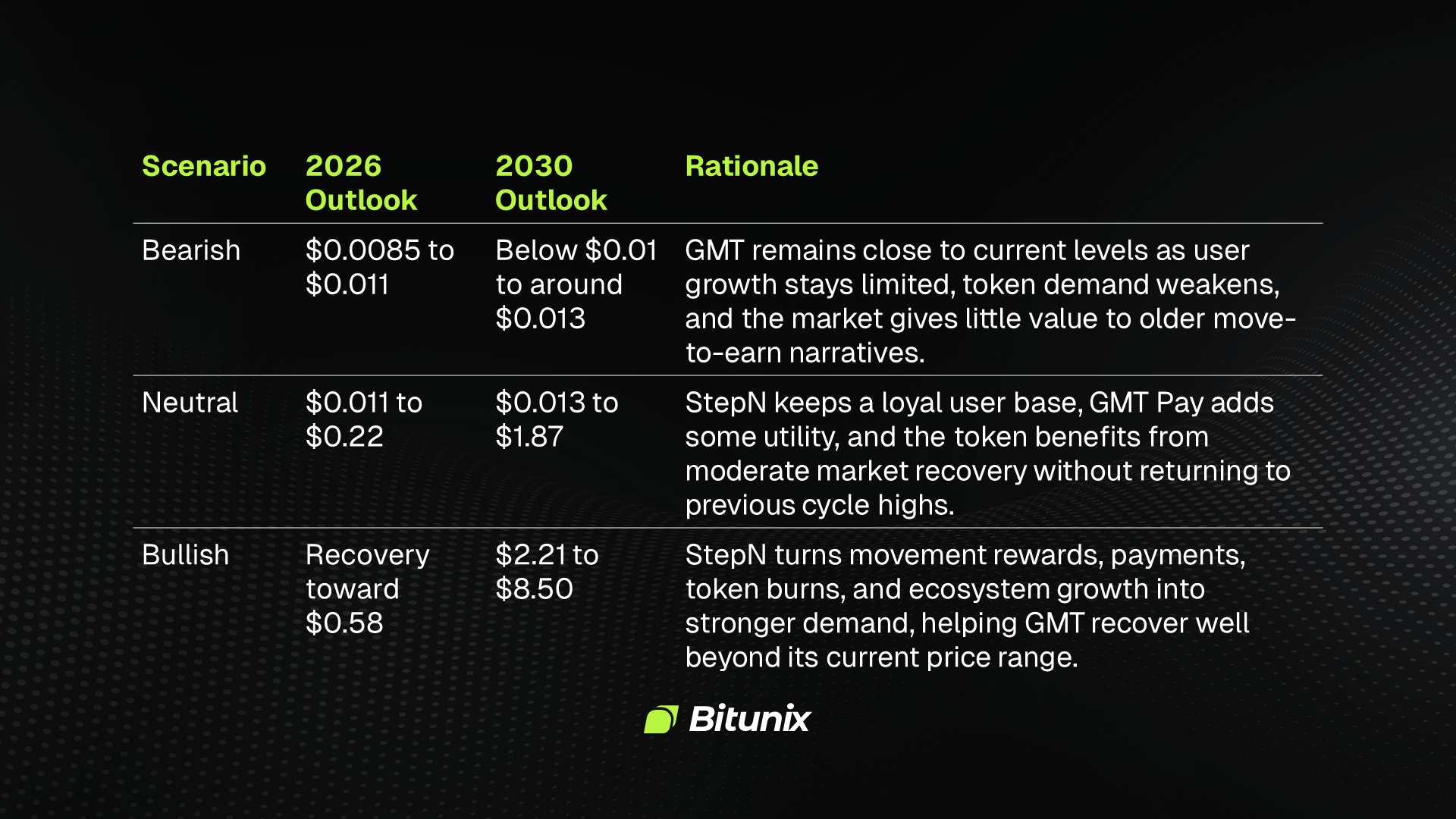
StepN (GMT) price prediction scenarios compare potential bearish, neutral, and bullish outcomes based on adoption, token demand, and market recovery.
Conclusion: The Future of StepN (GMT)
StepN (GMT) still has a recognizable move-to-earn identity, but calling it a compelling project requires caution. The token trades almost 99.7% below its all-time high, and recent 24-hour trading volume is only around $6.6 million, which points to much weaker market interest than during the 2022 cycle. The NFT side tells a similar story, StepN sneakers have a floor price near 0.011 SOL, with NFT Price Floor showing 0 SOL in 24-hour trading volume, while older reporting from 2022 placed sneaker floors around 4.5 SOL. That drop shows how much early NFT holders lost as the move-to-earn boom faded.
StepN still has a capped GMT supply, a 2026 halving mechanism, and a wider FSL ecosystem that now includes GMT Pay, but those positives need to be weighed against thin liquidity, weak NFT demand, and a token chart that still looks deeply damaged.
For traders, GMT is best treated as a high-risk ecosystem token. Track app activity, token unlocks, GMT Pay adoption, exchange liquidity, and broader crypto conditions before making a decision. Ready to trade StepN (GMT)? Download the Bitunix app, register, and access GMT/USDT markets with tools for spot and derivatives trading.
FAQ
What is StepN (GMT)?
StepN is a Web3 lifestyle app that rewards users for outdoor movement. Users equip NFT sneakers, walk, jog, or run, and interact with a token-based app economy. GMT is the governance and ecosystem token for StepN and other FSL products.
How does StepN (GMT) work?
StepN works by linking physical activity to digital rewards, and users need eligible NFT sneakers to participate. The app tracks outdoor movement, then distributes rewards based on sneaker type, level, energy, and earning settings. GMT adds governance and advanced utility within the ecosystem.
What is the utility of the StepN (GMT) token?
The StepN (GMT) token supports governance, marketplace activity, ecosystem participation, and some in-app functions. It can also connect to wider FSL products, including GMT Pay.
Who are the main competitors to StepN (GMT)?
StepN competes with move-to-earn apps, Web3 fitness platforms, mobile lifestyle games, NFT-based gaming projects, and normal fitness apps. Its biggest challenge is keeping users active when reward levels, market prices, and attention cycles change.
Is StepN (GMT) a good investment for the long term?
StepN (GMT) is a high-risk long-term investment. It has a real product, known brand, and defined token supply, but demand must recover for the token to perform well. Investors should review user activity, tokenomics, market liquidity, and competitive pressure before buying.
What factors could drive the price of StepN (GMT) up?
GMT can rise if StepN grows its active user base, GMT Pay gains adoption, token burns reduce supply pressure, and the broader crypto market improves. Strong partnerships, better retention, and more practical token utility would also support a stronger long-term price case.
What are the main risks associated with StepN (GMT)?
The main risks are weak user retention, token selling pressure, regulatory uncertainty, competition, and crypto market downturns. GMT also depends on the health of the StepN ecosystem. If users stop moving, earning, spending, or upgrading, token demand weakens.
How does StepN (GMT) differ from Bitcoin or Ethereum?
Bitcoin mainly serves as a decentralized store of value and payment network. Ethereum supports smart contracts and decentralized applications. StepN is an app-specific ecosystem focused on movement, NFTs, rewards, and lifestyle engagement. GMT's value depends much more on product usage.
What is the all-time high of StepN (GMT)?
GMT reached an all-time high of $4.11. By early May 2026, it traded far below that peak, indicating how much the token had corrected after its earlier market cycle. A return to previous highs would require major growth in demand.
Where can I buy StepN (GMT)?
You can buy GMT on centralized crypto exchanges that list the token. Bitunix offers GMT/USDT markets for users who want access through spot or futures trading. Before buying, check fees, liquidity, supported regions, and your own risk limits.
Glossary
- Move-to-Earn: A crypto app model that rewards users for physical activity, usually through tokens or NFTs linked to walking, jogging, or running.
- GMT: StepN's governance and ecosystem token, used across app features, marketplace activity, rewards, and wider FSL products.
- GST: StepN's in-app reward token, mainly connected to user activity, sneaker upgrades, and gameplay mechanics.
- NFT Sneakers: Digital sneakers users equip in StepN to earn rewards, access app features, and participate in the move-to-earn economy.
- Tokenomics: The economic design of a token, including supply, demand, utility, unlocks, emissions, burns, and distribution.
- Halving: A scheduled reduction in token emissions, designed to slow new supply and reduce potential selling pressure.
- Token Burn: The permanent removal of tokens from circulation, often used to reduce supply and support long-term token economics.
- Ecosystem Fund: A token reserve used to support development, partnerships, community growth, incentives, and broader project expansion.
- GMT Pay: An FSL payment product designed to help users spend GMT and related ecosystem earnings in real-world settings.
- Governance Token: A token that gives holders a role in project decisions, proposals, voting, or ecosystem direction.
- Circulating Supply: The number of tokens currently available in the market and not locked, burned, or reserved.
- Market Cap: A token's total market value, calculated by multiplying its current price by circulating supply.
- Perpetual Futures: Crypto derivatives that let traders speculate on price movements without owning the underlying asset.
- Crypto Price Prediction: An estimate of a token's future value based on market data, adoption, sentiment, and technical assumptions.
- Blockchain Technology: A distributed digital ledger system that supports crypto tokens, smart contracts, NFTs, and decentralized applications.
Disclaimer
This article does not provide:
(i) investment advice or investment recommendations;
(ii) an offer or solicitation to buy, sell, or hold digital assets;
(iii) financial, accounting, legal, or tax advice.
Digital assets, including stablecoins and NFTs, involve high risk and may fluctuate significantly. Consider whether trading or holding digital assets is appropriate for you given your financial situation. Consult a qualified legal, tax, or investment professional when needed. You are responsible for understanding and complying with applicable local laws and regulations.
About Bitunix
Bitunix is a global cryptocurrency derivatives exchange trusted by over 3 million users across more than 100 countries. At Bitunix, we are committed to providing a transparent, compliant, and secure trading environment for every user. Our platform features a fast registration process and a user-friendly verification system supported by mandatory KYC to ensure safety and compliance. With global standards of protection through Proof of Reserves (POR) and the Bitunix Care Fund, we prioritize user trust and fund security. The K-Line Ultra chart system delivers a seamless trading experience for both beginners and advanced traders, while leverage of up to 200x and deep liquidity make Bitunix one of the most dynamic platforms in the market.
Bitunix Global Accounts
X | Telegram Announcements | Telegram Global | CoinMarketCap | Instagram | Facebook | LinkedIn | Reddit | Medium