
What is the EMA Indicator, and What is Its Core Function?
The Exponential Moving Average (EMA) is a smoothed curve that calculates the weighted average price of a cryptocurrency over a defined period, assigning greater weight to recent prices and progressively lesser weight to older ones. This is its fundamental distinction from the Simple Moving Average (MA). Because EMA prioritises recent price movements, it responds more swiftly to market changes and is capable of identifying trend reversal signals earlier than conventional averages. In essence, it functions as a precision instrument for two purposes: trend tracking and inflection point detection. When prices move consistently along the EMA curve, the probability of trend continuation is high. Conversely, when prices breach or fall below the EMA curve, this frequently signals a short-term trend reversal or an acceleration in the existing direction.
The Core Function of EMA: Trend Verification
In cryptocurrency futures trading, the 30-day EMA serves as the primary reference for short-to-medium-term trend analysis. It is typically used alongside the 120-day and 200-day EMAs, which provide long-term directional context. When combined with supplementary indicators such as Bollinger Bands, MACD, and trading volume, this multi-layered approach enables comprehensive and well-rounded market assessment.
The recommended methodology is to first apply the EMA to establish the prevailing medium-to-long-term market direction. This anchors the analysis by confirming whether a long-term trend remains intact, while simultaneously supporting the identification of shorter-term market rhythm.
The core function of the EMA, therefore, is to verify trend continuity and determine whether a reversal is underway. This makes it the central analytical tool for locking in medium-to-long-term market rhythm and forms the foundational logic of a structured trend trading approach.
Practical Demonstration Cases
1、ETH/USDT Perpetual futures (Daily Timeframe) Short Case
🟨 Yellow line: EMA30
🟦 Blue line: EMA120
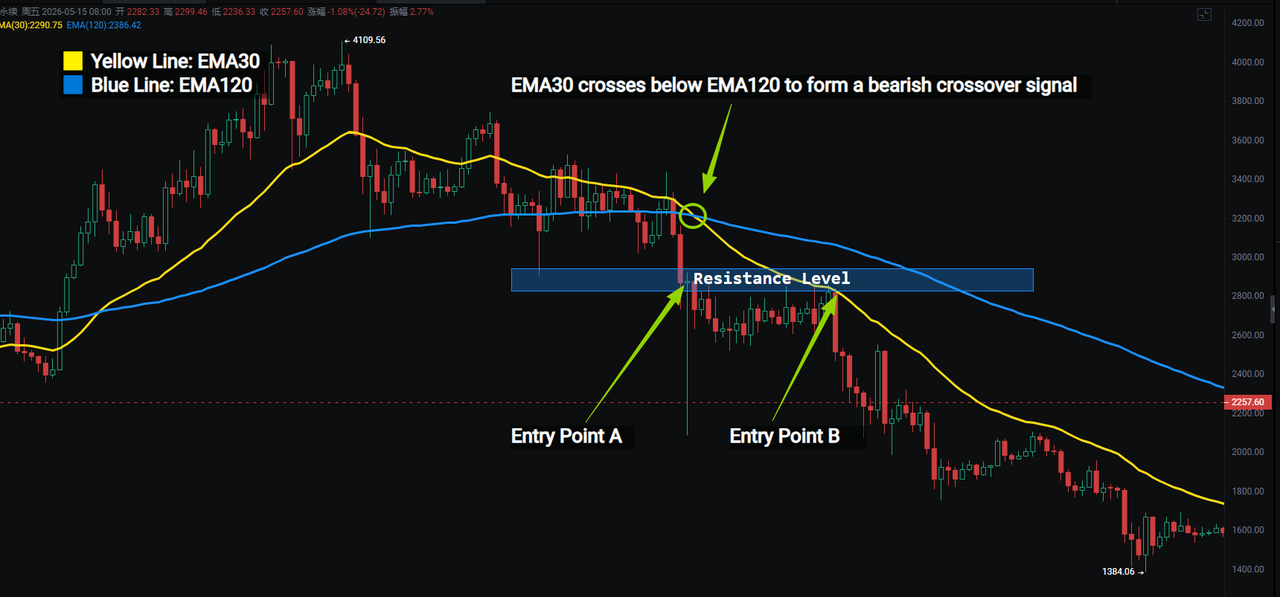
By utilising the Bitunix Warning Function, traders can configure alerts to trigger automatically when the short-cycle EMA and long-cycle EMA form a death cross. This allows for timely market entry in alignment with the prevailing trend, enabling precise capture of trend-based trading opportunities.
Trend Recognition
1. Pre-Structure: Price consolidates at elevated levels for approximately two to three months, forming a high-level ranging box. Throughout this period, bullish momentum gradually weakens, signalling a deterioration in buying pressure.
2. Key Signal: The EMA30 crosses below the EMA120, forming a death cross. This confirms a reversal in both short-term and long-term trend direction, marking the official establishment of a bearish market structure.
3. Breakout Confirmation: A bearish candlestick closes below the key support low of the high-level ranging box, accompanied by elevated volume. This breakdown shifts market conditions from consolidation to a defined downtrend, providing further validation of the bearish thesis.
Timing of Entry
| Entry Point | Entry Conditions | Operation Details |
|---|---|---|
| Point A (First Breakout) | Following the death cross, price declines sharply and breaks below the horizontal support level for the first time with a notable increase in volume, confirmed by bearish volume expansion and a clear breakout signal. | Initiate a light short position near the support level; scale into additional positions after effective resistance confirmation. |
| Point B (Second Retest) | After the initial decline, price enters short-term range consolidation and retests the horizontal support level. The retest is subsequently rejected by the EMA30, which acts as overhead resistance, preventing a recovery above the moving average. | Confirmed by dual resistance from both the support level and the moving average; this represents a more structurally sound entry point for short positions. |
Take Profit and Stop Loss Rules
Stop Loss Setting
- Fixed Stop Loss: Place the stop loss 5% above the horizontal resistance level. Should price break through and hold above this level, it signals a failure of the bearish structure, and the stop loss must be executed without exception.
Take Profit Strategy
- First Take Profit Level: Reference the low of the preceding decline. Once price reaches this level, close approximately 50% of the position to secure partial profits.
- Second Take Profit Level: Should the market continue lower, scale out the remaining position proportionally based on the available downside range, targeting a distance equivalent to the first take profit interval.
- Dynamic Take Profit: On the daily timeframe, monitor the EMA30 closely. If price breaks back above the EMA30 and the closing candle holds firm above it, exit all remaining positions to mitigate retracement risk associated with a potential trend reversal.
Leverage Use Rules
Steady Trading: Leverage not to exceed 10x. Position sizing must be strictly controlled, with any single position limited to no more than 10% of total account funds. •Aggressive Trading: Leverage not to exceed 20x. Single position sizing must not exceed 10% of total account funds. Full-position deployment is strictly prohibited, and high-leverage heavy-position operations are not permitted under any circumstances.
2、BTC/USDT Perpetual futures (Daily Timeframe) Long Case
🟨 Yellow line: EMA30
🟦 Blue line: EMA120
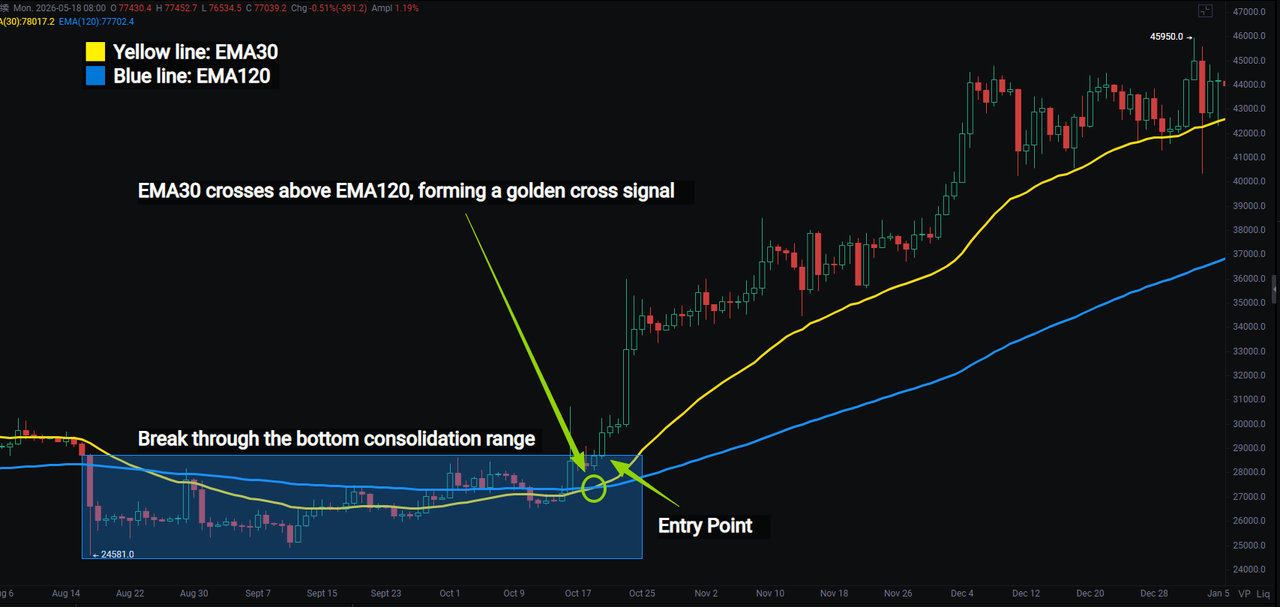
By utilising the Bitunix Warning Function, traders can configure alerts to trigger automatically when the short-cycle EMA and long-cycle EMA form a golden cross. This enables timely market entry in alignment with the prevailing trend, allowing for precise capture of trend-based trading opportunities.
Trend Confirmation
- Pre-Structure: Price undergoes a prolonged period of consolidation at the base, constructing a bottom ranging box. Throughout this phase, bearish momentum progressively weakens while bullish pressure accumulates in preparation for a directional move.
- Key Signal: The EMA30 crosses above the EMA120, forming a golden cross. This confirms a reversal in both short-term and long-term trend direction, marking the official establishment of a bullish market structure.
- Breakout Confirmation: Price simultaneously breaks above the upper boundary of the bottom ranging box, transitioning market conditions from consolidation to a defined uptrend, further validating the bullish thesis.
Timing of Entry
The optimal entry point is the convergence node at which the golden cross forms and price breaks out of the bottom ranging box. Long positions should be initiated at this juncture.
Take Profit and Stop Loss Rules
Stop Loss Setting
- Fixed Stop Loss: Place the stop loss 5% below the entry point.
Take Profit Strategy
- First Take Profit Level: Reference the key resistance zone of the prior uptrend. Upon reaching this level, close approximately 50% of the position to secure partial profits.
- Second Take Profit Level: Should the market continue higher, scale out the remaining position proportionally based on the available upside range, targeting a distance equivalent to the first take profit interval.
- Dynamic Take Profit: Manage remaining positions using the EMA30 on the daily timeframe as a trailing reference. If price breaks below the EMA30 and the closing candle holds firmly beneath it, exit all positions to mitigate retracement risk associated with a potential trend reversal.
Leverage Use Rules
- Steady Trading: Leverage not to exceed 10x. Position sizing must be strictly controlled, with any single position limited to no more than 10% of total account funds.
- Aggressive Trading: Leverage not to exceed 20x. Single position sizing must not exceed 10% of total account funds. Full-position deployment and high-leverage heavy-position operations are strictly prohibited under all circumstances.
Core Risk Considerations for the EMA Strategy
1. Guard Against False Reversal Signals Triggered by Short-Term Volatility
The EMA is inherently sensitive to rapid price movements. Sudden positive or negative news events and sharp price swings can easily generate false signals, including spurious golden crosses, death crosses, and misleading support breaks, which may result in premature stop-loss or take-profit execution. It is essential to filter short-term noise through the assessment of fundamentals, news developments, and broader market sentiment. Trading decisions must never be based on price signals alone.
2. Reject Single-Parameter and Single-Timeframe Analysis
Relying on a single EMA parameter produces signals of low reliability. Effective practical application requires a multi-parameter EMA framework combined with multi-indicator resonance confirmation:
- Establish the overarching trend direction on the daily chart by combining the short-to-medium-term EMA30 with the long-term EMA120 and EMA200.
- Supplement this analysis with key support and resistance levels of the current cycle, Fibonacci retracement zones, MACD golden cross and death cross conditions, and volume dynamics. This multi-dimensional confirmation process systematically filters noise and false signals, improving the accuracy and consistency of trend assessment.
3. Strictly Enforce Stop Loss and Take Profit Rules on Both Long and Short Reversals in Leveraged Trading
- Designate EMA30 as the short-cycle reference and EMA120 as the long-cycle reference for reversal determination.
- If the EMA30 decisively crosses below the EMA120, this constitutes a bearish reversal signal. All existing long positions must be stopped out immediately, and short positions should be established in alignment with the new trend direction.
- If the EMA30 decisively crosses above the EMA120, this constitutes a bullish reversal signal. All existing short positions must be closed immediately, and the strategy must transition to a long bias.
- futures leverage amplifies both gains and losses. Holding positions against the prevailing trend is strictly prohibited. EMA-based bullish and bearish reversal signals must be acted upon with discipline, and risk control principles must be upheld without exception.
4. Rigorously Select Suitable Trading Instruments and Avoid Ranging Markets
The EMA strategy is only appropriate for assets exhibiting strong directional trends, stable price behaviour, and sufficient liquidity. Assets characterised by frequent oscillation, wick-heavy candles, and an absence of clear directional bias will produce repeated EMA crossovers, frequent signal failures, and a pattern of consecutive stop-loss triggers. In ranging or directionless market conditions, the EMA trend strategy should be avoided entirely.
5. Maintain Medium-to-Long-Term Discipline and Avoid Overtrading
The foundation of this strategy is the identification and capture of medium-to-long-term trends. When the market approaches the target profit level and trend momentum begins to weaken, profits should be taken in a timely manner without pursuing maximum gain beyond what the structure supports. When a signal fails or a trend reversal is confirmed, stop-losses must be executed decisively to preserve capital and position the account for the next viable trend opportunity. Frequent short-term trading in pursuit of marginal gains is counterproductive and should be avoided.
Disclaimer
This article is not intended to provide
(I) investment advice or investment recommendations;
(Ii) an offer or solicitation to buy, sell or hold digital assets;
(Iii) Financial, accounting, legal or tax advice. Digital assets held (including stablecoins and NFTs) involve a high level of risk and may fluctuate significantly. You should carefully consider whether trading or holding digital assets is appropriate for you based on your financial situation. Please consult your legal/tax/investment professional for your specific situation. Please be responsible for understanding and complying with relevant local applicable laws and regulations.
About Bitunix
Bitunix is a global cryptocurrency derivatives exchange trusted by more than 3 million users from over 100 countries. Bitunix is committed to providing a transparent, compliance and secure trading environment for every user. The platform has a fast registration process and friendly verification system, and enforces KYC to ensure security and compliance.
Through global-level protection standards such as Proof of Reserve (PoR) and Bitunix Care Fund, Bitunix puts user trust and money security first.The K-Line Ultra charting system provides a seamless trading experience for both novice and advanced traders, with up to 200 times leverage and deep liquidity, making Bitunix one of the most dynamic platforms in the market.
Bitunix Global Account
X | Telegram Announcements | Telegram Global | CoinMarketCap | Instagram | Facebook | LinkedIn | Reddit | Medium