
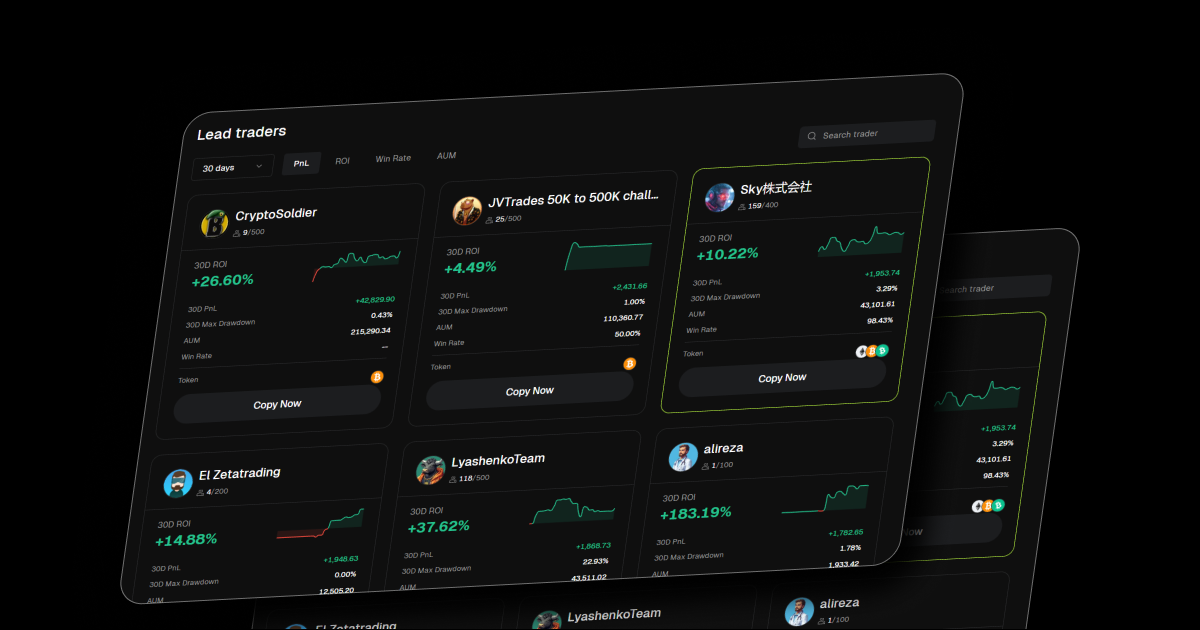
Crypto copy trading can be a practical way to participate in the market without manually placing every order. It can also become risky fast if you skip the setup details. At Bitunix, we focus on a simple principle: copy trading crypto is automation, so your settings must do the risk control work before the market gets volatile.
In this guide, we explain what copy trading is in crypto, then walk through a clean, repeatable setup for Bitunix copy trading on the Bitunix exchange. If you follow these steps, you will reduce preventable errors like skipped copies, accidental overexposure, and confusion about why your results differ from the lead trader.
What Is Copy Trading in Crypto?
What is copy trading in crypto? It is a trading feature that allows you to follow a lead trader and automatically replicate their trading actions in your own account.
Two points matter from day one:
- Copy trading is not a guarantee of profit. You are still exposed to market risk, especially in crypto futures copy trading where leverage and liquidation can apply.
- Copy trading is not “hands off.” You still need to monitor performance and risk behavior, because traders and market conditions change.
If you are choosing the best crypto copy trading platform for your goals, do not start with leaderboards. Start with controls: sizing options, risk limits, and clear execution rules.
Before You Start: What You Need Ready
Funds available for copy trading
We recommend allocating a defined amount, then keeping a buffer instead of using 100 percent of your available balance. A buffer reduces skipped trades due to insufficient margin and makes your experience more stable during volatility.
A simple risk rule
Before you copy anyone, decide these three numbers:
- Your total allocation to crypto copy trading
- The maximum weekly loss that triggers a pause
- How many lead traders you will copy initially
If you cannot write those down, reduce your allocation.
Realistic expectations about execution
Even on a well-designed platform, you should expect differences between the lead trader and the follower. Timing, liquidity, and slippage controls can all change your entry or exit.
How to Start Crypto Copy Trading on the Bitunix Exchange
Step 1: Go to Copy Square and choose a lead trader
Copy Square is where we select who to copy. If you are new, start with one lead trader. Copying multiple traders can increase overlap, raise margin usage quickly, and make it harder to understand what is driving results.
When we evaluate a lead trader, we avoid one-metric decisions. Instead, we look for consistency and a style that can be copied reliably.
A practical checklist:
- Is performance consistent across multiple weeks?
- Does the trader’s position sizing look stable?
- Does the trader trade liquid markets, or rely on fast entries that may be sensitive to slippage?
- Does the trading frequency feel manageable for copying?
Step 2: Choose your copy sizing method
This is the most important choice in the setup. Your sizing method determines how big your copied positions will be.
Option A: Fixed Ratio (Multiplier)
Fixed ratio sizing copies the lead trader’s position size based on a ratio you choose. If the trader opens 10 units and you set 50 percent, you open 5 units.
When we use fixed ratio:
- We have larger capital relative to the trader
- We want proportional exposure that scales with the strategy
- We have strict caps, because scaling can increase risk quickly
Option B: Fixed Amount
Fixed amount sizing means you always open a preset number of units, regardless of the lead trader’s position size.
When we recommend fixed amount:
- You want predictable exposure per copied trade
- You are learning how crypto futures copy trading behaves
- You prefer tighter, simpler risk control
Beginner recommendation: start with fixed amount. Once you can review performance calmly and you understand how exposure changes over time, then consider fixed ratio.
Step 3: Set your Copy Trading Amount
This is the capital you allocate to the copy trading team. It becomes your total margin for copy trading.
How we set it responsibly:
- Allocate an amount you can afford to risk
- Keep a buffer outside the copy allocation, especially if you are also trading manually
- Treat this as a portfolio allocation, not a single-trade budget
Step 4: Set a project stop-loss for the copy
A project stop-loss is designed to exit the copy trade when your loss reaches a preset percentage.
How we use it:
- We set it based on our maximum acceptable drawdown for the strategy
- We avoid setting it so tight that normal volatility triggers exits constantly
- We never “remove it to give the trader room,” because that usually means the allocation is too large
A simple approach: start conservative. If the strategy cannot survive a reasonable stop-loss, it is not a strategy you should be copying.
Step 5: Choose margin mode
Margin mode changes how collateral supports a position.
- Isolated margin: risk is confined to the margin of the specific position
- Cross margin: margin is shared across the account, which increases flexibility but can increase exposure
For most beginners, isolated margin is easier to manage because it keeps risk more contained per position. If you are copying a lead trader, aligning with the lead trader’s margin mode can improve consistency.
Step 6: Set leverage
Leverage increases exposure relative to margin. In crypto futures copy trading, leverage is one of the main drivers of volatility and liquidation risk.
How we set leverage:
- We keep leverage conservative when learning
- We prioritize survivability over speed
- We remember that higher leverage reduces the distance between entry and liquidation
If you feel compelled to increase leverage to “catch up” to a lead trader’s returns, pause. That is a risk escalation decision, not an optimization.
Step 7: Enable position risk management
Position risk management is a follower protection tool. It is designed to ensure the risk of a single position does not exceed a set percentage of total capital.
Why we consider it essential:
- It helps prevent one trade from dominating your account risk
- It provides protection if a lead trader increases size aggressively
- It forces diversification across time instead of concentration in a single entry
If you are serious about finding the best crypto copy trading platform for beginners, look for tools like this. They matter more than marketing claims.
Step 8: Keep slippage protection enabled
Slippage protection is a core execution control in copy trading crypto. It is designed to prevent adverse fills during volatility.
What this means in practice:
- During fast moves, some copied orders may fail rather than fill at a significantly worse price
- This can reduce risk, but it can also create “missed trades”
We treat missed trades as part of responsible execution, not a platform failure. If you want perfect replication, you will usually need to accept worse fills, and that is not a good trade-off for most followers.
Step 9: Confirm and start copying
Once you confirm, you are live. From this point forward, your main job is monitoring and review.
Step 10: Monitor performance in My Copy
My Copy is where we track:
- Open positions and exposure
- Trade history
- Real-time PnL
Our monitoring rhythm:
- Daily: confirm exposure is within limits, check for abnormal position sizing, and confirm copying is executing normally
- Weekly: evaluate results, behavior changes, and whether the strategy still matches our risk profile
What to Expect After You Start
Results can differ from the lead trader
This is normal in copy trading crypto. Common reasons include:
- Execution timing differences
- Slippage protection causing missed entries
- Different account size and risk settings
- Position-based copying behavior, especially if you join after the lead trader already has a position open
Profit sharing settlement is weekly
Profit sharing is typically calculated and settled on a weekly cycle. As a follower, you should align your performance review to that weekly rhythm instead of reacting to single-day swings.
Troubleshooting: Why Your Copy Trade Did Not Execute
If a copied trade did not execute, we do not guess. We check the common mechanical reasons and fix the setup.
Insufficient funds
What it usually means:
- Your allocation is too tight, and you have no margin buffer
- Multiple copied positions opened close together
Fix:
- Increase the buffer
- Reduce per-trade exposure
- Copy fewer traders until you can monitor comfortably
Excessive slippage
What it usually means:
- The market moved too quickly during execution
- The strategy is sensitive to fast entries and exits
Fix:
- Prefer traders focused on liquid markets
- Avoid copying during major volatility windows if your goal is stable execution
- Accept that slippage protection may reject trades to prevent poor fills
Margin cap reached
What it usually means:
- Your caps prevent additional exposure on a pair
Fix:
- Reduce concentration in that market
- Lower risk per position
- Reassess whether the trader’s style matches your intended limits
Safer Starter Setups We Use
Setup A: First-time follower
- Copy sizing: Fixed Amount
- Traders: 1
- Stop-loss: enabled
- Leverage: conservative
- Position risk management: enabled
- Slippage protection: enabled Goal: learn execution and risk control, not maximize returns.
Setup B: Intermediate follower scaling
- Copy sizing: Fixed Ratio with strict caps
- Traders: 1 to 2
- Weekly review: strict, with a pause rule Goal: proportional exposure without uncontrolled scaling.
Setup C: Two-trader diversification
- Two traders with different styles
- Smaller allocations per trader
- Clear combined drawdown threshold Goal: diversify behavior while keeping monitoring manageable.
Conclusion
If you want to start crypto copy trading on the Bitunix exchange the right way, focus on setup quality. Choose one lead trader, use predictable sizing, allocate a defined amount with a buffer, enable a project stop-loss, keep leverage conservative, turn on position risk management, and keep slippage protection enabled.
That is how Bitunix copy trading becomes a controlled process you can measure and improve, rather than a high-variance gamble.
FAQ
What is copy trading in crypto?
It is a feature that allows you to automatically replicate a lead trader’s trades using your own copy settings, allocation, and limits.
Is Bitunix copy trading suitable for beginners?
It can be, if you start with small allocation, use predictable sizing, keep leverage conservative, and monitor regularly.
Why can my results differ from the lead trader’s results?
Differences can come from execution timing, slippage protection, liquidity, and the fact that your sizing and caps may not match the lead trader’s account behavior.
What is crypto futures copy trading?
It is copy trading applied to futures positions, where margin, leverage, liquidation risk, and funding can materially affect outcomes.
What should I do if copied trades keep failing?
Most recurring failures come from insufficient funds, slippage, or caps. Increase your buffer, reduce exposure, and avoid overly fast strategies that are hard to copy reliably.
Glossary
- Futures contract: A derivative that tracks an asset’s price without owning the asset.
- Perpetual futures: A futures contract that typically has no expiry date.
- Margin: Collateral used to open and maintain a leveraged position.
- Leverage: A multiplier that increases exposure relative to margin.
- Liquidation: Forced closure when margin requirements are not met.
- Funding rate: Periodic payments between long and short positions in perpetual futures.
- PnL: Profit and loss, for an account or a position.
- Slippage: The difference between expected price and actual execution price.
- Liquidity: How easily an asset trades without significant price impact.
- Drawdown: The peak-to-trough decline over a period.
About Bitunix
Bitunix is a global cryptocurrency derivatives exchange trusted by over 3 million users across more than 100 countries. At Bitunix, we are committed to providing a transparent, compliant, and secure trading environment for every user. Our platform features a fast registration process and a user-friendly verification system supported by mandatory KYC to ensure safety and compliance. With global standards of protection through Proof of Reserves (POR) and the Bitunix Care Fund, we prioritize user trust and fund security. The K-Line Ultra chart system delivers a seamless trading experience for both beginners and advanced traders. At the same time, leverage of up to 200x and deep liquidity make Bitunix one of the most dynamic platforms in the market.
Bitunix Global Accounts
X |Telegram Announcements |Telegram Global |CoinMarketCap |Instagram |Facebook |LinkedIn |Reddit |Medium