

As we continue expanding Bitunix TradFi, we are adding more stock-linked markets tied to the companies traders already watch closely. One of those markets is AMDUSDT, which gives users a way to trade AMD-linked price movement in a USDT-based environment.
We added AMDUSDT to the Bitunix TradFi lineup because AMD is one of the most important names in today’s technology market. The company sits at the center of several major themes at once, including semiconductors, AI infrastructure, data centers, gaming, and PC computing.
For traders, that makes AMD much more than just another stock symbol. It is a company tied to some of the biggest growth narratives in global equities. In this guide, we explain what AMD is, why traders watch it so closely, how AMDUSDT on Bitunix works, and what beginners should understand before trading AMD stock on Bitunix.
What Is AMD?
AMD stands for Advanced Micro Devices. It is a technology company best known for designing processors, graphics products, and computing solutions used across data centers, gaming systems, PCs, and other high-performance applications.
In simple terms, AMD builds the kind of technology that powers many of the products and systems people use every day. That includes chips for desktops and laptops, graphics processing for gaming and professional workloads, and computing solutions used in large-scale data and AI environments.
That is a big reason AMD gets so much attention in the market. It is directly connected to real demand across some of the most important technology sectors in the world.
Why We Added AMDUSDT to Bitunix TradFi
We added AMDUSDT because AMD is one of the companies traders already follow when they want exposure to semiconductors, AI, and broader technology momentum.
Today, traders do not focus on one asset class alone. They may follow Bitcoin for crypto sentiment, gold for macro uncertainty, and AMD for semiconductor and AI-driven price action. By bringing AMDUSDT into Bitunix TradFi, we are giving users another way to trade a market they already care about through a workflow that feels familiar.
AMD was a natural fit because it sits at the intersection of innovation, earnings momentum, AI demand, and sector competition. Those are exactly the kinds of narratives active traders pay attention to.
Why AMD Matters to Traders
AMD matters because it is connected to several of the biggest themes in equities right now.
Traders watch AMD because:
- AMD is a major semiconductor company. It plays an important role in processors, graphics, and computing infrastructure.
- AMD is closely linked to AI growth. As AI demand continues shaping the market, AMD is increasingly seen as part of that story.
- AMD is exposed to data centers and PC demand. That gives the stock relevance across multiple technology segments, not just one niche category.
- AMD is regularly compared with Intel. The AMD vs Intel discussion keeps AMD central to broader semiconductor conversations.
- AMD earnings can move the market quickly. Revenue growth, margins, guidance, and product momentum all matter to traders.
What Is AMDUSDT on Bitunix?
AMDUSDT on Bitunix is a stock-linked trading market tied to AMD price movement in a USDT-based format.
This is the first thing beginners need to understand. Trading AMD stock on Bitunix is not the same as buying AMD shares through a traditional broker. Users are not purchasing direct equity ownership. They are trading a market product linked to AMD price action.
For beginners, the key points are simple:
- AMDUSDT is tied to AMD price movement.
- It uses a USDT-based trading framework.
- It is designed for active trading.
- It is not the same as directly owning AMD shares.
That distinction matters because the goal here is price exposure and active trade management, not long-term share custody.
What Does It Mean to Trade AMD on Bitunix?
To trade AMD on Bitunix means using a USDT-based market to gain exposure to AMD-linked price movement.
For many users, that feels more practical than opening a separate stock brokerage account. If they already understand chart analysis, margin, position sizing, and active trade management, then AMDUSDT fits into a workflow that already feels familiar.
This is why how to trade AMD on Bitunix is becoming a more relevant topic. Users are not only looking for access. They also want a trading structure that matches how they already approach markets.
AMD Stock Forecast: What Traders Are Watching
An AMD stock forecast is usually built around a few major themes rather than one single catalyst.
The biggest things traders watch include:
- AI infrastructure demand
- Data center growth
- CPU and GPU competitiveness
- Semiconductor sector momentum
- Earnings results and guidance
- Overall tech-sector sentiment
That is why an AMD stock outlook can shift quickly. When the AI trade strengthens, AMD often attracts more attention. When semiconductor sentiment weakens, AMD can reprice just as fast.
AMD AI Stock: Why This Theme Is So Important
The phrase AMD AI stock matters because AMD is now closely associated with the buildout of AI infrastructure.
For traders, that means AMD is no longer viewed only as a PC or gaming chip company. It is increasingly seen as part of the larger AI market story. That can have a major effect on sentiment, valuation expectations, and short-term momentum.
AMD vs Intel Stock: Why Traders Compare Them
The AMD vs Intel stock comparison stays relevant because both companies are major names in semiconductors and computing. Traders often compare them to judge competitive positioning, product momentum, and relative market strength.
AMD is often framed around performance growth, AI exposure, data center expansion, and broader chip momentum. Intel remains one of the most established semiconductor names in the market. That means sentiment around one often affects how traders think about the other.
For AMDUSDT traders, the comparison matters because AMD rarely trades in complete isolation. Sector-wide chip sentiment and peer comparisons can influence price action even when the immediate setup is focused on AMD alone.
AMD Earnings Forecast: Why Earnings Matter
An AMD earnings forecast matters because earnings are one of the biggest events for any stock-linked market.
For traders, earnings matter because the market is not just pricing reported numbers. It is also pricing forward guidance, AI demand expectations, data center momentum, and management commentary.
That is why AMDUSDT on Bitunix can become especially active around earnings season.
How to Trade AMDUSDT on Bitunix
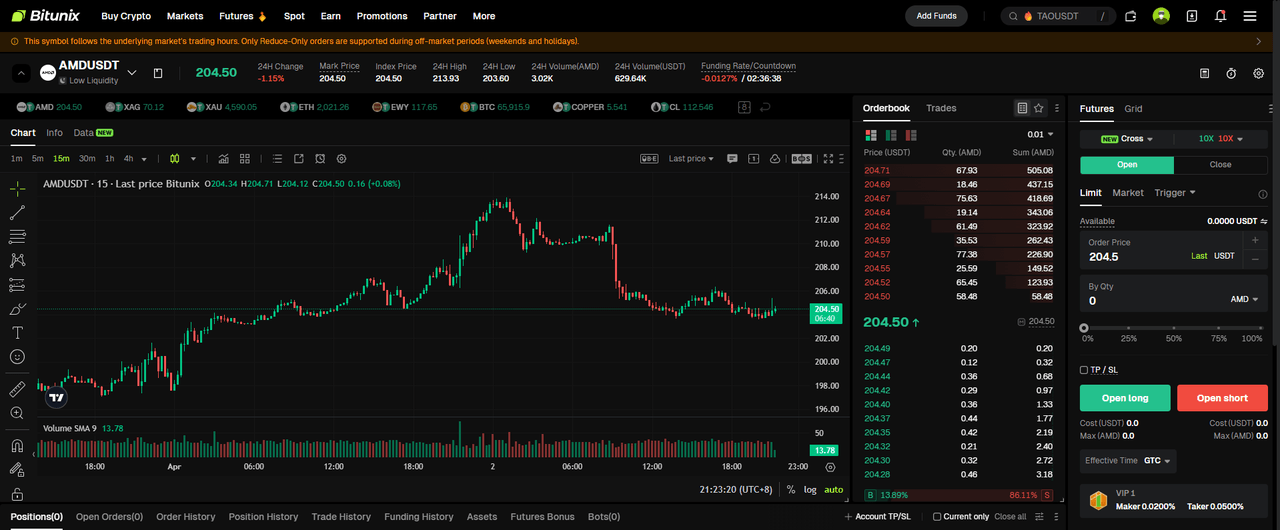
If you want to trade AMDUSDT on Bitunix, the best approach is to keep the process structured.
Understand the Product
Know that AMDUSDT on Bitunix is tied to AMD price movement, not direct stock ownership.
Understand the AMD Narrative
Before entering a trade, ask what is driving AMD right now. Is it AI momentum, earnings expectations, chip-sector strength, or broader tech sentiment?
Study the Chart
Look at:
- Trend direction
- Support and resistance
- Recent volatility
- Breakout levels
- Reaction to market news
Build a Setup
Do not trade AMD just because it is popular. Trade only when your setup is clear.
Examples include:
- Trend continuation
- Breakout above resistance
- Rejection from a key level
- Range trade inside a defined structure
Understand Leverage and Margin
If you are using a leveraged market, position sizing and risk control matter even more.
Define Risk Before Entry
Before opening a position, decide:
- Entry level
- Stop-loss area
- Invalidation point
- Position size
- Exit logic
Monitor Actively
Bitunix AMD trading is not passive investing. AMD can react quickly to earnings, AI headlines, and chip-sector sentiment changes.
Risks Beginners Should Understand When Trading AMD
Before trading AMD stock on Bitunix, beginners should understand the main risks.
- Volatility risk: AMD can move sharply because of earnings, AI headlines, and tech-sector sentiment.
- Leverage risk: If leverage is involved, both gains and losses can be amplified.
- Headline risk: AI announcements, guidance changes, and chip-sector developments can reprice AMD quickly.
- False familiarity: Knowing the AMD brand does not make it easy to trade.
- Product misunderstanding: AMD-linked trading markets are active trading products, not direct AMD share ownership.
Conclusion
AMDUSDT on Bitunix gives users a practical way to trade AMD-linked price movement through a USDT-based market.
We added AMDUSDT to Bitunix TradFi because AMD is one of the most important companies in today’s semiconductor and AI story. It is tied to data centers, advanced computing, AI infrastructure, gaming, and broader tech-sector momentum.
For beginners, the key point is simple. AMD stock on Bitunix is built for active trading, not direct stock ownership. Anyone exploring how to trade AMD on Bitunix should first understand what AMD is, why the company matters, and what kinds of catalysts can move the market.
FAQ
What Is AMD?
AMD, or Advanced Micro Devices, is a technology company known for processors, graphics products, and computing solutions used across data centers, gaming, and PCs.
What Is AMDUSDT on Bitunix?
AMDUSDT on Bitunix is a stock-linked trading market tied to AMD price movement in a USDT-based format.
Is AMD Stock on Bitunix the Same as Owning AMD Shares?
No. AMD stock on Bitunix refers to a trading product linked to AMD price movement, not direct share ownership.
Why Is AMD Called an AI Stock?
AMD is often described as an AI stock because traders associate it with AI infrastructure, computing demand, and the broader growth of AI-related technology.
Why Do Traders Compare AMD vs Intel Stock?
They compare AMD vs Intel stock to evaluate competitive positioning, semiconductor momentum, and broader market sentiment in computing and chip-related sectors.
What Affects an AMD Stock Forecast?
An AMD stock forecast is usually influenced by AI demand, earnings results, guidance, chip-sector trends, data center growth, and overall tech sentiment.
Glossary
- AMD: Advanced Micro Devices, a technology company focused on processors, graphics, and computing solutions.
- AMD AI stock: A market phrase used to describe AMD’s link to AI infrastructure and AI-driven growth narratives.
- AMD earnings forecast: Market expectations around AMD’s upcoming or recent earnings results and guidance.
- AMD stock forecast: A market view built around AMD’s potential future price direction.
- AMD stock outlook: A broader view of AMD’s direction based on AI, semiconductors, earnings, and sector sentiment.
- AMDUSDT: The AMD-linked trading market on Bitunix.
- Bitunix TradFi: Bitunix’s broader traditional finance market offering, including stock-linked products.
- Leverage: A feature that allows traders to control a larger position with a smaller amount of capital.
- Margin: The capital required to open and maintain a trading position.
- USDT: A stablecoin commonly used for pricing, settlement, and trading on exchange platforms.
Disclaimer
This article does not provide:
(i) investment advice or investment recommendations;
(ii) an offer or solicitation to buy, sell, or hold digital assets;
(iii) financial, accounting, legal, or tax advice.
Digital assets, including stablecoins and NFTs, involve high risk and may fluctuate significantly. Consider whether trading or holding digital assets is appropriate for you given your financial situation. Consult a qualified legal, tax, or investment professional when needed. You are responsible for understanding and complying with applicable local laws and regulations.
About Bitunix
Bitunix is a global cryptocurrency derivatives exchange trusted by over 3 million users across more than 100 countries. The platform is committed to providing a transparent, compliant, and secure trading environment for every user. Bitunix offers a fast registration process and a user-friendly verification system supported by mandatory KYC to ensure safety and compliance. With global standards of protection through Proof of Reserves (POR) and the Bitunix Care Fund, Bitunix prioritizes user trust and fund security. The K-Line Ultra chart system delivers a seamless trading experience for both beginners and advanced traders, while leverage of up to 200x and deep liquidity make Bitunix one of the most dynamic platforms in the market.
Bitunix Global Accounts
X | Telegram Announcements | Telegram Global | CoinMarketCap | Instagram | Facebook | LinkedIn | Reddit | Medium