
Article Summary
- This article explores the complex and high-stakes question of whether Ethereum (ETH) should be classified as a security under U.S. law.
- It explains the Howey Test, the primary legal framework used by the SEC to determine if an asset is a security, and applies its four prongs to Ethereum.
- The analysis focuses on two key periods: Ethereum's pre-mined ICO (which has security-like characteristics) and its current state after the transition to Proof-of-Stake (PoS).
- It discusses the arguments for and against ETH being a security, including the level of decentralization and the nature of staking rewards.
- The implications of a security classification are detailed, including strict regulations for exchanges and potential delistings.
It’s the question that hangs over the entire crypto industry, with trillions of dollars at stake: Is Ethereum, the second-largest cryptocurrency, an unregistered security? The answer could reshape the future of digital assets in the United States.
This matters because the U.S. Securities and Exchange Commission has spent the last few years using enforcement actions to push its view of how crypto should fit inside existing securities law. That approach leaves market participants reading court filings the way most people read weather apps. And if you use a crypto exchange, such as Bitunix, to buy or trade ETH, you feel the uncertainty through listings, disclosures, staking products, and which services get geo-blocked.
This analysis will break down the legal arguments surrounding Ethereum's classification. We will examine the Howey Test, the impact of the switch to Proof-of-Stake, and what a security designation would mean for ETH holders and the broader ecosystem.
The Legal Framework: What is the Howey Test?
In the U.S., most debates about crypto tokens and securities law circle back to a Supreme Court concept called an investment contract. Courts often apply the Howey Test to decide whether something functions like one. The SEC uses the same core idea in its digital-asset guidance.
Here is the key language the SEC points to:
"the investment of money in a common enterprise with a reasonable expectation of profits to be derived from the efforts of others."
A clean way to remember the test is to break it into four prongs:
- Investment of money: You put value at risk. It can be cash, crypto, or another form of consideration.
- Common enterprise: Your fortunes are linked with others or with a project. Your outcome depends on a shared venture, not just your own effort.
- Expectation of profit: You buy with a profit motive, not only for consumption or use.
- Profits primarily from the efforts of others: Your profit depends mainly on someone else’s managerial or entrepreneurial work.
Here’s an easy way to picture it. Imagine you join a small farm project. You and a group of people put money into it. The organizer uses the money to plant and run the farm. You expect to earn more than you paid because the farm sells the harvest later, but you are not doing the farming. You rely on the organizer and workers to make it succeed. That reliance is what the Howey test focuses on.
Applying the Howey Test to Ethereum
The Ethereum security question gets messy because this token has lived multiple lives. An early fundraising phase, years of rapid development, and a present-day network run by a large global community.
The table below shows how Ethereum lines up with the Howey Test and where the main disagreements are:
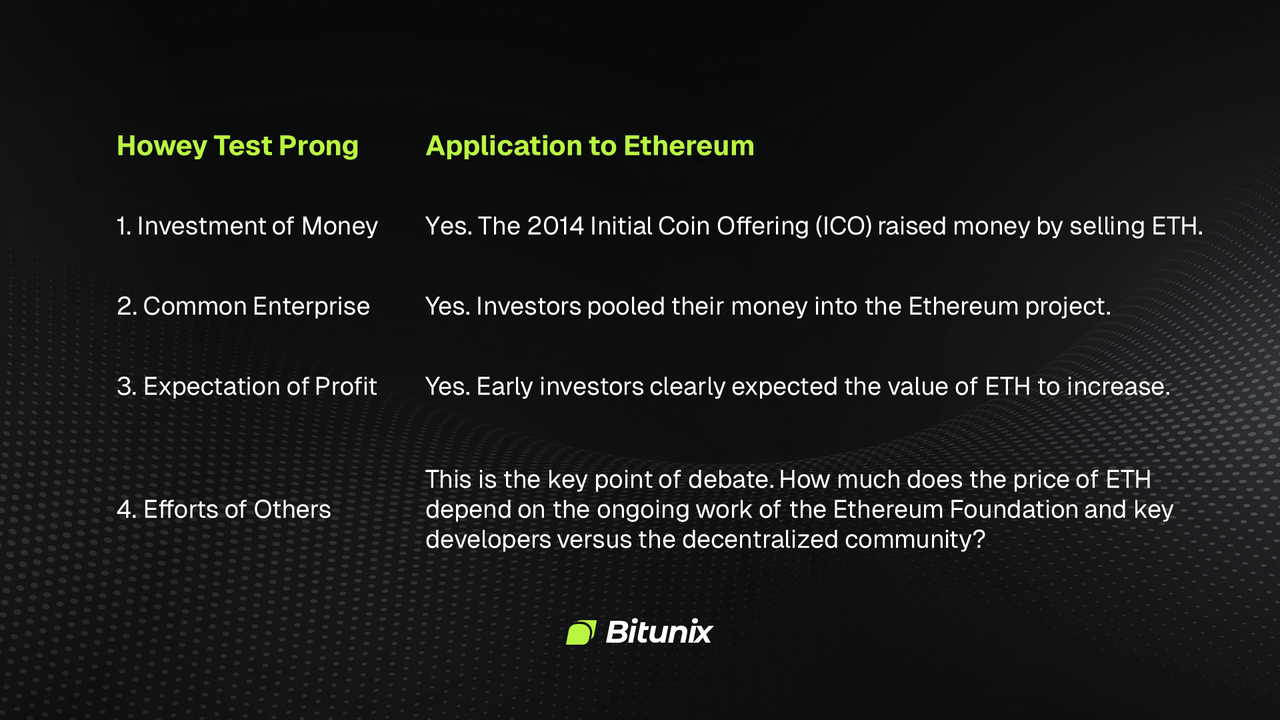
This last prong is where most arguments land. When people ask if Ethereum is a security, they usually want to know whether today’s ETH holders still rely on a clearly identifiable group to drive value.

The Great Debate: Decentralization and Proof-of-Stake
At first glance, decentralization feels like a technical topic, and securities law feels like paperwork. In practice, they collide. Securities law cares about who you rely on.
Decentralization asks whether anyone is in charge in a meaningful way. Ethereum’s shift to Proof-of-Stake adds another layer because it creates a widely used reward mechanism tied to holding and locking ETH.
The Argument For Ethereum as a Security
The pro-security argument starts with the origin story. Ethereum conducted an initial sale of ETH in 2014 to fund development, and critics say the structure looked like a capital raise to build a platform rather than a commodity launching into a mature market. That history gives regulators and plaintiffs a familiar hook that money came in before the network reached its current scale, and buyers expected the core team to deliver.
Then Proof-of-Stake enters. Ethereum moved from Proof-of-Work to Proof-of-Stake in 2022, and staking became a core part of the network’s economics. Some policymakers and regulators have argued that staking rewards can look similar to investment yield, especially when users delegate and expect a return while someone else runs the infrastructure. SEC Chair Gary Gensler has pointed to Proof-of-Stake tokens as raising securities-law questions because holders can receive returns tied to the efforts of others in the ecosystem.
There is also the institutional visibility problem. The Ethereum Foundation supports protocol development work, research, upgrades, and related programs. Even if the Foundation cannot force the network to change by itself, skeptics argue that it still influences priorities, funding, and coordination. For a Howey analysis, that becomes evidence that a recognizable group helps drive the roadmap and the narrative that supports value.
The Argument Against Ethereum as a Security
The core counterpoint is scale and distribution. Ethereum runs across many jurisdictions, many client implementations, and a large validator set. Thousands of independent developers build tooling, apps, and infrastructure without taking instructions from a single issuer. That makes it harder to claim that ETH holders depend primarily on one managerial group today.
This idea also shows up in the SEC’s own public history. In a 2018 speech, SEC official William Hinman said that, based on his understanding at the time, current offers and sales of Ether were not securities transactions, pointing to how decentralization can change the analysis over time. The speech was not a binding rule, but it remains a major reference point in the Ethereum SEC debate.
On staking, defenders emphasize activity and risk. Validators run software, keep systems online, attest to blocks, and face penalties such as slashing for misbehavior. That looks like providing a network security service rather than collecting a dividend. Recent SEC staff guidance has also signaled that certain protocol staking activities can fall outside securities registration, depending on the facts.
Finally, Ethereum’s market treatment matters in practice. The CFTC has publicly described Ether as a commodity in past remarks, and market structure has often followed that framing even while the SEC avoids giving a single definitive, always-true label.
What Happens if ETH is Declared a Security?
A security label would not just change a legal memo. It would change day-to-day access, product design, and liquidity. Here is what will probably look like:
- Stricter regulation for exchanges: Platforms that list and offer trading for a security can trigger broker-dealer, exchange, and disclosure obligations. That can require new registrations, surveillance systems, and ongoing reporting.
- Potential delistings for U.S. customers: Some venues would choose to stop offering ETH in the U.S. rather than operate under a multi-year compliance and litigation risk. That can fragment liquidity and increase spreads.
- A chilling effect on DeFi: Many DeFi systems depend on ETH as collateral, gas, or a base asset. A security designation raises questions for interfaces, teams, and intermediaries that support users, even when the protocol code is public.
- Knock-on effects for ETFs and institutions: In 2024, U.S. regulators approved rule changes that opened the door for spot ether ETFs to begin trading, and many market participants read that as evidence that ETH was not being treated like a typical unregistered security at that moment.
- Product changes around spot pairs and disclosures: Trading access can shift toward venues and jurisdictions that can support the new compliance burden. If you track market liquidity, you will often see it concentrated in major spot pairs like the ETH/USDT market.
Conclusion: A Cloud of Uncertainty Remains
Ethereum’s legal story has two truths side by side. The early fundraising phase had security-like traits. The modern network operates as shared infrastructure with many independent actors, and that weakens the case that a single group drives value.
Regulators have also sent mixed signals over time. The CFTC has described ETH as a commodity, SEC officials have discussed decentralization as a key factor, and the SEC has still used enforcement actions to test arguments across the industry.
So what do you do with that? Treat headlines as inputs, not instructions. Watch court outcomes and SEC actions, because they shape how other assets get analyzed. And if you trade or build on Ethereum, assume product availability can change quickly. If you use Bitunix, check the notices and product pages for your region, since exchanges adjust listings and features when rules change.
Navigating the regulatory landscape is key to being a smart investor. While the debate continues, Bitunix is committed to compliance and providing a secure platform for trading major digital assets like Ethereum. Stay informed and trade wisely.
After understanding all the implications regarding considering Ethereum a security, download the Bitunix app, sign up and start trading ETH/USDT.
FAQ
Has the SEC officially declared Ethereum a security?
No single SEC statement has settled ETH’s status for all contexts and all time. The SEC has often avoided giving a definitive label even while it pursues cases involving other tokens.
What did SEC officials say about Ethereum in the past?
In 2018, SEC official William Hinman said that, in his view at the time, current offers and sales of Ether were not securities transactions, tied to decentralization considerations.
How is Ethereum different from XRP in the eyes of the SEC?
The SEC sued Ripple over XRP sales and argued they involved unregistered securities offerings. A U.S. judge later drew distinctions between different types of XRP sales, and the SEC ended the lawsuit in 2025 with a payment, and both sides dropped appeals. That case was about Ripple’s sales conduct and disclosures, not about a mature base-layer network with Ethereum’s validator and developer structure.
If ETH is a security, what does that mean for my holdings?
It can change where you can trade, what disclosures apply, and whether intermediaries restrict access for compliance reasons. If a court later decides that Ethereum is a security under U.S. law, expect exchange products and staking services to change first, not last.
Does the switch to Proof-of-Stake make ETH more or less like a security?
It increases the legal attention on the fourth Howey prong because rewards tie holding ETH to returns. Regulators have pointed to Proof-of-Stake tokens as raising securities-law issues, while defenders argue that validators perform real work and take real operational risk.
What is a commodity in the context of crypto?
In this context, it generally means an asset treated more like a traded good than a security, often associated with CFTC oversight in derivatives markets. Past CFTC leadership has publicly described Ether as a commodity.
Could the U.S. Congress pass a law to clarify this issue?
Yes. Congress can create a clearer statutory framework for digital assets. Until that happens, agencies and courts keep shaping the edges.
How does this debate affect Ethereum ETFs?
Spot Ether ETFs began trading after the SEC approved rule changes in 2024. That does not equal a permanent legal determination, but it heavily influences how institutions assess risk and custody choices.
Is Bitcoin considered a security?
U.S. regulators have generally treated Bitcoin differently from many tokens, and it is commonly referenced as a commodity. Past CFTC remarks have grouped Bitcoin and Ether as commodities.
Where can I follow the latest news on crypto regulation?
Check the SEC newsroom and litigation releases, CFTC press releases, and major legal and financial outlets that cover regulatory filings and court rulings.
Glossary
- Howey Test: A U.S. legal test used to identify investment contracts under securities law.
- Investment contract: A type of security defined through case law and commonly evaluated using Howey.
- Common enterprise: A Howey element involving shared fortunes among investors or with a promoter.
- Expectation of profit: A Howey element focused on whether buyers expect financial gains.
- Efforts of others: The Howey element that asks whether profit depends mainly on managerial work by others.
- SEC: U.S. Securities and Exchange Commission.
- CFTC: U.S. Commodity Futures Trading Commission.
- Proof-of-Stake (PoS): A consensus model where validators stake assets to help secure the network and earn rewards.
- Validator: A participant that proposes or attests to blocks in PoS networks.
- Staking: Locking tokens to participate in network security and earn rewards in PoS systems.
- Slashing: A penalty that can reduce a validator’s stake for violations or misbehavior.
- Decentralization: Distribution of control across many independent participants rather than a central operator.
- Spot ETF: An exchange-traded fund that tracks the spot price of an asset.
- DeFi: Decentralized finance applications, often built on smart contract platforms like Ethereum.
- Protocol development: Work on core network software, research, and upgrades, sometimes supported by entities like the Ethereum Foundation.
About Bitunix
Bitunix is a global cryptocurrency derivatives exchange trusted by over 3 million users across more than 100 countries. The platform is committed to providing a transparent, compliant, and secure trading environment for every user. Bitunix offers a fast registration process and a user-friendly verification system supported by mandatory KYC to ensure safety and compliance. With global standards of protection through Proof of Reserves (POR) and the Bitunix Care Fund, Bitunix prioritizes user trust and fund security. The K-Line Ultra chart system delivers a seamless trading experience for both beginners and advanced traders, while leverage of up to 200x and deep liquidity make Bitunix one of the most dynamic platforms in the market.
Bitunix Global Accounts
X | Telegram Announcements | Telegram Global | CoinMarketCap | Instagram | Facebook | LinkedIn | Reddit | Medium
Disclaimer: Trading digital assets involves risk and may result in the loss of capital. Always do your own research. Terms, conditions, and regional restrictions may apply.