

Article Summary
- This article provides a comprehensive explanation of the 1% rule in the context of cryptocurrency trading.
- It breaks down the fundamental principle of risking only 1% of your trading capital on any single trade.
- The guide explores how to calculate position sizes based on the 1% rule and how to implement it consistently.
- It highlights practical applications for traders, including how the 1% rule compounds wealth over time and protects against catastrophic losses.
- The article concludes with actionable advice for implementing the 1% rule in your trading strategy.
- Most traders fail because they risk too much when a trade moves against them, turning one bad decision into a loss that damages both their account and their confidence. Once that happens, the next trade often becomes emotional rather than planned, and the trader starts chasing recovery instead of focusing on clean execution.
- The 1% rule gives traders a clear limit before emotions take over, keeping the maximum planned loss on any single trade to 1% of total trading capital. For example, if your account has $10,000, the most you should plan to lose on one trade is $100, which helps protect your account while giving you enough room to learn, adjust, and improve over time.
- This rule is especially useful in crypto, where fast moves, leverage, and sharp reversals are common. When you trade on a crypto exchange like Bitunix, your goal is to decide how much capital you are willing to lose if the trade does not work. Bitunix offers spot and futures trading tools, including risk features that make more sense when traders already understand their own limits.
- This guide explains the 1% rule, how to calculate position sizes, and how this risk management habit supports long-term trading. You will also see why capital preservation matters more than one exciting trade, especially in markets that can move against you faster than expected.
Understanding the 1% Rule
The 1% rule keeps your maximum planned loss on any single trade below 1% of your total account, so the dollar amount changes as your balance changes. For example, a $5,000 account would risk no more than $50 per trade, while a $25,000 account would risk no more than $250, but the core principle stays the same: each trade should only expose a small, controlled part of your capital.
This limit caps your planned loss at 1% if your stop loss is triggered, but it does not automatically determine the size of the trade. Your position size depends on the distance between your entry price and stop loss, which means a wider stop requires a smaller position, while a tighter stop allows for a larger one.
Many traders confuse position size with risk, which creates problems. Position size is how much of an asset you buy or sell, while the risk is how much you lose if the trade fails. A trader can open a large position with a small planned loss if the stop is tight, but the stop still needs to make sense on the chart.
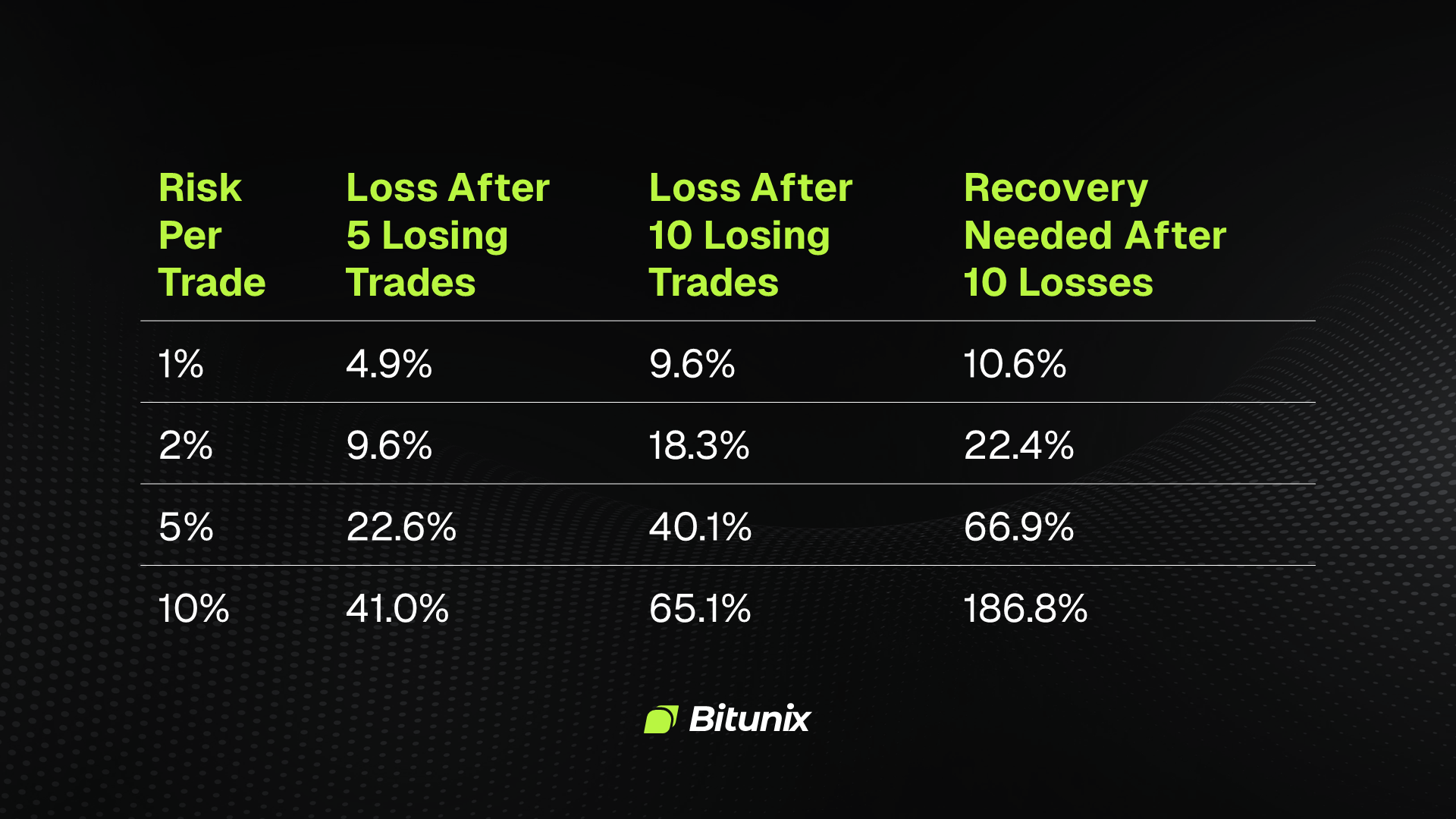
How different risk levels affect drawdown and the recovery needed after 10 losing trades.
The table shows how fast account damage increases when risk per trade rises. A trader who risks 1% per trade can lose 10 trades in a row and still keep most of the account intact. A trader who risks 10% per trade faces a much deeper drawdown and needs a much larger return just to reach the starting balance again.
Consistent use of the 1% rule also supports compound growth over time. When your account grows, your 1% risk amount grows with it. A $10,000 account risks $100 per trade, while a $15,000 account risks $150. The rule lets your position sizing increase as your capital grows, without forcing you to gamble for bigger returns.
The psychological benefit is just as important as the math. When you know your maximum loss before entering a trade, the setup becomes easier to manage. You can accept being wrong without feeling like the account is in danger. That reduces panic, revenge trading, and the urge to move your stop loss.
Calculating Position Sizes Using the 1% Rule
Position sizing turns risk management from a general idea into a specific number you can use before entering a trade. With it, you know how much to trade based on your account size, entry price, and stop loss.
The Formula
The basic position sizing formula connects your account risk to the distance between your entry and stop loss.
Position Size = Account Size × 1% ÷ Entry Price - Stop Loss Price
This formula helps you calculate how many coins, tokens, or contracts you can trade while keeping your planned loss at 1%. For example, if your account has $10,000, your 1% risk is $100, and if you enter Bitcoin at $70,000 with a stop loss at $69,000, your risk per BTC is $1,000. That means your position size would be 0.1 BTC, because $100 divided by $1,000 equals 0.1.
Step-by-Step Example
A practical example makes the 1% rule easier to apply before a real trade. Assume you want to trade ETH with a defined entry, stop loss, and account size:
- Start with your account size: In this example, your account has $8,000.
- Calculate 1% of your account: One percent of $8,000 equals $80.
- Choose your planned entry price: Assume your entry is $2,285.
- Choose your stop loss price: Set it to $2,205.
- Calculate the risk per coin: The difference between $2,285 and $2,205 is $80.
- Divide your allowed risk by the risk per coin: Your $80 allowed risk divided by $80 risk per ETH equals 1 ETH.
- In this example, your maximum position size is 1 ETH. If the stop loss is triggered at the planned price, the trade loses $80, or 1% of the account. The same logic applies to smaller accounts, though the position size is smaller. A trader with a $1,000 account and a 1% risk limit can lose $10 on one trade. That trader needs a smaller position, a tighter valid stop, or a setup with better structure.
Adjusting for Risk Tolerance
Traders can adjust the rule to 0.5% or 2% based on experience, account size, and market conditions. A 0.5% limit works well for beginners, traders testing a new trading strategy, or anyone trading during volatile periods. It gives you more room to make mistakes without causing heavy account damage.
A 2% limit is more aggressive and creates faster drawdowns when trades go wrong. Experienced traders sometimes use it, but they need a tested system, consistent execution, and strict stop losses, since higher risk also adds emotional pressure.
The useful way to think about risk tolerance is that a 0.5% risk limit is defensive, a 1% risk limit is balanced, and a 2% risk limit is aggressive. Anything above that needs a strong reason, because the account recovery math becomes much less forgiving.
Account Growth
The 1% rule adjusts naturally as your account balance changes, so your allowed risk increases when your capital grows and decreases when your capital falls. This automatic adjustment helps protect your account during losing periods while still letting you scale your position sizes during winning periods.
A trader who grows an account from $10,000 to $15,000 increases the 1% risk amount from $100 to $150. That account can now support a slightly larger planned loss because the capital base is larger.
The same rule protects you after losses. If your account falls from $10,000 to $9,000, your 1% risk drops from $100 to $90, helping to slow further damage during drawdowns and giving you more time to review what is going wrong.
Implementing the 1% Rule in Practice
The rule is easy to understand, but it only works when you apply it before entering a trade. Risk management should be part of your routine, so your position size, stop loss, and maximum loss are already clear before the market starts moving against you.
1. Pre-Trade Planning
Pre-trade planning involves calculating your risk before opening a position. You should know your entry, stop loss, target area, position size, and maximum planned loss before placing the order.
A simple checklist helps keep the process consistent. Ask yourself where the entry is, where the stop loss is, how much the trade can lose, and what position size fits that risk. If you cannot answer those questions, the trade needs more work.
Bitunix's Fixed Risk feature is an example of how trading tools can support this process. The feature lets traders set a maximum loss per trade, such as 50 USDT, and the system calculates position size based on that predefined risk input.
2. Stop Loss Placement
Stop loss placement directly affects position sizing because it defines how much each unit of the trade can lose. When the stop loss is close to the entry, the risk per coin or contract is smaller, so the trader can take a larger position while still respecting the 1% rule. When the stop loss is farther from the entry, the risk per unit increases, so the position size needs to be smaller.
For example, if your maximum risk is $100 and your stop is $1 away from entry, you can trade 100 units. If your stop is $5 away, you can only trade 20 units. In both cases, the planned loss remains $100, but the position size adjusts to match the stop loss distance.
Stop losses should be based on the position size you want to take. If the chart requires a wider stop below support or above resistance, the better choice is to reduce the position size. Moving the stop closer to trade a larger position can weaken the setup and increase the risk of being stopped out by normal price movement.
3. Scaling Positions
Scaling into a trade means building a position in increments, while scaling out means taking profits in increments. Both methods can be used with the 1% rule, but the total planned risk must remain within your chosen limit.
A trader with a $10,000 account and a 1% limit can risk $100 total on the trade idea. That risk can be split across two entries of $50 each, or across several smaller entries. What breaks the rule is risking $100 on the first entry and then adding another $100 of risk later because the trade feels good.
Scaling out can also reduce emotional pressure after the trade moves in your favor. A trader can take partial profit, adjust the stop, and reduce open risk, keeping the trade managed.
4. Tracking and Monitoring
Tracking actual risk is just as important as calculating planned risk. Fees, slippage, poor execution, and leverage can make the final loss larger than the number you wrote down before the trade. A trading journal helps you see whether your real results match your plan.
A useful journal includes entry price, stop loss, position size, planned risk, actual profit or loss, fees, slippage, and notes about your decision-making. Over time, this record shows whether you follow the rule consistently or quietly bend it when emotions take over.
Recent market data reinforces the need for careful tracking. CoinGecko's Q1 2026 Crypto Industry Report shows that total crypto market cap fell 20.4% during the quarter to $2.4 trillion, while average daily trading volume dropped 27.2% to $117.8 billion. Lower trading activity and weaker liquidity can make exits less smooth, especially during volatile periods.
Limitations and Considerations
The 1% rule protects capital, but it does not make a weak strategy profitable. A trader can follow the rule perfectly and still lose money if entries are poor, exits are random, or the strategy has no edge. The rule gives you more time to improve, but it does not do the trading for you.
Slippage and fees can push actual risk above the planned 1% limit. If you expect to lose $100 but pay fees and exit worse than planned, the final loss can exceed your target. This issue becomes more common in fast markets, thin altcoin pairs, and leveraged positions.
Extreme market events create another risk because stop losses do not always execute exactly where planned. Reuters reported in February 2026 that Bitcoin investors liquidated $2.56 billion during a broader crypto downturn, a move exacerbated by low liquidity.
Institutional market infrastructure is also paying more attention to crypto volatility. Cboe announced in March 2026 that it would launch BITVX, a volatility index designed to measure 30-day forward-looking Bitcoin volatility based on options on the iShares Bitcoin Trust ETF. This type of product reflects the growing centrality of volatility measurement in digital asset markets.
Fidelity's 2026 crypto outlook gives a useful risk reminder for anyone trading digital assets:
"Crypto as an asset class is highly volatile, can become illiquid at any time, and is for investors with a high risk tolerance. Crypto may also be more susceptible to market manipulation than securities.”
Flexibility can help, but it needs rules. Some traders reduce risk during choppy markets and increase it slightly when conditions are cleaner. That approach can work when it is written into the plan. It becomes dangerous when the trader changes risk only because they feel impatient, angry, or desperate to recover.
Conclusion: Building Wealth Through Disciplined Risk Management
The 1% rule is one of the simplest risk management tools available to traders. It limits the damage from any single trade, supports capital preservation, and helps you think in probabilities instead of emotions.
Over time, that discipline becomes part of the trading strategy itself. By applying the rule consistently, you can survive losing streaks, recover from drawdowns, and give your strategy enough time to prove whether it works. You still need valid setups, clear exits, and honest trade reviews, but position sizing provides a safer structure for those habits.
Ready to implement the 1% rule in your trading? Download the Bitunix app, and register to access trading tools that can help you plan position size, monitor risk, and manage trades with more discipline.
FAQ Section
What exactly is the 1% rule in trading?
The 1% rule means you risk no more than 1% of your total account on one trade. For a $10,000 account, that means the planned loss should not exceed $100. The rule helps limit damage from losing streaks and supports capital preservation.
How do I calculate position size using the 1% rule?
You calculate position size by dividing your allowed dollar risk by the distance between your entry price and stop loss. For example, if you can risk $100 and your stop is $5 away, your position size is 20 units.
Why is the 1% rule important for trading success?
The 1% rule helps you manage losses before emotions take over. By limiting each trade's downside, you protect your account during losing streaks and make it easier to follow a trading plan rather than changing your decisions under pressure.
Can I adjust the 1% rule to 2% or 0.5%?
You can adjust the rule based on experience, market conditions, and strategy performance. A 0.5% limit is more conservative, while 2% is more aggressive and usually better suited to traders with proven results and strong risk controls.
How does the 1% rule protect against account ruin?
The 1% rule protects against account ruin by keeping each loss small enough to recover from. A long losing streak still hurts, but it does not usually hurt the account. Higher risk per trade creates deeper drawdowns and makes recovery much harder.
What happens if I ignore the 1% rule?
Ignoring the 1% rule increases the chance that one or two bad trades cause serious damage. Larger losses also create emotional pressure, which often leads to revenge trading, oversized positions, and weaker decisions after the original trade has already gone wrong.
How does the 1% rule work with different stop loss distances?
The 1% rule adjusts position size around your stop loss distance. A wider stop means each unit carries more risk, so the position must be smaller. A tighter stop allows a larger position, as long as the stop still makes sense on the chart.
Does the 1% rule guarantee profits?
The 1% rule does not guarantee profits because risk control cannot fix a weak strategy. You still need strong entries, clear exits, and consistent execution. The rule's main job is to protect your capital while you test and improve your trading process.
How do I account for slippage and fees with the 1% rule?
You account for slippage and fees by building them into your risk calculation before entering the trade. If execution costs can push the loss above 1%, reduce the position size slightly so the final loss stays closer to your planned risk.
Where can I find position sizing calculators?
You can find position sizing calculators on trading platforms and specialist trading tools. Bitunix also provides trading features that help users define risk before opening positions, while third-party calculators can estimate size from account balance, risk percentage, entry, and stop loss.
Glossary
- 1% rule: A risk management rule that limits planned loss on one trade to 1% of total account capital.
- Account equity: The current value of your trading account, including open profits or losses.
- Capital preservation: The practice of protecting trading funds so losses do not end your ability to trade.
- Drawdown: The decline in account value from a previous high after a series of losses.
- Entry price: The price at which you open a trade based on your planned setup.
- Exit price: The price at which you close a trade for profit or loss.
- Fees: Trading costs charged by an exchange when you open or close positions.
- Leverage: Borrowed exposure that lets traders control a larger position than their account balance alone allows.
- Liquidation: Forced position closure when margin falls below required levels.
- Position sizing: The process of deciding how large a trade should be based on risk.
- Risk management: A trading process that limits losses and protects long-term capital.
- Risk-reward ratio: A comparison between the amount risked and the potential profit target.
- Slippage: The difference between the expected trade price and the actual execution price.
- Stop loss: An order or planned exit level used to close a losing trade.
- Trading strategy: A structured plan that defines entries, exits, risk, and trade selection rules.
Disclaimer
This article does not provide:
(i) investment advice or investment recommendations;
(ii) an offer or solicitation to buy, sell, or hold digital assets;
(iii) financial, accounting, legal, or tax advice.
Digital assets, including stablecoins and NFTs, involve high risk and may fluctuate significantly. Consider whether trading or holding digital assets is appropriate for you given your financial situation. Consult a qualified legal, tax, or investment professional when needed. You are responsible for understanding and complying with applicable local laws and regulations.
About Bitunix
Bitunix is a global cryptocurrency derivatives exchange trusted by over 3 million users across more than 100 countries. At Bitunix, we are committed to providing a transparent, compliant, and secure trading environment for every user. Our platform features a fast registration process and a user-friendly verification system supported by mandatory KYC to ensure safety and compliance. With global standards of protection through Proof of Reserves (POR) and the Bitunix Care Fund, we prioritize user trust and fund security. The K-Line Ultra chart system delivers a seamless trading experience for both beginners and advanced traders, while leverage of up to 200x and deep liquidity make Bitunix one of the most dynamic platforms in the market.
Bitunix Global Accounts
X | Telegram Announcements | Telegram Global | CoinMarketCap | Instagram | Facebook | LinkedIn | Reddit | Medium