
Article Summary
- This article provides a detailed price prediction and fundamental analysis for the Coq Inu (COQ) token.
- It explains Coq Inu as the leading meme coin on the Avalanche (AVAX) blockchain, created entirely for entertainment and community building with no intrinsic utility.
- The bull case focuses on its massive, highly engaged community, its position as the "mascot" of the Avalanche ecosystem, and the historical tendency for top-tier meme coins to achieve multi-billion dollar valuations during bull markets.
- The bear case highlights the extreme volatility of meme coins, the complete lack of fundamental utility, and the risk of the community moving on to the next trending token.
- It presents detailed price prediction scenarios (bearish, neutral, bullish) for both 2026 and 2030, based entirely on market sentiment and Avalanche network growth.
Crypto has a funny habit of proving that utility is not the only thing markets care about. Sometimes, a strong joke, a recognizable mascot, and a loud online crowd are enough to build a real market cap, at least for a while, and a good example is Coq Inu, a meme coin built for speculation and community culture inside Avalanche. For readers who follow volatile assets on a crypto exchange, Bitunix is one place to watch the broader meme coin market, but COQ still lives and dies by attention more than fundamentals.
At its core, the COQ token has no formal utility promise, no intrinsic value, and no business model to support it. Its role is cultural and speculative within the AVAX ecosystem, where it serves as a recognizable community token for traders seeking exposure to Avalanche's meme-coin corner. This analysis examines the chain it runs on, the fair-launch structure that underpins it, and the sentiment-driven scenarios that could shape possible 2026 and 2030 outcomes.
The Technology and Ecosystem
COQ runs on Avalanche C-Chain, which gives it the same basic advantages other Avalanche tokens get, namely fast settlement and relatively low transaction costs compared with older Ethereum mainnet trading. C-Chain is an EVM chain where gas is paid in AVAX, and C-Chain transactions reach finality in about one second. For retail users, that makes an Avalanche meme coin much cheaper and easier to trade than a similar token living on a more expensive chain.
Avalanche also spent 2025 trying to improve that experience. In March 2025, the Octane upgrade activated ACP-176 to improve gas-target dynamics and lower fee pressure on C-Chain. The official Avalanche blog put it this way:
"This upgrade activates ACP-176, which positions the Avalanche C-Chain to have cheaper gas fees and better handle future increases in network demand."
That line connects the meme trade to the base-layer environment. COQ has no serious technology of its own, but it benefits from being cheap to move, cheap to swap, and accessible for small traders.
The tokenomics are part of the appeal. CoinGecko's current COQ page says the token was founded by community members who took no distribution, put the full supply together with 150 AVAX in initial liquidity, and then left the contract fully renounced with liquidity burned. That setup is why fair launch still matters in the COQ story. It tells traders there is no team wallet waiting in the wings and no mint function ready to surprise the market later.
What keeps COQ alive more than anything else is the community around it. The token serves as a cultural badge inside Avalanche much more than as a productive asset.
CoinGecko currently values it at about $10.5 million, with 24-hour trading volume of roughly $2.37 million and a circulating supply of 69 trillion tokens. Those are not giant numbers by crypto standards, but they are enough to keep a social narrative alive when traders start rotating back into memes.
The Bull Case: The Avalanche Mascot
Forecasts for COQ are wide enough to show that analysts are not really modeling utility or cash generation here. They are modeling sentiment, liquidity, and how much meme energy Avalanche can hold in the next cycle.
- CoinCodex's price prediction projects COQ at about $0.0000001394 by the end of 2026 and $0.0000003812 by 2030.
- Kraken's model uses a flatter path, with COQ around $0.00000015 in 2026 and $0.00000018 in 2030.
- TradersUnion's forecast is more optimistic for 2026 at roughly $0.0000002121, but much weaker for 2030 at about $0.0000000371.
- Changelly's price prediction is the most aggressive of the group, with an average 2026 estimate near $0.000000286 and an average 2030 estimate around $0.00000126.
1. The Dogecoin of AVAX
The strongest bullish argument is the brand position inside its home chain. Every major ecosystem tends to produce one meme asset that becomes the cultural shorthand for the whole scene. Dogecoin did it for early crypto culture, Shiba Inu did it for Ethereum-era meme mania, and BONK did it for Solana. COQ has a real shot at filling that role for Avalanche because it already markets itself as the number one meme coin on AVAX and has a fair-launch story that meme traders like to repeat.
There is still a huge size gap between COQ and the category leaders, which is exactly why some speculators stay interested. CoinGecko currently shows Dogecoin at a $15.1 billion market cap, Shiba Inu at $3.66 billion, and Bonk at $566 million, while COQ sits at $10.5 million. The best-case scenario is that COQ keeps its place as Avalanche's mascot, remains the default meme ticker for that chain, and captures the kind of catch-up speculation that smaller meme coins often see.
2. Ecosystem Liquidity
The second bullish factor is liquidity on the base chain. DefiLlama currently shows Avalanche with a stablecoin market cap of about $1.427 billion, roughly $121 million in 24-hour DEX volume, about 620,781 active addresses over 24 hours, and around 2.06 million daily transactions. Those numbers do not belong to COQ itself, but they matter because meme coins rise when the home chain is active, easy to use, and liquid enough for retail flows to move fast.
That is where the best-case scenario connects back to Avalanche. If more traders rotate into the AVAX ecosystem, some share of that risk capital usually leaks into the chain's meme layer. COQ benefits from already being recognizable. It only needs to remain the first meme ticker many Avalanche traders think about when speculation returns.
3. The Power of Hype
CoinGecko's current meme sector page says the meme token category still carries a $37.79 billion valuation even after cooling off from prior peaks. Its summary also says the sector remains about 75% below its December 2024 peak. That is useful context because it shows meme coins are just resting between manias, which tends to be when the next narrative gets built.
That is the logic behind the most optimistic Coq Inu price prediction. If meme coins get another broad retail wave, coins with recognizable identity, old community lore, and clean launch stories often run harder than technically stronger projects.
The Bear Case: The Gravity of Zero Utility
The downside case is easier to explain because COQ gives you almost nothing fundamental to hide behind. The same forecast spread that supports a meme-driven upside also leaves room for collapse. CoinCodex's 2026 target is already below the current price, Kraken's estimate stays basically flat, and TradersUnion's 2030 estimate drops sharply below today's level. For a token with no revenue, no product, and no formal roadmap, that kind of divergence is exactly what you should expect.
1. Extreme Volatility
The first bear factor is raw price behavior. CoinGecko shows COQ reached an all-time high of $0.000006447 in March 2024 and an all-time low of $0.00000007773 in February 2026. It is currently about 97.7% below the peak and only 94.1% above the low.
The worst-case scenario does not require a scandal or an exploit. It only requires traders to lose interest, and when that happens, these tokens often drop fast and stay down for a long time. Some recover in a later cycle, but many never return to their old levels.
2. No Fundamental Floor
Another major bear factor is the absence of any real valuation floor. COQ has no protocol fees, no staking yield, no governance relevance, and no operating network that people depend on. CoinGecko's self-description makes that clear indirectly by centering the fair launch and community identity rather than any utility layer. If the meme stops being funny and the crowd finds another token to chase, there is no cash flow or strategic reason for anyone to step in and defend the price.
3. The Attention Economy
The risk of replacement is another serious problem for COQ, as meme coin traders are among the least patient participants in crypto. They constantly rotate into newer narratives, funnier branding, or chains with better momentum. COQ may be prominent inside Avalanche today, but nothing stops another token from taking that cultural slot if the social energy shifts. And once attention moves, liquidity often moves with it.
That risk is especially relevant because COQ already sits far below the market cap tier of the biggest meme names. Smaller tokens can move faster on the upside, but they can also disappear from conversation much faster. If Avalanche traders decide another ticker is more entertaining, or if market focus moves back to Solana or Ethereum memes, COQ can lose relevance without any change in its contract, supply, or chain environment.
Coq Inu Price Prediction Scenarios (2026 & 2030)
Published outlooks for COQ are spread so widely that using a single target would make the forecast look more precise than it really is. A scenario table is a better fit here because the token's path depends less on fundamentals and more on how current price levels, market cap, and meme-cycle sentiment interact across the very different models from CoinCodex, Kraken, TradersUnion, and Changelly.
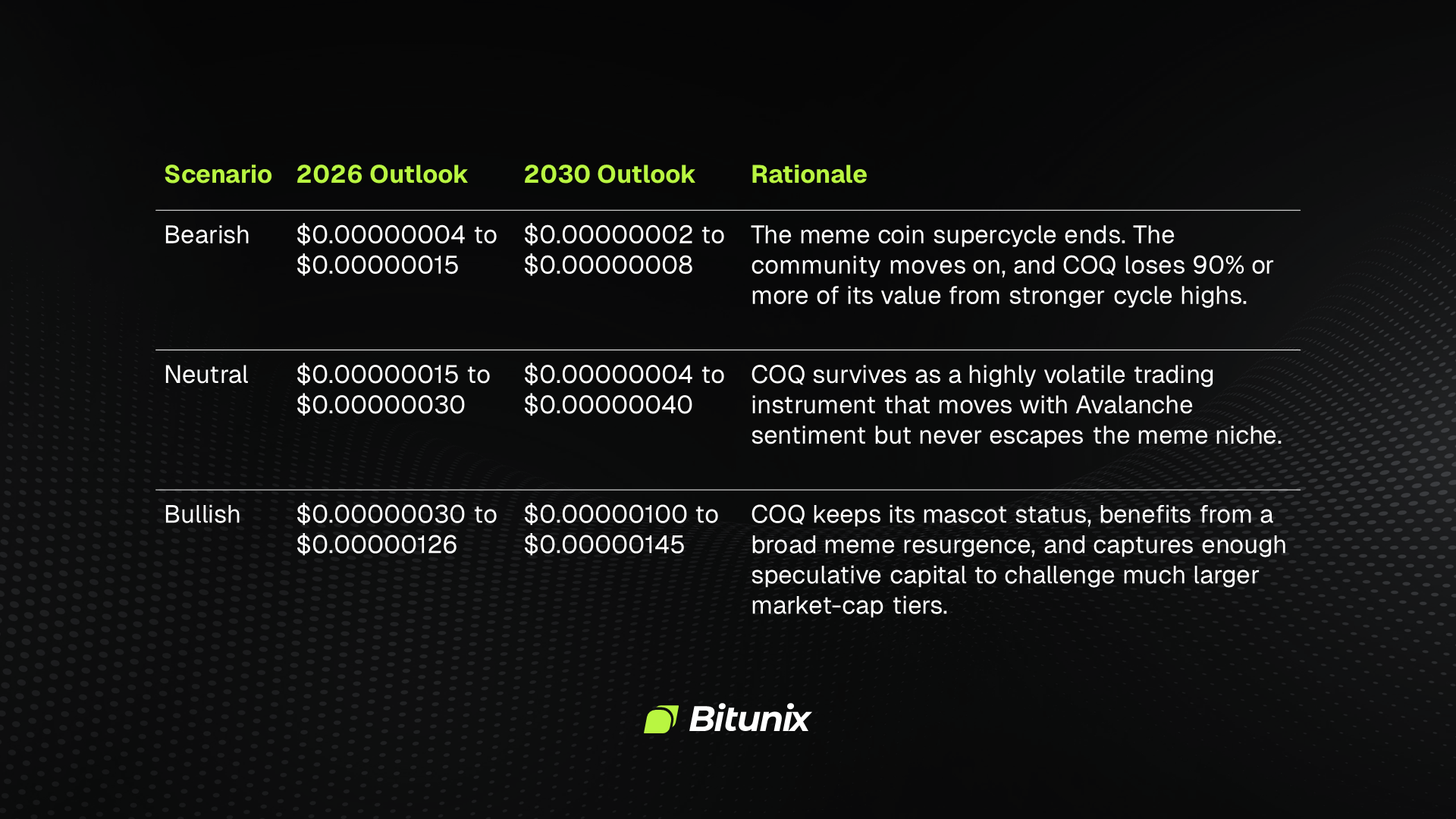
Coq Inu price prediction scenario table comparing bearish, neutral, and bullish outlooks for 2026 and 2030.
Conclusion: A High-Risk Gamble
Coq Inu remains the clearest meme coin symbol inside Avalanche, and that alone gives it some staying power. It has a fast chain under it, a fair-launch backstory, and a social identity that still resonates with traders who like chain-native culture plays. But that does not change what the asset is. COQ is driven by hype, liquidity rotation, and internet attention, not by underlying utility or revenue.
Buying COQ is not a bet on technology. It is a high-risk gamble on crowd behavior, meme persistence, and whether the Avalanche ecosystem keeps enough speculative energy alive to support its top joke asset. Bitunix is one place to follow volatile crypto markets, and you can download the Bitunix app and register to keep an eye on meme coin pricing as conditions change.
FAQ
What is Coq Inu (COQ)?
Coq Inu is a meme coin on Avalanche C-Chain. It was launched by community members, has no formal utility promise, and trades mostly on social momentum, speculation, and its identity as a culturally recognizable AVAX-native meme asset.
Does the COQ token have any utility?
Not in the usual protocol sense. COQ does not have a formal revenue model, staking role, or core network function. Its value comes from meme culture, trading activity, and community interest rather than from a productive use case.
Why is COQ built on the Avalanche network?
Avalanche gives COQ fast finality and relatively low transaction costs, which makes it easier for retail users to swap and move small positions. Meme coins work better when trading friction is low, and Avalanche fits that pattern well.
What does it mean that the COQ contract is renounced?
A renounced contract means the creators no longer control key administrative functions. In practice, that helps reduce fears that a team can later change rules, mint more supply, or manipulate the token after launch.
Who created Coq Inu?
Coq Inu was created by anonymous Avalanche community members, most often identified as Wojak Satoshi and Gribbly Fire. They launched it on December 7, 2023, as a fair-launch meme coin, with no presale or team allocation, and handed control to the community.
How does COQ compare to Dogecoin or Shiba Inu?
COQ is much smaller and much riskier. Dogecoin and Shiba Inu already have multibillion-dollar market caps, while COQ remains a microcap meme asset. The upside can look larger, but so can the downside when attention leaves.
Is Coq Inu a safe investment?
No. COQ is a highly speculative meme coin with no fundamental floor, significant price swings, and heavy reliance on community attention. It can rise fast during a meme cycle, but it can also lose most of its value when hype disappears.
What drives the price of COQ?
The main drivers are sentiment, meme coin market conditions, Avalanche activity, social media attention, and liquidity rotation from traders looking for chain-native speculation. Price behavior is much more emotional than fundamental.
What are the risks of investing in meme coins?
The biggest risks are extreme volatility, weak liquidity during downturns, lack of intrinsic value, crowd-driven pump-and-dump behavior, and the constant threat of newer meme tokens taking attention away from older ones.
Where can I buy COQ tokens?
COQ trades on both decentralized and centralized exchanges. CoinGecko currently lists LFJ as the most active venue for COQ/WAVAX, with other active centralized options including Gate, HTX, KuCoin, MEXC, and Kraken.
Glossary
- Active addresses: The number of wallet addresses interacting with a blockchain over a set period, often used to estimate network activity.
- All-time high: The highest recorded market price a token has ever reached.
- AVAX ecosystem: The broader collection of applications, tokens, users, and liquidity built around Avalanche.
- C-Chain: Avalanche's EVM-compatible chain, where smart contracts run, and gas is paid in AVAX.
- Circulating supply: The number of tokens currently available on the market and able to trade.
- Community token: A token whose value depends mostly on social identity, memes, and community participation rather than utility.
- Contract renounced: A status where the creator no longer has administrative control over the token contract.
- DEX volume: The amount traded on decentralized exchanges over a specific period.
- Fair launch: A token launch structure with no presale, no insider allocation, and open market access from the start.
- FDV: Fully diluted valuation, which estimates market cap assuming the full token supply is in circulation.
- Liquidity pool: A smart contract pool of token pairs used to enable decentralized trading.
- Market capitalization: The total value of a token's circulating supply, calculated by price multiplied by supply.
- Meme coin: A cryptocurrency whose value comes mainly from internet culture, community hype, and speculation.
- Stablecoin market cap: The total value of stablecoins circulating on a given chain or within a sector.
- Volatility: The degree of price movement over time, especially sharp rises and falls.
Disclaimer
This article does not provide:
(i) investment advice or investment recommendations;
(ii) an offer or solicitation to buy, sell, or hold digital assets;
(iii) financial, accounting, legal, or tax advice.
Digital assets, including stablecoins and NFTs, involve high risk and may fluctuate significantly. Consider whether trading or holding digital assets is appropriate for you given your financial situation. Consult a qualified legal, tax, or investment professional when needed. You are responsible for understanding and complying with applicable local laws and regulations.
About Bitunix
Bitunix is a global cryptocurrency derivatives exchange trusted by over 3 million users across more than 100 countries. At Bitunix, we are committed to providing a transparent, compliant, and secure trading environment for every user. Our platform features a fast registration process and a user-friendly verification system supported by mandatory KYC to ensure safety and compliance. With global standards of protection through Proof of Reserves (POR) and the Bitunix Care Fund, we prioritize user trust and fund security. The K-Line Ultra chart system delivers a seamless trading experience for both beginners and advanced traders, while leverage of up to 200x and deep liquidity make Bitunix one of the most dynamic platforms in the market.
Bitunix Global Accounts
X | Telegram Announcements | Telegram Global | CoinMarketCap | Instagram | Facebook | LinkedIn | Reddit | Medium