

Article Summary
- This article provides a detailed price prediction and fundamental analysis for the Lido DAO (LDO) token.
- It explains the core technology and use cases of the Lido DAO (LDO) ecosystem.
- The bull case focuses on network adoption, technological upgrades, and broader market trends.
- The bear case highlights potential regulatory challenges, competition, and market volatility.
- It presents detailed price prediction scenarios (bearish, neutral, bullish) for both 2026 and 2030.
Lido DAO (LDO) remains one of the most important projects in Ethereum staking because it connects ETH staking, liquid tokens, DeFi access, and decentralized governance. The project lets users stake ETH without running validators themselves, while stETH gives them a liquid token that can be used across DeFi. That role gives Lido a direct link to Ethereum's proof-of-stake economy and to one of the largest categories in decentralized finance.
Lido DAO is the organization that manages the Lido liquid staking protocol, including key parameters such as fees, node operators, oracles, and governance processes. For traders following LDO markets, Bitunix is a crypto exchange that offers LDO/USDT trading with market and limit order access. This analysis looks at Lido DAO's technology, market position, token utility, and data-based price scenarios for 2026 and 2030.
The Technology and Ecosystem
Lido's investment case starts with Ethereum staking. Many ETH holders want staking rewards but do not want to run validator hardware, manage keys, wait in withdrawal queues, or give up liquidity. Lido solves that problem by pooling staking infrastructure and issuing stETH, a liquid staking token that represents staked ETH plus rewards.
Liquid Staking and stETH Utility
Lido's core product is simple to understand. Users stake ETH through the protocol and receive stETH, which can be held, transferred, or used in supported DeFi applications. That structure gives users exposure to staking rewards while keeping their capital more flexible than traditional locked staking.
The official Lido documentation explains the basic value of liquid staking clearly:
"Liquid staking is unlocking the potential of PoS by giving users the ability to not only stake their tokens, but have the liquidity to use those tokens in DeFi projects."
The foundation of the Lido DAO ecosystem is that Lido turns staking into a liquid financial building block. stETH can function as collateral, a liquidity asset, or a base asset for yield strategies, making Lido relevant beyond simple staking because its products connect to lending markets, DEX liquidity, structured products, and institutional treasury strategies.
Product Expansion Beyond Simple Liquid Staking
Lido's 2025 execution report shows that the protocol moved beyond a single staking product. The report says Lido launched Lido Earn with three vault strategies, advanced stVaults, expanded the Community Staking Module, revised curated module fees, and activated Dual Governance. It also says Lido remained the largest liquid staking solution, with 24.12% of all staked ETH in 2025.
Lido V3 is the key product update to watch because it expands the protocol from standard pooled staking into a modular staking infrastructure. Its January 2026 mainnet launch introduced stVaults, a system that lets institutions, node operators, and builders create staking products with different validator setups, fee structures, risk controls, and optional stETH liquidity. Lido's launch article explains that vault owners can define operators, operating requirements, fee design, and risk/reward choices, while staked deposits can still mint stETH.
Lido V3 extends the protocol beyond the original pooled staking model by serving multiple needs within a single stETH-centered system. Institutions can use stVaults for dedicated validator setups, segregation, auditability, and policy controls, while DeFi builders can design products around composable staking assets. Node operators also get more room to offer differentiated setups with their own fee structures, operating requirements, and risk choices. That wider design helps Lido support custom staking products while keeping stETH as the shared liquidity layer.
LDO Tokenomics and Governance
The Lido DAO (LDO) token is a governance token that holders use to vote on the protocol's decisions, including parameters, node operator decisions, incentives, grants, upgrades, and treasury-related matters. Lido's documentation also states that the DAO can accumulate service fees and use them for research, development, liquidity incentives, insurance, and protocol upgrades.
Current market data shows the gap between Lido's protocol size and LDO's token valuation. DeFiLlama recently listed Lido, with a stETH TVL of around $21.44 billion and an APY of about 2.44% on the stETH pool, while also showing LDO near $0.38, with a market cap of around $319 million. CoinGecko similarly listed LDO near $0.375, with a circulating supply of around 850 million tokens and a market cap of around $318 million.
That gap is central for investors. Lido is huge in staking terms, but LDO's value capture is less direct than the protocol's TVL. Governance matters, but token holders still need a stronger reason to hold LDO if they expect price appreciation.
The Bull Case: Drivers of Growth
The positive case for LDO depends on Lido turning staking scale into stronger ecosystem demand. Lido already has the largest stETH footprint, deep DeFi integrations, and a clear role in Ethereum staking. The next phase depends on whether stVaults, institutional staking, Dual Governance, and treasury alignment improve the LDO story.
Institutional and Retail Staking Demand
Ethereum staking remains Lido's main adoption driver because it serves both retail users and institutions. Retail users need an easier way to stake ETH without managing validators, while institutions need staking systems with controls, reporting, custody compatibility, and liquidity options. Lido V3 addresses that institutional side more directly through stVaults.
Lido's 2025 report explains why that shift became necessary. Ethereum staking faced APR compression, capital moved away from simple liquid staking tokens, and competition increased from exchange staking and institutional low-risk staking products. Gross revenue declined 18.2% year over year, driven by net staking outflows and lower network-wide staking returns.
That data looks negative at first, but it also explains the bull case. Lido is adjusting to a more segmented staking market where retail users, institutions, DeFi builders, and node operators need different staking products. CoinPedia's March 2026 forecast reflects that upside scenario, with a 2026 range of $0.19 to $3.18 and a 2030 range of $2.53 to $15.42 if stETH demand, stVault adoption, and institutional use improve.
stVaults, Dual Governance, and Product Depth
Lido's ecosystem expansion focuses on making staking more modular. stVaults allow specific validator configurations, risk choices, and optional stETH liquidity. Dual Governance adds a safety mechanism that gives stETH holders greater protection in governance decisions, especially relevant for larger users who care about counterparty and governance risk.
Those upgrades also help explain why a Lido price prediction can vary so much across models. If Lido remains a simple liquid staking provider in a more competitive market, LDO has limited upside. If Lido becomes a broader staking infrastructure layer with institutional products, DeFi vaults, and stronger token alignment, the upside case becomes more credible.
Lido's treasury discussion adds another layer to the tokenholder alignment debate. A March 2026 proposal sought authorization for the Growth Committee to use up to 10,000 stETH from the DAO treasury to acquire LDO, with acquired tokens returned to the treasury. That kind of proposal shows that the DAO is actively discussing how treasury strategy can relate to LDO demand and long-term governance alignment.
Market Recovery and DeFi Rotation
LDO's price behavior is still closely tied to the broader crypto market. Liquid staking tokens tend to benefit when ETH performs well, staking activity rises, and DeFi users take on more risk. When markets weaken, smaller governance tokens often fall faster than the underlying protocol metrics.
Conservative models show how slow-growth assumptions affect LDO's outlook. Kraken's 5% annual growth table places LDO around $0.38 in 2026 and $0.46 in 2030. Changelly's August 2026 estimate falls within a similar short-term range, with a possible minimum of $0.373, an average near $0.405, and a peak near $0.436.
Market recovery creates a much stronger upside case for LDO. CoinPedia's high-end 2030 target above $15 assumes deeper stETH demand, more institutional finance adoption, and greater value moving through Lido's ecosystem. That is a bullish scenario, but it shows how much upside some models attach to Lido if Ethereum staking becomes a larger financial layer.
The Bear Case: Potential Risks
LDO's downside case comes from the gap between Lido's protocol strength and the token's direct value capture. Lido can remain a major staking platform even if LDO underperforms in governance demand, treasury alignment, and token utility remain weak.
Regulatory Pressure Around Liquid Staking
Lido's regulatory risk is specific because liquid staking sits at the intersection of staking services, receipt tokens, DeFi integrations, governance, and exchange access. In August 2025, the SEC's Division of Corporation Finance issued a staff statement on certain liquid staking activities. The statement described liquid staking as protocol staking, where depositors receive newly created crypto assets that evidence ownership of staked assets and accrued rewards, and noted that receipt tokens can be used as collateral or in crypto applications.
That statement was helpful for the sector, but it does not remove all risk. Lido still operates in a global market where exchanges, wallets, staking interfaces, and DeFi apps face different rules. In Europe, MiCA creates uniform rules covering transparency, disclosure, authorization, supervision, and crypto-asset service providers. ESMA also warned in 2025 that firms should not blur the line between regulated and unregulated products.
For Lido, the practical issue is communication. stETH, wstETH, staking rewards, governance, and vault products need clear explanations. Marketing that implies guaranteed yield, full regulatory protection, or risk-free staking creates problems.
Competition From Exchanges and Restaking
Lido faces pressure from several staking categories that now compete for the same ETH deposits. Centralized exchanges offer staking through simple interfaces, institutional providers compete on custody and reporting, and restaking platforms attract users with higher-risk yield strategies. Other liquid staking protocols also compete with DeFi users seeking alternatives to stETH.
Lido's 2025 report shows how that competition affected the protocol. Capital moved away from simple liquid staking tokens toward exchange staking, institutional low-risk staking, and APR-focused products, while liquid restaking providers used token subsidies to attract demand. Lido still remained the category leader, but the report linked those shifts to lower market share and weaker revenue.
Market forecasts also reflect that pressure on LDO. CoinCodex's May 2026 model projects LDO at $0.2915 by the end of 2026 and $0.1722 by 2030, which implies that strong protocol usage does not automatically translate into token upside when competition, lower yields, and weak value capture remain unresolved.
Macro Pressure and Token Liquidity
Macroeconomic pressure affects LDO because governance tokens rely heavily on risk appetite. When liquidity tightens, traders often reduce exposure to DeFi tokens first. When ETH underperforms, liquid staking narratives also tend to weaken because staking demand, DeFi leverage, and collateral activity can slow.
Recent market data shows that LDO is tradable but still much smaller than the protocol it governs. CoinGecko listed LDO with around $30.6 million in 24-hour trading volume and a market cap near $318 million, while DeFiLlama showed Lido's protocol-level TVL far above that token valuation.
A careful crypto price prediction should treat that gap as both opportunity and risk. LDO can reprice if the market values governance and token alignment more highly, but it can also stay cheap if investors continue to separate Lido's staking dominance from the LDO token.
Lido Price Prediction Scenarios (2026 and 2030)
Forecasts for LDO vary because each model makes different assumptions about Ethereum staking, DeFi activity, stVault adoption, treasury alignment, and token value capture. Conservative forecasts keep LDO near current levels or lower, while bullish models assume that Lido becomes a broader institutional staking infrastructure. This Lido price prediction groups those views into bearish, neutral, and bullish scenarios.
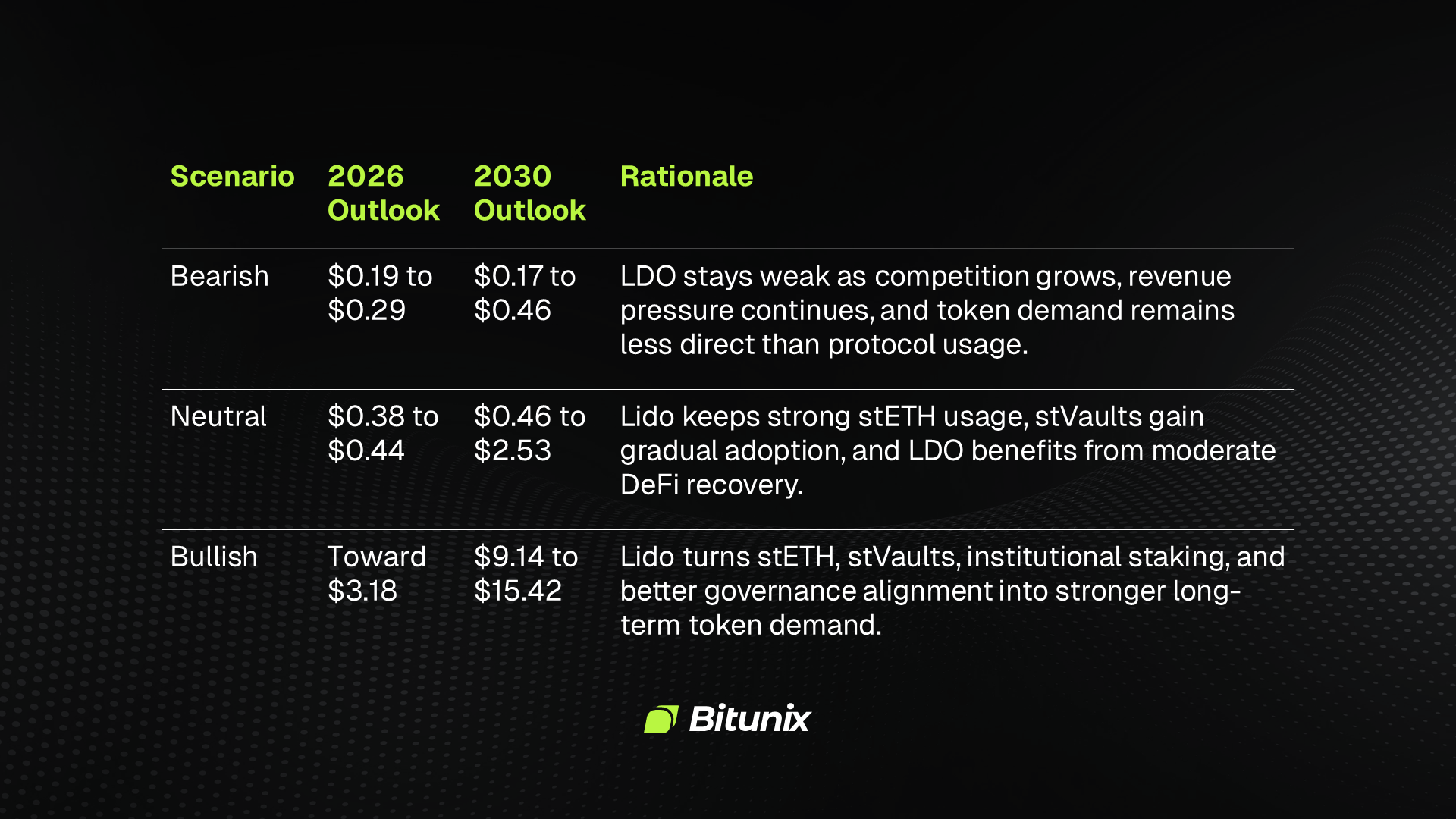
Lido DAO (LDO) price prediction scenarios compare potential outcomes based on staking demand, stVault adoption, competition, token demand, and DeFi market recovery.
Conclusion: The Future of Lido DAO (LDO)
Lido DAO is in a stronger position than many DeFi protocols because it is tied directly to Ethereum staking, one of the network's core activities. The protocol has deep stETH liquidity, broad DeFi integrations, and a clear product expansion path through Lido V3 and stVaults. Still, LDO's long-term performance depends on whether that protocol strength translates into stronger token demand.
For investors, the main takeaway is balance. Lido has scale, brand recognition, and a useful product, but LDO remains exposed to regulatory pressure, competition from exchanges and restaking platforms, lower staking yields, and weak value capture. The token can benefit if stVault adoption grows, institutional staking expands, and the DAO improves alignment between protocol success and LDO holders.
Before trading LDO, compare the token's price action with developments in the Lido ecosystem: track stETH demand, stVault adoption, DAO proposals, ETH sentiment, and liquid staking competition. To follow or trade the market directly, download the Bitunix app, register, and access the LDO/USDT trading pair.
FAQ
What is Lido DAO (LDO)?
Lido DAO is the decentralized organization that governs the Lido liquid staking protocol. LDO is the protocol's governance token, and users can stake ETH to receive stETH, a liquid token that can be used across supported DeFi applications.
How does Lido DAO (LDO) work?
Lido lets users stake ETH through a shared validator system and receive stETH in return, which represents their staked ETH plus accumulated staking rewards. The DAO manages the protocol's key decisions, including fees, node operators, incentives, upgrades, and governance processes.
What is the utility of the Lido DAO (LDO) token?
The LDO token gives holders governance power over Lido DAO decisions. Holders can vote on protocol parameters, node operator management, treasury use, incentives, and upgrades. Its long-term value depends on governance relevance and stronger alignment with protocol growth.
Who are the main competitors to Lido DAO (LDO)?
Lido competes with other liquid staking protocols, centralized exchange staking products, institutional staking providers, restaking platforms, and liquid restaking tokens. Its biggest challenge is defending stETH's market position while expanding beyond simple pooled staking.
Is Lido DAO (LDO) a good investment for the long term?
LDO is a high-risk long-term investment. Lido has strong staking infrastructure and deep DeFi integration, but token value capture remains a key concern. Investors should track stETH demand, revenue, governance proposals, competition, and Ethereum staking trends.
What factors could drive the price of Lido DAO (LDO) up?
LDO can rise if Ethereum staking grows, stETH usage expands, stVaults gain adoption, and the DAO improves tokenholder alignment. Stronger DeFi activity, institutional staking demand, and improved market sentiment can also support a higher valuation.
What are the main risks associated with Lido DAO (LDO)?
The main risks include regulatory pressure, competition from exchanges and restaking platforms, lower staking yields, weak token value capture, smart contract risk, validator risk, and broader crypto market downturns. LDO can underperform even if Lido remains widely used.
How does Lido DAO (LDO) differ from Bitcoin or Ethereum?
Bitcoin is a decentralized monetary network, Ethereum is a smart contract platform, and Lido DAO is an application-layer staking protocol built around Ethereum staking. LDO governs the protocol, while stETH represents liquid staked ETH used across DeFi.
What is the all-time high of Lido DAO (LDO)?
Lido DAO (LDO) reached its all-time high of $7.30 on August 20, 2021. By April 2026, LDO traded around $0.37, roughly 95% below that peak. The drawdown reflects broader DeFi token volatility, competition in ETH staking, and changing market conditions.
Where can I buy Lido DAO (LDO)?
You can buy LDO on centralized crypto exchanges that list the token, including Bitunix, through the LDO/USDT trading pair. You can also access LDO through supported decentralized exchanges, depending on your wallet, network, and available liquidity.
Glossary
- Lido DAO: The decentralized organization that governs the Lido liquid staking protocol and manages key decisions through LDO voting.
- LDO: The governance token used to vote on Lido DAO decisions, including fees, operators, incentives, upgrades, and treasury use.
- stETH: A liquid staking token that represents ETH staked through Lido plus accumulated staking rewards.
- wstETH: A wrapped version of stETH designed for easier use across DeFi protocols and smart contracts.
- Liquid Staking: A staking method that gives users a liquid receipt token while their underlying crypto asset remains staked.
- Proof of Stake: A blockchain consensus system where validators secure the network by staking assets instead of mining.
- Validator: A network participant that proposes and validates blocks in a proof-of-stake blockchain.
- Node Operator: An entity that runs validator infrastructure for staking protocols such as Lido.
- stVault: A Lido V3 staking vault that lets users or institutions customize validator setup, fees, policies, and liquidity options.
- Dual Governance: A Lido governance design that adds protection for stETH holders and improves alignment between token holders and protocol users.
- DeFi: Decentralized finance applications that support lending, trading, collateral, liquidity, and yield without traditional intermediaries.
- TVL: Total value locked, which measures the value of assets deposited in a protocol or DeFi system.
- Governance Token: A token that gives holders voting power over protocol decisions and upgrades.
- Staking Yield: Rewards earned from staking crypto assets to help secure a proof-of-stake network.
- Crypto Price Prediction: An estimate of future token value based on market data, adoption trends, technical models, and investor sentiment.
Disclaimer
This article does not provide:
(i) investment advice or investment recommendations;
(ii) an offer or solicitation to buy, sell, or hold digital assets;
(iii) financial, accounting, legal, or tax advice.
Digital assets, including stablecoins and NFTs, involve high risk and may fluctuate significantly. Consider whether trading or holding digital assets is appropriate for you given your financial situation. Consult a qualified legal, tax, or investment professional when needed. You are responsible for understanding and complying with applicable local laws and regulations.
About Bitunix
Bitunix is a global cryptocurrency derivatives exchange trusted by over 3 million users across more than 100 countries. At Bitunix, we are committed to providing a transparent, compliant, and secure trading environment for every user. Our platform features a fast registration process and a user-friendly verification system supported by mandatory KYC to ensure safety and compliance. With global standards of protection through Proof of Reserves (POR) and the Bitunix Care Fund, we prioritize user trust and fund security. The K-Line Ultra chart system delivers a seamless trading experience for both beginners and advanced traders, while leverage of up to 200x and deep liquidity make Bitunix one of the most dynamic platforms in the market.
Bitunix Global Accounts
X | Telegram Announcements | Telegram Global | CoinMarketCap | Instagram | Facebook | LinkedIn | Reddit | Medium