
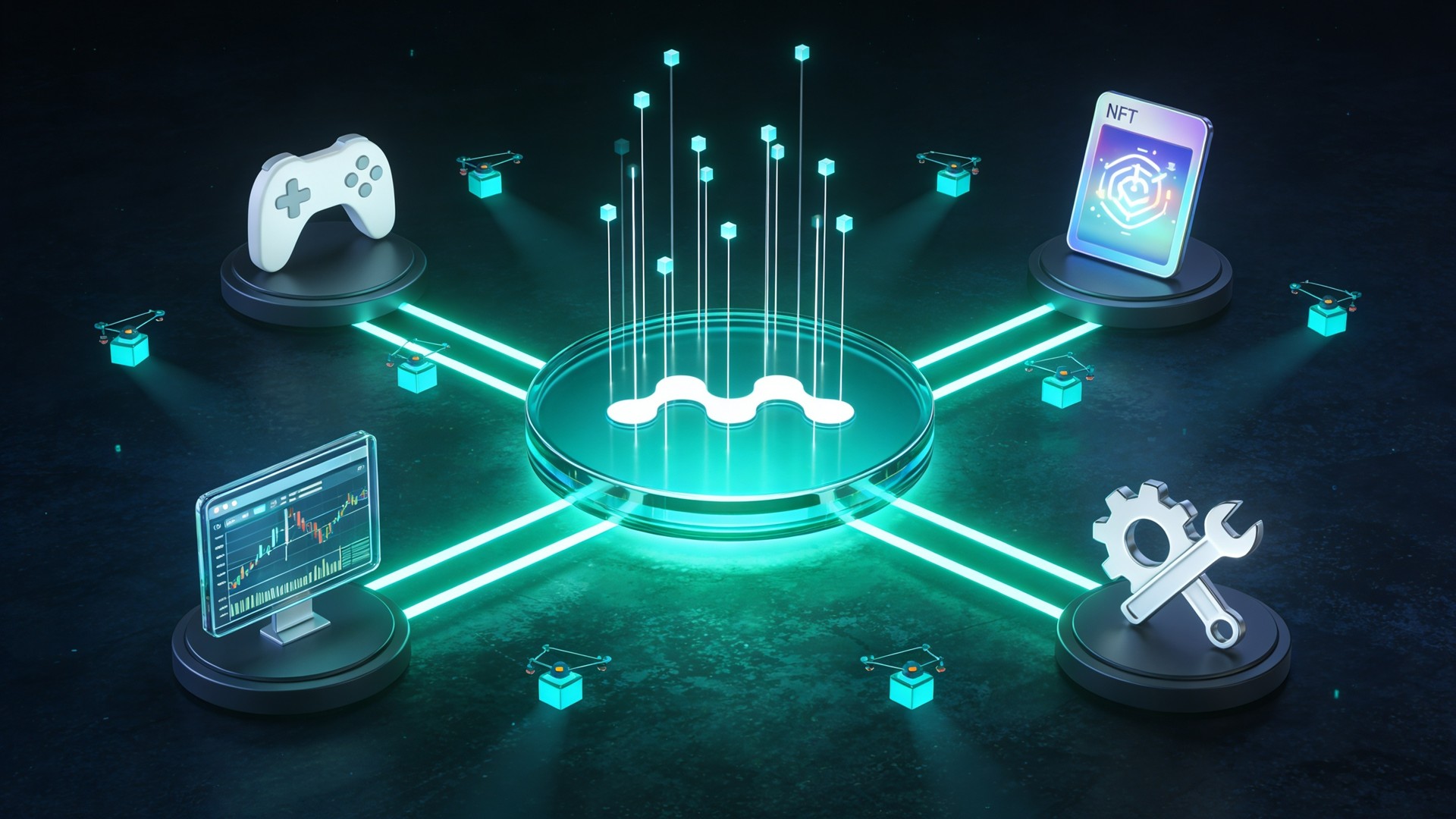
Article Summary
- This article provides a detailed price prediction and fundamental analysis for the Myria (MYRIA) token.
- It explains Myria as an Ethereum Layer-2 scaling solution specifically designed to facilitate blockchain gaming and NFT minting with zero gas fees and instant transactions.
- The bull case focuses on its rapidly growing ecosystem of games, its developer-friendly SDKs, and the decentralized security provided by its node network.
- The bear case highlights the intense competition from established gaming Layer-2s (Immutable X, Ronin), the challenge of attracting top-tier game developers, and token inflation from node rewards.
- It presents detailed price prediction scenarios (bearish, neutral, bullish) for both 2026 and 2030, based on gaming adoption and network activity.
Ethereum works well for finance, but games ask for a different kind of speed. Players do not want to wait around for settlement, and they definitely do not want to pay a fee every time they mint, trade, or move an item. Myria was built around that problem. It started as a gaming-first zk-Rollup network for Ethereum, designed to batch transactions off-chain, post a validity proof back to Ethereum, and give players a smoother experience than the mainnet can usually offer. For users who already follow gaming tokens on a crypto exchange, Bitunix is one place to view the MYRIA/USDT pair. Still, the bigger question sits with adoption and execution, not with exchange availability alone.
At a product level, Myria aims to give developers and players the best parts of Ethereum without the usual pain points. The project frames itself as a dedicated gaming ecosystem where developers can launch NFT-based economies, players can trade instantly, and the network handles the heavy lifting behind the scenes. This article examines the technology, gaming ecosystem, and data that shape realistic 2026 and 2030 outlooks for MYRIA.
The Technology and Ecosystem
Myria was built to make blockchain game actions feel less like on-chain paperwork and more like normal gameplay. Its core pitch is a STARK-based zk-Rollup powered by StarkEx, aimed at scaling NFT minting, trading, and transfers while still leaning on Ethereum for security.
The official developer page explains the structure clearly, and it remains the best short description of what the network was trying to solve:
"Myria's Ethereum L2 scaling solution uses zero-knowledge technology to roll-up or bundle thousands of L2 transactions into one single transaction."
That architecture is why Myria spent so much time highlighting zero gas fees, instant transactions, and easier developer tooling. The current site says minting is free, transactions are instant, and the stack comes with modular APIs and an SDK designed to remove the need for heavy Solidity or Cairo work for basic game integrations. The developer grant page goes even further and says studios can handle NFT-related blockchain actions through REST API.
There is also a 2026 wrinkle that you cannot ignore. Myria's current homepage carries a notice saying the ecosystem is migrating to Ethereum L1 and asks users to bridge assets from Myria L2 before April 27, 2026. That does not erase the value of the original Myria Layer-2 design, but it does change the investment story in a serious way. Anyone writing about Myria in 2026 has to treat that migration notice as more than a footnote. It suggests that the project's original scaling thesis is being revised in real time, which adds uncertainty even while the old technology stack still explains why the ecosystem attracted attention in the first place.
The developer side is still the most compelling part of the bull case. Myria's grant page says more than 15 million wallets have been created, more than 270 games are built on the ecosystem, and more than 3 million NFTs have been minted on Myria's L2. Those numbers deserve caution because they do not tell you how many players stay active or how many games become real hits.
The MYRIA token sits in the middle of that design, serving as protocol fees, governance, node purchase and rewards, staking, and additional in-game utility. Operators receive daily MYRIA rewards, exclusive NFTs, and voting rights, while only 40,000 node licenses will ever be released. That community-driven model can create sticky participation, but it also creates supply pressure if rewards outpace real usage. In other words, the MYRIA token only looks healthy when gameplay, NFT minting, and marketplace demand absorb the emissions coming from nodes and broader ecosystem incentives.
The Bull Case: The Developer Hub
Forecast models for MYRIA still paint a cautious picture, but they also show that the upside case depends heavily on whether Myria can turn its infrastructure and gaming ecosystem into real, lasting usage.
- CoinCodex's price prediction forecasts $0.00003386 by the end of 2026 and $0.00009099 by 2030.
- TradersUnion's forecast projects MYRIA at about $0.00003733 by the end of 2026 and around $0.00001215 by the end of 2030.
- CoinDataFlow's model gives a much wider range, with 2026 estimates from about $0.0000072 to $0.000033 and 2030 estimates from roughly $0.000024 to $0.000211.
- With MYRIA trading around $0.0000345 and its market cap sitting near $1.72 million, the token is still priced like a very small, high-risk gaming asset, which means even modest execution can shift sentiment quickly.
1. Developer-Friendly Infrastructure
What makes the optimistic case believable is that Myria tried to lower the hardest barrier in Web3 gaming, which is not player onboarding but developer pain. The official developer materials state that studios can use SDK tools, code snippets, and REST APIs to mint collections, launch tokens, and integrate NFT functionality without writing complex smart contract logic for every feature. The docs page for collections even tells developers there is no need to write Solidity code for the provided example, which is a practical sign that Myria wanted to reduce friction.
DappRadar's 2025 gaming reports support that broader infrastructure angle. In February 2025, it said blockchain gaming investments jumped to $55 million, with 92% of that funding going to infrastructure. By Q2, the same research said 74.8% of funding still went to infrastructure plays. That tells you where investors thought the missing piece still was. They were funding tools, rails, and distribution. For Myria, that is the part of the thesis that still makes sense even after the migration notice.
2. A Growing Ecosystem
Myria's official pages still show a range of games and studios, including Metarush, Nitro League, Boss Fighters, Space Falcon, Cricket 360, and Billiards Clash. That mix shows the network is not betting the farm on a single flagship release. Metarush also entered open beta in May 2025 with play-and-earn USDT rewards, which at least shows that one Myria-connected title was still shipping live product during the period when much of Web3 gaming was getting closures and funding cuts.
The wider gaming backdrop also helps explain why chains like Myria kept pushing. DappRadar's May 2025 games report said gaming became the most dominant product category in the dApp industry, with more than 4.9 million unique active wallets per day, and its Q2 report still counted 4.8 million daily unique active wallets even after a rough quarter. So Web3 gaming did not disappear, but it became more selective. The winners were the projects that could either ship better products or offer better infrastructure to the people trying to build them.
3. The Node Operator Community
A third positive factor is the node base. Myria's node program gives holders daily MYRIA rewards, voting rights, and NFT incentives, while the total supply of licenses is capped at 40,000. That sort of structure can create a user base that is financially invested in the network's long-term survival. It is not enough on its own, but it does help explain why Myria has maintained a recognizable community even with weak token performance.
For a constructive Myria crypto price prediction, that node community is part of the argument. A project with a weak token and no engaged base usually fades fast. A project with a weak token but a committed operator class can survive longer, keep governance active, and keep distributing incentives while it tries to find a better product-market fit.
The Bear Case: The Layer-2 Bloodbath
A realistic Myria crypto price prediction has to weigh the original developer-first pitch against a much harsher 2025 to 2026 market. DappRadar's Q2 2025 report said gaming activity fell 17% quarter over quarter to 4.8 million daily unique active wallets, more than 300 gaming dApps went inactive, and funding collapsed 93% year over year to $73 million. That is not a forgiving backdrop for a small gaming token trying to prove that its chain, its node economy, and now its migration plan all deserve long-term confidence.
1. The Immutable X Shadow
Competition was always going to be brutal, and Myria picked a lane where the biggest rival had a head start. L2Beat currently describes Immutable X as an NFT-focused validium that offers zero gas fees, instant trades, and StarkEx-based scalability for applications.
DappRadar's February 2025 report adds the harder number. ImmutableX handled 72% of gaming NFT transactions that month, alongside $41 million in gaming NFT volume and 421,853 assets traded. When one competitor already owns that much of the visible activity, the burden on everyone else gets heavy fast.
"In February, gaming NFTs secured the second-highest trading volume, reaching $41 million with 421,853 assets traded. ImmutableX handled 72% of these transactions." (DappRadar)
That is why the Myria story feels tougher than a simple Gala Games competitor narrative. Myria is also fighting infrastructure battles against larger gaming rails with bigger ecosystems, more visible publishers, and a clearer market position.
2. The Play-to-Earn Stigma
Traditional gamers still do not trust tokenized economies very much, and Web3 has done a lot to earn that suspicion. DappRadar's May and Q2 2025 reports repeatedly tied project failures to weak engagement, speculative NFT drops, and unsustainable tokenomics. That is a problem for every gaming chain, even the ones with good tooling. If players think NFTs are just monetization with extra steps, better infrastructure alone will not fix the reputation problem.
This is where Myria's zero gas fees pitch helps a little, but not enough. Free trades and easier onboarding reduce costs and friction, but they do not address player skepticism. You still need games people want to play, even if they do not care about crypto. Until that happens, every MYRIA bull case has to live under the same cloud that hangs over the rest of Web3 gaming.
3. Token Inflation
Supply pressure is the last big risk. CoinMarketCap lists MYRIA with a 50 billion max supply and roughly 48.44 billion already in circulation. The official site says node operators receive daily MYRIA rewards, and the grant program says 40% of the native token is allocated to the ecosystem fund. That means the network needs real economic activity to do more than absorb emissions. If usage stalls, the token has very little protection.
If Myria fails to attract games that generate meaningful trading, fees, and retention, then the reward structure becomes a weight instead of a growth tool. Small-cap tokens do not get many second chances, and MYRIA's market cap already tells you investors are treating it as a speculation.
Myria Crypto Price Prediction Scenarios (2026 & 2030)
Outside forecasts for MYRIA still point to a cautious and highly uncertain market, so the table below works better as a scenario framework than as a single target. CoinCodex, TradersUnion, and CoinDataFlow all show that the token's long-term direction still depends heavily on adoption, competition, and execution across the broader gaming ecosystem.
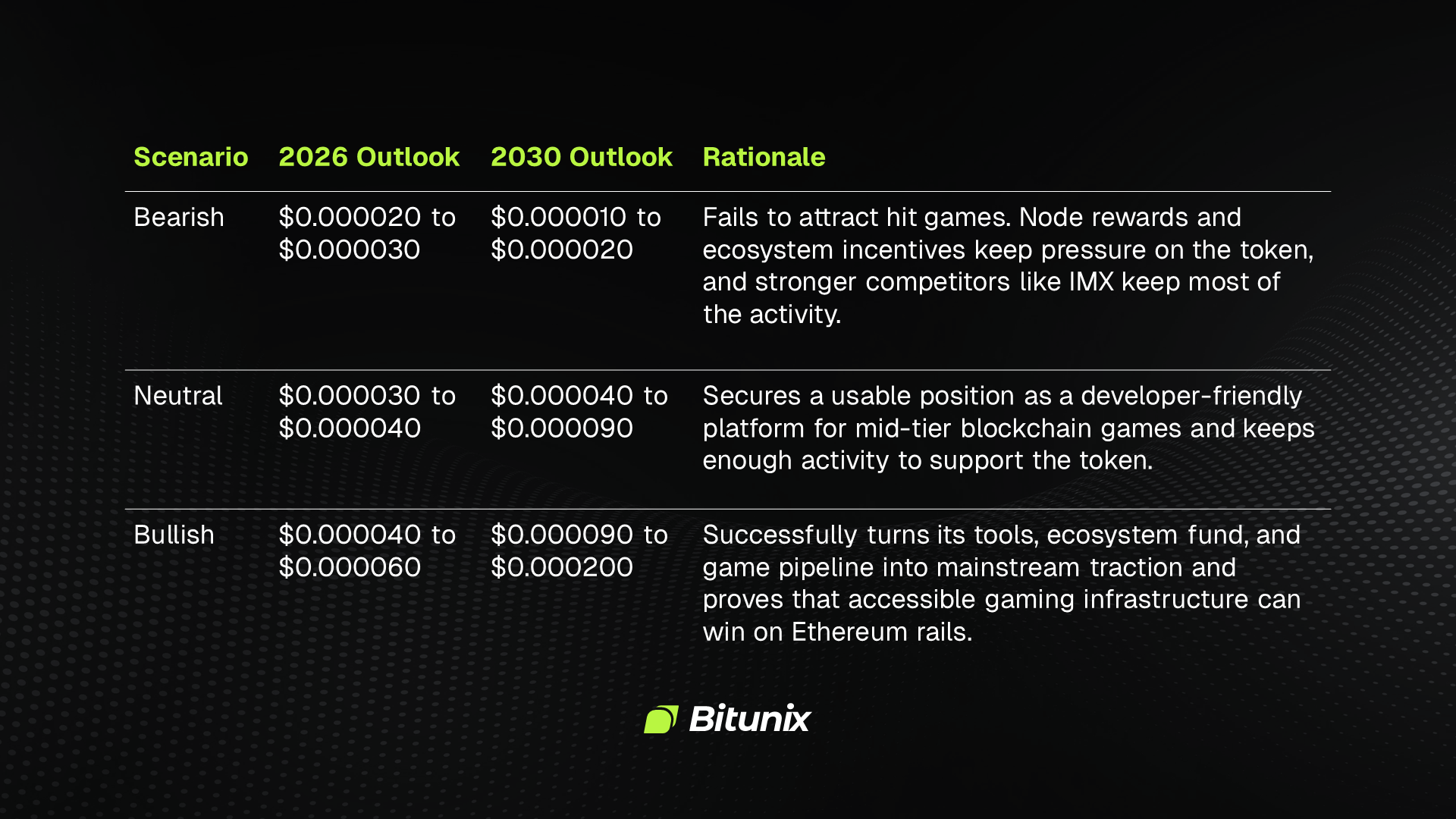
Myria price prediction scenario table comparing bearish, neutral, and bullish outlooks for 2026 and 2030.
Conclusion: A Bet on Accessible Web3 Gaming
What still makes Myria worth watching is the practical problem it set out to solve. The project tried to make blockchain gaming faster, cheaper, and easier for both players and developers, and it built real tooling around zero gas fees, instant transactions, SDK support, and NFT infrastructure.
The harder truth is that MYRIA now sits in a much more complicated place than the original pitch suggested. Competition from Immutable X is real, broader Web3 gaming sentiment remains fragile, and Myria's own move toward Ethereum L1 changes the old L2 thesis in a major way. For investors who still want to dive deeper and monitor MYRIA/USDT liquidity, download the Bitunix app and register to keep track of how the project develops from here.
FAQ
What is Myria (MYRIA)?
Myria is a gaming-focused Ethereum ecosystem built around scalable NFT infrastructure, developer tools, a marketplace, and the MYRIA token. It originally centered on a zk-rollup design for fast, low-cost game transactions, though the current platform is also moving assets from Myria L2 to Ethereum L1.
How does Myria achieve zero gas fees?
Myria batches many Layer 2 actions together and posts a validity proof back to Ethereum instead of settling every player action directly on the mainnet. That lets the platform reduce user-facing transaction costs and make NFT-related actions much cheaper than normal Ethereum activity.
What is a zk-Rollup?
A zk-Rollup is a scaling system that processes transactions off-chain, bundles them together, and submits a cryptographic proof to the main chain. You get faster throughput and lower costs while still leaning on Ethereum for final security.
How does Myria compare to Immutable X?
Both projects built gaming-friendly infrastructure around StarkEx-style scaling and zero-fee NFT activity. Immutable X has had more visible gaming NFT traction, while Myria focused heavily on developer tooling, grants, nodes, and ecosystem breadth. In 2026, Myria also faces extra uncertainty because of its migration to Ethereum L1.
What is the utility of the MYRIA token?
MYRIA is used for protocol fees, governance, staking, node purchase, rewards, and other in-game ecosystem functions. Its value depends less on hype and more on whether games, marketplaces, and network activity actually create steady demand for the token.
What are Myria Nodes and how do they work?
Myria Nodes are licensed community-run nodes that support the network and give operators daily MYRIA rewards, voting rights, and NFT incentives. The official node sale page says the total number of licenses is capped at 40,000, which helps define the size of that operator base.
Can I earn MYRIA by running a node?
Yes. Operators receive daily MYRIA rewards for supporting the network. That said, earning tokens is not the same as earning profit. The value of those rewards depends on token price, liquidity, and whether ecosystem demand keeps pace with supply.
What types of games are built on Myria?
Myria's official ecosystem pages show a mix of racing, action, sports-style, and multiplayer titles, including Metarush, Nitro League, Boss Fighters, Cricket 360, and Space Falcon. The platform clearly aimed for a broad game catalog rather than a one-game ecosystem.
What are the risks of investing in MYRIA?
The main risks are weak game adoption, tough competition from larger gaming rails, supply pressure from rewards and ecosystem incentives, and the current migration to Ethereum L1 reshaping Myria's L2 story. MYRIA also remains a very small-cap, volatile token.
Where can I buy MYRIA tokens?
You can buy MYRIA on centralized exchanges such as BitMart, Bitunix, Gate.io, MEXC, KuCoin, Bybit, and BingX, usually through the MYRIA/USDT pair after completing KYC and funding your account. It is also available on Uniswap V3 on Ethereum for wallet-based swaps.
Glossary
- zk-Rollup: A scaling system that processes transactions off-chain and posts a proof back to Ethereum.
- StarkEx: StarkWare's scaling engine used to power Myria's original L2 architecture.
- MYRIA token: The ecosystem's utility token for fees, governance, staking, nodes, and in-game use.
- Myria Layer-2: The original Ethereum L2 environment Myria used for low-cost gaming and NFT activity.
- NFT minting: The process of creating blockchain-based digital items such as game assets or collectibles.
- Zero gas fees: A user experience where minting or trading does not require paying normal Ethereum gas directly.
- REST API: A developer interface that lets studios interact with blockchain tools through standard web requests.
- SDK: Software development kit that helps developers integrate game and NFT functions faster.
- Node license: The right to run a Myria node and participate in rewards and governance.
- Governance: The process by which token holders or node operators vote on ecosystem decisions.
- Ethereum mainnet: The base Ethereum chain that provides final settlement and security.
- Validity proof: A cryptographic proof that confirms a batch of off-chain transactions is valid.
- Web3 gaming: Games that use blockchain-based assets, tokens, or ownership systems.
- Marketplace: A platform where players buy, sell, and trade game assets and collectibles.
- Layer 2: A scaling network built on top of a base blockchain to improve speed and reduce costs.
Disclaimer
This article does not provide:
(i) investment advice or investment recommendations;
(ii) an offer or solicitation to buy, sell, or hold digital assets;
(iii) financial, accounting, legal, or tax advice.
Digital assets, including stablecoins and NFTs, involve high risk and may fluctuate significantly. Consider whether trading or holding digital assets is appropriate for you given your financial situation. Consult a qualified legal, tax, or investment professional when needed. You are responsible for understanding and complying with applicable local laws and regulations.
About Bitunix
Bitunix is a global cryptocurrency derivatives exchange trusted by over 3 million users across more than 100 countries. At Bitunix, we are committed to providing a transparent, compliant, and secure trading environment for every user. Our platform features a fast registration process and a user-friendly verification system supported by mandatory KYC to ensure safety and compliance. With global standards of protection through Proof of Reserves (POR) and the Bitunix Care Fund, we prioritize user trust and fund security. The K-Line Ultra chart system delivers a seamless trading experience for both beginners and advanced traders, while leverage of up to 200x and deep liquidity make Bitunix one of the most dynamic platforms in the market.
Bitunix Global Accounts
X | Telegram Announcements | Telegram Global | CoinMarketCap | Instagram | Facebook | LinkedIn | Reddit | Medium