

Article Summary
- This article provides a price prediction for Siacoin (SC), the native utility token of the Sia decentralized cloud storage network.
- It explains Sia's core value proposition: a peer-to-peer marketplace where users can rent out their unused hard drive space to others, creating a decentralized and censorship-resistant alternative to Amazon S3 and Google Cloud.
- The bullish case is built on Sia's long history (one of the oldest crypto projects, launched in 2015), its extremely low storage costs, and the growing demand for decentralized storage solutions.
- The bearish case focuses on the project's struggle to gain mainstream adoption despite its technical strengths, intense competition from both centralized giants and other decentralized storage projects (like Filecoin), and complex tokenomics with a potentially inflationary supply.
Long before AI agents, meme coins, and yield farms crowded the market, Sia kept working on a very practical problem: where to store data without handing it all to one company.
For readers asking what is Siacoin, SC is the utility token that powers Sia's storage marketplace. Hosts rent out unused hard drive space, renters pay to store files, and the blockchain enforces the contracts between them.
If SC first shows up on a crypto exchange, including Bitunix, it helps to know that the token's value still depends on one core question: can Sia turn a working product into wider adoption by 2026?
This analysis looks at the fundamentals first, then the chart. The bullish case rests on real utility, low storage costs, privacy, and the network's technical upgrades in 2025 and 2026. The bearish case rests on slow adoption, brutal competition, uncapped supply, and a market that still treats SC as a small, speculative token rather than as essential infrastructure.
The Bullish Case for Siacoin
The bull case for Sia starts with something many crypto projects never achieve: it already works. Sia has been live since 2015, it still runs, and the Foundation spent 2025 and early 2026 improving the stack with v2, faster syncing, browser-friendly infrastructure, and better tools for renters and hosts.
Official updates from 2025 describe renterd, hostd, and walletd as the new base layer of the network, while January 2026 updates added host instant sync, smaller partial reads, and more operational safeguards.
A Real, Working Product
Sia's strongest argument is that it is already a functioning decentralized cloud storage network. The docs explain that renters upload files to hosts through blockchain-enforced storage contracts, and the network forms those contracts automatically when users upload data. The renter software is no longer a command-line punishment either. The Windows guide published in February 2026 says the rented desktop app provides a user-friendly web UI, which is exactly the kind of improvement real products need.
The Foundation's own website still puts the thesis in one clean sentence:
"Sia is the world's safest cloud storage, by design."
That line is marketing, yes, but it also points to the core architecture. Sia encrypts data before upload, splits it into pieces, and distributes those pieces across independent hosts. The current docs say each chunk becomes 30 encrypted pieces, only 10 are needed for recovery, and no single host stores enough data to reconstruct the original file.
Lower Costs Than Centralized Clouds
Cost is where Sia still looks unusually strong. Official docs updated in 2025 say network pricing averages around $3 per terabyte per month, including 3x redundancy. The SiaGraph pricing dashboard tracks live host-market pricing across the network, giving users a real-time view of what hosts are charging. For centralized benchmarks, Backblaze's cloud storage comparison tool currently lists storage at $6 per TB per month on B2, $20 on Azure, $23 on Google Cloud, and $26 on Amazon S3. That does not guarantee adoption, but it does show why Sia keeps getting attention from cost-sensitive users.
That price gap matters more in 2026 than it did a few years ago. Enterprise cloud spending keeps climbing, and Synergy Research said Amazon, Microsoft, and Google together captured 63% of enterprise cloud infrastructure spending in Q3 2025, with the total market reaching $107 billion. In a market that big, a niche low-cost option does not need to beat everybody. It just needs to win enough use cases where price, privacy, and control matter more than buying everything from one giant vendor.
Privacy, Censorship Resistance, and Resilience
Sia also stands out in privacy. The 2025 security and privacy articles from the Foundation explain that data is encrypted, fragmented, and distributed before it leaves the device. The official site says Sia stores but never sees user data, and the April 2025 security article says no provider, employee, or platform can access the content because the user alone holds the keys. For people who care about sovereignty over their files, that is the real product edge.
Longevity and Resilience
Age is another advantage. Sia launched in 2015 and is still here. Coinbase's current SC page says the token launched in 2015, and the Foundation's 2025 retrospective describes Sia's first decade as a sequence of technical and political challenges that the network survived. In crypto, longevity does not guarantee upside, but it does filter out a lot of nonsense. A chain that made it through multiple cycles deserves at least a second look.
There is also real ecosystem activity behind the chain. The official site says 32 projects are built on Sia and that $3.2 million was allocated to grant funding in 2026. That is not huge by L1 standards, but it is enough to show ongoing builder interest. The v2 transition also made Sia the first Utreexo-native blockchain deployed in production, according to the May 2025 Foundation update. For bulls, that combination of functioning product, lower costs, and steady technical progress supports a higher-end 2026 target.
The Bearish Case and Challenges
The bear case is less romantic and more familiar. Sia works, but working does not automatically lead to scale. The product still asks users to think like storage operators, and that gap between utility and adoption has haunted SC for years. Recent market data shows the token trading around $0.00103, with a market cap of $58.5 million and a 24-hour volume of $5.28 million. That is small enough to move fast, but also small enough to stay ignored for long stretches.
The Struggle for Mainstream Adoption
The biggest problem is usability. Sia's 2026 roadmap admits that users need simpler onboarding and should be able to start using Sia without complex software setup or acquiring Siacoins first. That is refreshingly honest. It also says the quiet part out loud. The current product still asks too much from mainstream users. Centralized services win a lot of business simply because they are easier to start using on a Monday morning when nobody wants surprises.
Intense Competition
Competition is fierce on both sides. In the traditional cloud, Amazon, Microsoft, and Google still dominate enterprise spending. In decentralized storage, Filecoin has a much larger market cap and more market visibility. CoinMarketCap currently puts Filecoin near a $658 million market cap, while Coinbase places Siacoin near $58.5 million. That gap does not prove Filecoin is the better product, but it does show where attention and capital have gone. Sia has the older network. Filecoin has the louder market presence.
Inflation and Tokenomics
Tokenomics add another headache. Sia's own docs say around 60.5 billion Siacoins had been created by June 6, 2025, and that new coin issuance continues, though it slows over time. The same page explains that block rewards cannot simply stop because miners still need incentives. For investors, that means SC does not have the clean scarcity story that many traders prefer.
Reliability Trade-Offs
Host reliability is another concern. The docs explain that hosts compete for contracts and put up collateral, which helps align incentives, but the network still depends on many individual providers staying online and behaving well. Sia's architecture reduces the risk of losing data by spreading pieces across many hosts, yet it still cannot match the simple sales pitch of a centralized provider promising near-perfect uptime under one brand.
Bearish Forecast Inputs
Recent forecast sources reflect that tension. CoinCodex's March 2026 model projects SC in a narrow 2026 range of about $0.000723 to $0.001047, which implies limited upside from current levels. CoinMarketCap's AI analysis is also cautious, saying SC is down sharply over the past year and remains below key moving averages, with the 200-day SMA around $0.00189.
Siacoin Price Prediction 2026: Technical Outlook
The short-term setup for Siacoin still looks tentative rather than decisive. Recent trading has kept SC close to the $0.00104 area, which is acting as an important near-term pivot for buyers and sellers. CoinMarketCap's latest analysis says SC can stay constructive if it holds above its 7-day simple moving average near $0.00104, while the next immediate hurdle sits around the 30-day SMA near $0.00110. A drop below roughly $0.00103 would weaken that setup and open the door to a retest of recent lows. MEXC's latest pivot data points in a similar direction, with classic pivot support near $0.00105 and resistance near $0.00110.
Forecast models also suggest limited upside unless momentum improves. CoinCodex currently projects SC ending 2026 around $0.001066, which is close to today's price and reflects a cautious view of the trend. Bitget is slightly more optimistic, with a 2026 estimate near $0.001110, while its short-term model sees only modest gains over the next few months. Taken together, those forecasts describe a market that still needs a stronger catalyst. Right now, Siacoin looks more like a consolidation trade than a breakout story, unless it can reclaim resistance near $0.00110 and build from there.
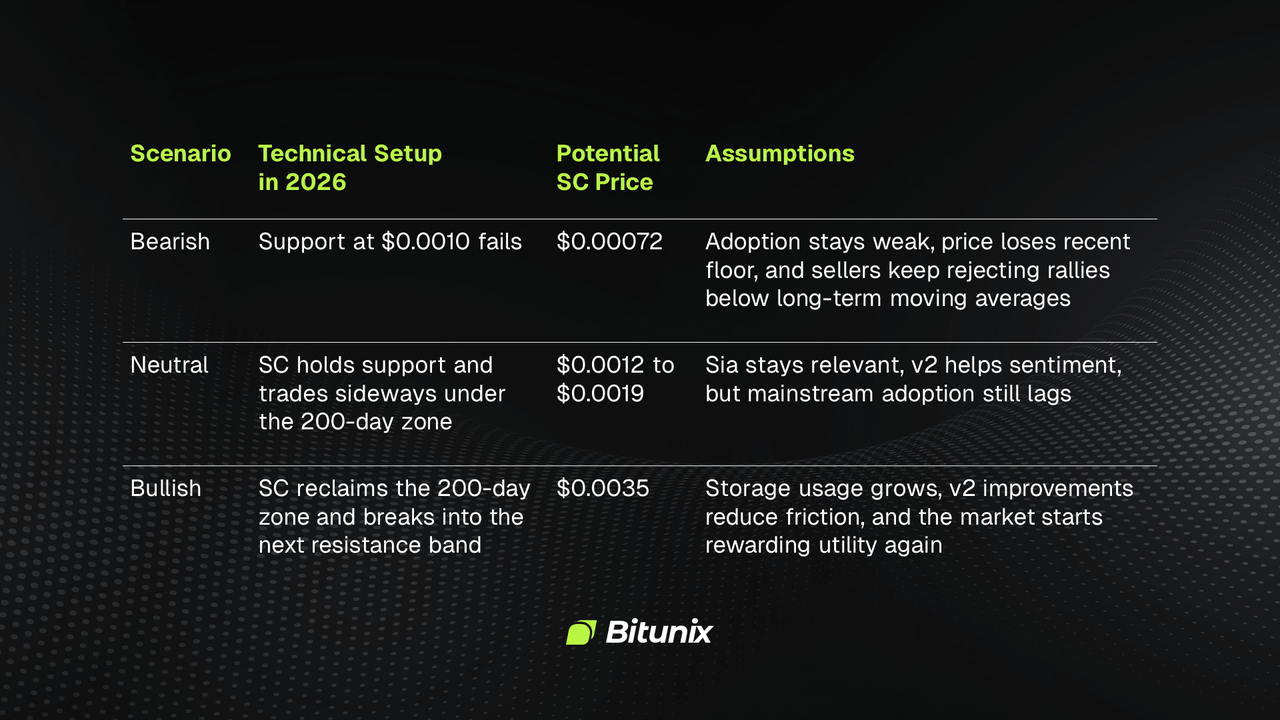
Siacoin price outlook for 2026, comparing bearish, neutral, and bullish scenarios based on support levels, trend recovery, and storage network adoption.
Conclusion: A Utility Project at a Crossroads
Sia still has one of the clearest real-world use cases in crypto. It offers decentralized cloud storage, lower average storage costs than major centralized providers, strong privacy properties, and a network that kept improving through 2025 and early 2026. But adoption remains the bottleneck. The product needs to get easier, the ecosystem needs more visible demand, and the token still has to fight its way through a weak long-term chart.
So, is Siacoin a good investment? It suits investors who want exposure to utility tokens with a real product and are comfortable with small-cap risk. It does not suit anyone expecting fast mainstream adoption or a clean scarcity narrative. The more useful question is whether Sia can turn technical quality into wider usage. If that answer improves in 2026, SC has room to rerate. If not, the token probably stays niche.
Bitunix offers a secure platform to trade utility tokens like Siacoin. Download the app,register, and explore the projects building the decentralized infrastructure of the future, and execute your trading strategy based on our in-depth analysis.
FAQ
What is the difference between Sia and Siacoin?
Sia is the decentralized storage network. Siacoin is the utility token used to pay for storage, bandwidth, and host services on that network. Think of Sia as the marketplace and infrastructure, while SC is the currency that keeps contracts and payments moving.
How does Sia compare to Filecoin?
Sia focuses on low-cost storage, privacy, and a mature renter-host marketplace. Filecoin has a much larger market capitalization and stronger market visibility today. In March 2026, Filecoin's market cap sat around $658 million on CoinMarketCap, while Siacoin's sat near $58.5 million.
Is Siacoin inflationary?
Yes. Siacoin has no fixed maximum supply. Sia's docs say about 60.5 billion coins had been created by June 2025, and issuance continues, although it slows over time. The Foundation also explains that miner incentives need to remain in place, which is why supply does not cap out.
How do I rent storage on the Sia network?
Users rent storage through renterd. The 2025 docs explain that you install the software, create and fund a wallet with SC, configure an allowance, and upload files. The software automatically forms storage contracts with hosts and manages uploads through the network.
How can I become a host on the Sia network?
Hosts install hostd, add storage space, set pricing, and announce their node to the network. Hosts choose storage price, bandwidth price, contract fees, and collateral. Good uptime and competitive pricing help hosts win contracts from renters.
Who is the team behind Sia?
David Vorick and Luke Champine originally created Sia through Nebulous. Today, the Sia Foundation, a nonprofit formed to steward the core protocol, leads ongoing development. The Foundation's 2025 history article also notes that it absorbed key talent after Skynet Labs shut down in late 2022.
Is storing data on Sia safe?
The architecture is strong. Files are chunked, erasure-coded into 30 encrypted pieces, and distributed to separate hosts, with only 10 pieces needed for recovery. The Foundation's 2025 security articles also stress that users keep the keys and hosts never see full file contents.
What is the all-time high for Siacoin?
Coinbase's current SC market page lists Siacoin's all-time high at $0.1117. CoinGecko lists a slightly lower figure at $0.09287.
What is the Sia Foundation?
The Sia Foundation is the nonprofit organization that stewards the Sia protocol and network. Its 2025 public-good article says it was launched through a hard-fork-backed community decision, with funding for development, grants, education, and ecosystem support, without relying on venture capital or advertising.
What are Skynet and the Sia renterd?
Skynet was a separate venture-backed effort around decentralized web portals that shut down in late 2022. renterd is the current renter software for storing and retrieving data on Sia.
Glossary
- Sia: A decentralized cloud storage network where renters and hosts form blockchain-enforced storage contracts.
- Siacoin: The utility token used to pay for storage, bandwidth, and host services on Sia.
- Decentralized cloud storage: Data storage spread across independent hosts instead of one centralized provider or data center.
- Host: A storage provider who rents out disk space and earns SC from renters.
- Renter: A user or business that pays SC to store files on the Sia network.
- Storage contract: A blockchain-enforced agreement between renter and host for storage, duration, and payment terms.
- renterd: Sia's renter software and desktop app for uploading, managing, and retrieving stored data.
- hostd: Sia's host software for offering storage, setting prices, and managing node operations.
- walletd: A watch-only wallet server used for monitoring addresses and supporting modern Sia workflows.
- Erasure coding: A method that splits data into many pieces so files survive host failures.
- Utreexo: A consensus upgrade that reduces node storage requirements and speeds up syncing.
- Allowance: The spending limit a renter sets so renterd can form and manage storage contracts.
- Collateral: SC that hosts lock up and lose if they fail contract obligations.
- Sia Foundation: The nonprofit steward of the Sia network, focused on protocol development and grants.
- SiaGraph: A community statistics site that tracks Sia network pricing, hosts, and usage metrics.
Disclaimer
This article does not provide:
(i) investment advice or investment recommendations;
(ii) an offer or solicitation to buy, sell, or hold digital assets;
(iii) financial, accounting, legal, or tax advice.
Digital assets, including stablecoins and NFTs, involve high risk and may fluctuate significantly. Consider whether trading or holding digital assets is appropriate for you given your financial situation. Consult a qualified legal, tax, or investment professional when needed. You are responsible for understanding and complying with applicable local laws and regulations.
About Bitunix
Bitunix is a global cryptocurrency derivatives exchange trusted by over 3 million users across more than 100 countries. At Bitunix, we are committed to providing a transparent, compliant, and secure trading environment for every user. Our platform features a fast registration process and a user-friendly verification system supported by mandatory KYC to ensure safety and compliance. With global standards of protection through Proof of Reserves (POR) and the Bitunix Care Fund, we prioritize user trust and fund security. The K-Line Ultra chart system delivers a seamless trading experience for both beginners and advanced traders. At the same time, leverage of up to 200x and deep liquidity make Bitunix one of the most dynamic platforms in the market.
Bitunix Global Accounts
X | Telegram Announcements | Telegram Global | CoinMarketCap | Instagram | Facebook | LinkedIn | Reddit | Medium