
Article Summary
- This is a comprehensive guide to the Bitunix perpetual futures platform, designed for both beginners and experienced traders.
- Bitunix offers leverage up to 200x on major pairs, allowing traders to amplify their position size and potential profits.
- The platform is built with a professional-grade, intuitive interface that features advanced charting tools, multiple order types, and a high-performance matching engine.
- Crucial risk management tools are at the core of the experience, including easy-to-set Stop-Loss and Take-Profit orders, as well as the choice between Isolated and Cross margin modes.
- This guide provides a step-by-step walkthrough of placing your first trade, managing your position, and utilizing the platform’s key features to trade responsibly.
Futures trading offers incredible opportunities, but to succeed, you need a robust, reliable platform that puts risk management at your fingertips.
Welcome to Bitunix Futures! This all-in-one guide will walk you through every feature of our platform, showing you how to harness its power responsibly. It’s the starting point for any user, from beginner to pro.
This guide will provide a complete overview of the Bitunix perpetual futures trading platform, from its core features and leverage options to its essential risk management tools, culminating in a step-by-step guide to your first trade on a high-profile crypto exchange.
The Bitunix Perpetual Futures Platform - An Overview
Bitunix offers a comprehensive suite of futures contracts, with perpetual futures among its most popular services. Unlike traditional futures contracts, perpetual futures do not have fixed expiration dates, making them more flexible and accessible even to less experienced traders.
Perpetual futures contracts can fit into almost any trading strategy. However, traders should have a good understanding of the mechanisms underlying this type of trade:
- The Funding Rate is a periodic, small payment exchanged directly between long and short traders to keep perpetual futures prices aligned with the spot price.
- Leverage allows traders to open positions that are larger than their margin deposit.
- Mark-to-Market Settlement calculates the profits and losses from open positions periodically and settles them to the traders' accounts, rather than waiting for the contract to expire.
Bitunix offers perpetual futures trading, featuring both USDT-margined (USDT-M) and Coin-margined (Coin-M) contracts. Traders can utilize leverage up to 200x on specific assets, such as BTC and ETH. The platform's trading offers also include essential risk management tools and the option to trade popular crypto pairs.
Additionally, Bitunix simplifies perpetual futures trading with its clean and user-friendly interface, including easy navigation and quick access to essential tools.
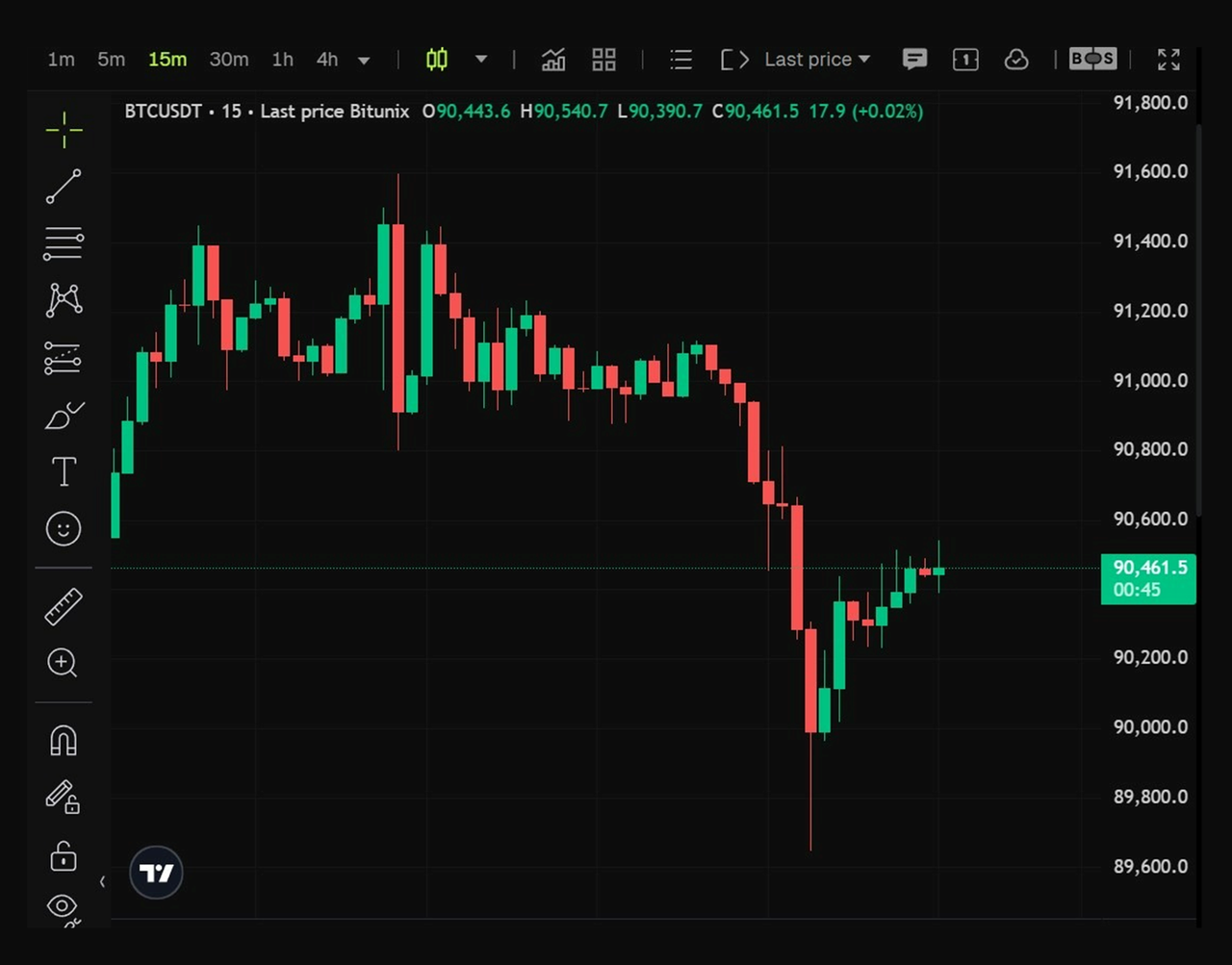
Bitunix integrates the TradingView charting window into its platform, providing real-time data and advanced analysis across web and mobile apps.
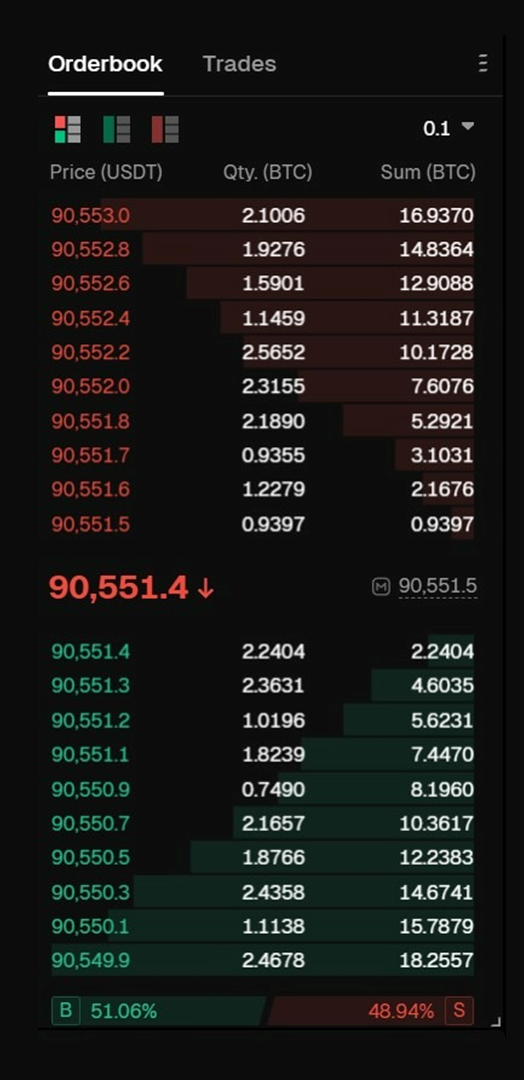
The Bitunix Order Book shows real-time buy and sell limit orders for a crypto pair. Users can quickly see the pair’s market depth, liquidity, and price levels. In the same menu, the Recent Trades panel lists executed transactions, revealing recent buying/selling pressure and price movement. This feature enables traders to make better-informed trades.
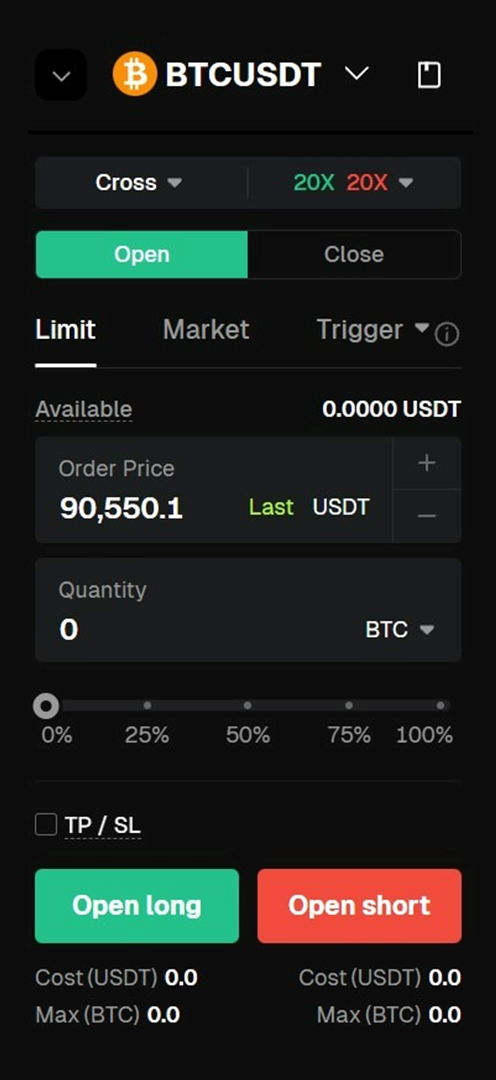
The Order Entry Panel allows traders to select order types, set parameters like price and quantity, choose leverage, and execute trades. The platform provides real-time price updates, allowing traders to react quickly to market changes.
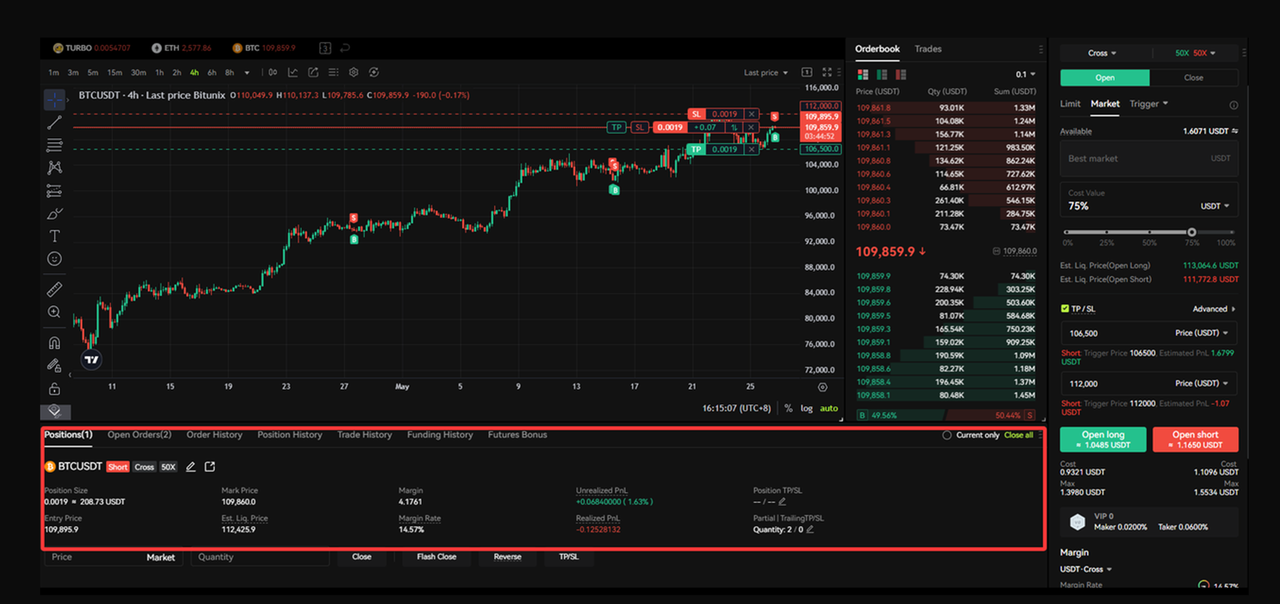
The Position Management Panel allows users to monitor, adjust, and close their open trades. Additionally, it provides traders with a comprehensive view of all active positions and their associated risk metrics.
Bitunix’s high-performance engine plays a crucial role in perpetual futures trading, preventing slippage during volatile periods. This way, the platform can provide fast and reliable trading experiences while minimizing the risk of untimely trade execution.
The Power and Peril of Bitunix Leverage Trading
Leverage is the no. 1 tool for perpetual futures trading, enabling users to control positions larger than their initial margin. It gives traders exposure to both high-potential gains and substantial losses.
So, how does Bitunix leverage trading work?
Suppose you only have $100 to trade. In spot trading, that is the maximum amount you can place on a pair. However, with futures trading, you can use 10x leverage, e.g., to control a $1,000 position. As a result, a 10% market move results in a 100% gain or loss on your initial funds.
Bitunix offers perpetual futures trading with up to 200x leverage on select pairs, such as BTC/USDT. This tool is especially suited to advanced traders with high-risk strategies.
It’s worth noting that high leverage amplifies profits but also magnifies losses, bringing your liquidation price dangerously close. For example, losing an open position with high leverage could liquidate your funds and place you in debt. Therefore, user-centric platforms like Bitunix recommend maximum caution when using this tool.
Mastering Risk Management - The Key to Survival
Bitunix leverage trading is a double-edged sword, particularly dangerous in the hands of novice traders. However, you don’t have to use it if it is not necessary for your strategy. Instead, you can approach perpetual futures trading with a strong emphasis on risk management, which is the most critical skill for a trader.
Mastering risk management in futures trading involves a set of crucial strategies and tools, such as:
Stop-Loss (SL) and Take-Profit (TP)
These tools are every trader’s essential orders. A Stop-Loss order automatically closes a position when the price reaches a specific, predetermined value to limit potential losses. Meanwhile, a Take-Profit order automatically closes a profitable position at a pre-set price, protecting your gains against the market’s extreme volatility.
Bitunix allows you to quickly and directly set Stop-Loss and Take-Profit orders directly from the order panel by checking the TP/SL box. Alternatively, you can drag the SL or TP lines directly on the chart to your desired profit level.
Isolated vs. Cross Margin
Isolated margin limits potential loss to the specific funds allocated as collateral, without any impact on the rest of your account balance. This option is perfect for beginners, offering a safe way to learn with a clear maximum loss limit.
Cross-margin trading uses all available funds in your futures account balance as collateral. This strategy suits concurrent trades, as profits from one trade can offset losses from another. More importantly, it allows your positions to stay open longer than single-position margin trades.
It’s worth noting that a single bad trade within a cross-margin strategy can drain your entire futures account balance and lead to the liquidation of all your positions. Therefore, the cross-margin strategy suits experienced traders better.
The Liquidation Price
An exchange automatically closes a leveraged position when the mark price hits the liquidation price. This happens because the margin balance has fallen below the Maintenance Margin Requirement (MMR).
Bitunix is a crypto exchange that prioritizes transparency and aims to provide a fair user experience. To this end, it clearly displays the liquidation price on the trading interface before a trade is placed. Therefore, users always know the terms of a trade before advancing with their strategy.
Your First Trade on Bitunix’s Futures Trading Platform:
Here are the simple steps to placing your first futures trade on Bitunix:
- Sign up for Bitunix.
- Go to Assets and transfer funds (e.g., USDT) from your Spot account to your Futures Account.
- Click the Futures tab on the Bitunix interface.
- Choose your desired contract (e.g., BTC/USDT) from the list.
- Set your leverage (e.g., 50x).
- Choose the margin mode between Isolated and Cross.
- Select the order type between Market or Limit.
- Enter the Amount
- Set your Take Profit (TP) and Stop Loss (SL) levels.
- Buy Open Long or Sell Open Short.
Lastly, you should monitor and manage your trade by reviewing your open positions and using TP/SL to manage risk.
Conclusion: Trade with Power, Control, and Confidence
Bitunix Futures provides a powerful engine, flexible leverage, and, most importantly, intuitive risk management tools. Our platform is designed to empower traders not just with opportunity, but with the controls needed to trade responsibly and sustainably.
You now have a complete overview of the Bitunix Perpetual Futures trading platform. The next step is to practice. Open a Bitunix account, start with a small deposit, and place your first trade with low leverage. Practice risk management and ensure you understand the market before increasing your leverage.
Bitunix allows you to trade on a perpetual futures position with 200x leverage and capitalize on market swings. Keep in mind that this feature is better suited to experienced traders.
New users can deposit crypto or link a fiat method (KYC required only for fiat operations) and start trading with as little as $10. Alternatively, you can join the Earn program, which provides several earning features.
The low Bitunix fees have convinced over 3 million traders to join the platform. Moreover, Bitunix reassures users that their assets are safe with a dedicated Protection Fund, high security, and compliance with global regulations.
Bitunix is available for both desktop and mobile users. You can download the Bitunix mobile application for iOS or Android on the app download page.
Don’t compromise. Get the wide selection you want and the professional experience you deserve. Upgrade your trading and switch to Bitunix!
FAQ Section
What is the maximum leverage I can use on Bitunix?
On Bitunix, you can use leverage up to 200x for BTC/USDT and ETH/USDT perpetual futures, while other pairs typically offer up to 125x.
Is Bitunix perpetual futures trading safe?
Bitunix offers security features, such as the Protection Fund, and strong liquidity to support efficient, secure futures trading. Nevertheless, futures trading involves several risks that you can mitigate by practicing caution and having a solid risk management strategy.
What are the fees for trading futures on Bitunix?
Bitunix charges trading fees for futures trades within an 8-tier VIP system based on trading volume or balance. The fees start at 0.02% maker / 0.06% taker (VIP 0), and they decrease significantly as you move up the VIP system, potentially dropping to 0.006% maker / 0.03% taker (VIP 7).
How do I avoid liquidation on Bitunix?
Prevent liquidation on Bitunix through effective risk management, primarily by carefully managing leverage and strategically using tools like stop-loss orders and appropriate margin settings.
What is the difference between a Market order and a Limit order?
A Market Order buys or sells immediately at the best available current price, prioritizing speed and guaranteed execution, but risking slippage. Meanwhile, a Limit Order buys or sells only at a specific price or better, ensuring the price but not execution if the market never reaches it.
Which margin mode should I use as a beginner?
As a beginner in crypto futures trading, you should use the Isolated Margin mode because it limits your risk exposure to the funds explicitly allocated to a single trade.
How do I close an open position on Bitunix?
To close an open position on Bitunix, you can take the opposite action (buy to close a short, sell to close a long) using a market order for instant closure. Alternatively, you can set a Take Profit/Stop Loss order on the position details page to automatically close it at a predetermined price.
Glossary
TVL: The entire value locked in a protocol, a rough usage proxy.
DeFi: Decentralized finance applications on public blockchains.
Layer 1: Base blockchain that verifies and records transactions.
Layer 2: A scaling solution that processes transactions off the main chain and posts proofs to L1.
Gas: Network fee for processing a transaction.
Altcoin: Any crypto asset that is not Bitcoin.
Volatility: Degree of price fluctuation for an asset over time.
Proof of Stake (PoS): Consensus where validators lock native tokens to secure the network and earn rewards.
Validator: Operator that proposes or attests blocks in PoS and shares rewards with delegators.
Incentive Program: Extra token rewards used to direct liquidity or votes.
Governance: Process for changing parameters or logic, often token-based with timelocks.
Trading Pair: A combination of two different digital or fiat currencies that can be exchanged for one another on a cryptocurrency exchange.
Stable Pair: A pool of assets that track similar values, such as two stablecoins.
About Bitunix
Bitunix is a global cryptocurrency derivatives exchange trusted by over 3 million users across more than 100 countries. At Bitunix, we are committed to providing a transparent, compliant, and secure trading environment for every user. Our platform features a fast registration process and a user-friendly verification system supported by mandatory KYC to ensure safety and compliance. With global standards of protection through Proof of Reserves (POR) and the Bitunix Care Fund, we prioritize user trust and fund security. The K-Line Ultra chart system delivers a seamless trading experience for both beginners and advanced traders. At the same time, leverage of up to 200x and deep liquidity make Bitunix one of the most dynamic platforms in the market.
Bitunix Global Accounts
X |Telegram Announcements |Telegram Global |CoinMarketCap |Instagram |Facebook |LinkedIn |Reddit |Medium