
Article Summary
- This article provides a price prediction and fundamental analysis for the PENGU token.
- It explains PENGU's origin as the official token of the highly successful Pudgy Penguins NFT collection, bridging the gap between Web3 IP and mainstream consumer products.
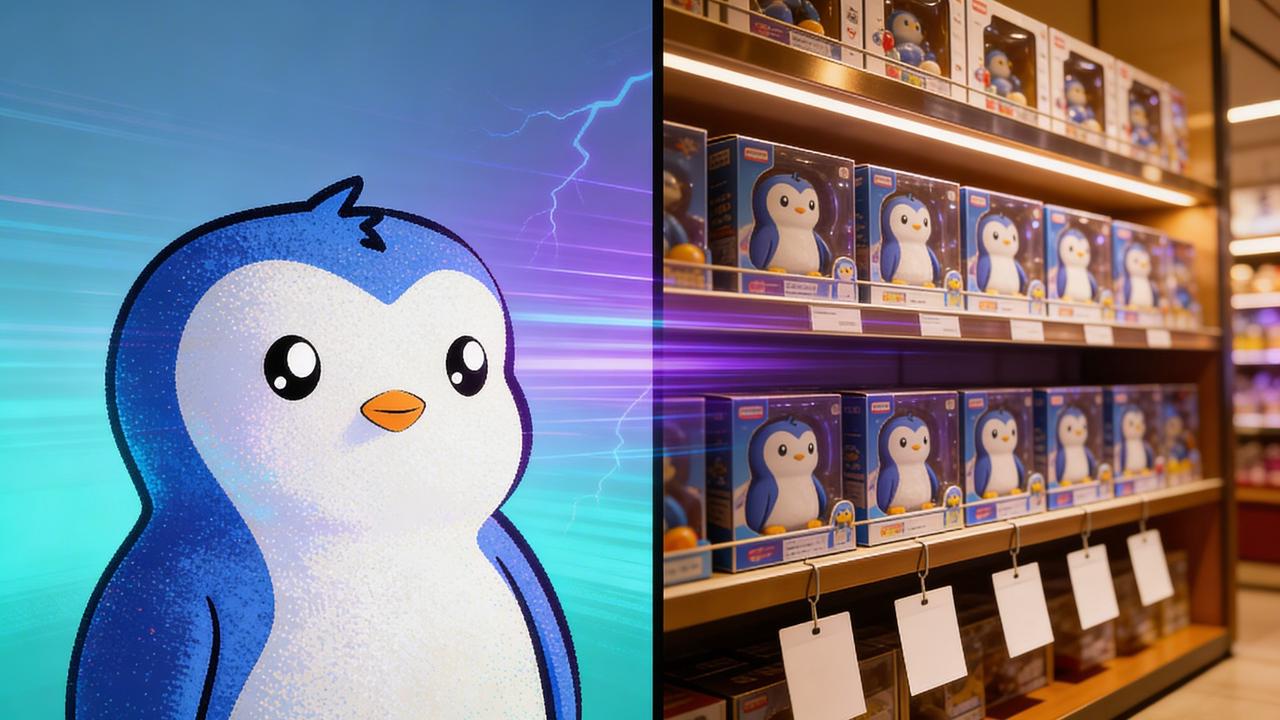
- The bull case focuses on the massive existing community (the "Huddle"), the brand's successful expansion into physical toys (sold in Walmart and Target), and the potential for PENGU to become a leading "culture coin" on Solana.
- The bear case highlights the inherent volatility of meme/culture coins, the risk of the NFT market cooling down, and the challenge of maintaining long-term utility for the token beyond initial hype.
- It presents three detailed price prediction scenarios (bearish, neutral, bullish) based on community growth and broader crypto market conditions.
Pudgy Penguins started as an NFT brand, then did the hard part that most collections never manage. It crossed into mainstream retail, with physical toys showing up in major stores, and it kept expanding that presence into 2026. This year, the brand story now includes a token, PENGU, which gives traders a liquid way to speculate on the Pudgy Penguins ecosystem without buying an NFT.
For anyone looking to trade it, the first step is looking for places where PENGU can be bought and sold with enough liquidity and familiar order tools. Bitunix is a crypto exchange that lists PENGU/USDT and lets users trade it like any other spot asset, alongside other Solana tokens.
This guide breaks down the bull and bear cases, the token mechanics that can move price,
and how to think about PENGU without pretending anyone can forecast memes perfectly.
The Bull Case: The Power of the Huddle
PENGU has a rare setup for a meme-adjacent token. It sits on top of an IP that already escaped the NFT bubble and landed in mainstream retail, then kept expanding the distribution footprint into 2026. That matters for price because this is ultimately a demand game. Attention drives buyers, buyers drive liquidity, and liquidity keeps the narrative alive long enough for utility experiments to stick.
Price-wise, forecasts are all over the place, which is normal for a young cultural asset. CoinCodex's March 2026 model puts an end-of-2026 target around $0.019 for PENGU, with a 2030 estimate around $0.0209. DigitalCoinPrice's 2026 ranges sit lower, with monthly bands that dip into the $0.004 to $0.007 area later in 2026. And a CoinCodex snapshot from 2025 showed a much wider 2026 trading channel, which is a good reminder that PENGU price prediction models swing hard when the token's trend and circulating supply change.
1. Proven IP and Mainstream Penetration
Most Solana meme coins start with a logo and a Telegram. Pudgy Penguins built distribution, and 2026 made that even more obvious. In March 2026, Pudgy Toys and licensed Lil Pudgys expanded into Target stores nationwide, moving beyond a single retailer footprint and putting the characters in a second major national chain. That kind of placement helps the brand outlive crypto cycles, because people meet the penguin before they ever meet the token.
This matters for PENGU because retail exposure changes the top of the funnel. A meme coin usually fights for attention solely in crypto. A consumer brand can recruit outside crypto, then pull that attention back on-chain during hot market moments. If the brand keeps stacking distribution channels, PENGU has a better chance of catching a narrative wave without relying on a single influencer tweet.
2. A Rabid Community
The Huddle is a real advantage, but the main benefit is distribution and coordination. A large community can push content, onboard new users, and keep markets active when attention shifts to the next thing. That is how a token survives the mid-cycle chop that kills most meme coins.
A community also helps with product adoption experiments. Pudgy World, for example, launched in March 2026 as a free-to-play browser game designed to feel familiar first, with crypto elements kept optional and low-friction. That design choice lowers the onboarding barrier and gives the brand more room to test retention, conversion, and wallet activation over time.
3. The Culture Coin Narrative
PENGU's best bull argument is that it tries to price culture, not code. Culture assets can move fast when the market wants simple stories, and 2026 has already shown how quickly headlines can create tradable bursts around brand moments like game launches and product announcements.
A culture token also has more narrative hooks than a random meme. There is the toy pipeline, the licensing angle, the game layer, and now the payments narrative. When those hooks land close together, PENGU has more reasons to show up on trader watchlists, which usually improves liquidity and reduces the odds of a dead chart.
4. Solana Ecosystem Synergy
Solana is still the main ecosystem for fast meme coin turnover. Cheap transactions and quick settlement matter because this market runs on lots of small, impulsive trades. PENGU launching and trading in that environment gives it a structural advantage over culture tokens that live on chains where every click feels expensive.
In 2026, PENGU also benefited from catalysts that fit Solana's retail trading style. CoinMarketCap's February 2026 coverage tied PENGU to a Visa card narrative through a partnership announcement, framing it as a jump from an NFT brand into payments. Whether that product scales or not, the key point is that it created a tradeable headline that Solana markets tend to amplify.
The Bear Case: The Gravity of Meme Coin Economics
The bear case is that a culture token can have real brand momentum and still trade like a meme coin, meaning price spikes get sold, and the chart bleeds when attention moves elsewhere. In 2026, the market also began paying closer attention to supply schedules, as large unlocks can cap rallies even when the narrative looks strong.
This is also where forecasts start to diverge. CoinCodex's 2026 view is meaningfully higher than DigitalCoinPrice's later-2026 bands, and that gap is basically the whole debate. Bulls assume the brand keeps converting attention into demand faster than supply expands. Bears assume dilution and hype cycles win most weeks, and the token behaves like a typical meme asset again.
1. Inherent Volatility
Even with a strong brand, PENGU still trades in the Solana meme coin ecosystem, which punishes hesitation. Tokens can move 20% on a headline, then give it back the next day when traders rotate into whatever is trending. That kind of volatility makes it hard to build stable support levels unless there is consistent, measurable usage that creates steady buy pressure.
For anyone asking is PENGU a good investment, this volatility is the first filter. If the strategy requires predictability, PENGU is a mismatch. If the strategy accepts drawdowns as the entry fee for narrative exposure, then risk control becomes the real job.
2. Lack of Clear Utility
A culture token needs clear reasons to hold, not just trade. New products help, but they have to translate into token demand in a way that is visible and repeatable. A payments headline is fun, but it does not automatically create token sinks, and traders will notice quickly if utility is mostly marketing language instead of on-chain mechanics.
Pudgy World's approach of making crypto optional can help with onboarding, but it also creates a question. If users can enjoy the ecosystem without touching the token, then PENGU needs a separate value loop that is strong enough to justify long-term holding.
3. NFT Market Dependence
Pudgy Penguins crypto still carries the shadow of the NFT market. When NFTs as a category cool down, anything attached to NFT IP often gets repriced, even if the consumer brand is doing fine.
This dependence also shows up in liquidity. When NFT traders are active, they tend to trade related tokens and drive volume. When they leave, spreads widen, and prices become more jumpy, which scares off the cautious capital that could stabilize the chart.
4. Airdrop and Unlock Sell Pressure
Larger unlocks increase circulating supply, and supply growth usually needs matching demand growth to keep prices stable. CoinMarketCap's March 2026 write-up highlighted ongoing tokenomics pressure and pointed to meaningful recurring unlocks as a potential headwind while broader market sentiment stayed weak.
There is also a second-order effect. Early recipients often sell into strength, especially after big headlines. That can create a pattern where good news spikes become exit liquidity, which trains traders to sell rallies faster, keeping the token stuck in a short-cycle loop.
5. Security and Brand Risk Spillovers
Consumer brands attract scammers, and 2026 showed how quickly that can become a problem. A phishing campaign targeting Pudgy World used a fake site and wallet connection tricks designed to steal credentials, and it even tried to evade analysis by detecting research environments. That kind of incident increases user friction and fear, which hurts conversion.
Brand risk also includes legal distraction. In March 2026, major coverage highlighted a trademark lawsuit tied to penguin-themed apparel marks. Legal outcomes take time, but headlines like this create uncertainty, and uncertainty usually shows up as reduced risk appetite in highly speculative tokens.
PENGU Price Prediction Scenarios
This PENGU price prediction section is a way to map plausible paths based on the few things that actually move meme assets: brand growth, liquidity, supply, and headlines.
Start with what models already imply. CoinCodex shows an end-of-2026 estimate of around $0.009144 and an end-of-2030 estimate of around $0.01862. CoinLore's long-range table lists $0.0559 for 2030 in a bullish market case, with lower prices in the intervening years. CoinMarketCap stays more cautious for 2026 with a low of around $0.00433 and an average of around $0.00475.
With that in mind, here are three scenario buckets traders actually use
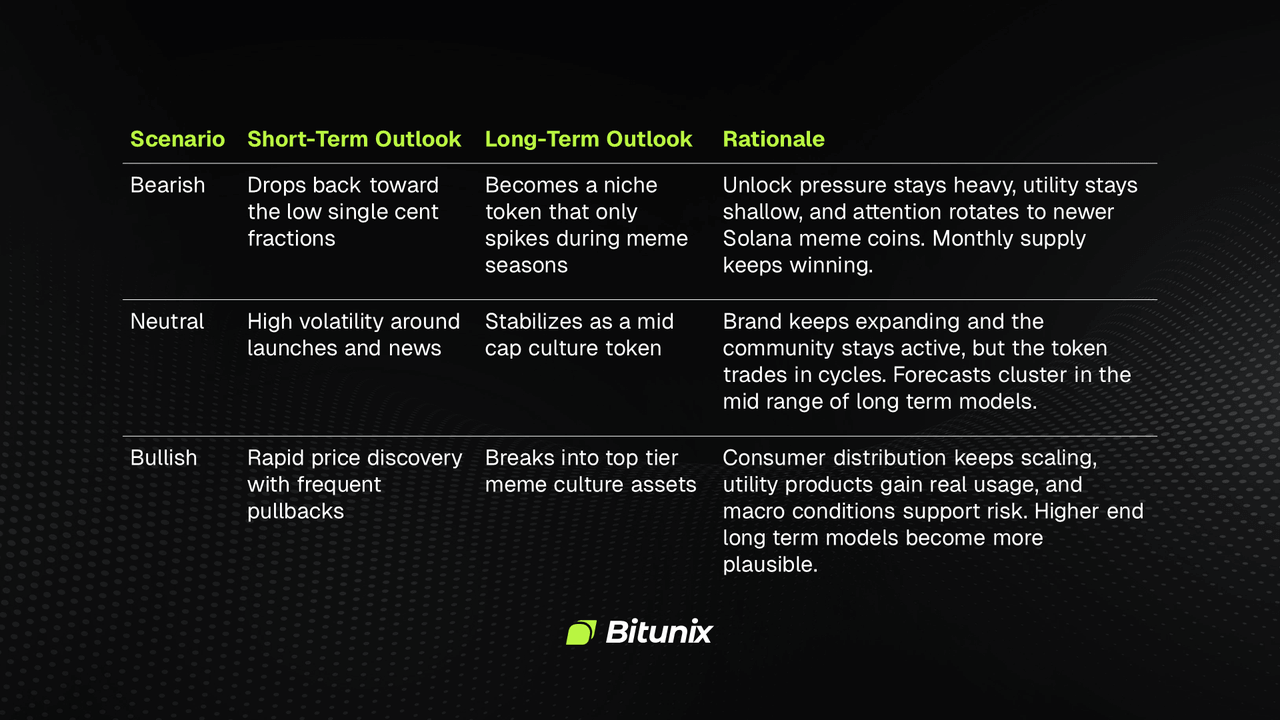
PENGU scenario map showing short-term and long-term outlooks.
Conclusion: A Bet on Web3 Brand Building
PENGU is not a normal meme coin. It sits on top of a brand that keeps pushing into retail, partnerships, and consumer products. That gives it a stronger narrative foundation than most Solana tokens.
At the same time, it still trades like a meme asset. Token unlocks and sentiment swings can dominate for long stretches, and legal headlines can hit fast. Anyone treating it like a steady long-term compounder usually learns the hard way.
For traders who want exposure to the Pudgy Penguins ecosystem, Bitunix provides a straightforward way to trade PENGU and other Solana tokens. Download the Bitunix app, register, and start small until the market proves it deserves a bigger size.
FAQ
What is the PENGU token?
PENGU is the ecosystem token tied to Pudgy Penguins. Traders use it to speculate on brand momentum, community growth, and ecosystem products.
What are Pudgy Penguins?
Pudgy Penguins is a Web3 brand that began as an NFT collection and expanded into consumer products, licensing, and partnerships. It combines digital collectibles with mainstream distribution, a rare approach in the NFT market.
Is PENGU a meme coin?
It trades like a meme coin because price reacts heavily to sentiment, social reach, and narrative cycles. The difference is the brand footprint. Many meme coins are only jokes. PENGU is tied to a recognizable IP with real-world products.
What blockchain is PENGU built on?
PENGU is a Solana token. That means fast transfers and low network fees compared with many older chains. It also means it sits inside the most active meme trading ecosystem, where new tokens and liquidity rotate quickly.
How was the PENGU token distributed?
Token distribution usually includes multiple buckets, such as community allocation, ecosystem incentives, and team or company vesting. The exact schedule matters because unlocks can add steady sell pressure. Traders should check vesting and unlock calendars before sizing up.
Who is the CEO of Pudgy Penguins?
Luca Netz (Luca Schnetzler) is the CEO of Pudgy Penguins. He acquired the project in early 2022 for about 750ETH after backlash against the original team. Since then, he has expanded Pudgy Penguins into toys sold at major retailers, licensing, gaming, and the PENGU token.
Does owning PENGU give me ownership of the company?
No. Holding a token does not usually grant equity, profits, or voting rights over a company unless a legal structure explicitly says so. Most tokens represent participation in an ecosystem and market exposure to that ecosystem's narrative.
What is a culture coin?
A culture coin is a token that trades on brand identity and community belonging, more than on a technical product. The idea is similar to how brands create loyalty. The risk is that attention can shift quickly, which can crush prices.
Where can I buy Pudgy Penguin toys?
Pudgy toys are sold through major retailers and online storefronts, depending on your region. Availability changes with stock cycles and expansions into new stores. Checking official product pages and large retailers is usually the fastest way to confirm availability.
Where can I trade the PENGU token?
PENGU trades on centralized and decentralized markets, depending on listings and regional rules. Centralized exchanges are often easier for newer traders who want simple order entry. Decentralized swaps are faster for on-chain users but require wallet setup and gas awareness.
Glossary
- Meme coin: A token driven mainly by internet culture, attention, and speculation rather than core utility.
- NFT: A non-fungible token that represents unique ownership of a digital item on a blockchain.
- IP (intellectual property): Brand assets such as characters, logos, and designs that can be licensed or monetized.
- Tokenomics: The rules of a token's supply, distribution, incentives, and unlock schedule.
- Vesting: A schedule that releases locked tokens over time, often for teams or companies.
- Token unlock: The event when previously locked tokens become transferable and can be sold.
- Circulating supply: The amount of tokens currently available in the market, excluding locked supply.
- Market cap: Token price multiplied by circulating supply, used to estimate relative size.
- Liquidity: How easily a token can be bought or sold without moving the price too much.
- Spread: The gap between the best buy price and the best sell price on an order book.
- Slippage: The difference between the expected and actual execution price, common in thin markets.
- Solana: A high-throughput blockchain known for low fees and fast transactions.
- Airdrop: Free token distribution to users, often used to bootstrap attention and adoption.
- On chain: Activity recorded directly on a blockchain, such as transfers or swaps.
- CEX: A centralized exchange that matches buyers and sellers through an internal order book.
Disclaimer
This article does not provide:
(i) investment advice or investment recommendations;
(ii) an offer or solicitation to buy, sell, or hold digital assets;
(iii) financial, accounting, legal, or tax advice.
Digital assets, including stablecoins and NFTs, involve high risk and may fluctuate significantly. Consider whether trading or holding digital assets is appropriate for you given your financial situation. Consult a qualified legal, tax, or investment professional when needed. You are responsible for understanding and complying with applicable local laws and regulations.
About Bitunix
Bitunix is a global cryptocurrency derivatives exchange trusted by over 4 million users across more than 100 countries. At Bitunix, we are committed to providing a transparent, compliant, and secure trading environment for every user. Our platform features a fast registration process and a user-friendly verification system supported by mandatory KYC to ensure safety and compliance. With global standards of protection through Proof of Reserves (POR) and the Bitunix Care Fund, we prioritize user trust and fund security. The K-Line Ultra chart system delivers a seamless trading experience for both beginners and advanced traders. At the same time, leverage of up to 200x and deep liquidity make Bitunix one of the most dynamic platforms in the market.
Bitunix Global Accounts
X | Telegram Announcements | Telegram Global | CoinMarketCap | Instagram | Facebook | LinkedIn | Reddit | Medium