
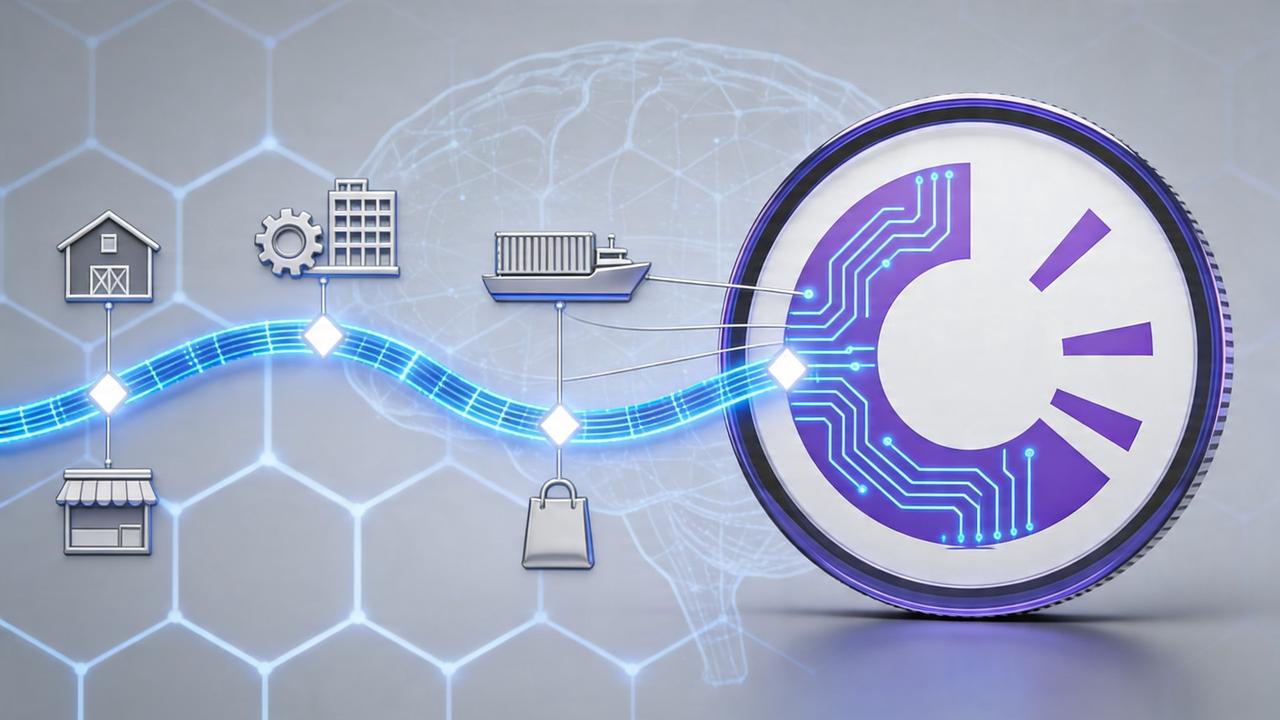
Article Summary
- This article provides a detailed price prediction and fundamental analysis for the OriginTrail (TRAC) token.
- It explains OriginTrail as a Decentralized Knowledge Graph (DKG) designed to organise, discover, and verify data across supply chains and other industries.
- The bull case focuses on growing enterprise adoption for supply chain transparency, real-world utility, and increasing regulatory demands for data integrity.
- The bear case highlights slow enterprise adoption cycles, intense competition from centralised data solutions, and limited mainstream crypto awareness.
- It presents detailed price prediction scenarios (bearish, neutral, bullish) for both 2026 and 2030, based on enterprise integration and network usage.
Global supply chains depend on shared data, but that data often becomes fragmented, hard to verify, and easier to distort as it moves across more systems and counterparties. OriginTrail was built to deal with that problem. Its core product is a knowledge network that lets organizations publish, connect, and verify information without relying on one central database to act as the referee. For anyone who uses a crypto exchange to follow infrastructure-focused tokens, TRAC offers exposure to a blockchain project tied to enterprise adoption and data verification. Bitunix also lists TRAC/USDT, which makes the token easier to access once that thesis looks strong enough to justify the risk.
OriginTrail's pitch is easy to understand at a high level. It wants companies, institutions, and AI systems to work from verifiable data instead of scattered records, weak provenance, and trust-me spreadsheets. That makes it relevant to supply chain transparency, regulated industries, and newer AI use cases where data integrity matters as much as model quality. What you are really buying with TRAC is the possibility that verified data becomes more valuable as regulation, AI, and cross-company coordination all get harder at the same time.
This analysis will examine OriginTrail's technology, its enterprise focus, and provide data-driven price predictions for 2026 and 2030.
The Technology and Ecosystem
OriginTrail's own documentation describes the network like this:
"The OriginTrail Decentralized Knowledge Graph is a global decentralized data structure that interlinks Knowledge Assets in a semantic format, hosted on a permissionless network."
A Decentralized Knowledge Graph, or DKG, treats data as connected knowledge assets rather than isolated records. In practice, that lets multiple parties publish related information, verify provenance, and preserve those links across systems instead of trapping everything inside one corporate silo.
The project's multichain design uses off-chain data hashing and reference checking to enable different nodes to verify integrity and authenticity without exposing the underlying data. That is important for enterprise blockchain use cases because companies often need shared verification without full public disclosure. OriginTrail is trying to give them a way to prove that data has not been altered while still keeping sensitive business information selective and controlled.
The TRAC token gives that system an economic engine. The official OriginTrail documentation states that the TRAC token is the foundational utility asset of the DKG and is used for publishing fees, staking, and delegated participation. Knowledge publishers pay TRAC to mint knowledge assets onto the network, while core nodes and delegators stake TRAC to secure the system and earn a share of publishing fees. The current delegated staking docs also make an important point for token holders: staking rewards are utility-based and come from DKG usage rather than token inflation.
There is also a bridge here to actual market access. Bitunix has a live TRAC/USDT spot page, which matters because enterprise-focused tokens often lose attention when they are hard to trade or poorly distributed across exchanges. Easy exchange access removes one small friction point between enterprise narrative and investor participation.
The Bull Case: Enterprise Adoption and Regulation
A bullish OriginTrail price prediction starts with a market that still has not settled on how much TRAC should be worth if enterprise adoption improves. As of April 15, 2026, CoinMarketCap showed TRAC at $0.2935, with a market cap of $146.8 million and daily volume of $8.7 million. From there, forecast models spread out quickly. CoinCodex's forecast projects TRAC at $0.6222 by the end of 2026 and $0.6676 by the end of 2030, Kraken's simpler 5% growth model stays far more conservative at about $0.30 in 2026 and $0.36 in 2030, and Changelly's price prediction lands between those two in the near term, with a 2026 range around $0.306 to $0.460, then turns more optimistic by 2030 with an average near $0.582 and a maximum around $0.735. In the next few sections, we will explore the best-case scenarios for TRAC's growth.
1. Real-World Utility
Unlike many crypto projects that are still searching for a job, OriginTrail is aimed at industries that already spend money on traceability, trust, and compliance. The clearest supply chain example on OriginTrail's own site is SCAN, the Supplier Compliance Audit Network. SCAN members include Costco, Walmart, and Target, and the network covers $1.36 trillion in annual sales and more than 22,000 sourcing factories. The OriginTrail DKG enters this system to help secure audits, meet privacy standards, and support data sharing with U.S. customs programs.
The healthcare angle also strengthens the bull case by showing OriginTrail expanding beyond traditional provenance tracking. In September 2025, Oxford PharmaGenesis and Trace Labs announced a collaboration to build a structured, connected, and verifiable pool of clinical trial knowledge on the OriginTrail DKG. The post says Oxford PharmaGenesis works with more than 50 healthcare organizations, including 8 of the world's top 10 pharmaceutical companies. If OriginTrail becomes useful in regulated, knowledge-intensive sectors like pharma, the market has more reason to value it as infrastructure.
2. Regulatory Demand
Regulation is also moving in a direction that favors better product data. A 2026 KPMG survey on the European Digital Product Passport framed this shift:
"By establishing a product-level data infrastructure, the DPP is designed to enable trusted information, stronger customer confidence, circularity, and operational resilience."
That matters for OriginTrail because the DPP model pushes companies toward verified, interoperable product data across large supply networks. SGS wrote in January 2025 that the Digital Product Passport enhances transparency, sustainability, and traceability across the product life cycle, while KPMG's 2026 survey found high awareness but uneven readiness among more than 70 organizations. In other words, regulation is creating demand, but most companies are still not fully prepared for it. That kind of gap is where infrastructure vendors and data-layer protocols can find work.
3. AI and Data Integrity
As AI becomes more important to OriginTrail's long-term case, the DKG documentation presents the network as a verifiable knowledge layer for AI. The September 2025 Oxford PharmaGenesis announcement also notes that each contribution on the DKG includes verifiable ownership, transparent version history, and contextual links for both AI and human use. That is important in a market where AI models still make mistakes, inherit weak source data, and struggle to prove provenance. If enterprises place more value on auditable AI outputs, OriginTrail's data integrity case becomes stronger.
The Bear Case: The Enterprise Hurdle
A cautious OriginTrail price prediction still has to account for a much harder reality than the bull case suggests. While public models like CoinCodex and Changelly leave room for upside, the conservative range from Kraken stays close to the current price, and even the more optimistic forecasts still keep TRAC well below its old cycle peak.
1. Slow Adoption Cycles
Enterprise adoption almost always takes longer than token holders want. A 2025 enterprise blockchain report from the Mass Tech Leadership Council put it well:
"Blockchain has quietly matured into a powerful enabler for specific enterprise use cases, particularly those involving transparency, traceability, and trust."
That is encouraging, but the same report also says adoption is selective and strategic rather than universal. However, OriginTrail can have real utility and still take years to convert that utility into revenue, larger network usage, and higher token demand. Big companies do not rewrite data systems overnight, especially when those systems already connect to procurement, compliance, ERP, and supplier workflows.
2. Centralized Competition
OriginTrail also competes against companies that already own enterprise relationships. SAP highlights blockchain's value for traceability and provenance in complex supply chains, while Oracle markets cloud supply chain tools with real-time status access, analytics, and predictive visibility. That means OriginTrail is competing with established software stacks that large manufacturers and retailers already trust for day-to-day operations.
3. Limited Mainstream Awareness
Because OriginTrail focuses on business-to-business infrastructure, it also lacks the retail hype that often drives crypto valuations far faster than fundamentals do. CoinMarketCap currently ranks TRAC around #153 by market cap, which is respectable but far from front-page territory, and that limited awareness feeds back into price. Fewer retail holders means less reflexive momentum, fewer speculative surges, and a smaller pool of people willing to pay up before enterprise growth is obvious, making valuation look slow even when the underlying work is real.
OriginTrail Price Prediction Scenarios (2026 & 2030)
Putting the forecasts side by side makes it clear that the market sees several possible futures for TRAC, and they are far apart. The conservative models assume OriginTrail keeps building but grows at an enterprise pace. The more aggressive models assume that regulation, AI demand, and data verification needs will ultimately make OriginTrail a larger infrastructure winner.
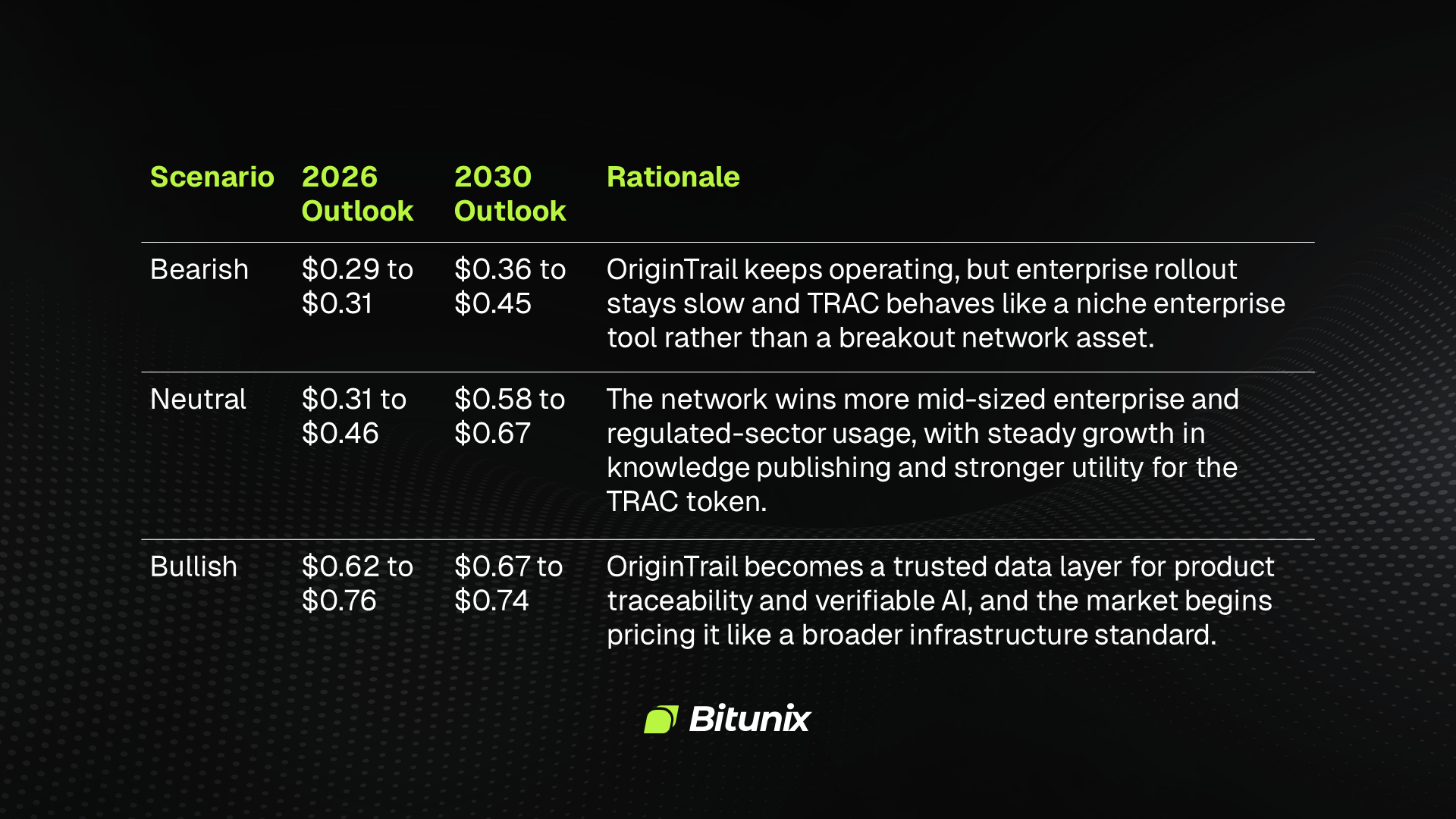
OriginTrail price prediction scenarios for 2026 and 2030, comparing bearish, neutral, and bullish outcomes based on enterprise adoption, utility growth, and verified data demand.
Conclusion: A Bet on Verifiable Data
OriginTrail is one of the cleaner enterprise blockchain use cases in crypto because it addresses a real problem and a real market need. Companies already need verified product data, connected records, and stronger proof that shared information has not been tampered with. The DKG provides OriginTrail with a robust architecture for that job, and the TRAC token has a clearer utility model than many infrastructure tokens because publishing, staking, and node incentives all tie back to actual network use.
Investing in TRAC is a long-term bet on transparent supply chains, verifiable AI inputs, and rising demand for trustworthy data across fragmented enterprise systems. That thesis has substance, but it also comes with slow sales cycles, strong centralized competition, and limited mainstream awareness. For traders who want exposure, Bitunix offers the TRAC/USDT trading pair, so you can download the app, register, and decide whether the current valuation looks attractive enough for an infrastructure trade.
FAQ
What is OriginTrail (TRAC)?
OriginTrail is a blockchain-based knowledge network built around its Decentralized Knowledge Graph. It helps organizations publish, connect, and verify data across supply chains, AI systems, and enterprise environments. TRAC is the network's utility token for publishing, staking, and securing node participation.
What is a Decentralized Knowledge Graph (DKG)?
A DKG is a shared, decentralized data structure that links knowledge assets in a semantic format. It works more like a verifiable web of connected information than a simple ledger, which makes it useful for discovery, provenance, and cross-system interoperability.
How does OriginTrail improve supply chain transparency?
OriginTrail improves supply chain transparency by letting multiple parties publish and verify shared data without depending on a single database owner. Its DKG supports trusted data sharing, integrity checks, and selective disclosure, which helps with audits, provenance, and compliance-heavy coordination.
What is the utility of the TRAC token?
The TRAC token pays for knowledge publishing, supports staking by core nodes and delegators, and secures the network's economic model. Current OriginTrail docs say rewards come from publishing fees tied to usage rather than from ongoing inflationary emissions.
Which industries use OriginTrail?
OriginTrail is used across supply chains, healthcare, transportation, construction, and AI applications. Official materials highlight SCAN for supply chain audits and an Oxford PharmaGenesis collaboration for structured, verifiable clinical trial knowledge tied to pharma and medical communications.
How does OriginTrail relate to Artificial Intelligence (AI)?
OriginTrail positions the DKG as a verifiable knowledge layer for AI. The idea is that AI systems perform better when they can access source-linked, structured, and auditable information instead of relying only on opaque training outputs or unverified web content.
Can I run a node on the OriginTrail network?
Yes. OriginTrail supports core nodes and delegated staking. Node operators provide DKG services, while TRAC delegators can stake to support selected nodes and share in rewards. The docs also say delegated tokens remain locked in smart contracts and stay inaccessible to operators.
Who are OriginTrail's main competitors?
OriginTrail competes with other blockchain-based traceability projects, but the bigger practical competition often comes from centralized enterprise software providers such as SAP and Oracle, which already sell supply chain visibility, traceability, and planning tools to large organizations.
What are the risks of investing in TRAC?
The main risks are slow enterprise adoption, tough competition from incumbent software vendors, and limited retail awareness compared with more hype-driven crypto assets. Price models also vary widely, which shows that the market still has low conviction about how fast OriginTrail can scale.
Where can I buy TRAC tokens?
You can buy TRAC on major centralized exchanges such as Coinbase, Kraken, KuCoin, MEXC, Crypto.com, and Gate.io. It is also available on decentralized platforms like Uniswap on Ethereum.
Glossary
- TRAC token: OriginTrail’s utility token used for publishing fees, staking, and node incentives.
- Decentralized Knowledge Graph: A networked data structure that links verifiable knowledge assets across systems.
- Knowledge Asset: A published unit of data on the DKG that can be linked, discovered, and verified.
- Supply chain transparency: The ability to see and verify product, sourcing, and process data across the supply chain.
- Enterprise blockchain: Blockchain infrastructure designed for business, compliance, and multi-party data coordination.
- Data integrity: Assurance that data remains accurate, unchanged, and verifiable over time.
- Node operator: A participant who runs infrastructure that stores, validates, and serves knowledge assets on the DKG.
- Delegated staking: A system where TRAC holders lock tokens with a node to help secure the network and share rewards.
- Publishing fee: The TRAC payment required to mint or publish knowledge assets onto the DKG.
- Semantic format: A structured data format that preserves meaning and relationships between data points.
- Multichain: Designed to work across more than one blockchain network.
- Digital Product Passport: A regulatory product data record tied to transparency, sustainability, and lifecycle reporting.
- Provenance: Information about where data or a product came from and how it changed over time.
- Verifiable AI: AI systems that rely on auditable, source-linked knowledge rather than opaque or untraceable data alone.
- Interoperability: The ability of different systems or networks to exchange, use, and verify data across shared environments.
Disclaimer
This article does not provide:
(i) investment advice or investment recommendations;
(ii) an offer or solicitation to buy, sell, or hold digital assets;
(iii) financial, accounting, legal, or tax advice.
Digital assets, including stablecoins and NFTs, involve high risk and may fluctuate significantly. Consider whether trading or holding digital assets is appropriate for you given your financial situation. Consult a qualified legal, tax, or investment professional when needed. You are responsible for understanding and complying with applicable local laws and regulations.
About Bitunix
Bitunix is a global cryptocurrency derivatives exchange trusted by over 3 million users across more than 100 countries. At Bitunix, we are committed to providing a transparent, compliant, and secure trading environment for every user. Our platform features a fast registration process and a user-friendly verification system supported by mandatory KYC to ensure safety and compliance. With global standards of protection through Proof of Reserves (POR) and the Bitunix Care Fund, we prioritize user trust and fund security. The K-Line Ultra chart system delivers a seamless trading experience for both beginners and advanced traders, while leverage of up to 200x and deep liquidity make Bitunix one of the most dynamic platforms in the market.
Bitunix Global Accounts
X | Telegram Announcements | Telegram Global | CoinMarketCap | Instagram | Facebook | LinkedIn | Reddit | Medium