
Article Summary
- This article explains the concept of DePIN (Decentralized Physical Infrastructure Networks) and how it bridges the gap between blockchain and the physical world.
- It details how DePIN uses token incentives to crowdsource the building and maintenance of infrastructure like wireless networks, sensors, and computing power.
- The article provides real-world examples of successful DePIN projects, such as Helium (wireless) and Filecoin (storage).
- It includes a comparison table highlighting the advantages of DePIN over traditional, centralized infrastructure models.
- The piece addresses the challenges facing the DePIN sector, including regulatory hurdles and the need for sustained demand.
Crypto gets mocked for living in its own bubble. DePIN is one of the clearest answers to that criticism. It connects token incentives to real machines, real coverage, real storage, and real compute. In simple terms, decentralized physical infrastructure networks (DePIN) is a model where people or businesses deploy hardware, provide a service, and earn tokens for doing useful work in the real world.
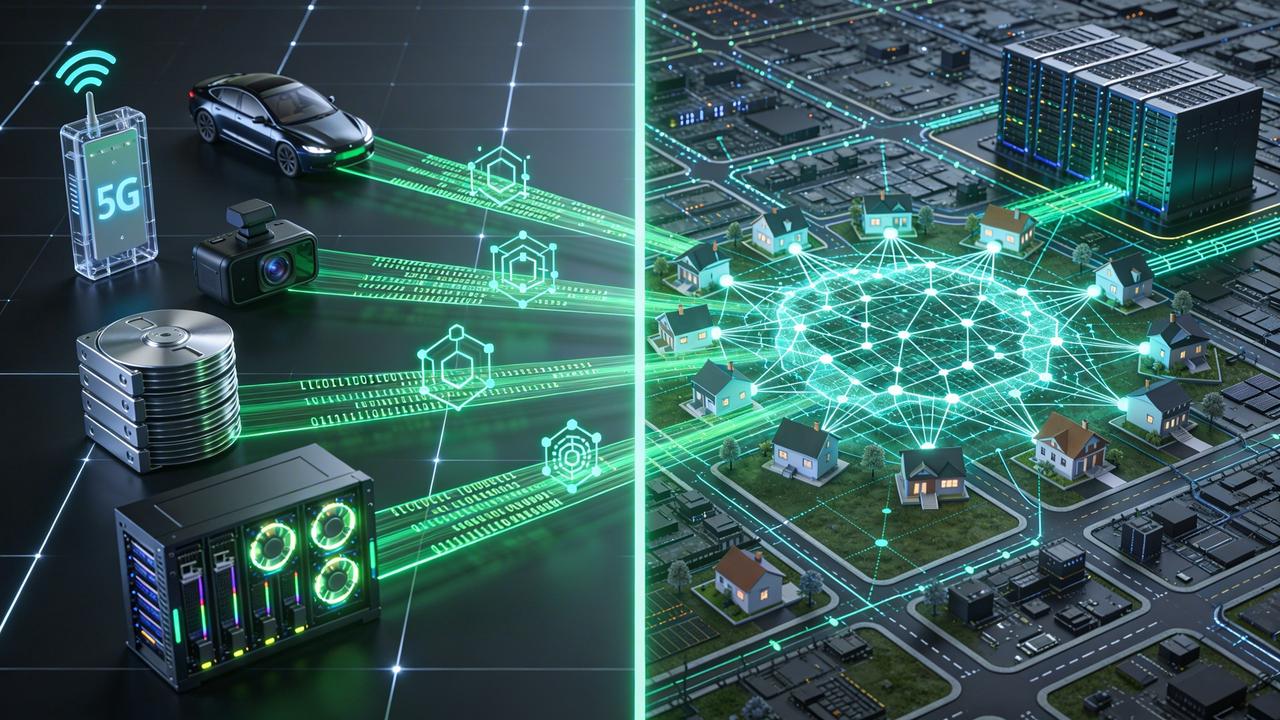
That makes DePIN easier to understand than a lot of crypto sectors. For example, Helium hotspot provides wireless coverage, Hivemapper camera captures road imagery, Filecoin storage provider offers disk space, and Render node supplies GPU power. If you want to track or trade some of these assets from a central venue, Bitunix is a crypto exchange that lists trading pairs such as FIL/USDT, HNT/USDT, and RENDER/USDT, alongside its mobile trading app.
This guide explains how DePIN works, where its strongest use cases are, why the model can beat slow corporate infrastructure in some niches, and where its weak points still lie.
How DePIN Works: The Token Incentive Flywheel
The DePIN pitch looks simple on the surface. Instead of one giant company spending billions to build infrastructure, a network spreads the cost across thousands of participants who each contribute a small piece. The blockchain side keeps track of rewards, payments, and coordination, while the hardware side does the actual work.
Messari's January 2026 sector report summed up the shift well:
"DePIN has matured from speculative experiments into real, revenue-generating infrastructure businesses. The sector now represents roughly $10B in circulating market cap."
That same report estimated about $72 million in on-chain revenue in the first half of 2025 and roughly $1 billion in 2025 raised by DePIN startups. So for this category, it is still early, but it is early with real numbers behind it.
What is DePIN Crypto In Practice?
If you are still asking what is DePIN crypto, the best definition is that it pays people to install and operate the useful hardware a network needs. Traditional telecoms, cloud storage, and compute markets typically rely on significant upfront capital expenditures, centralized ownership, and pricing power that smaller players cannot challenge. Grayscale's February 2025 report argues that DePIN fits best in markets with high capital needs, high barriers to entry, monopolistic dynamics, and underused resources.
The crowdsourced model flips that setup: one person buys a hotspot, another installs a dashcam, another rents out extra storage or idle GPU capacity, the network rewards those who supply with tokens, and then customers pay to use the service, either in the native token or in fiat that gets converted into token demand somewhere in the system. That is the basic answer to how DePIN works.
Helium is a good example. Its docs say hotspot owners earn HNT for providing coverage and handling wireless traffic, while HNT gets burned when the network is used. Helium's 2025 year-in-review post said the network ended 2025 connecting more than 2 million people every day, and a December 2025 expansion post said the network spanned more than 120,000 hotspots across the U.S. and Mexico, showing that the supply-and-demand loop was working in public.
Hivemapper shows the same structure in mapping. Its May 2025 docs explain that users of network data must redeem Map Credits; those credits can only be generated by burning HONEY, and one Map Credit has a fixed price of $0.0075. The network had two core products, imagery and map features, so contributors supply the map, developers pay to use the data, and the token sits in the middle of the economics.
And if you view these tokens from a trading perspective, Bitunix gives you market access without altering the fundamental truth underlying them. A FIL or HNT pair is still tied, at least over time, to whether the network is attracting usage rather than just attention. That gap between attention and usage is where DePIN either matures or falls apart.
Categories and Examples of DePIN
The best way to organize DePIN examples is to split them into physical resource networks and digital resource networks. Physical resource networks (PRNs) provide location-specific services, such as wireless connectivity, while digital resource networks (DRNs) provide fungible digital resources, such as compute or storage.
Messari's May 2025 tokenomics report adds an investor twist: across 80 projects it studied, DRNs had median fully diluted valuations that were more than three times those of PRNs.
1. Physical Resource Networks
PRNs depend on location. A hotspot is more useful in a busy area than in an empty one, and a mapping camera only has value where people actually drive. So, where the hardware is deployed directly affects how much the network can earn and how useful the service is.
Helium is the best-known PRN, it replaces cell towers with hotspots that provide connectivity, and major U.S. carriers use Helium as an offload solution when better or cheaper coverage is needed. In April 2025, Helium announced that AT&T subscribers could connect to its community-built Wi-Fi network. This is important because it moves Helium away from being a crypto curiosity and closer to being an actual telecom layer with paying demand.
Hivemapper is another strong PRN example. It is a decentralized system of people, cameras, and apps mapping the world in real time. Anyone driving with a purpose-built device can help build the map, and the token docs show how customer demand feeds back into HONEY burns and contributor rewards. That makes Hivemapper one of the clearest examples of a tokenized data-collection network.
2. Digital Resource Networks
DRNs provide resources that do not depend on location. Storage and compute can come from many places without losing their value. That makes these networks easier to scale, which is one reason investors often value them more highly.
Filecoin is the most well-known storage case. Its February 2026 strategy post says the network has become the world's largest decentralized storage network and is now shifting from growing supply to scaling demand. Its June 2025 network update projected more than 1 EiB in paid storage deals for 2025, and its January 2026 year-in-review post said the ecosystem spent 2025 delivering verifiable, high-quality storage services for paying customers, including the launch of Filecoin Onchain Cloud.
That is an important signal for DePIN investors. Having a lot of storage capacity is no longer enough. What matters now is whether customers are actually paying to use it.
Arweave fits the same broad storage bucket, though with a different design. It is a global, permissionless hard drive built for permanent storage, giving DePIN another branch beyond cloud rentals.
Render covers the compute side as a decentralized GPU rendering platform. The network's March 2026 annual update said demand for decentralized GPU rendering continued to grow through 2025. That same report highlighted the launch of Dispersed, a dedicated compute subnet for AI workloads, and pointed to large-scale production use cases such as an immersive project involving 16 artists and 12 3D works. In other words, Render is trying to move from creative rendering into the much larger AI compute market.
From an investor's angle, what is DePIN crypto really buying in these DRN names? You are buying a claim on whether decentralized storage or compute can be good enough, cheap enough, and reliable enough to win real customers.
DePIN vs. Traditional Infrastructure
The easiest way to understand DePIN vs traditional infrastructure is to stop thinking like a token trader and think like an infrastructure operator. Who owns the equipment, who pays to expand capacity, who sets prices, and what happens when a central provider fails?
Here are the main topics for comparison between DePIN and traditional infrastructure:
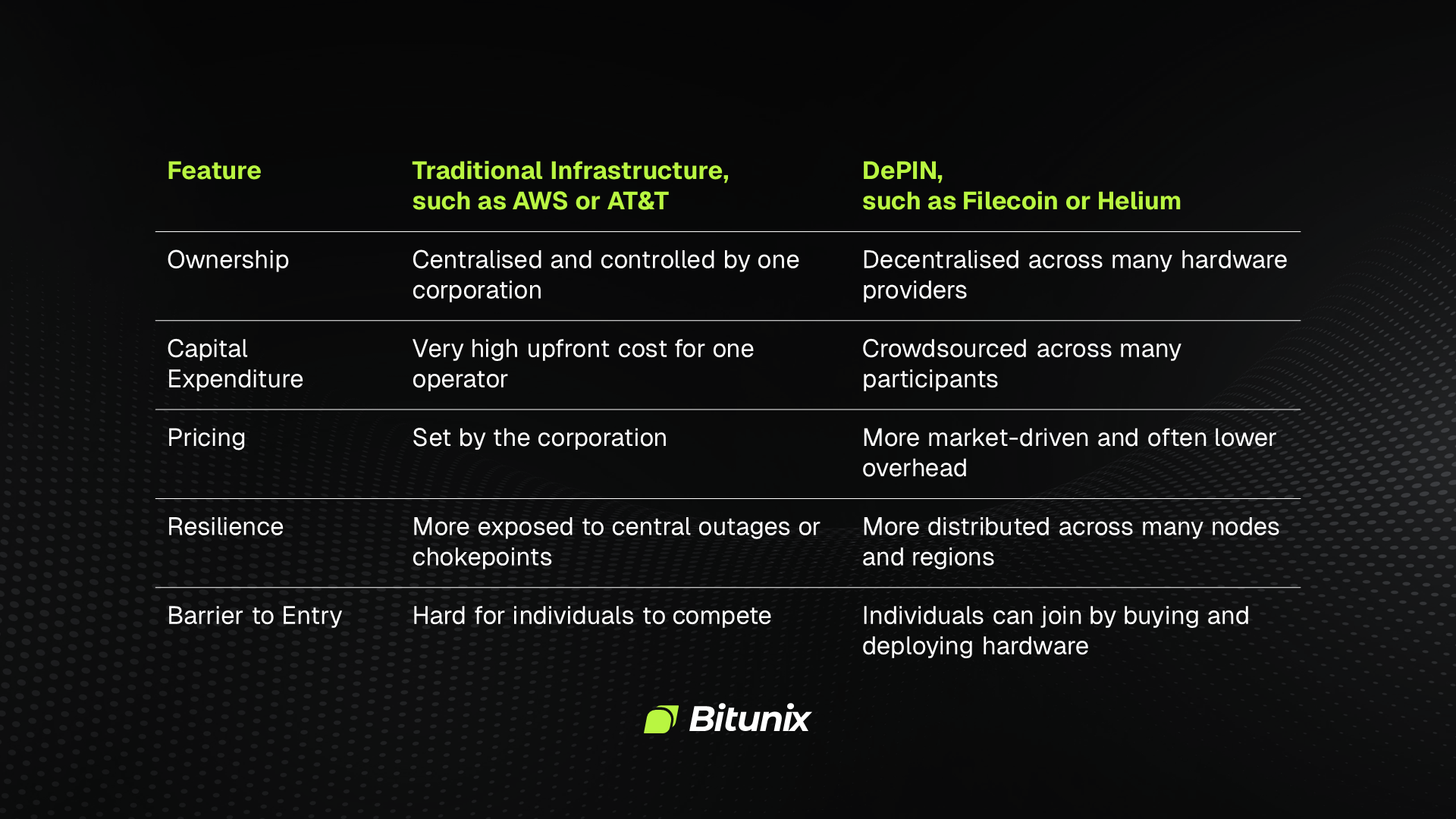
Comparison table showing how DePIN differs from traditional infrastructure in ownership, capital costs, pricing, resilience, and accessibility for individual participants.
That does not mean DePIN wins automatically. Corporate infrastructure is still better at quality control, customer support, and standardization. But DePIN can move faster in underbuilt or underpriced niches.
Challenges and the Future of DePIN
The hardest part in DePIN is making the solutions durable. Most networks can attract supply with token rewards. Far fewer can create demand that keeps paying after the subsidies cool off. Messari's 2026 sector report says only a narrow set of scaling paths remain viable, including InfraFi, capex-light models with fast paybacks, or access to speculative capital in stronger markets.
Below, we discuss the main challenges that will probably come in the future of DePIN:
1. The Demand Problem
Supply is usually the easy side. Tokens can attract hardware fast. Demand is slower and harder because real customers care about uptime, coverage quality, data freshness, compliance, and price. Filecoin's 2026 strategy is basically a sector lesson in public. After years of building storage capacity, the community explicitly shifted focus from supply growth to paid on-chain deals and better network economics. If a DePIN network cannot win customers, token emissions just become a subsidy with an expiry date.
2. Regulatory Uncertainty
DePIN lives in the real world, so it inherits real-world rules. A 2025 legal analysis of DePIN flagged exposure to virtual asset rules, securities rules, data-management law, telecom regulation, and other infrastructure-specific regulations. That is especially relevant for wireless and mapping networks, where privacy, location data, and licensing can become legal headaches fast.
3. Hardware Quality Control
Community hardware is cheaper to scale, but harder to standardize. Helium's March 2026 Helium World update and business toolkit pages show how much work goes into quality metrics, offload logic, and deployer tooling just to improve consistency. If node quality varies too much, customers stop treating the network like infrastructure and start treating it like a gamble.
Conclusion: The Physical Web3
DePIN is one of the clearest real-world use cases in crypto. It uses token incentives to turn spare hardware, local coverage, storage capacity, and GPU time into networks that people can actually use. That model does not solve every infrastructure problem, but it does create a genuine alternative to a world where only giant corporations can build and own critical services.
DePIN works best when it combines three things: real demand, sensible token design, and useful hardware without requiring heroic effort from every participant. Some networks already look more like businesses than experiments. Others still look like experiments with nice dashboards.
If you want exposure to the tokens behind the sector, On Bitunix you can trade DePIN tokens such as FIL, HNT, and RENDER. To start you just have to download the Bitunix app and register there to track the category from one place.
FAQ Section
What does DePIN stand for?
DePIN stands for decentralized physical infrastructure networks. It describes blockchain-based systems that reward people for deploying and operating hardware or digital resources that deliver real services, such as wireless coverage, storage, mapping data, or compute.
How do you make money with DePIN?
You usually make money in two ways. First, you earn token rewards for supplying hardware or network services. Second, some networks route customer demand back into the token economy through burns, fees, or service payments.
Is DePIN the same as the Internet of Things (IoT)?
No. IoT is about connected devices that collect and exchange data. DePIN is an economic and ownership model that can include IoT devices, but also covers storage, wireless, mapping, and compute networks coordinated through tokens and blockchains.
What is the difference between a PRN and a DRN?
A PRN depends on location-specific hardware, such as hotspots or cameras. A DRN provides more fungible digital resources, such as storage or compute.
Is Helium a DePIN project?
Yes. Helium is one of the clearest DePIN examples. It uses community-deployed hotspots to provide wireless coverage, rewards participants in HNT, and links network usage to token burns. It also works with major carriers for mobile offload.
What are the risks of participating in a DePIN network?
The main risks are weak customer demand, falling token rewards, hardware payback periods, regulatory trouble, inconsistent service quality, and token price volatility. A DePIN network can look busy on the supply side and still fail if paying demand never catches up.
Do I need technical skills to join a DePIN project?
Usually some, but not always many. Many DePIN projects are designed for normal users who can install approved hardware and follow setup instructions. The protocol, wallet software, or device firmware often handles the deeper technical work.
How does DePIN compete with Amazon Web Services (AWS)?
It competes by spreading hardware costs and allowing many participants to supply resources rather than having a single corporation own everything. That can lower overhead and improve resilience. But DePIN still has to match centralized providers on reliability, support, and product quality.
Are DePIN tokens a good investment?
Some are promising, but the category is uneven. The best projects show real customer demand, transparent economics, and working infrastructure.
Where can I buy DePIN cryptocurrencies?
You can buy many of them on centralized exchanges and, in some cases, through on-chain venues. Bitunix offers markets for assets like FIL, HNT, and RENDER, giving traders a simple way to follow DePIN assets from one platform.
Glossary
- DePIN: Blockchain-based networks that use token incentives to coordinate the deployment and operation of real-world infrastructure.
- PRN: Physical Resource Network. A DePIN category built around location-specific hardware such as hotspots, sensors, or cameras.
- DRN: Digital Resource Network. A DePIN category built around fungible resources such as storage or compute.
- Capital Expenditure: The upfront spending needed to build infrastructure, such as towers, servers, or large data centres.
- Hotspot: A wireless gateway or access point that provides network coverage in systems like Helium.
- HNT: Helium's native token, used to reward network builders and burned when the network is used.
- Map Credits: Hivemapper's non-transferable usage credits, generated by burning HONEY to access map data products.
- HONEY: The token used in Hivemapper's map data economy.
- Paid Storage Deal: A Filecoin transaction where a customer pays for storage, a stronger demand signal than unused capacity alone.
- Filecoin Onchain Cloud: Filecoin's 2025 expansion into a broader verifiable cloud-services stack for storage, retrieval, and payments.
- GPU Compute: Graphics processing power used for rendering, AI workloads, and other intensive tasks.
- Render Network: A decentralized GPU network that connects compute demand with distributed node operators.
- Token Burn: A mechanism that permanently removes tokens from circulation, often when a service is consumed.
- On-chain Revenue: Revenue that can be verified through blockchain activity rather than inferred from off-chain reporting.
- Value Accrual: The share of network demand or customer spending that actually benefits the token or the protocol economy.
Disclaimer
This article does not provide:
(i) investment advice or investment recommendations;
(ii) an offer or solicitation to buy, sell, or hold digital assets;
(iii) financial, accounting, legal, or tax advice.
Digital assets, including stablecoins and NFTs, involve high risk and may fluctuate significantly. Consider whether trading or holding digital assets is appropriate for you given your financial situation. Consult a qualified legal, tax, or investment professional when needed. You are responsible for understanding and complying with applicable local laws and regulations.
About Bitunix
Bitunix is a global cryptocurrency derivatives exchange trusted by over 3 million users across more than 100 countries. At Bitunix, we are committed to providing a transparent, compliant, and secure trading environment for every user. Our platform features a fast registration process and a user-friendly verification system supported by mandatory KYC to ensure safety and compliance. With global standards of protection through Proof of Reserves (POR) and the Bitunix Care Fund, we prioritize user trust and fund security. The K-Line Ultra chart system delivers a seamless trading experience for both beginners and advanced traders, while leverage of up to 200x and deep liquidity make Bitunix one of the most dynamic platforms in the market.
Bitunix Global Accounts
X | Telegram Announcements | Telegram Global | CoinMarketCap | Instagram | Facebook | LinkedIn | Reddit | Medium