
Article Summary
- This article provides a comprehensive explanation of market depth in the context of cryptocurrency trading.
- It breaks down the core mechanics of how market depth functions and why it is a critical concept for traders to understand.
- The guide explores practical applications and strategies for using market depth to make more informed trading decisions.
- It highlights the risks and limitations associated with relying solely on market depth.
- The article concludes with actionable advice for integrating this knowledge into a broader trading plan.
- Crypto markets move through visible prices, but those prices only tell part of the story. Behind every candle, the order book shows how much buying and selling interest exists at different levels, and that depth affects liquidity, slippage, and execution quality. Market depth helps traders understand whether a move has real support or whether one larger order can push the price around.
- Market depth shows how many buy and sell orders exist at different price levels in an order book. A deep market has enough orders near the current price to absorb larger trades with limited slippage. A shallow market has fewer orders, so even a moderate trade can push the price sharply.
- For traders using a crypto exchange like Bitunix, understanding market depth helps with entries, exits, order sizing, and risk management. Bitunix also provides access to spot and futures markets, making order-book awareness useful for both short-term and active traders.
What Is Market Depth in Crypto? Understanding the Mechanics
A clearer way to understand market depth is to look at the order book behind the current price. Market depth shows the available buy and sell liquidity across different price levels, using bids from buyers and asks from sellers to reveal how much support or resistance exists near the market price.
A basic example makes it easier. Imagine Bitcoin trades at $90,000. If the order book has $10 million in buy orders between $89,900 and $90,000, a large sell order may only move the price slightly. If that same range has only $200,000 in buy orders, the same sell order can cut through several price levels and create more slippage.
The main parts of market depth are bid size, ask size, spread, order concentration, and price impact. Bid size shows how much buyers are willing to pay at each level, ask size shows how much sellers want to sell, the spread is the difference between the highest bid and lowest ask, and the price impact shows how much your order changes the execution price.
Crypto markets trade around the clock, so liquidity can change depending on the session, the pair, and overall market activity. A pair that looks easy to trade during active hours can become harder to execute later, with wider spreads and more slippage. Amberdata’s 2025 BTC/FDUSD analysis showed that market depth was much stronger around 11:00 UTC than later in the day, which means timing alone can affect execution quality.
Market depth explained through charts usually appears in two formats. The first is the order book ladder, where you see bids and asks by price level. The second is the depth chart, where cumulative bids and asks appear as two curves. A steep curve near the market price usually indicates greater liquidity, while a flat or thin curve suggests the price may move more easily.
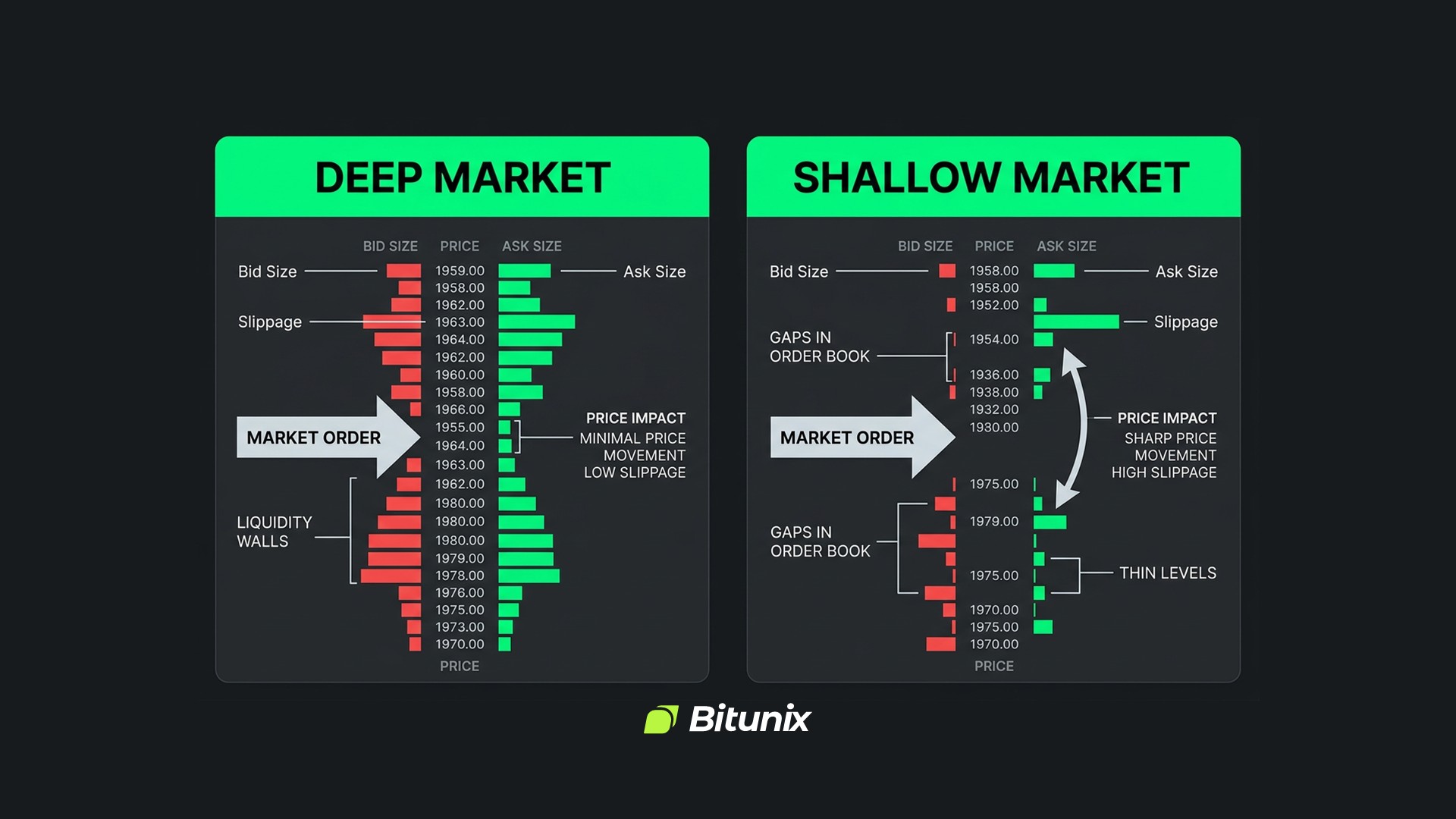
A deep market can absorb a market order with limited price movement, while a shallow market has thinner order-book levels and higher slippage risk.
Why Market Depth Matters for Traders
Market depth directly affects trade execution because the chart shows only the last traded price, not the liquidity behind it. The order book shows whether that price can handle real buying or selling pressure. In a deep market, your trade is more likely to fill near the expected price. In a shallow market, your final execution price can be worse because the order moves through multiple price levels. Investopedia explains that market depth measures a market's ability to absorb large orders without major price movement.
Liquidity and volatility are closely linked in crypto trading because the available order book depth shapes how sharply the price reacts to buying or selling pressure. Deep liquidity can soften price swings by providing more orders to absorb demand. Thin liquidity can cause prices to move quickly because fewer orders sit between the current price and the next major level. That is why low-cap altcoins often move more sharply than Bitcoin or Ethereum during sell-offs, especially when market orders create slippage.
CoinGecko's 2025 centralized exchange liquidity report showed how uneven order-book depth can be across venues. For BTC liquidity, Binance accounted for around 32% of observed liquidity, with about $8 million in order-book depth on both the buy and sell side. Bitget followed with about $4.6 million, while OKX had about $3.7 million.
Extreme market stress shows why depth is not just a metric. FTI Consulting reviewed the October 2025 crypto crash and described how top-of-book BTC depth on key venues collapsed by more than 90%, while spreads widened sharply. The report described the liquidity problem clearly:
"Liquidity still existed, but only in small clips and at prices that did little to clear the imbalance of sellers over buyers."
That kind of environment changes market dynamics, as traders may see a price on screen, but the available liquidity at that price can disappear. When market makers widen spreads or step away, stop orders, liquidations, and market orders can hit thinner books. Price then moves faster because fewer resting orders are available to absorb the pressure.
Understanding what is market depth also helps traders identify better entry and exit areas. Large bid clusters can act as short-term support, as buyers wait below the price, while large ask clusters can act as short-term resistance, as sellers wait above the price. These levels are not guaranteed, but they help you see where the market may react.
Practical Strategies and Applications
Market depth works best as a confirmation layer alongside technical analysis, rather than as a standalone signal. Start by marking support, resistance, trend direction, and recent volatility on the chart, then compare that setup with the order book. If the price is breaking higher and the ask liquidity above the market is thin, the move may face less resistance.
If the breakout runs into a large ask wall, price may slow, reject, or need much stronger volume to continue. Investopedia notes that market depth helps traders assess liquidity and understand how large orders may affect prices, making it useful for confirming execution conditions around key chart levels.
Order type matters when using depth. Market orders prioritize speed, but they can create slippage in shallow markets. Limit orders give you more control over price, but they may not fill if the price moves away from your limit. Larger traders often split orders into smaller parts to reduce visible impact. Retail traders can use the same idea at a smaller scale by avoiding oversized entries in thin books.
Risk management becomes easier to apply when you understand how depth affects execution. Before entering a trade, check whether your stop-loss sits near an obvious liquidity cluster, since crowded levels can attract short-term sweeps. Then compare your position size with the available order-book depth. If your order is large relative to nearby liquidity, you are adding pressure that can move the price against you.
Market depth also helps you avoid false confidence from headline trading volume. A coin can show strong 24-hour volume yet still have weak liquidity near the current price, which means your order may experience slippage. Volume shows what has already traded, while depth shows what liquidity is available now. CoinGecko's 2025 liquidity research focused on narrow price ranges because nearby depth gives traders a clearer view of how much capital can move markets.
Common mistakes usually come from reading the order book too literally. Some traders assume a large bid wall always means the price will bounce, while others assume a large ask wall always means the price will reject. In reality, visible orders can be moved, canceled, or used to influence sentiment.
Use this checklist before placing a trade to connect market depth with execution risk. Market depth shows how much buy and sell liquidity exists at different price levels, while slippage happens when the final execution price differs from the expected price.
- Check whether the spread is tight or wide.
- Compare nearby bid depth and ask depth.
- Estimate whether your order size would cause slippage.
- Look for liquidity concentrated at one obvious level.
- Confirm whether the chart supports the order-book signal.
- Reduce the size or wait if the book looks thin, unstable, or easy to sweep.
Limitations and Considerations
Market depth analysis can improve your execution, but it should never become your whole trading strategy. Order books change quickly, especially in crypto, and visible liquidity can disappear before your order reaches the market. Depth also shows resting orders, allowing a trader to place an order, cancel it, and change the book within seconds.
Market manipulation is a serious limitation because visible order-book depth can be shaped to influence how traders react. Large traders can use spoofing, layering, or fake liquidity to create the appearance of support or resistance, then cancel those orders before execution. ESMA's 2025 MiCA guidelines focus on helping authorities prevent and detect market abuse in crypto-asset markets, including risks linked to the structure and behavior of digital markets.
US enforcement priorities also keep market abuse in focus for traders who rely on depth signals. In March 2026, the CFTC's enforcement director identified spoofing, disruptive trading during closing periods, and wash trading as market abuse that can distort price signals and reduce market efficiency.
Different market conditions change how useful market depth signals are in practice. In a strong bull market, buy walls can appear and disappear quickly as traders chase prices. In a bear market, bid depth can look strong until heavy selling pressure hits it. In a range-bound market, depth can help identify possible liquidity sweeps near support and resistance.
Timeframe selection also changes how traders should interpret order-book depth. Scalpers may care about small depth changes every few seconds, while swing traders should focus on larger liquidity zones, spread changes, and whether depth confirms the broader chart structure. Long-term investors usually need depth most when entering or exiting larger positions.
Conclusion: Elevating Your Trading Game
Understanding market depth is a key step toward reading crypto markets with more structure. It helps you see whether a market can absorb your order, whether slippage risk is high, and whether liquidity supports or weakens a chart setup. That makes it useful for entries, exits, and risk control.
Market depth works best when combined with technical analysis, volume, volatility, funding rates, open interest, and broader market context. A deep order book can support smoother execution, while a shallow one can turn a normal trade into a costly mistake.
Before placing your next trade, take a minute to read the order book, check nearby liquidity, and estimate your possible slippage. To practice this in live markets, download the Bitunix app, register, and use its spot and futures trading tools to compare chart signals with real market depth before entering a position.
FAQ
What exactly is market depth?
Market depth shows how many buy and sell orders exist at different price levels in an order book. A deeper market can absorb larger trades with less price movement, while a shallow market can move sharply when a large order hits.
Why is market depth important in crypto trading?
Market depth helps traders understand liquidity, slippage, and execution risk. It indicates whether there are enough orders near the current price to support a trade. This is especially useful in crypto, where liquidity can change quickly across exchanges and trading sessions.
How does market depth affect price volatility?
Market depth affects volatility because thin order books move faster when large orders enter the market. Deep books can absorb buying or selling with less price impact, while shallow books often create sharper candles, wider spreads, and higher slippage.
Can market depth be manipulated?
Market depth can be manipulated through spoofing, layering, or fake liquidity. Large traders may place visible orders to influence sentiment, then cancel them before execution. That is why order-book data should be combined with volume, price action, and risk controls.
How do I track or measure market depth?
You can track market depth through order books, depth charts, bid-ask spreads, liquidity heatmaps, and price impact tools. Traders often compare nearby bid and ask liquidity to see whether the market is balanced, thin, or stacked on one side.
Is market depth more important for day traders or long-term investors?
Market depth is more important for day traders because they rely on real-time order-book data to manage slippage, spreads, support, resistance, and fast execution. Long-term investors still benefit when entering or exiting large positions, but they usually focus more on fundamentals, time horizon, and portfolio strategy. Market depth is especially relevant for short-term and larger trades.
How does market depth relate to liquidity?
Market depth is one way to measure liquidity. It shows how much buying and selling interest exists near the current price. A liquid market usually has deeper order books, tighter spreads, and lower slippage for normal trade sizes.
What are the common mistakes traders make regarding market depth?
Common mistakes include trusting visible walls too much, ignoring slippage, using oversized market orders, and assuming high volume always means deep liquidity. Traders also forget that order-book liquidity can disappear quickly during volatile conditions.
Should I base my trades solely on market depth?
No. Market depth should support a broader trading plan. Use it with technical analysis, volume, volatility, support and resistance, funding rates, and risk management. It improves execution awareness, but it does not guarantee market direction.
Where can I practice trading using these concepts?
You can practice by watching live order books, depth charts, spreads, and price impact before placing trades. Bitunix provides crypto trading tools where users can observe spot and futures markets and apply these concepts with controlled position sizing.
Glossary
- Market Depth: The amount of buy and sell liquidity available at different price levels.
- Order Book: A live list of buy and sell orders for a trading pair.
- Bid: The price buyers are willing to pay for an asset.
- Ask: The price sellers are willing to accept for an asset.
- Bid-Ask Spread: The difference between the highest bid and the lowest ask.
- Liquidity: The ease of buying or selling without moving the price heavily.
- Slippage: The difference between the expected trade price and the actual execution price.
- Depth Chart: A visual chart showing cumulative bids and asks around the price.
- Liquidity Wall: A large cluster of buy or sell orders at one price area.
- Price Impact: The change in price caused by executing a trade.
- Market Order: An order that executes immediately at the best available prices.
- Limit Order: An order that executes only at a chosen price or better.
- Volatility: The speed and size of price movements over time.
- Technical Analysis: A trading method that studies charts, indicators, and market structure.
- Market Dynamics: The forces that shape price include liquidity, volume, sentiment, and order flow.
Disclaimer
This article does not provide:
(i) investment advice or investment recommendations;
(ii) an offer or solicitation to buy, sell, or hold digital assets;
(iii) financial, accounting, legal, or tax advice.
Digital assets, including stablecoins and NFTs, involve high risk and may fluctuate significantly. Consider whether trading or holding digital assets is appropriate for you given your financial situation. Consult a qualified legal, tax, or investment professional when needed. You are responsible for understanding and complying with applicable local laws and regulations.
About Bitunix
Bitunix is a global cryptocurrency derivatives exchange trusted by over 3 million users across more than 100 countries. At Bitunix, we are committed to providing a transparent, compliant, and secure trading environment for every user. Our platform features a fast registration process and a user-friendly verification system supported by mandatory KYC to ensure safety and compliance. With global standards of protection through Proof of Reserves (POR) and the Bitunix Care Fund, we prioritize user trust and fund security. The K-Line Ultra chart system delivers a seamless trading experience for both beginners and advanced traders, while leverage of up to 200x and deep liquidity make Bitunix one of the most dynamic platforms in the market.
Bitunix Global Accounts
X | Telegram Announcements | Telegram Global | CoinMarketCap | Instagram | Facebook | LinkedIn | Reddit | Medium