
Article Summary
- This article provides a comprehensive overview of Algorand, a Layer 1 blockchain designed to be fast, secure, and scalable, a combination often called the "blockchain trilemma."
- It highlights Algorand's founder, Silvio Micali, a Turing Award-winning MIT professor and a co-inventor of key cryptographic technologies like zero-knowledge proofs.
- The guide's core focus is explaining Algorand's unique consensus mechanism, Pure Proof-of-Stake (PPoS). It breaks down how PPoS secretly and randomly selects a small committee of validators for each block, enabling high speed and security.
- It details the key features that result from this design: near-instant transaction finality, low fees, and a non-forkable chain.
- The article discusses Algorand's focus on real-world adoption, particularly in the areas of Central Bank Digital Currencies (CBDCs), traditional finance (TradFi), and institutional use cases.
- Crypto has plenty of loud projects and mystery founders. Algorand took a different route. It came from Silvio Micali, an MIT cryptographer with a long track record in serious research.
- If you usually buy and sell coins through a crypto exchange instead of using on-chain swaps, you have probably seen ALGO/USDT listed next to the usual majors. Bitunix is one example where ALGO trading is available, so you can execute your crypto strategy with safety and confidence.
- Algorand is research-driven by design. The goal is mainstream-grade performance and security, the kind you can plug into payments and financial infrastructure without treating every transfer like an experiment.
- The article discusses Algorand's focus on real-world adoption, particularly in the areas of Central Bank Digital Currencies (CBDCs), traditional finance (TradFi), and institutional use cases.
Solving the Blockchain Trilemma
The blockchain trilemma is a simple headache with three faces. You want security, so attackers cannot rewrite history. You want scalability, so the network stays usable when demand spikes. You want decentralization, so no small group can quietly steer the system.
Many networks optimize one or two goals and accept trade-offs. Algorand's pitch is that you can keep all three in balance with the right consensus design, especially when committees rotate fast and unpredictably.
A lot of people first encounter Algorand through the question what is Algorand, and the honest answer starts here. Algorand is a base-layer chain designed around verifiable randomness and committee voting, so it can finalize blocks quickly without relying on a small, known validator set.
This is also where Proof-of-Stake enters the conversation. Algorand uses a PoS family approach, but it implements it in a way that tries to reduce predictability and concentration, which are common pain points in many PoS systems.
The Secret Sauce - Pure Proof-of-Stake (PPoS)
This is the part that makes Algorand feel like it came out of a cryptography lab, because it did. PPoS is built around the idea that you can pick a small group to do the work for each block, then swap that group out immediately, before anyone has time to interfere.
How It Works
PPoS runs like a private draw that repeats every block. The network picks a small group to propose and vote, then immediately replaces it, so power stays distributed and hard to predict. These are the main characteristics of this system:
- Universal participation: Anyone holding ALGO can be eligible to participate, and the system draws from a wide pool of potential voters each round. That design keeps consensus from depending on a fixed, easily mapped validator set.
- The secret lottery: The protocol uses cryptographic randomness, so participants learn they were selected only when they reveal a proof. Outsiders cannot pre-target the next committee, since the committee identity stays hidden until it is time to vote.
- The committee: A small, rotating committee proposes and validates each block, then the network selects a new committee for the next block. Algorand emphasizes rapid rotation and stable operation, which supports fast settlement for repeated financial actions.
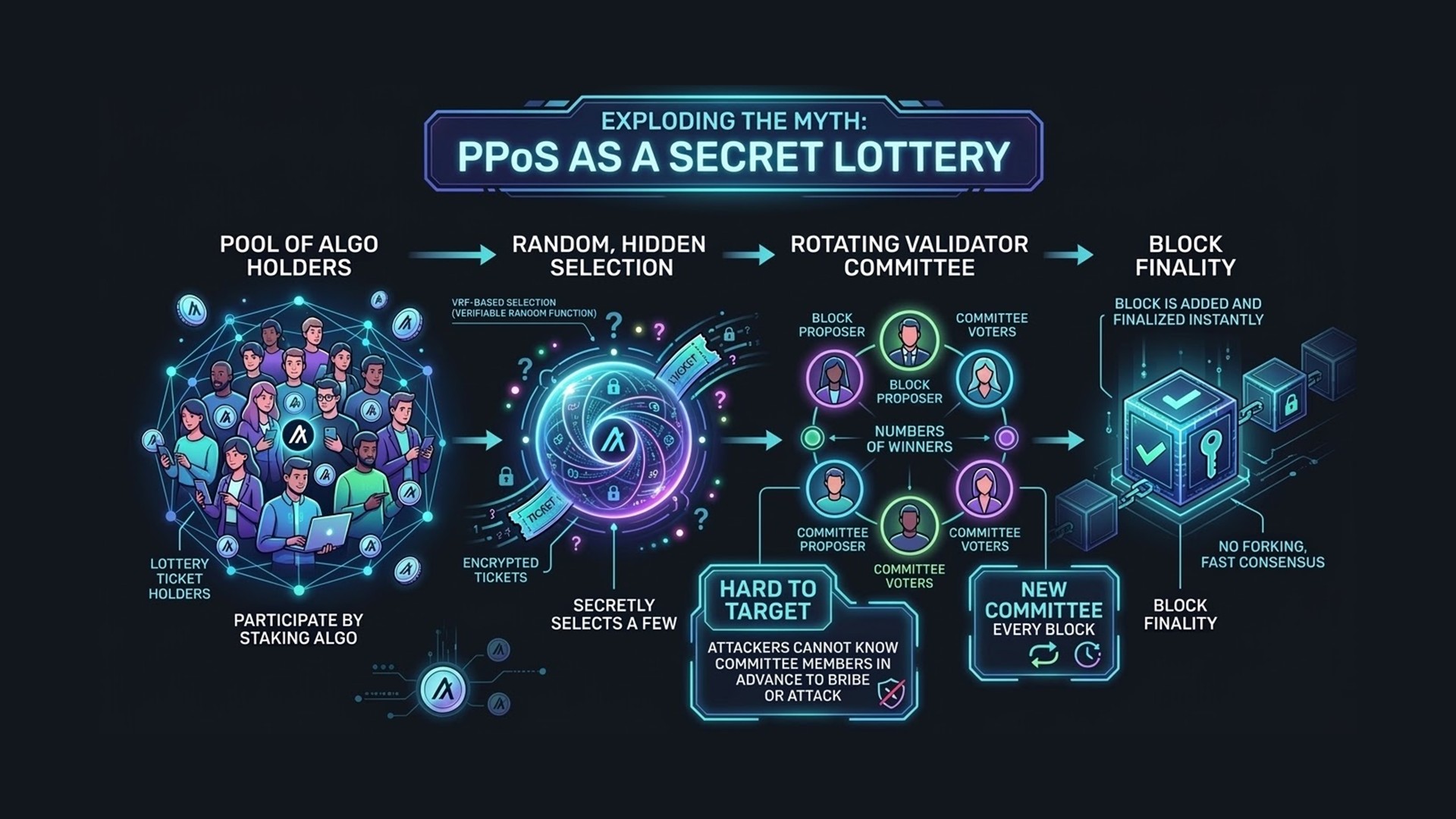
- How Algorand PPoS works: a hidden random selection picks a new committee every block, making attacks harder and enabling fast, fork-resistant finality.
Why This Model Helps
Algorand's committee design aims to turn the trilemma into an engineering problem you can actually manage. Small committees speed up coordination, secret selection reduces targeted attacks, and broad eligibility supports decentralization over time. These are the main advantages of this system:
- Scalability: With only a limited committee per block, the network avoids the overhead of every validator talking to every other validator. Algorand's 2025–2026 reporting and roadmap updates keep pointing to throughput and reliability as core priorities for real-world usage.
- Security: Secret, last-moment selection makes targeted disruption harder, because attackers cannot easily identify who will vote next. Algorand also highlights strong operational stability, which reduces the number of real-world failure modes you have to plan around.
- Decentralization: Broad eligibility means you do not need permission to be in the potential voting set, and the committee keeps changing. Foundation updates in 2025 framed decentralization and participation as ongoing roadmap goals.
Key Features of Algorand
Algorand's consensus design shows up as user-facing features that developers and financial teams care about. You see it in settlement speed, predictable fees, native asset issuance, and the ability to bundle transfers safely. Here is what that looks like in practice:
Near-Instant Finality
Algorand targets instant finality in the sense that once a block is accepted, the chain treats it as final without rollbacks under normal operation. The Foundation's materials describe finality as immediate, with no rollbacks, and tie that property to the PPoS voting process.
This matters a lot for finance because you can build workflows that assume a transaction is done when it lands, instead of waiting through a long confirmation ritual. It also reduces the surface area for fork-related confusion, which is where a lot of ugly edge cases live.
Low, Predictable Fees
Algorand fees are designed to stay low and easy to reason about. In 2025, the Foundation described typical fees as fractions of a penny per transaction, citing a minimum fee of 0.001 ALGO.
In real systems, predictable fees are often more valuable than just low fees. It lets a product team budget costs, and it lets a developer test repeatedly without treating every deploy like a cost event.
ASA (Algorand Standard Assets)
Algorand supports token creation at the protocol level through Algorand Standard Assets, usually shortened to ASA. The developer documentation frames ASAs as the standard way to represent both fungible tokens like stablecoins, such as USDT, and non-fungible assets, with built-in parameters for management and opt-in mechanics.
In 2025, the Foundation also highlighted work on tokenization standards and mentioned an upcoming Debt ASA MVP, which shows ASAs sit at the center of its real-world asset strategy.
Atomic Swaps And Atomic Transfers At The Base Layer
Algorand supports atomic transfers, meaning you can group multiple transactions so they either all succeed or all fail. That enables trust-minimized exchanges and multi-party settlement without relying on a single intermediary to coordinate execution.
This is one reason Algorand gets described as a Layer 1 designed for real-world settlement. You can compose payments and asset moves at the protocol level, then reason about outcomes without writing a huge custom smart contract every time.
Use Cases and Adoption
Algorand's adoption story leans heavily toward payments, stablecoins, tokenization, and public-sector adjacent projects. Some of that is branding, yet a good chunk is just product-market fit, including instant finality and low fees, which work well when people want to move value repeatedly.
Focus on Institutional and Government-Style Use
Algorand's 2025+ roadmap frames the project as built for real-world use, and it explicitly calls out performance and uptime as foundations before pushing harder into adoption. Here is a short, direct quote from the Algorand Foundation:
"With support for over 10,000 TPS and instant finality, Algorand has consistently delivered on this promise for over six years."
In late 2025, the Foundation also pushed regulated payment infrastructure partnerships, as the Noah partnership focused on compliant payment rails that connect traditional finance and on-chain activity.
Noah's role was to provide regulated payment infrastructure such as virtual USD and EUR accounts, bank on-ramps, payout APIs, and hosted checkout. The announcement also highlighted Noah's compliance posture, including EU VASP licensing and registrations or licenses across the US, Canada, and other regions, with initial implementations planned for 2026.
CBDCs and Digital Cash Research
By 2025–2026, CBDC work had moved from small pilots to structured planning and market testing. A 2025 BIS survey found 91% of central banks were exploring retail and/or wholesale CBDCs, with wholesale generally further along. The ECB also advanced its digital euro work, building a rulebook and running technical experiments with many market participants, while outlining a path that targets readiness for a potential first issuance in 2029, depending on EU legislation.
Algorand's relevance here is technical fit. Central banks typically study fast final settlement, predictable costs, and strong integrity guarantees, especially for wholesale settlement and tokenized assets. Algorand's design targets instant finality, low fees, native assets, and atomic transfers, which map well to requirements like secure delivery-versus-payment style settlement and programmable rules.
TradFi and Real-World Asset Tokenization
Tokenization is where Algorand spends a lot of messaging effort, and there are concrete signals behind it. CoinShares' 2026 guide pointed to tokenized real-world assets and highlighted that Algorand was chosen by Midas to issue a tokenized US Treasury certificate called mTBILL. On the network side, the Foundation's Q4 2025 transparency report reported RWA TVL around $109.91 million and framed it as part of Algorand's growing role in tokenized assets.
Sustainability
Algorand frames sustainability around two ideas: low energy use and verifiable offsets. Because Pure Proof-of-Stake does not rely on mining, the network avoids the heavy electricity demand you see in proof-of-work systems, which makes it easier for organizations with ESG rules to consider.
The Algorand Foundation also states that the chain has been carbon-neutral since 2021, using offsets to cover remaining emissions and linking those offsets to on-chain records for transparency. Beyond offsets, Algorand highlights real-world green accounting use cases, such as Bullfrog Power sustainability certificates recorded on Algorand, where companies can track and validate environmental attributes with tamper-resistant logs.
A Quick Look At The 2025 and 2026 Network Signals
If you want recent, concrete activity metrics, the Foundation's January 2026 Algo Insights report is unusually specific. It reported 49.56 million total wallets, over 3.44 billion transactions overall, 896,000 active accounts for the month, and 808,000 deployed smart contracts.
It also reported total ALGO staked at 2.0 billion, with the community accounting for about 80.4% of the stake, which points toward a more distributed security profile over time.
If you are trading, market access still matters. Most traders will interact with ALGO via major pairs like ALGO/USDT, since liquidity and tight spreads often concentrate there across venues.
Conclusion: A Technically Superior Blockchain in a Crowded Market
Algorand is one of the cleaner designs in public blockchains, at least on the architecture level. Its Pure Proof-of-Stake consensus uses verifiable randomness and rotating committees to combine speed, finality, and broad participation in a way that is hard to game at scale.
The challenge is adoption. Even with strong engineering, ecosystems win by attracting developers, users, and liquidity over the years. Foundation reporting in 2025 and 2026 shows progress on decentralization, staking participation, and developer tooling, but it also signals that the work is ongoing.
If you are evaluating what is Algorand as an asset, separate the tech from the token. ALGO's value depends on usage, fee economics, and whether Algorand captures a meaningful share in payments and tokenization. That framing helps you answer is Algorand a good investment based on your time horizon and risk tolerance.
If you want a simple execution path, Bitunix lets you trade ALGO on a familiar interface. Download the Bitunix app, register, and make sure your position sizing matches the reality that crypto markets swing hard.
FAQ Section
Who is Silvio Micali?
Silvio Micali is an MIT professor and cryptographer known for foundational work in modern cryptography. A current MIT Sloan bio notes he received major awards, including the Turing Award, Gödel Prize, and RSA prize. He founded Algorand to apply research-grade security and consensus design to blockchains.
Is Algorand a Proof-of-Stake blockchain?
Yes. Algorand uses a PoS-family consensus called Pure Proof-of-Stake. The protocol selects block proposers and voting committees randomly and privately for each block, with selection probability tied to stake. The goal is fast agreement, strong security assumptions, and broad participation without long confirmation delays.
Can Algorand be forked?
Algorand is designed for immediate finality, so confirmed blocks are treated as final without rollbacks under normal operation. The Foundation describes instant finality and no rollbacks as core properties tied to the consensus mechanism. Like any distributed system, extreme failure scenarios exist, but forks are not expected behavior.
What is the Algorand Foundation?
The Algorand Foundation is the main nonprofit organization supporting the ecosystem, including governance programs, developer initiatives, transparency reporting, and partnerships. Its public transparency reports detail treasury activity and ecosystem spending. Foundation communications also outline roadmap priorities such as decentralization, on-chain governance, and developer tooling upgrades.
Is ALGO a good investment?
ALGO is a high-volatility crypto asset, so the answer depends on your time horizon and risk tolerance. The tech case focuses on fast finality, low fees, and tokenization and payments adoption. The investment case depends on whether usage grows enough to support sustained demand and a stronger ecosystem.
How does Algorand's consensus differ from Cardano's or Ethereum's?
Algorand uses private, per-block committee selection via verifiable randomness, then committees vote to finalize blocks quickly. Ethereum uses validator attestations with finality achieved through its PoS design and checkpoints, while Cardano uses an epoch-slot leader schedule. Algorand's key distinction is the unpredictable selection of the committee for each block.
What is the total supply of ALGO?
ALGO has a fixed maximum supply of 10 billion. The Foundation's January 2026 insights report put circulating supply at 8.87 billion, around 88.7% of the maximum.
Can I stake ALGO?
Yes, staking exists through participation in consensus and through staking products offered by different services. Foundation reporting in 2025 and 2026 discussed staking rewards and rising online stake, including 2.0 billion ALGO staked by January 2026.
What programming language is used for Algorand smart contracts (TEAL)?
Algorand smart contracts ultimately run in TEAL, which is executed by the Algorand Virtual Machine. The developer portal describes TEAL as an assembly-like language and notes you can also author contracts using higher-level tooling through AlgoKit, including Python and TypeScript approaches.
What was the all-time high for ALGO?
Algorand (ALGO) reached an all‑time high of $3.28 per coin in June 2019.
Glossary
- Blockchain trilemma: The trade-off between security, scalability, and decentralization when designing a public network.
- Pure Proof-of-Stake (PPoS): Algorand consensus using private, random committee selection and voting to finalize blocks quickly.
- Verifiable Random Function (VRF): Cryptographic method to prove a random selection happened fairly, without revealing it early.
- Cryptographic sortition: Process where nodes self-check selection eligibility, then reveal proofs that the network can verify.
- Committee: A randomly selected subset of participants that proposes or votes on a block in a given round.
- Finality: The point when a transaction becomes irreversible under normal network assumptions and rules.
- Validator: A participant that helps secure the network by proposing or voting on blocks, earning rewards.
- Staking: Using ALGO to participate in consensus security and, depending on setup, earn protocol rewards.
- Minimum transaction fee: The baseline fee required for a valid transaction, often cited as 0.001 ALGO.
- Algorand Standard Assets (ASA): Native token standard for fungible and non-fungible assets, supported at the protocol level.
- Opt-in: The requirement for an account to explicitly accept an ASA before it can receive that asset.
- Atomic transfer: A grouped set of transactions that either all execute or all fail as one unit.
- Tokenization: Representing real-world assets like bonds or funds as on-chain tokens for transfer and settlement.
- Stablecoin: A token pegged to a fiat currency, often used for payments and settlement across wallets and exchanges.
- Algorand Virtual Machine (AVM): Execution environment that runs TEAL programs and smart contracts on Algorand.
About Bitunix
Bitunix is a global cryptocurrency derivatives exchange trusted by over 3 million users across more than 100 countries. At Bitunix, we are committed to providing a transparent, compliant, and secure trading environment for every user. Our platform features a fast registration process and a user-friendly verification system supported by mandatory KYC to ensure safety and compliance. With global standards of protection through Proof of Reserves (POR) and the Bitunix Care Fund, we prioritize user trust and fund security. The K-Line Ultra chart system delivers a seamless trading experience for both beginners and advanced traders. At the same time, leverage of up to 200x and deep liquidity make Bitunix one of the most dynamic platforms in the market.
Bitunix Global Accounts
X | Telegram Announcements | Telegram Global | CoinMarketCap | Instagram | Facebook | LinkedIn | Reddit | Medium