
1. Introduction to Avalanche
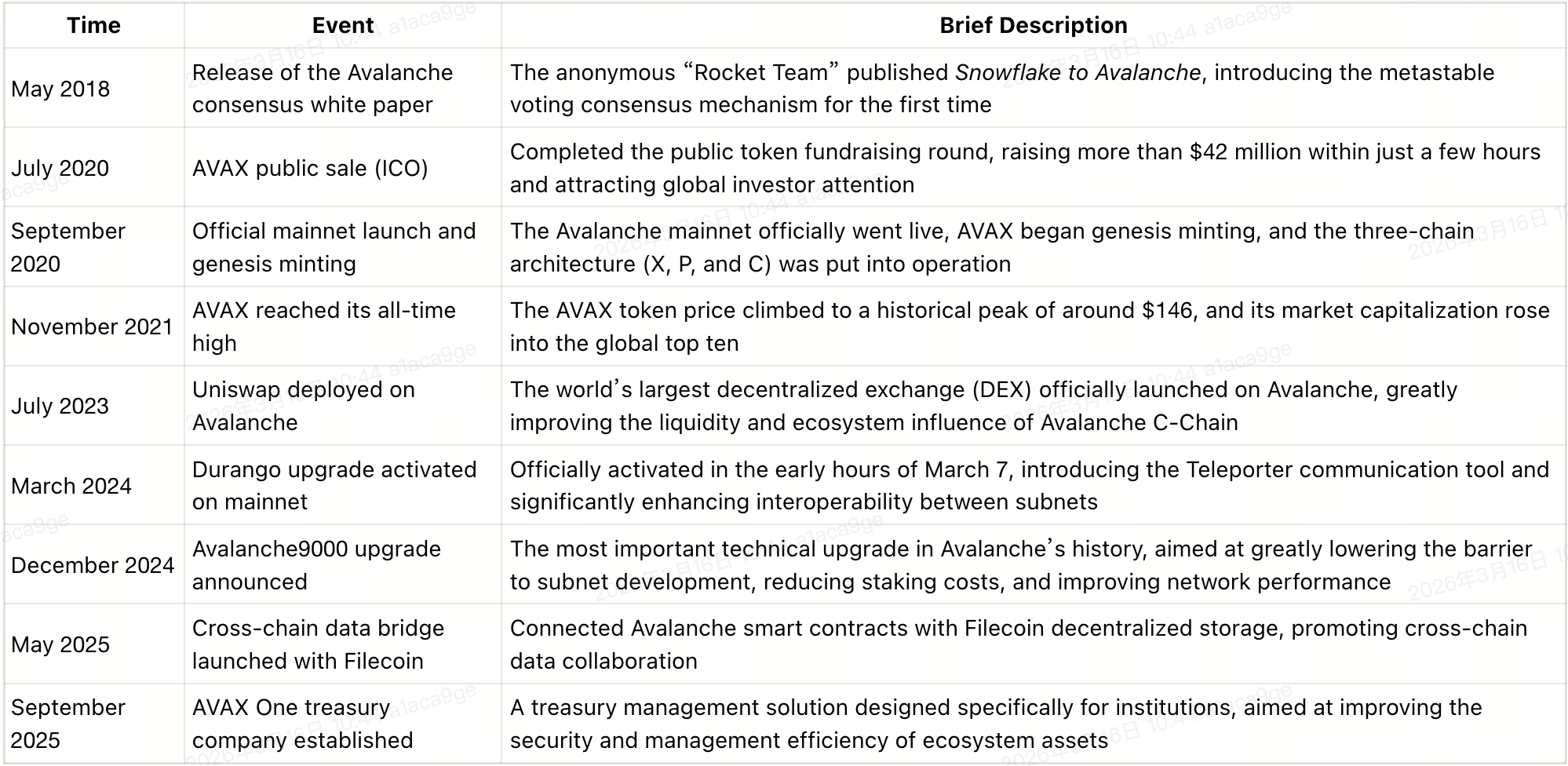
In May 2018, an anonymous group calling itself the “Rocket Team” published a paper on IPFS titled Snowflake to Avalanche, proposing a revolutionary consensus protocol. Soon after, Cornell University professor Emin Gün Sirer and his team founded Ava Labs, dedicated to turning this concept into reality. Professor Emin had already built a strong reputation in distributed systems and had even experimented with cryptocurrency earlier than Satoshi Nakamoto.
Unlike Ethereum, which aims to become a “world computer,” Avalanche’s vision is to build a “global digital asset issuance platform.” It is designed to solve the blockchain “trilemma” of security, decentralization, and scalability. In September 2020, the Avalanche mainnet officially launched, and its native token, AVAX, was issued at the same time.
2. Avalanche: A Three-Chain Architecture
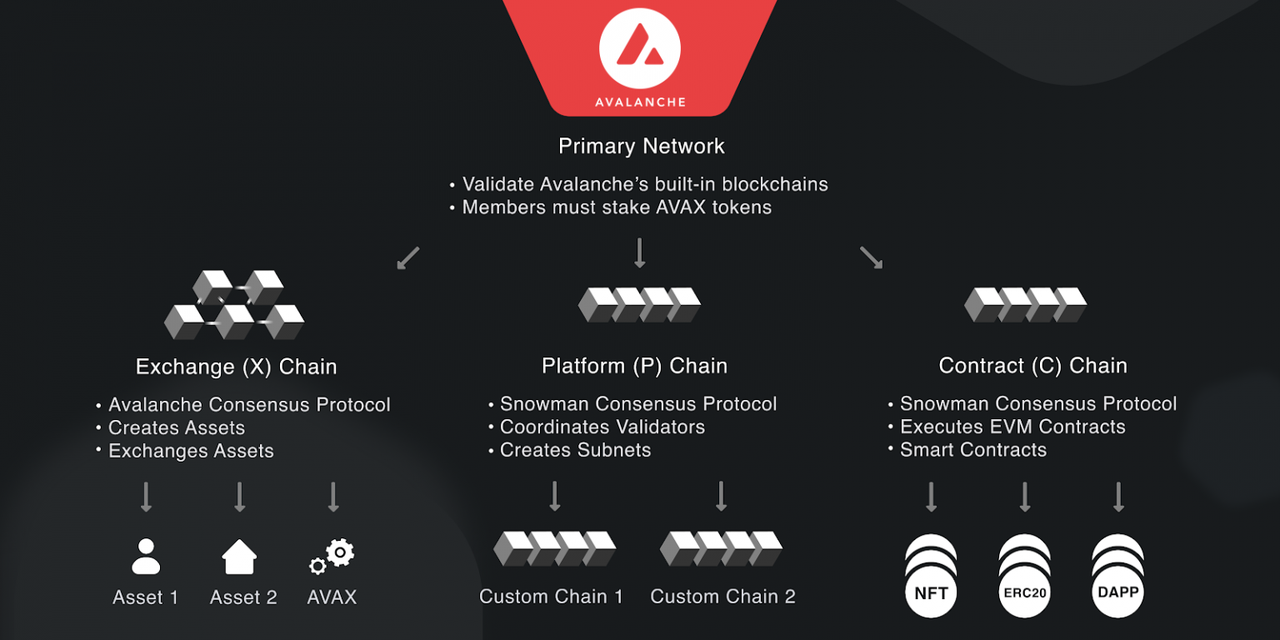
Unlike most single-chain public blockchains, Avalanche adopts a design in which three core blockchains operate together:
• X-Chain (Exchange Chain)
The Exchange Chain is an instance of the Avalanche Virtual Machine (AVM), mainly used for asset transfers and receipts, but it does not support DeFi functions, which are handled by the Contract Chain. It has its own custom address structure and requires a specific AVAX wallet for operation.
• P-Chain (Platform Chain)
The Platform Chain is responsible for coordinating validators and tracking subnets running the Snowman consensus mechanism. Users can serve as validators here or earn token rewards by staking and delegating AVAX. In addition, the P-Chain also allows developers to deploy custom blockchains.
• C-Chain (Contract Chain)
The Contract Chain mainly handles smart contracts and decentralized finance (DeFi). The C-Chain uses the Snowman consensus mechanism and runs an instance of the Ethereum Virtual Machine. Therefore, unlike the other two chains, it uses an Ethereum-compatible address structure and supports wallets such as MetaMask.
This structure gives Avalanche extremely high flexibility. The C-Chain in particular inherits Ethereum’s functionality, but greatly reduces gas fees and improves transaction speed through Avalanche consensus. Like Ethereum, users on the C-Chain interact through EOA accounts and build various DApps by writing smart contracts in Solidity.
3. Avalanche Protocol: Consensus Mechanism and Economic Model
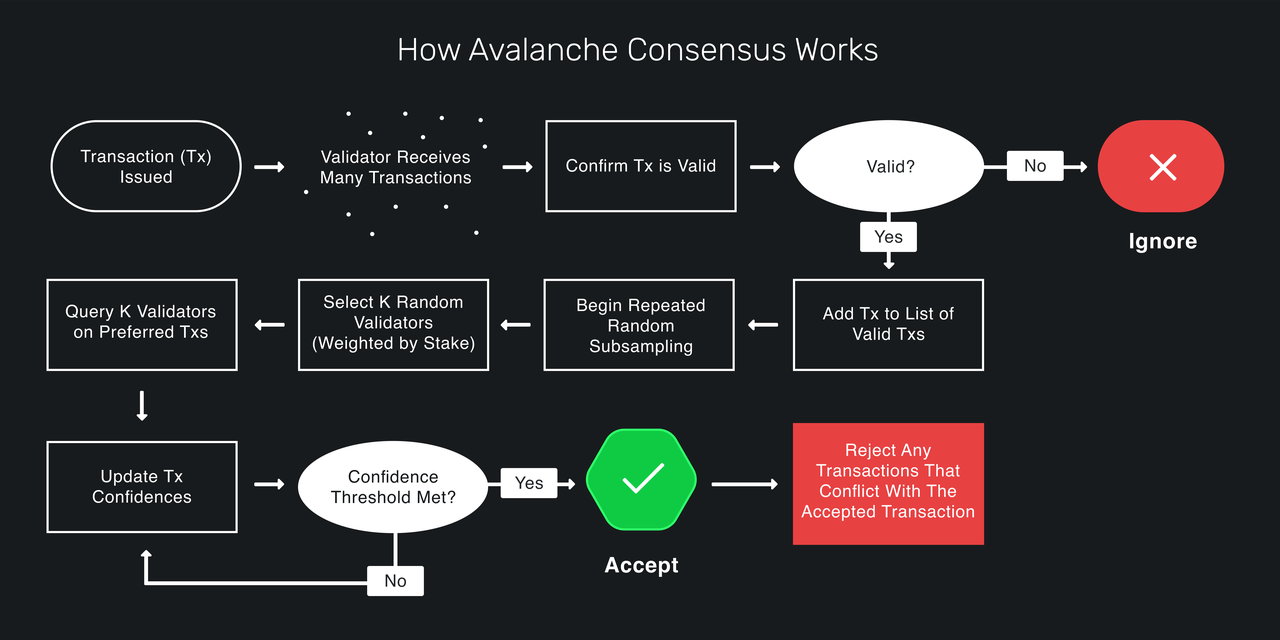
Another major feature of the Avalanche public blockchain is its unique “Avalanche Consensus.” Unlike Bitcoin’s PoW or Ethereum’s traditional PoS, Avalanche uses a metastable voting mechanism. Nodes randomly sample nearby nodes and quickly reach network-wide consensus. This is similar to shouting on a snowy mountain and triggering an avalanche, where information spreads exponentially and becomes fixed almost instantly. While maintaining decentralization, it also achieves extremely fast transaction finality.
In terms of its economic model and staking mechanism, Avalanche also adopts a PoS (Proof of Stake) system. Validators must stake at least 2,000 AVAX to participate in network maintenance, while ordinary users can earn rewards through delegation. It is worth noting that AVAX has a very aggressive scarcity design. Unlike Ethereum’s EIP-1559, which only burns part of the base fee, all transaction fees on the Avalanche network are burned completely. This means that as network usage increases, AVAX supply continues to decrease. In addition, unlike Ethereum’s theoretical unlimited issuance, AVAX has a strictly capped total supply of 720 million tokens. This gives it a Bitcoin-like scarcity profile and creates an economic loop that combines high performance with strong asset value.
4. Avalanche Ecosystem: Subnets and DeFi
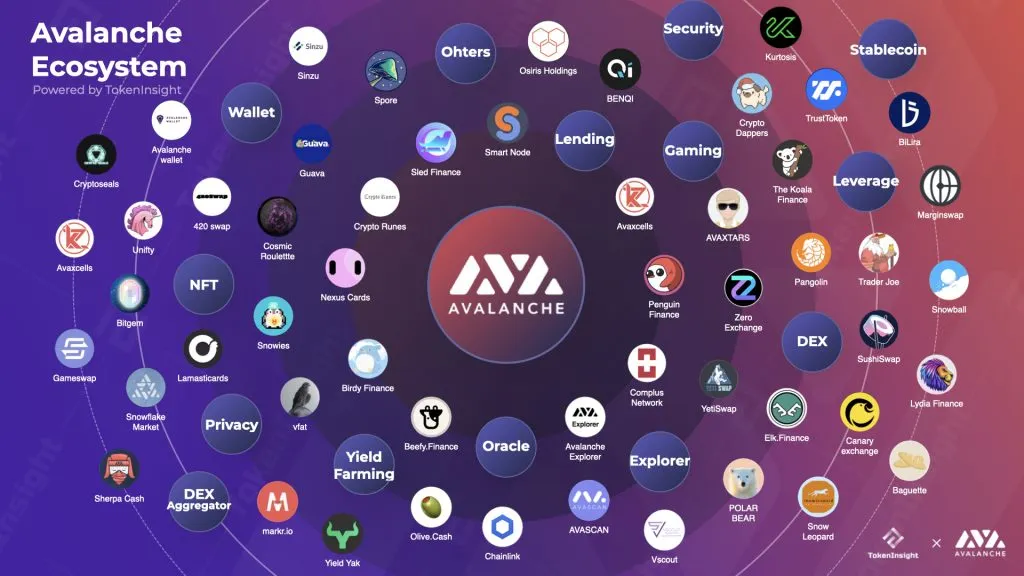
Beginning with the 2021 “Avalanche Rush” incentive program, the Avalanche ecosystem experienced explosive growth, and its total value locked and network activity increased accordingly. In the DeFi sector, Avalanche has fostered highly representative projects such as Trader Joe and Benqi.
Avalanche’s true “killer feature” lies in its unique subnet technology. This allows any institution or project to easily build a highly customized dedicated blockchain without competing with the main network for bandwidth. This flexibility has attracted high-quality blockchain games such as Shrapnel and has also led mainstream financial institutions such as J.P. Morgan’s Onyx project to build on Avalanche. To ensure these subnets do not become isolated information islands, Avalanche introduced its native communication protocol, Avalanche Warp Messaging (AWM), enabling millisecond-level cross-chain interaction. This gives the entire ecosystem the close coordination and high interoperability of an “organic galaxy.”
5. How to Buy Avalanche (AVAX) on Bitunix Exchange
Under the Avalanche protocol mechanism, newly added AVAX on the network is awarded to validators, or staking nodes, for participating in consensus. For individual investors, becoming an Avalanche network node requires a high-performance server and at least 2,000 AVAX staked in the node network, which creates both technical and capital barriers. Purchasing AVAX through a cryptocurrency exchange is a relatively easier way to access it.
By purchasing AVAX through centralized cryptocurrency exchanges such as Bitunix, the platform acts as a trusted intermediary and supports users in buying AVAX directly with fiat currency or stablecoins. Some platforms also support instant purchases by credit card, reducing the barrier to entry for investors. Before first use, you need to register an account and complete identity verification (KYC). This process requires the submission of personal information such as identification documents and proof of address, mainly to comply with global anti-money laundering (AML) and counter-terrorist financing regulations and to ensure the legality and compliance of platform fund sources. Bitunix has an industry-leading compliance and risk control system. Asset segregation between hot and cold wallets, multi-signature technology, and real-time monitoring mechanisms can provide a level of security well above the market average, making Bitunix one of the most convenient and reassuring choices for beginners.
6. Timeline of Major Avalanche Events
Disclaimer
This article is not intended to provide:
(i) investment advice or investment recommendations;
(ii) an offer or solicitation to buy, sell, or hold digital assets;
(iii) financial, accounting, legal, or tax advice.
Holding digital assets, including stablecoins and NFTs, involves high risk and may fluctuate significantly. You should carefully consider whether trading or holding digital assets is suitable for you based on your financial situation. For your specific circumstances, please consult your legal, tax, or investment professionals. You are solely responsible for understanding and complying with all applicable local laws and regulations.
About Bitunix
Bitunix is a global cryptocurrency derivatives exchange trusted by over 3 million users across more than 100 countries. At Bitunix, we are committed to providing a transparent, compliant, and secure trading environment for every user. Our platform features a fast registration process and a user-friendly verification system supported by mandatory KYC to ensure safety and compliance. With global standards of protection through Proof of Reserves (POR) and the Bitunix Care Fund, we prioritize user trust and fund security. The K-Line Ultra chart system delivers a seamless trading experience for both beginners and advanced traders, while leverage of up to 200x and deep liquidity make Bitunix one of the most dynamic platforms in the market.
Bitunix Global Accounts
X | Telegram Announcements | Telegram Global | CoinMarketCap | Instagram | Facebook | LinkedIn | Reddit | Medium