1.Introduction to Solana
In 2017, engineer Anatoly Yakovenko published a technical whitepaper titled “Proof of History” (PoH). His goal was to solve a long standing problem in distributed systems: how to create a reliable, global source of time without relying on any single trusted party. Yakovenko realized that if a blockchain could embed a verifiable cryptographic clock directly into its consensus process, it could process transactions far more efficiently and at much higher throughput. Based on this idea, he proposed Proof of History as a new way to order events in a distributed ledger.
In 2018, Anatoly teamed up with Greg Fitzgerald and others to found Solana Labs, naming the new high performance blockchain Solana, after the coastal town of Solana Beach where several of the early team members had lived. In 2019, Solana completed several rounds of financing. In March 2020, the Solana mainnet beta officially went live and opened to developers worldwide. Thanks to its high throughput, low latency and low transaction fees, the Solana blockchain quickly attracted a large number of builders across DeFi, GameFi, NFTs and social applications.
In just a few years, Solana has grown from a single high performance Layer 1 chain into one of the most active developer ecosystems in the crypto industry. Whether you look at user growth, on chain activity or the steady stream of new products, Solana continues to push high speed, low cost blockchains toward mainstream adoption and remains one of the most closely watched networks in the Web3 space.
2.Solana as a High Performance Blockchain
Compared with earlier public chains such as Ethereum, XRP and EOS, Solana is a latecomer. Its mainnet did not go live until 2021, when Ethereum was already in a strong bull cycle with DeFi, GameFi, NFTs and stablecoins driving record activity. Even in this crowded environment, Solana quickly stood out by focusing on very high throughput and low transaction fees, positioning itself as a high performance Layer 1 for large scale applications.
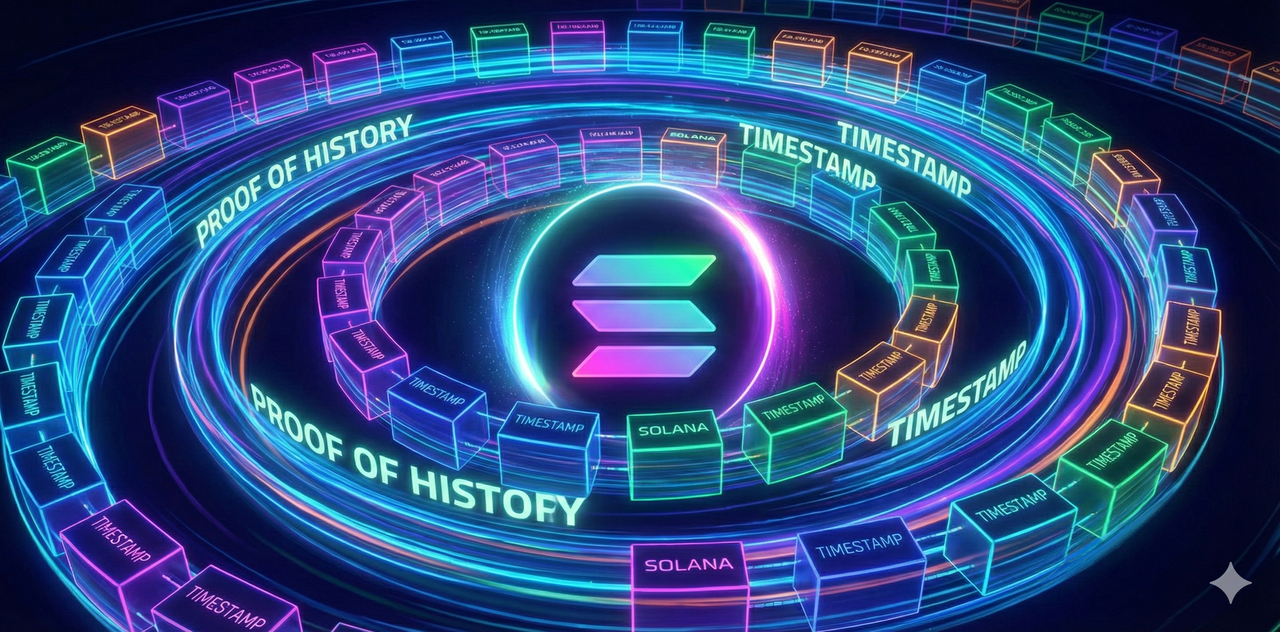
The core of Solana’s design is Proof of History (PoH). You can think of PoH as a built in cryptographic clock that gives every transaction a verifiable timestamp. On traditional blockchains, nodes must constantly communicate to agree on the order of transactions, which slows things down. On Solana, transactions are written into this cryptographic timeline in sequence, so their order is clear from the start. Validators can then verify and process many transactions at the same time instead of queuing them one by one. This is what allows Solana to reach very high TPS with low confirmation times while keeping gas fees low for users.
High performance also depends on hardware. Running a Solana validator typically requires a modern multi core CPU, sufficient memory and a fast SSD, which lets the network handle a large volume of data and signatures every second. With this combination of protocol design and hardware support, Solana delivers fast, low cost transactions and has become a popular base layer for DeFi, gaming and other high frequency on chain applications.
3.Solana Foundation
The year 2021 was a breakout moment for Solana. The mainnet went live, on chain metrics climbed rapidly and the network attracted a large number of developers and users. The picture changed in 2022. Solana’s early growth had been closely tied to support from the FTX exchange. When FTX collapsed at the end of 2022 because of a liquidity crunch, the shock quickly spread across the Solana ecosystem. Many builders left, and core indicators such as total value locked fell by more than 80 percent within just two months.
Even in this downturn, Solana did not stall. Under the leadership of president Lily Liu, the Solana Foundation continued to offer token incentives and ecosystem support, helping the community rebuild. Solana’s smart contracts use Rust and the SPL token standard, which is different from Ethereum’s Solidity and ERC 20. This creates a higher technical barrier for new developers. To lower that barrier and attract fresh talent, the Solana developer community has produced detailed Rust tutorials, starter kits and learning resources. With backing from the foundation, Lily Liu and her team have invested heavily in education and grants so that more developers can join the ecosystem quickly and continue to experiment.
On the project funding side, the Solana Foundation has supported a wide range of DeFi and ecosystem teams, including Jupiter, Jito and Pump.fun. These projects cover trading, yield strategies and consumer facing applications, and together they showcase what Solana’s high performance infrastructure can support. A representative example is DePIN, short for decentralized physical infrastructure networks. DePIN projects connect blockchains with real world hardware devices, where each node’s bandwidth and computing power are critical to the network. This kind of application has very demanding performance requirements, and only a few blockchains, Solana among them, can handle the load.
Since 2023, the Solana Foundation has made DePIN a strategic focus and has increased its investment in related projects. The Solana Saga phone is a flagship example of this push into hardware, showing Solana’s ambition to extend beyond pure software into real world devices. As more users and developers pay attention to these efforts, the Solana ecosystem is steadily tightening the link between on chain activity and the physical world and opening up new directions for long term growth.
4.Use Cases of SOL
SOL is the native asset of the Solana ecosystem. Holders can use SOL to participate in on chain governance, submit and vote on proposals, and help decide on upgrades and parameter changes that affect the network. In on chain voting, voting power comes from staked SOL, which gives long term holders a direct say in the future direction of the Solana ecosystem. For example, in March 2025, community proposal SIMD-228 reached a turnout rate of more than 72 percent, showing how actively SOL holders are now taking part in governance.
Beyond governance, SOL also serves as the gas token of the Solana network. Any time a user sends a transaction or interacts with a smart contract, they pay a small amount of SOL as a transaction fee. Compared with many other blockchains, Solana’s gas fees are very low, which supports high frequency use cases such as DeFi trading, gaming and on chain social applications. At recent network conditions, a typical transaction costs only a tiny fraction of 1 SOL, often well below one U.S. cent. Low fees make it easier for users to experiment with new protocols and for developers to design products that rely on frequent on chain interactions.
SOL is also widely used as staking collateral. Validators must stake SOL to help secure the network and to earn staking rewards. Token holders who do not run their own validator can delegate SOL to trusted validators and share the rewards. This mechanism aligns the interests of token holders with the overall security of the network and creates an additional source of yield for long term SOL holders.
5.How to Obtain SOL
For new users entering the Solana ecosystem, the most common way to obtain SOL is to buy it on a centralized cryptocurrency exchange and then transfer it to a self custodial wallet if needed. For long term investors, SOL is often treated as a core holding that can be used for trading, staking and governance.
On Bitunix, users can purchase SOL through spot trading pairs such as SOL/USDT. The platform supports a variety of deposit methods, including crypto deposits and fiat on ramp options provided by partners. After completing standard identity verification (KYC) and passing basic risk checks, users can place market or limit orders to buy SOL directly in the trading interface.
Once purchased, SOL can be kept on Bitunix in secure hot and cold wallet storage or withdrawn to an external wallet for staking and on chain use. Bitunix focuses on fast order matching, stable system performance and strict security controls, which helps users acquire and trade SOL efficiently while keeping assets as safe as possible.
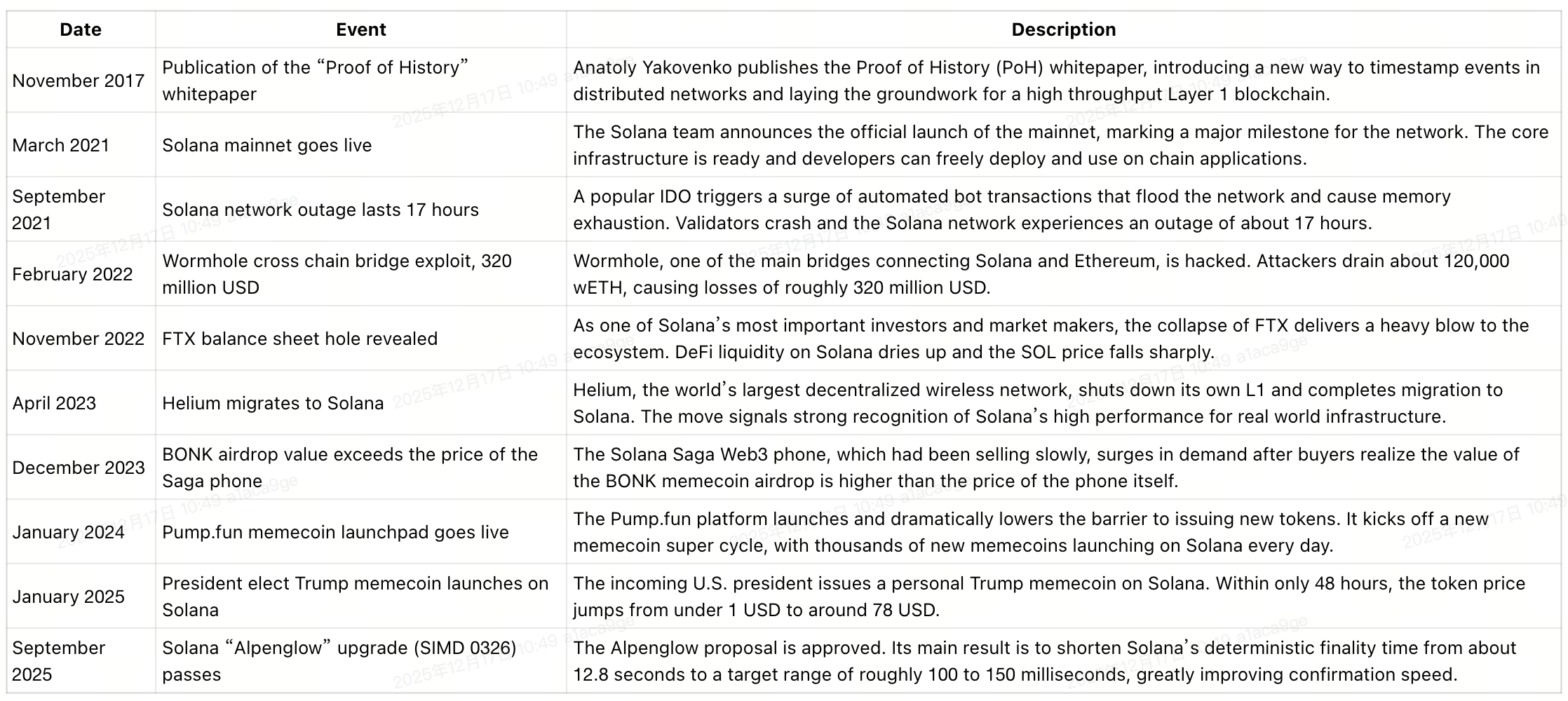
6.Solana Key Events Timeline
Disclaimer
This article is not intended to provide: (i) investment advice or investment recommendations; (ii) an offer or solicitation to buy, sell, or hold digital assets; or (iii) financial, accounting, legal, or tax advice. Digital assets (including stablecoins and NFTs) involve high risk and may be highly volatile. You should carefully consider whether trading or holding digital assets is suitable for you based on your financial situation. For your specific circumstances, consult your legal, tax, or investment professionals. You are responsible for understanding and complying with all applicable local laws and regulations.
About Bitunix
Bitunix is a global cryptocurrency derivatives exchange trusted by over 3 million users across more than 100 countries. At Bitunix, we are committed to providing a transparent, compliant, and secure trading environment for every user. Our platform features a fast registration process and a user-friendly verification system supported by mandatory KYC to ensure safety and compliance. With global standards of protection through Proof of Reserves (POR) and the Bitunix Care Fund, we prioritize user trust and fund security. The K-Line Ultra chart system delivers a seamless trading experience for both beginners and advanced traders, while leverage of up to 200x and deep liquidity make Bitunix one of the most dynamic platforms in the market.
Bitunix Global Accounts
X | Telegram Announcements | Telegram Global | CoinMarketCap | Instagram | Facebook | LinkedIn | Reddit | Medium