
Article Summary
- This guide provides an in-depth comparison between two popular crypto trading platforms: Bitunix and BingX.
- Key areas of comparison include trading fees, product offerings (spot, futures, copy trading), security infrastructure, and overall user experience.
- BingX is known for its strong focus on social and copy trading features, attracting users who want to follow expert traders.
- Bitunix distinguishes itself with a highly competitive fee structure, a user-friendly interface designed for efficiency, and a robust security framework including a dedicated Protection Fund.
- For new traders, Bitunix offers a more intuitive and cost-effective entry point.
- For experienced traders, Bitunix provides the low fees and reliable performance necessary for serious trading, while still offering powerful copy trading tools.
Deciding which side to go with in the Bitunix vs BingX debate is not easy. Both exchanges have proven over the years to be reliable platforms for swapping crypto assets, derivatives trading, and earning yield on USDT. While either exchange is a solid choice for newcomers and experienced traders, there is growing evidence to suggest that Bitunix may be the better option, especially for traders interested in more advanced trading tools, staking features, and copy trading options.
This article aims to provide a clear and structured comparison between Bitunix and BingX, focusing on the areas that matter most to traders in 2025. These include trading fees, copy trading systems, overall user experience, and security measures designed to protect user funds.
By the end of this comparison, readers should have a clear understanding of which crypto exchange best aligns with their individual trading style, risk tolerance, and long-term goals, whether they prioritize low fees, simplicity, or advanced trading functionality.
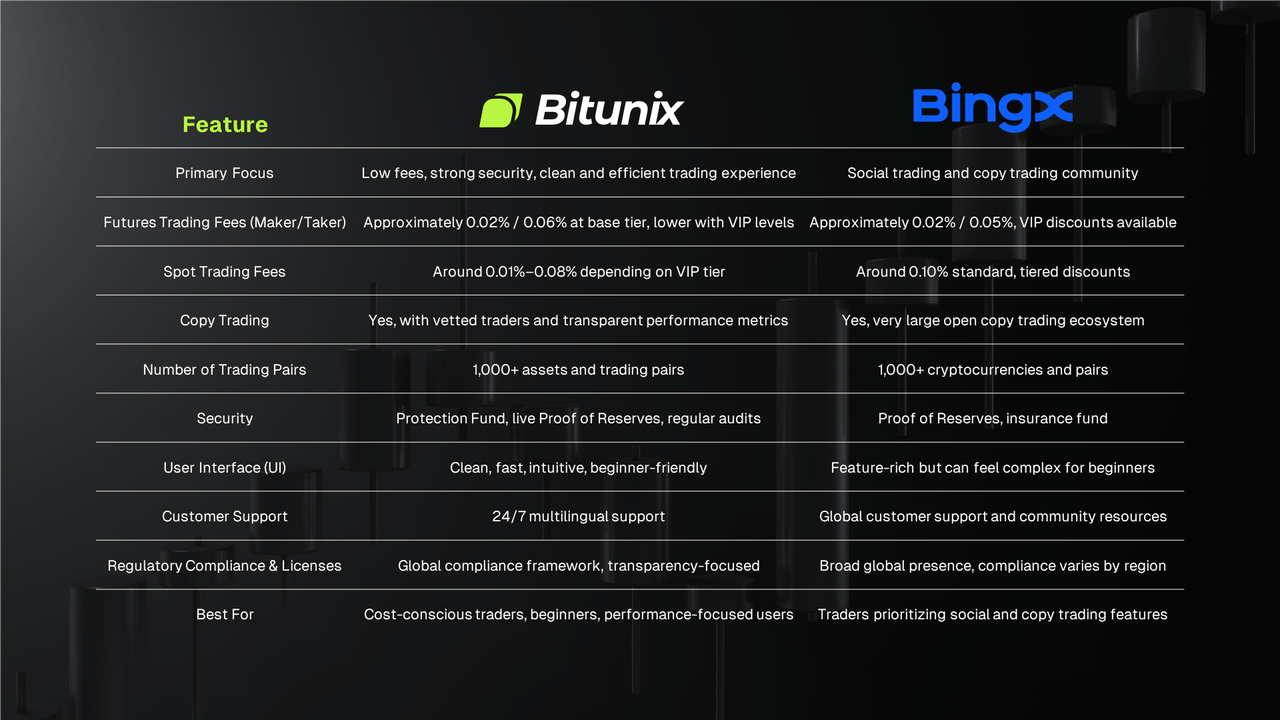
Bitunix vs BingX: At a Glance
Round 1: Trading Fees – The Impact on Your Profitability
Bitunix fees are one of the reasons that the exchange has managed to grow its user base into the millions. While all features are important, this one often dominates because, at the end of the day, it determines how much profit a trader takes home and how much the exchange keeps for its own coffers.
On centralized exchanges, fees are charged on every trade through maker and taker models. While these costs may seem minor on a single transaction, they compound quickly for active traders, directly impacting long-term profitability.
Bitunix offers low maker and taker fees that are highly competitive within the CEX landscape. When compared to BingX, Bitunix is often the more cost-efficient option, particularly for traders executing frequent or high-volume trades.
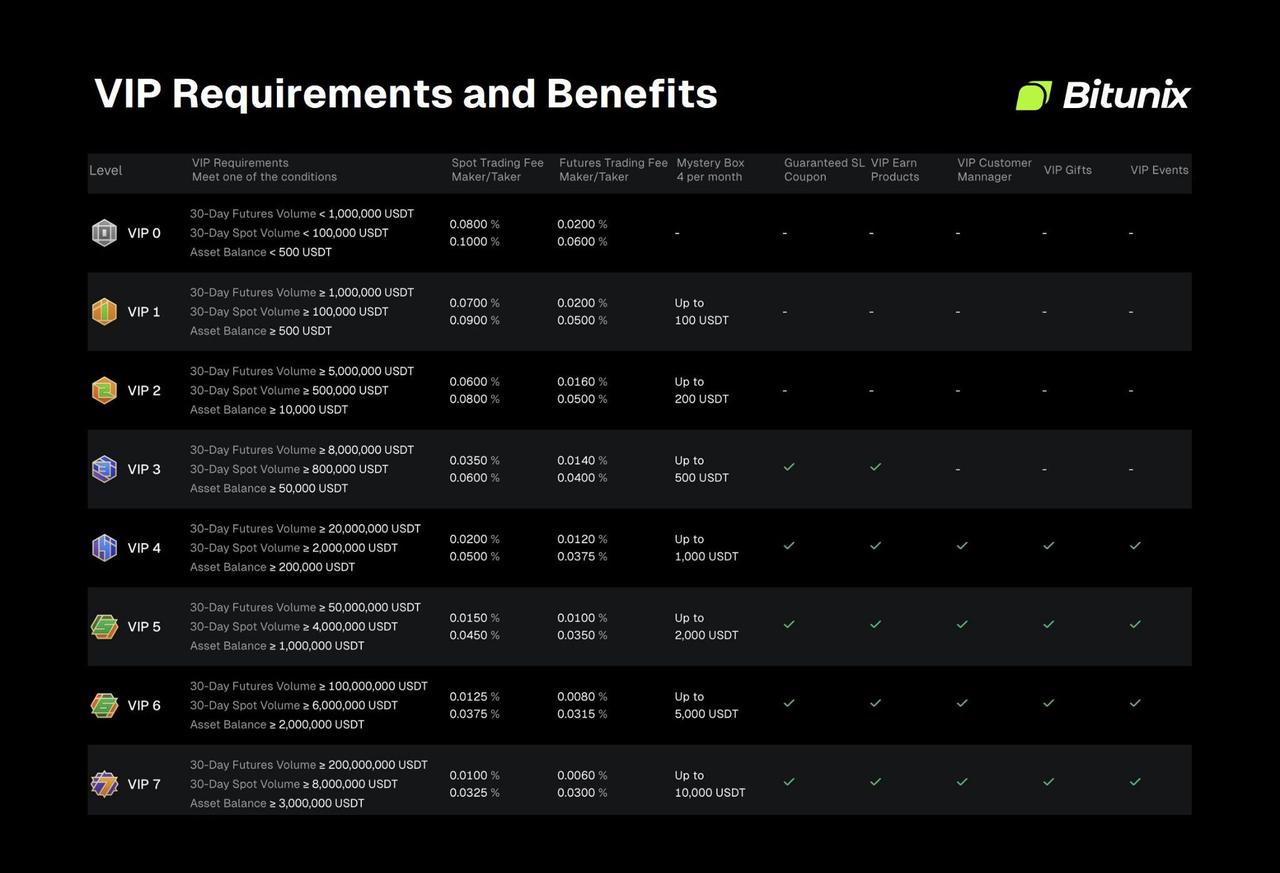
VIP tiers further enhance this advantage by unlocking reduced fees based on trading activity. This tiered structure gives Bitunix an additional edge, positioning it as a smarter choice for frequent traders focused on minimizing costs and maximizing retained profits.
Round 2: Copy Trading – Community vs. Curation
Copy trading has gone from a gimmick to a must-have on leading crypto exchanges. Many traders rely on it every single day, and some of the best copy trading strategies have helped crypto investors generate consistent profits. It is also one of the major factors to consider in the Bitunix vs BingX debate.
Copy trading allows users to automatically mirror the trades of experienced traders in real time. For example, when a lead trader opens or closes a position, the same action is executed proportionally on the follower’s account.
Bitunix takes a curated approach by selecting and vetting copy traders before listing them. Users get clear performance data, risk metrics, and simple controls, making it easier to follow strategies without unnecessary complexity.
BingX’s copy trading focuses on a large social trading network with a wide selection of traders. While this offers variety, it can also introduce noise and make quality harder to assess.
Overall, Bitunix is arguably the better choice for traders who value clarity, transparency, and controlled risk over sheer volume.
Round 3: Security and Trust – Protecting Your Funds
Both exchanges offer solid security systems and established track records. Following the FTX collapse, traders have become far more aware of the security protocols followed by their exchanges, as the mantra “not your keys, not your crypto” has grown more relevant than ever. In addition, there is a general distrust of centralized services in crypto, which is why platforms operating in this space face intense scrutiny from the community.
Security and transparency are critical on centralized exchanges because users are entrusting platforms with custody of their funds. Earlier this year, Bitunix experienced a security incident, which brought increased attention to its internal controls and response measures.
Bitunix maintains a layered security stack that includes a dedicated Protection Fund and a live Proof of Reserves system. This allows users to verify that assets are fully backed and available on demand.
BingX follows a similar approach, also offering a live Proof of Reserves system. With both exchanges demonstrating asset backing, the risk of a bank run scenario is significantly reduced, strengthening overall user trust.
Why Choose Bitunix in 2026?
In 2025 and beyond, Bitunix is arguably the better choice for crypto trading and earning. While BingX remains a solid platform with mixed user feedback, it increasingly lags behind Bitunix in terms of feature depth and efficiency.
Earning is made simple through Bitunix Earn, which allows users to generate passive returns without complex setup or strategy management. Bitunix also maintains a strong security track record, reinforced by transparent systems and ongoing infrastructure improvements.
For active traders, Bitunix delivers robust derivatives trading with automated buy orders, deep liquidity, flexible leverage options, and fast execution. Combined with very low fees, especially when unlocked through VIP tiers, and a leading affiliate program, Bitunix positions itself as a well-rounded, trader-first exchange.
How to Start Trading on Bitunix
It’s easy to get started with crypto trading on Bitunix. Simply follow these steps to make your first spot or futures trade:
- Sign up on PC using your email or mobile number, create a strong password, and secure your account with two-factor authentication or download the app on your smartphone.
- Complete identity verification if you want higher withdrawal limits or access to fiat services.
- Fund your account by depositing crypto to your Bitunix wallet or using a supported fiat on-ramp.
- Navigate to Spot or Futures trading and select your preferred spot trading pair.
- Choose an order type, set position size, leverage if applicable, and review risk settings.
- Confirm the trade and track performance in the Orders and Positions dashboard.
Bitunix traders can access far more than just spot trading options after signing up. There is a comprehensive Earn section with stablecoin and major cryptocurrency staking options, a crypto affiliate program, and a task center offering crypto-incentivized missions to complete.
Conclusion: The Verdict for Bitunix vs BingX
Billions of dollars are traded on centralized exchanges every single hour. The industry has grown into a behemoth over the past few years, with some exchanges now considered household names. Bitunix and BingX are two of the strongest exchanges currently on the market, and Bitunix’s steadily growing trading volume and market share are a testament to its strong position. Overall, there is a solid argument in favor of choosing Bitunix over BingX due to its security track record, copy trading options, extensive trading pairs, and competitive fee structure.
FAQs
Is Bitunix safer than BingX?
Both exchanges implement strong security measures, including Proof of Reserves and standard account protections. Bitunix places a heavier emphasis on transparency and reserve verification, which may appeal to security-focused traders.
Which exchange is cheaper for trading futures, Bitunix or BingX?
Bitunix generally offers lower futures trading fees, especially for active traders who qualify for VIP tiers. BingX remains competitive but can become more expensive at higher trading volumes.
Is copy trading on Bitunix profitable?
Copy trading profitability depends on the selected trader and market conditions. Bitunix improves risk control by offering curated traders with clear performance metrics and transparency.
Can I use both Bitunix and BingX?
Yes, many traders use multiple exchanges to access different features, liquidity pools, or trading strategies depending on their needs.
Which platform is better for a complete beginner?
Bitunix is often easier for beginners due to its cleaner interface and simpler copy trading setup. BingX may feel overwhelming because of its feature dense, social trading focus.
Does Bitunix have as many trading pairs as BingX?
BingX offers a slightly broader selection of trading pairs. Bitunix focuses on liquidity and quality, covering most major and high demand assets.
What is a Protection Fund and does BingX have one?
A Protection Fund is a reserve used to cover losses during extreme market events. Bitunix maintains a dedicated Protection Fund of 30M USDC, while BingX relies on broader risk management systems rather than a clearly defined fund.
How easy is it to deposit and withdraw from Bitunix compared to BingX?
Both platforms support straightforward crypto deposits and withdrawals. Bitunix is often praised for faster processing times and a simpler withdrawal flow.
Are there any hidden fees on either platform?
Neither Bitunix nor BingX is known for hidden fees. Trading costs are transparent, though users should always review funding rates and withdrawal fees.
Which exchange has better customer support?
Bitunix generally receives stronger feedback for responsiveness and clarity. BingX support is functional but can be slower during periods of high demand.
Glossary
Centralized Exchange (CEX): A crypto trading platform that holds custody of user funds and executes trades internally.
Maker Fee: A fee paid when placing an order that adds liquidity to the order book.
Taker Fee: A fee charged when an order removes liquidity by filling immediately.
Copy Trading: A feature that allows users to automatically replicate another trader’s positions.
Derivatives Trading: Trading contracts such as futures that derive value from underlying assets.
VIP Tiers: Volume based account levels that unlock reduced fees and additional benefits.
Proof of Reserves (PoR): A transparency system showing that an exchange holds sufficient user assets.
Protection Fund: A reserve fund designed to cover losses during extreme market events.
Stablecoin: A cryptocurrency pegged to a stable asset, typically a fiat currency like USD.
About Bitunix
Bitunix is a global cryptocurrency derivatives exchange trusted by over 3 million users across more than 100 countries. At Bitunix, we are committed to providing a transparent, compliant, and secure trading environment for every user. Our platform features a fast registration process and a user-friendly verification system supported by mandatory KYC to ensure safety and compliance. With global standards of protection through Proof of Reserves (POR) and the Bitunix Care Fund, we prioritize user trust and fund security. The K-Line Ultra chart system delivers a seamless trading experience for both beginners and advanced traders. At the same time, leverage of up to 200x and deep liquidity make Bitunix one of the most dynamic platforms in the market.
Bitunix Global Accounts
X |Telegram Announcements |Telegram Global |CoinMarketCap |Instagram |Facebook |LinkedIn |Reddit |Medium