

Article Summary
- This article provides a detailed price prediction and fundamental analysis for the Helium (HNT) token.
- It explains Helium's pioneering role in the DePIN sector, incentivizing users to build decentralized wireless networks (IoT and 5G) using physical hotspots.
- The bull case focuses on the successful migration to the Solana blockchain, the rapid growth of Helium Mobile (its 5G cellular service), and real-world utility.
- The bear case highlights the historical struggles with the IoT network's demand side, the complexity of its multi-token model (HNT, IOT, MOBILE), and intense competition from traditional telecom giants.
- It presents detailed price prediction scenarios (bearish, neutral, bullish) for both 2026 and 2030, based on network adoption and cellular subscriber growth.
Helium is still one of the easiest tech projects to explain to someone outside the crypto space. People install hardware, provide real wireless coverage, and get rewarded when the network gets used. That is why Helium became one of the clearest examples of DePIN crypto, and why the project continues to attract attention after the usual boom-and-bust cycle washed through the market. HNT also trades on Bitunix, a crypto exchange that gives investors a direct way to buy the asset and track the price action.
The tension is obvious, though. Helium has real hardware, real network traffic, and a real consumer wireless product. It also has a history of overbuilding supply before matching it with enough demand. So the key question for 2026 and 2030 is whether the network can turn genuine wireless usage into durable value for the HNT token.
This analysis will examine Helium's technological pivot and the promise of its 5G network, and will provide data-driven price predictions for 2026 and 2030.
The Technology and Ecosystem
The core model still looks unusual by crypto standards. Helium's official docs say the network powers two wireless systems: a global LoRaWAN network for Internet of Things (IoT) devices and a cellular offload Wi-Fi network for mobile connectivity, with community-operated Hotspots providing the coverage and earning HNT for coverage and traffic.
Proof-of-Coverage and traffic rewards are the practical mechanisms behind that model. Hotspots can earn rewards for both Proof of Coverage and data transfer, and their data-only Hotspots can still earn for transferring real network data even if they do not participate in Proof-of-Coverage rewards. That is important because Helium is increasingly trying to reward actual usage.
The Solana migration was the other big turning point. The network migrated from its own purpose-built blockchain to Solana on April 18, 2023, and the move took Helium from roughly 10 TPS to more than 1,600 TPS, cut transaction costs sharply, and made hotspot NFTs dramatically cheaper to mint. For traders on Bitunix, that means HNT is no longer tied to a standalone Helium chain. It is now a Solana-based asset attached to a wireless infrastructure network.
Helium's wallet docs list support for HNT, MOBILE, IOT, DC, SOL, and USDC, making the token system more complex than before. However, HNT remains the native network and governance token, while Data Credits are derived from HNT and used to pay for network usage. In practice, that means the ecosystem now works more like a family of subnetworks around one base token.
The Bull Case: Real-World Utility
The market is not fully convinced, but the published forecast range is wide enough to leave room for a strong recovery.
- Kraken's current model puts HNT at about $1.01 in 2026 and $1.23 in 2030.
- CoinCodex's forecast is similar for 2026 at about $1.05, but much lower by 2030 at roughly $0.346.
- Changelly's price prediction is more optimistic in late 2026, with a December 2026 average near $2.16 and a maximum near $2.42, though its 2030 average falls back to about $0.384.
- Bitget's February 2026 outlook is the aggressive outlier, arguing that HNT could move toward $10 in 2026 and approach $50 by 2030 if adoption accelerates sharply.
That range tells you the bull case exists, but it depends heavily on actual network usage. A serious Helium crypto price prediction has to start there.
1. Helium Mobile Success
The strongest bullish argument is that Helium is one of the few crypto networks that regular people can use without caring that it is crypto. Helium Mobile's current site shows three plans, from a free Zero plan to the Infinity unlimited tier, and the official terms show that the old $5 Beta and $20 Unlimited plans were retired in January 2026 as the product moved to a more standard lineup. Meanwhile, Messari reported cumulative Helium Mobile account signups of 595,800 by the end of Q4 2025, with daily new signups still growing quarter over quarter.
The same report also said that Helium offloaded 4,388 TB of data from major U.S. mobile carriers in Q4 alone, up 60.7% quarter over quarter. Average daily users grew to 1.6 million, and the network surpassed 2 million daily users for the first time, reaching 2.5 million on December 20. FalconX's January 2026 note described Helium as one of the most widely used crypto applications and said signups had climbed to nearly 600,000 by year-end. That is the kind of usage profile that can support a more optimistic HNT outlook.
2. The DePIN Narrative
DePIN remains one of the more credible crypto sectors because it produces something you can point at in the physical world. Messari's 2026 DePIN work says the sector has matured into real revenue-generating infrastructure businesses, and Helium is usually treated as the benchmark wireless name in that category. FalconX went further, highlighting Helium as one of the three DePIN protocols and noting record activity heading into 2026. So the DePIN narrative is backed by usage, revenue, and physical deployment.
Helium also benefits from the fact that it is no longer only an IoT blockchain story. There are now two separate wireless networks, Helium Plus deployments, converted Wi-Fi networks, and mobile hotspot rewards all feeding into the broader system. That makes the project more flexible than the earlier version, which depended much more narrowly on IoT sensor demand arriving at scale.
3. Deflationary Mechanics
The HNT token still has one of the more intuitive usage loops in crypto. Data Credits (DCs) are produced only by burning HNT, and all network usage on both the IoT and Mobile subnetworks is paid for with DCs. DCs are set to $0.00001 each, meaning real network demand creates recurring HNT burn pressure regardless of token price. That burn-and-mint equilibrium is the cleanest long-term reason to watch HNT. The more the network is used, the more HNT has to be destroyed to keep the system running.
And the burn side has started to look more meaningful. Messari said average daily DC burns rose 83.6% quarter over quarter in Q4 2025, from $30,920 to $56,760. It also said the Mobile Network accounted for 99.8% of that quarter's total, which shows where the real demand now sits. If that growth keeps compounding, the HNT token can start behaving more like a usage-linked infrastructure asset.
The Bear Case: The Demand Problem
The main risk is that Helium’s network can stay technically impressive without becoming economically strong enough to support the HNT token over the long term.
The current HNT price on CoinGecko is about $1.01, with a market cap of $186.6 million and a 24-hour trading volume of around $2.8 million. Those are not terrible numbers, but they are small for a network that once looked like a major breakout story.
The forecast spread also reflects that caution.
- Kraken sits near the current price.
- CoinCodex turns decisively lower by 2030.
- Changelly's 2030 model is also weak.
That is why the downside case cannot be dismissed. A second Helium crypto price prediction reality is that most mainstream forecasts still assume modest or negative long-term appreciation unless usage grows much faster.
1. The IoT Disappointment
Helium's original IoT network proved that token incentives can build a huge supply base. Messari said the network had over 385,000 total IoT hotspots by the end of Q4 2025 when historical and post-migration counts are combined. But the same report shows how weak the usage side remained: of roughly $56,760 in average daily DC burns in Q4 2025, mobile accounted for $56,635 while IoT contributed just $124.77. That is a brutal difference that shows the original IoT blockchain dream has not yet translated into strong economic demand.
2. Telecom Goliaths
Helium Mobile's real-world success is also tied to outside partners. Helium Mobile users connect to Helium hotspots when available and switch to T-Mobile's network when hotspot coverage is not available. That helps Helium provide wider service, but it also shows the network is not fully self-sufficient. Light Reading complicated the picture further in June 2025 by reporting that T-Mobile said it did not have a formal carrier offload agreement with Helium Network. That does not erase Helium's actual usage, but it does remind you that telecom relationships can be messy, strategic, and fragile.
3. Hardware ROI
Hotspot economics get tougher as the network matures. Helium's token design reduces emissions over time through scheduled halvings, which means operators cannot rely on the same reward levels forever. At the same time, more deployed hardware means rewards are spread across a larger base of participants, raising the bar for profitability.
To stay attractive, hotspot owners increasingly need strong placement, reliable uptime, and meaningful data traffic, not just a device plugged in at home. If HNT stays weak or usage growth slows, some operators may decide that the returns no longer justify the hardware and maintenance costs.
Helium (HNT) Price Prediction Scenarios (2026 & 2030)
Forecast tables can make crypto look more precise than it really is. Helium does not fit neatly into that kind of clean prediction model because its price depends on two moving targets at once: token market sentiment and real wireless network usage. That is why the best way to frame HNT for 2026 and 2030 is not to pretend one forecast got it exactly right, but to build realistic scenario bands from the range of current published estimates.
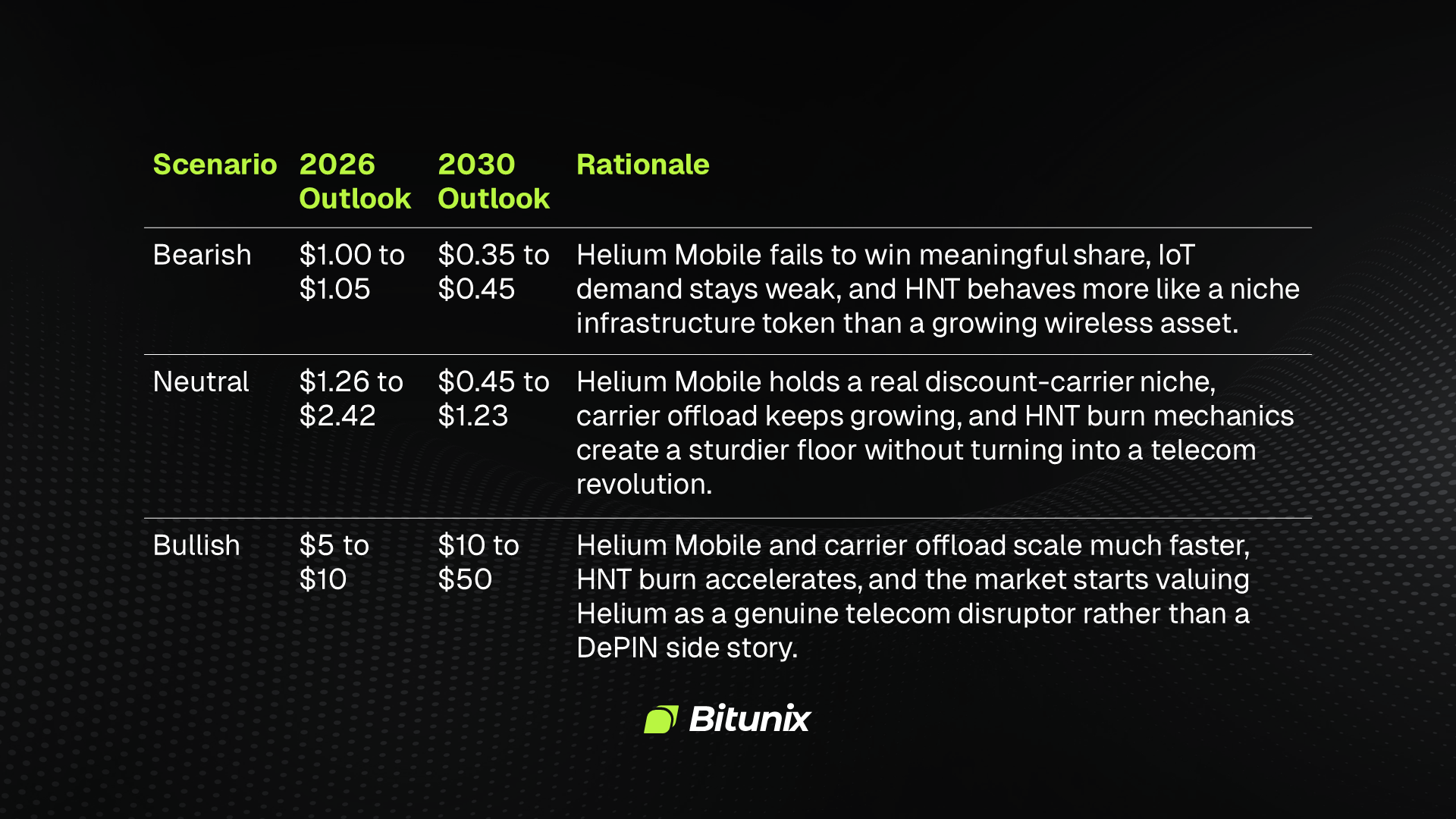
Helium price prediction scenarios for 2026 and 2030, comparing bearish, neutral, and bullish outcomes based on network adoption and carrier offload growth.
These ranges are based on forecasts from Kraken, CoinCodex, Changelly, and Bitget. The more conservative models stay close to current price levels, while the more aggressive upside cases only make sense if Helium Mobile adoption, carrier offload, and HNT burn all grow much faster than they have so far.
Conclusion: A Tangible Crypto Use Case
Helium remains one of the few crypto projects with a visible physical footprint: hotspots, wireless traffic, and consumer plans exist. The Solana migration reduced friction, and Helium Mobile gave the network a clearer path toward mainstream utility.
The big picture is that buying HNT is a bet that real network usage will drive stronger token value over time. The lower-end outlook for 2026 and 2030 remains close to current price levels, reflecting a market that still sees Helium as a niche infrastructure project rather than a major telecom challenger. The stronger upside case only works if Helium Mobile keeps expanding, carrier offload grows, and HNT burn increases enough to create meaningful supply pressure. So the conclusion is fairly clear: if network adoption stays limited, HNT can struggle to break out; if real-world usage scales, the token has a much stronger path to outperform.
If you want to track that setup more closely, start by downloading the Bitunix app, then register to access HNT markets while keeping the wider DePIN sector on your screen.
FAQ Section
What is Helium (HNT)?
Helium is a decentralized wireless network that uses community-operated hotspots to provide IoT and mobile connectivity. HNT is the main network token and supports rewards, governance, and the issuance of Data Credits, which are used to pay for actual network usage.
What is DePIN?
DePIN stands for decentralized physical infrastructure networks. These projects use token incentives to get people to deploy and maintain real-world hardware such as hotspots, storage nodes, or compute devices. Helium is one of the clearest examples because it turns wireless coverage into a tokenized network.
Why did Helium migrate to Solana?
Helium migrated to Solana to improve scalability, reduce costs, and integrate with a much larger on-chain ecosystem. Current Helium docs confirm the move, and Solana's 2025 case study says it sharply improved transaction throughput while cutting costs and enabling broader composability.
What is the difference between HNT, IOT, and MOBILE tokens?
HNT is the base network and governance token. IOT and MOBILE are subnetwork-related tokens tied to Helium's IoT and mobile ecosystems, while Data Credits are created by burning HNT to pay for usage.
How does Helium Mobile work?
Helium Mobile blends coverage from community-built Helium hotspots with the nation's largest 5G network. Users join through retail plans, and when Helium hotspot coverage is unavailable, traffic can fall back to partner coverage. That hybrid design is how Helium can offer consumer service at real scale.
Is Helium mining still profitable?
It can still generate rewards, but the economics are harder than before. Rewards now depend more on useful placement, data transfer, and network quality, while emissions keep stepping down over time. More hotspots competing for slower issuance means weak deployments can become unattractive fast.
What is Proof-of-Coverage?
Proof-of-Coverage is Helium's way of rewarding hotspots for providing useful wireless availability. Helium's docs say mobile hotspots can earn both PoC rewards and data-transfer rewards, and the IoT network still uses PoC logic to encourage better deployment density.
How does the Burn-and-Mint Equilibrium work?
Helium users burn HNT to create Data Credits, which pay for network activity. Because DCs are fixed in dollar terms and only come from burned HNT, higher network usage can create ongoing deflationary pressure on HNT supply over time.
What are the risks of investing in Helium?
The main risks are weak IoT demand, dependence on outside carrier relationships, lower hotspot ROI as emissions fall, and the possibility that consumer growth slows before token economics fully mature. Helium has real utility, but the telecom business is brutally competitive and execution-heavy.
Where can I buy HNT?
You can buy HNT on centralized crypto exchanges and then use Helium-compatible wallets if you want to move on-chain. Bitunix is one place where HNT is listed, and current market trackers like CoinGecko also follow its price, volume, and market cap.
Glossary
- HNT token: The native cryptocurrency and protocol token of the Helium Network.
- DePIN crypto: Crypto networks that use token incentives to coordinate real-world hardware and infrastructure.
- Helium Mobile: Helium's consumer wireless service that combines community-built coverage with nationwide 5G partner coverage.
- Helium 5G: The mobile side of the Helium ecosystem, now built around cellular offload, Wi-Fi, and hotspot-based coverage.
- IoT blockchain: A blockchain system designed to support device connectivity and data transfer for internet-connected sensors and machines. In Helium's case, this is its LoRaWAN IoT network.
- Hotspot: Community-operated wireless hardware that provides Helium network coverage and can earn rewards.
- Proof-of-Coverage: Helium's reward system for validating useful wireless coverage.
- Data Credit: A non-transferable utility token created by burning HNT and used to pay for network usage.
- Burn-and-Mint Equilibrium: The Helium token model, where HNT is burned to create Data Credits as the network is used.
- Carrier offload: Traffic routed from traditional carriers onto the Helium Network to improve or extend coverage.
- LoRaWAN: A low-power wireless standard used by the Helium IoT network for connected devices.
- MVNO: Mobile Virtual Network Operator. Helium Mobile operates as an MVNO using both Helium coverage and outside carrier infrastructure.
- Solana migration: Helium's move from its own blockchain to Solana in April 2023 to improve performance and composability.
- DC burn: The consumption of Data Credits for network usage, which reflects real wireless demand on Helium.
- Mobile hotspot ROI: The practical return that hotspot operators get from coverage and data-transfer rewards relative to hardware and deployment costs.
Disclaimer
This article does not provide:
(i) investment advice or investment recommendations;
(ii) an offer or solicitation to buy, sell, or hold digital assets;
(iii) financial, accounting, legal, or tax advice.
Digital assets, including stablecoins and NFTs, involve high risk and may fluctuate significantly. Consider whether trading or holding digital assets is appropriate for you given your financial situation. Consult a qualified legal, tax, or investment professional when needed. You are responsible for understanding and complying with applicable local laws and regulations.
About Bitunix
Bitunix is a global cryptocurrency derivatives exchange trusted by over 3 million users across more than 100 countries. At Bitunix, we are committed to providing a transparent, compliant, and secure trading environment for every user. Our platform features a fast registration process and a user-friendly verification system supported by mandatory KYC to ensure safety and compliance. With global standards of protection through Proof of Reserves (POR) and the Bitunix Care Fund, we prioritize user trust and fund security. The K-Line Ultra chart system delivers a seamless trading experience for both beginners and advanced traders, while leverage of up to 200x and deep liquidity make Bitunix one of the most dynamic platforms in the market.
Bitunix Global Accounts
X | Telegram Announcements | Telegram Global | CoinMarketCap | Instagram | Facebook | LinkedIn | Reddit | Medium