
Article Summary
- This article provides a comprehensive comparison of the full derivatives suites offered by Bitunix and BloFin.
- The analysis covers Product Variety (beyond perpetuals), Advanced Trading Features, Fee Structure, and Overall Platform Experience.
- While both exchanges offer strong perpetual futures products, Bitunix is strategically expanding its derivatives offerings and provides a more professional, intuitive, and secure trading environment.
- BloFin’s platform can feel less polished, and it lacks the verifiable security of Bitunix’s Proof of Reserves.
- For the discerning derivatives trader who values a clean interface, advanced tools, and transparent security, Bitunix stands out as the more professional and trustworthy choice.
The world of crypto derivatives is expanding far beyond simple perpetual futures. To succeed, modern traders need a platform that offers a full suite of tools. BloFin and Bitunix are both strong contenders, but which exchange provides the more comprehensive and professional derivatives trading experience?
This article compares the complete derivatives offerings of Bitunix and BloFin, analyzing product variety, trading features, fees, and security to name the definitive crypto exchange winner for derivatives traders.
Round 1: Derivatives Product Suite
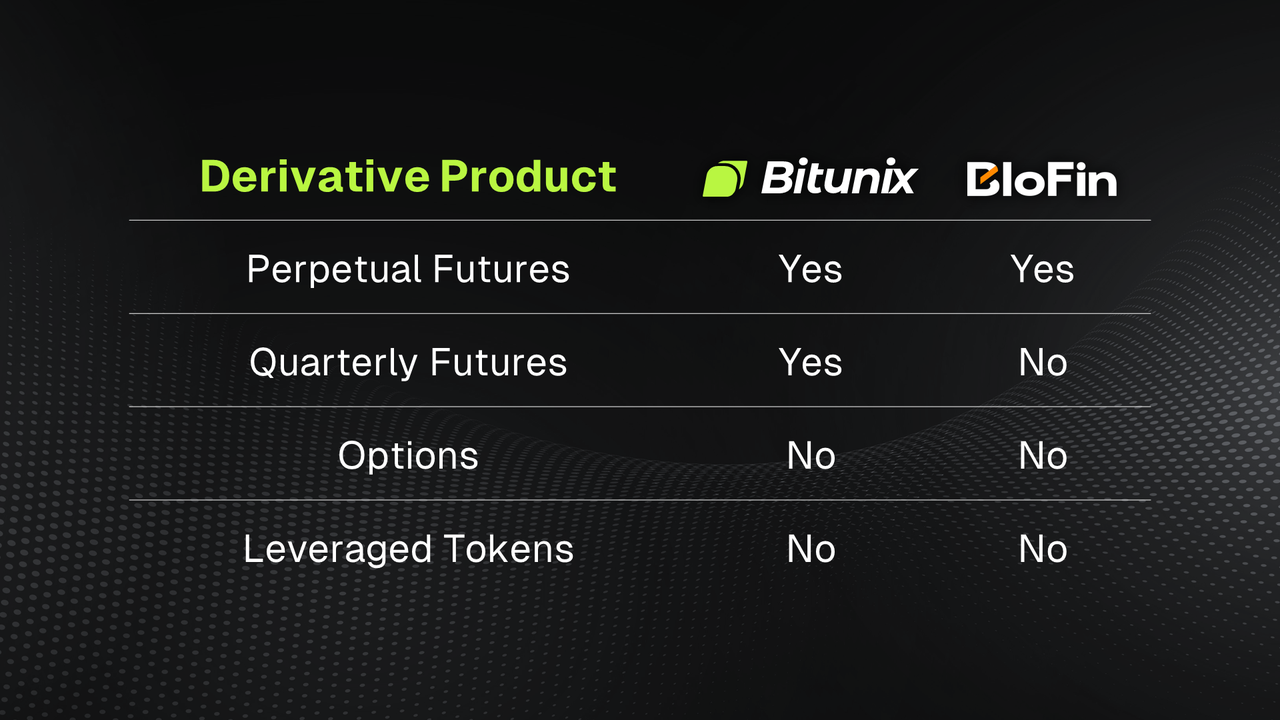
Perpetual futures trading is one of the most popular practices in the crypto landscape. However, it is not the only type of derivative trade that crypto traders can access on crypto exchanges. Here are other derivative products suitable for experienced traders and advanced strategies:
Quarterly Futures
Quarterly futures are a type of investment designed to expire on the final Friday of each quarter. The fixed expiration date allows investors to track and formulate trading strategies in time.
BloFin offers perpetual futures contracts. However, its offer is limited to USDT-M, USDC-M, and Coin-M perpetual contracts.
Besides its popular perpetual futures, Bitunix also provides quarterly futures contracts, giving traders the flexibility to speculate on asset prices using a fixed maturity date.
Options
Crypto options are derivative contracts that allow speculation on crypto price movements without owning the asset and give traders the option to trade, requiring a premium payment. Many traders choose options over futures because they get increased risk control and do not carry any obligations.
Neither Bitunix nor BloFin provides options as part of their futures trading offers.
Leveraged Tokens
Leveraged Tokens (LTs) are derivative tokens that give you amplified exposure to an underlying asset like Bitcoin or Ethereum. They act like a tokenized futures position but without requiring you to manage margin or collateral. Instead, they use automatic rebalancing to maintain leverage.
The BloFin exchange does not offer traditional leveraged tokens in the same way some other exchanges do. Instead, the platform lists leveraged tokens from other protocols on its spot market, such as LEVX from Leverage Protocol. Since these tokens manage their own underlying leverage, this feature can be considered more of a third-party service.
Bitunix does not offer a separate asset class of leveraged tokens either. However, it provides leveraged trading via perpetual futures with up to 200x leverage on specific pairs, such as BTC/USDT and ETH/USDT.
Bitunix is committed to expanding its derivatives offerings, starting with the integration of Quarterly Futures. The platform is actively developing the tools professional traders will need in the future, positioning itself as a forward-thinking platform with a clear development strategy.
Verdict:
Bitunix joins a handful of top crypto exchanges embracing innovation and expanding their derivatives offerings. Meanwhile, BloFin does not show any signs of joining that movement, keeping its futures trading offer limited. As a result, this round can have only one winner: Bitunix.
Round 2: Advanced Trading Features & Tools
Experienced crypto traders always consider a platform’s trading toolset before joining. More precisely, they examine advanced order types beyond simple buy/sell or market/limit orders, enabling them to automate risk-management and profit-taking strategies.
Here are the most common advanced options and order types in crypto:
Stop-Loss and Take-Profit (SL/TP) Order
SL/TP are conditional orders that trigger a market or limit order to exit a position when a specified price is reached.
One-Cancels-the-Other (OCO) Order
This feature allows users to place two orders at once. If one executes, the other is automatically canceled, making it ideal for defined price targets.
Stop-Limit Order
This feature triggers a limit order only after a specific price is reached. It provides traders with more control over the execution price than a basic stop-market order.
Iceberg Order
This setting hides large orders by displaying only a small portion (a.k.a. the tip) to the market. The order gradually reveals more chunks as the initial portions fill, making it ideal for large trades to minimize market impact.
Time-Weighted Average Price (TWAP) Order
This feature breaks large orders into smaller, scheduled executions over time to achieve a price close to the average market price and reduce slippage.
Sub-Accounts
Sub-accounts are secondary, linked profiles within a main exchange account. They allow users to separate funds, manage different trading strategies, and practice better risk management, including asset isolation, all under a single primary login.
API access for Algorithmic Trading
An API securely links your trading strategy code to the platform. This feature gives you access to real-time market data, order execution, automated trading, and portfolio management.
BloFin has an extensive trader’s toolset, including trading bots and copy trading features. Additionally, the platform allows new traders to use a Demo account to test their strategy with virtual funds, without risking their assets.
BloFin also provides REST and WebSocket APIs for developers seeking to build custom automated trading systems and access real-time market data, order management, and risk management tools. However, the exchange hosts all these features on a rather crowded user interface (UI) that is renowned for its slow speed and average performance.
On the other hand, Bitunix is designed from the ground up for professional traders. The UI is cleaner, and the sub-account management is more robust. Also, the API is built for high-performance and low-latency trading.
Some of the main components of Bitunix’s toolkit include advanced order types, leverage and margin options, advanced charting, and copy trading. Bitunix also provides a Demo account with essential educational tips for new users. All these enable Bitunix to offer a superior experience for anyone running complex strategies.
Verdict:
While both platforms cover the basics of trading derivatives, Bitunix’s focus on a professional-grade experience gives it the edge in execution and strategy management. Winner: Bitunix.
Round 3: Fee Structure
Trading fees can eat into futures traders' profits, especially when they run multiple positions simultaneously. This downside of crypto trading is the reason why so many experienced traders do their due diligence on an exchange’s fee structure before joining.
Bitunix offers a competitive fee structure with added flexibility for high-volume traders. At VIP 0, Bitunix futures fees are set at 0.02% for makers and 0.06% for takers. As traders progress through higher VIP tiers, fees are reduced significantly, with top-tier users paying as little as 0.0060% maker and 0.0300% taker, making Bitunix increasingly cost-effective for active and professional traders. Bitunix is highly cost-effective for active and professional traders.
BloFin charges base futures fees at 0.02% for makers and 0.06% for takers. Active users can enter the platform’s VIP program depending on their asset balance or trading volume over the past 30 days. If they reach the 5th and uppermost VIP tier, traders will pay 0% maker fees and 0.0350% taker fees. However, they must reach a 30-day futures trading volume of $500 million and have an $8 million spot trading volume over the past 30 days.
Bitunix also charges base futures fees at 0.02% for makers and 0.06% for takers. The platform also rewards active, successful traders with access to an 8-tier VIP system. The highest VIP tiers offer significantly reduced Bitunix fees, reaching lows of 0.0060% for makers and 0.0300% for takers.
However, the qualifications for reaching the highest Bitunix VIP tier are easier than on BloFin, requiring only $200 million in futures trading volume over 30 days.
Verdict:
This was a close round. Bitunix’s overall commitment to providing the best value makes it a more attractive long-term partner. However, the BloFin exchange remains competitive with its multi-tier trading fee structure. The result is a tie between the two platforms.
Round 4: Security & User Experience
So far, the Bitunix vs. BloFin comparison has been closely contested by both exchanges. This final round will focus on their security standards, as experienced traders will admit, when performance is similar, trust and ease of use become paramount.
BloFin provides industry-standard security measures, including enhanced data protection, regulatory compliance, and 2FA for users. Also, the platform partners with Fireblocks for secure, efficient digital asset custody, and it securely stores user data for at least 5 years after account termination.
Bitunix’s cleaner, more modern interface is the result of the platform’s simple yet efficient security approach. The exchange employs 24/7 monitoring and integrates with institutional security partners, including Fireblocks & Elliptic. Bitunix keeps 95% of the users’ funds in cold storage and reassures users that their assets are safe with a dedicated Protection Fund and compliance with global regulations.
More importantly, Bitunix provides a 1:1 Proof of Reserves for all user assets. The platform even allows users to verify that Bitunix is fully reserving these assets using the integrated Merkle tree.
Verdict:
A better interface and provable security create a superior and safer trading environment. The evident winner of this round is Bitunix.
Final Verdict in the BloFin Exchange vs. Bitunix Debate
The clear winner of the Bitunix vs. BloFin battle is Bitunix. BloFin is a competent derivatives exchange with a versatile offer of derivatives trading options and accessible trading fees.
However, Bitunix is a more professional crypto exchange with a more comprehensive product vision, a cleaner, more functional interface, and an unparalleled commitment to verifiable security.
For a derivatives trader managing significant capital and complex positions, knowing your funds are verifiably safe is not a luxury. It’s a necessity. Bitunix provides this peace of mind, while BloFin falls short.
In less than 4 years since its inception, Bitunix has established itself as the superior platform for any trader serious about the full spectrum of crypto derivatives.
Bitunix is available for both desktop and mobile users. You can download the Bitunix mobile application for iOS or Android on the app download page.
Sign up for Bitunix today and upgrade your trading toolkit. Move to a platform built for professionals and backed by proof.
FAQ Section
Does BloFin offer options trading?
No, BloFin does not offer traditional options trading, such as buying/selling calls and puts on contracts.
What are the advantages of using sub-accounts for trading?
Sub-accounts in crypto trading are invaluable tools for traders, primarily because they enhance organization, provide robust risk management, and offer superior security. They enable traders to isolate strategies and manage risk without impacting the main account.
Is Bitunix a good platform for algorithmic trading?
Bitunix is a good choice for algorithmic trading due to its professional tools and robust API access.
How do I verify Bitunix’s Proof of Reserves?
You can verify Bitunix's Proof of Reserves by either using the online verification page or by downloading their open-source tool and data file to run locally for a detailed check.
What are leveraged tokens?
Leveraged tokens are crypto derivatives that offer magnified exposure (e.g., 2x or 3x) to price changes, allowing traders to amplify gains or losses without margin calls or liquidation risks.
Can I use the same account for spot and derivatives on Bitunix?
Bitunix allows users to manage both types of trading within a single account environment. However, you will need to transfer assets between your dedicated spot and futures wallets within that main account before trading.
Why is a clean UI so crucial for trading in crypto derivatives?
A clear, intuitive user interface (UI) is crucial for this type of trading. Due to the market's speed, risk, and complexity, an effective UI is vital for traders to process information quickly, make informed decisions, and manage risk efficiently.
Glossary
Liquidity: The ability to enter or exit trades efficiently.
Trading Engine: A system that matches orders and executes trades.
Proof of Reserves: Verifiable evidence that user funds are fully backed.
Copy Trading: Automatically mirroring trades from experienced professionals.
Leverage: Borrowed capital used to amplify trading exposure.
Maker Fee: Fee paid for adding liquidity to order books.
Taker Fee: Fee paid for removing liquidity via market orders.
TVL: The entire value locked in a protocol, a rough usage proxy.
DeFi: Decentralized finance applications on public blockchains.
Incentive Program: Extra token rewards used to direct liquidity or votes.
Governance: Process for changing parameters or logic, often token-based with timelocks.
About Bitunix
Bitunix is a global cryptocurrency derivatives exchange trusted by over 3 million users across more than 100 countries. At Bitunix, we are committed to providing a transparent, compliant, and secure trading environment for every user. Our platform features a fast registration process and a user-friendly verification system supported by mandatory KYC to ensure safety and compliance. With global standards of protection through Proof of Reserves (POR) and the Bitunix Care Fund, we prioritize user trust and fund security. The K-Line Ultra chart system delivers a seamless trading experience for both beginners and advanced traders. At the same time, leverage of up to 200x and deep liquidity make Bitunix one of the most dynamic platforms in the market.
Bitunix Global Accounts
X |Telegram Announcements |Telegram Global |CoinMarketCap |Instagram |Facebook |LinkedIn |Reddit |Medium