
Article Summary
- This article provides a detailed price prediction and fundamental analysis for the Star Atlas (ATLAS) token.
- It explains Star Atlas as a massively multiplayer online (MMO) space exploration strategy game built on the Solana blockchain using Unreal Engine 5 for cinematic graphics.
- The bull case focuses on its incredibly ambitious scope, high-fidelity visuals, deep economic simulation, and the speed and low cost of the Solana network.
- The bear case highlights the massive development timeline required for such an ambitious project, the historical failure of many metaverse concepts, and the complexity of its dual-token economy.
- It presents detailed price prediction scenarios (bearish, neutral, bullish) for both 2026 and 2030, based on game development milestones and player adoption.
Star Atlas took the opposite approach from most blockchain games by aiming for a large-scale space massively multiplayer online (MMO) game with political control, resource extraction, ship combat, NFTs, and cinematic presentation on Unreal Engine 5, rather than keeping the scope tight, the graphics light, and the economy simple. If you already follow gaming tokens on a crypto exchange, Bitunix is one place to keep an eye on the broader Solana sector, but Star Atlas still stands or falls on execution.
At its core, the Star Atlas game is a grand strategy MMO set in a shared sci-fi universe where players explore sectors, mine resources, trade assets, join factions, and take part in a player-driven economy and governance structure. This analysis examines the project's technology stack, the design of the ATLAS and POLIS tokens, and the numbers that inform a realistic outlook for 2026 and 2030.
The Technology and Ecosystem
Star Atlas keeps drawing attention because of its unusually ambitious technical vision for a Web3 game. The current Unreal Engine 5 product is the Showroom, a playable 3D environment built as the first live piece of the larger metaverse. The project uses Nanite and Lumen, which are the kinds of tools you expect in a modern AAA release. The official site also presents Star Atlas as a space exploration MMO with ship combat, fleet command, crafting, and territorial control, which shows how wide the design scope remains even before full release.
The official help center puts the current playable state this way:
"The Star Atlas Showroom is the first playable product of Star Atlas built in Unreal Engine 5, allowing players to interact with the metaverse."
Solana is an essential part of its design because a game built around ships, resources, market activity, transport, and faction systems requires cheap, frequent transactions. Star Atlas's own support documentation says Solana was chosen for speed, scalability, and low transaction costs. It describes it as suitable for real-time interactions between players, assets, and the game world. Even token-locking actions usually cost less than $0.01 in SOL network fees.
The project's live products show how that design works in practice. SAGE Labs is the browser-based 4X strategy layer where exploring, mining, crafting, and transporting are signed and settled on-chain. Holosim is the free browser entry point, with no wallet required to start, and the UE5 Showroom on the Epic Games Store is the graphical front end for the larger vision. In other words, Star Atlas already exists as a stack of playable modules.
Star Atlas becomes more complex once you look at its dual-token structure. ATLAS is the inflationary in-game utility currency used across the economy, while POLIS is the governance asset with fixed supply characteristics and voting power in the Star Atlas DAO. ATLAS is used for gameplay purchases such as ships, resources, and crew, while POLIS is locked for governance and reward rights. The official site currently lists $68.3 million in total volume traded, $21.1 million in annual GDP, and 9.69 million average ATLAS earned daily, which gives you a sense of the scale the team wants investors to focus on.
For anyone following the market on Bitunix or elsewhere, that connection is the key point. The ATLAS token only works as an investment thesis if players keep using ships, crew, resources, and the game's market systems.
The Bull Case: The Ultimate Metaverse
Current forecasts for ATLAS show a market that remains cautious, with most models still pricing the token as a small and highly speculative gaming asset. The spread between conservative and more stable projections reflects the same tension that has followed Star Atlas for years: the project still has a huge vision, but the market wants proof of delivery.
- CoinCodex's price prediction projects ATLAS at $0.0001496 by the end of 2026 and $0.00002448 by 2030, suggesting a much weaker long-term outlook.
- MEXC's model provides a firmer estimate of $0.000194 for 2026 and $0.000235 for 2030, suggesting a more stable path if development continues.
- Kraken's forecast uses a similarly conservative growth model, placing ATLAS at $0.00020 in 2026 and $0.00024 in 2030.
- With the token trading around $0.000198 and the market cap near $4.83 million, even moderate progress can shift sentiment because expectations remain very low.
1. Unmatched Ambition
What makes the bullish case compelling is not just the size of the original idea, but the fact that Star Atlas is already building several layers that most Web3 games never attempt at once, including a UE5 Showroom for immersive 3D play, SAGE for browser-based on-chain strategy and resource production, Holosim as a lighter entry point, and later roadmap phases focused on PvP, PvE, expanded professions, and deeper DAO systems.
Official Star Atlas materials describe development in stages from Preseason through Season 0 and beyond, which suggests the project is trying to assemble a full game stack. If those pieces keep connecting into one coherent universe, Star Atlas starts looking like one of the few blockchain games with real MMO depth, player specialization, and persistent economic infrastructure.
2. Deep Economic Simulation
What strengthens the bullish case is the depth of the in-game economy. Star Atlas official SAGE documentation says every on-chain action can tie into exploration, mining, crafting, transport, and market activity, and that everything you collect or produce exists as a digital asset in your wallet. The NFT structure covers ships, crew, resources, and crafted components, while the marketplace lets players buy and sell assets inside and outside gameplay.
If the metaverse ever becomes more than a buzzword here, players do not just log in to grind quests. They mine, transport, rent fleets, support starbases, and trade digital property with actual economic consequences. Done well, that creates a loop where the ATLAS token serves daily utility, and the POLIS token represents long-term control.
3. The Solana Resurgence
The third bullish factor is the chain it chose. Solana's official site says February 2026 saw network metrics diverge from broader market contraction, with SOL-denominated TVL at all-time highs, RWA market cap at $1.71 billion, and stablecoin transactions above $650 billion. The Solana homepage also currently lists 50 million monthly active addresses, 3.5 billion monthly transactions, and $3.3 trillion in trading volume. That is not gaming-specific data, but it does show a network that still attracts capital and activity at scale.
Solana's own Breakpoint 2025 recap also showed where attention moved inside the ecosystem. The event focused on revenue, institutional scale, infrastructure, payments, and AI-related products. That backdrop helps Star Atlas in one way and hurts it in another. It helps because Star Atlas already sits on the chain that is still winning attention. It hurts because the project has to prove it deserves that attention against faster-moving sectors. Still, if you want a flagship gaming bet inside Solana gaming, Star Atlas remains near the front of that conversation.
The Bear Case: The Development Marathon
The bearish side begins with the fact that the market still prices ATLAS like a tiny token. CoinMarketCap shows it around $0.000198 with a market cap of roughly $4.83 million and 24-hour volume under $650,000, while CoinCodex's 2030 model drops to $0.00002448.
1. The Vaporware Risk
The biggest risk is that Star Atlas remains more impressive as a concept than as a finished game. Official support pages openly state that the full metaverse experience is still evolving, even as SAGE, Holosim, the Showroom, fleet rental, claims, and the DAO are already live. That sounds productive, but it also confirms that the full release is still not here. Meanwhile, the marketplace continues to sell ships, resources, and services. The main concern is that players have been able to buy into the universe for a long time while the complete MMO stays under construction.
Large online worlds also take years, even for established studios. Reuters reported in March 2025 that CD Projekt had pushed Witcher IV past 2026, while analysts already expected a 2026 to 2028 release window. And in December 2025, Blizzard's World of Warcraft leadership said its focus was on the next five years, not on a neat short-term endpoint.
2. Economic Complexity
The second risk is internal. Official Star Atlas docs describe ATLAS as inflationary and POLIS as fixed-supply governance, with the DAO influencing distribution, treasury use, and broader economic policy. However, that can be hard to manage. If ATLAS inflates faster than demand grows, the utility token weakens. If POLIS loses credibility, governance stops carrying weight, and because both tokens are still small, the margin for policy mistakes is thin.
3. The Metaverse Winter
The wider market still believes in games, but it is less patient with metaverse grand plans than it was in 2021. Reuters reported in December 2025 that Meta was expected to cut its metaverse budget by up to 30%. Around the same time, Solana's own Breakpoint coverage centered on revenue, institutions, AI, and payments rather than on virtual-world storytelling. That does not kill Star Atlas, but it does mean the project now sells a harder pitch to mainstream capital.
Star Atlas Price Prediction Scenarios (2026 & 2030)
This Star Atlas price prediction table uses current market levels plus the better-known outside forecast models as anchors. CoinCodex gives the downside edge, while Kraken and MEXC offer more stable 2026-2030 paths. It's using those published numbers as guardrails, then widening them slightly into scenario ranges based on execution, retention, and Solana ecosystem strength.
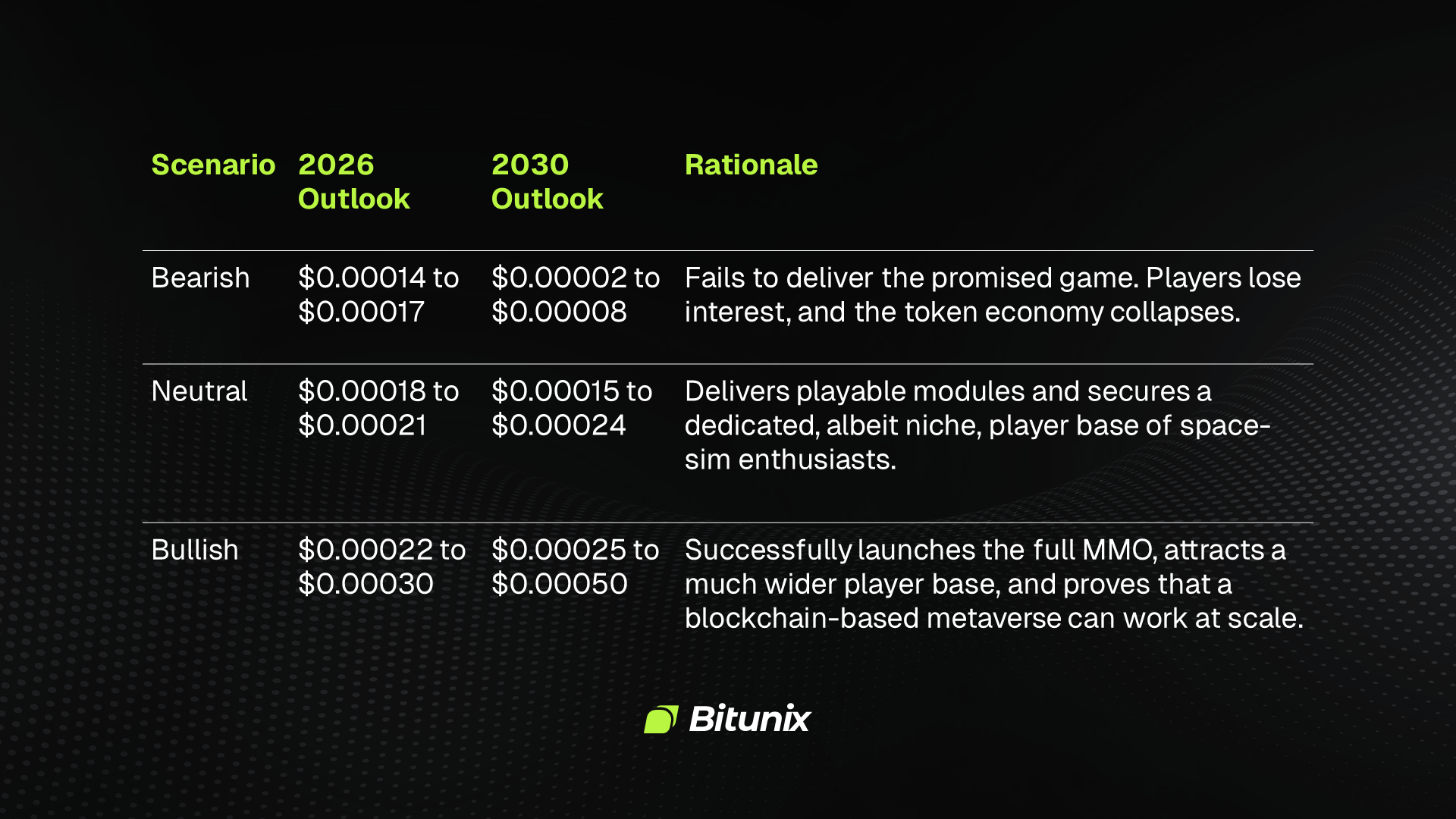
Star Atlas price prediction scenario table comparing bearish, neutral, and bullish outlooks for 2026 and 2030.
Conclusion: A Bet on the Ultimate Vision
What keeps Star Atlas relevant is the scale of the idea it is still trying to execute. Few Web3 gaming projects combine a live on-chain economy, multiple playable modules, a Solana-based infrastructure layer, and a UE5 visual environment that aims to feel closer to a traditional AAA game. That combination gives the project a higher ceiling than most blockchain games, but it also leaves very little room for delays, weak adoption, or economic imbalance.
Taking a position in ATLAS is a high-risk, high-reward bet on the team's ability to complete a long development marathon and turn an ambitious concept into a durable game world that players actually want to spend time in. Ready to invest in the future of the metaverse? Download the app, create a Bitunix account today to trade many tokens with deep liquidity, and to keep track of the market as the project develops.
FAQ
What is Star Atlas (ATLAS)?
Star Atlas is a blockchain-based space strategy game universe built on Solana. It combines browser modules, a UE5 Showroom, NFTs, faction systems, and a player-driven economy where assets like ships, crew, and resources can exist in your wallet.
What is the difference between ATLAS and POLIS tokens?
ATLAS is the in-game utility currency used for gameplay purchases and economic activity. POLIS is the governance token used for DAO voting, treasury influence, and longer-term control over ecosystem decisions.
Why is Star Atlas built on the Solana blockchain?
Solana was chosen for speed, scalability, and low transaction costs. That makes sense for a game with frequent on-chain actions, market activity, and asset ownership that would be too slow or too expensive on heavier settlement layers.
What game engine does Star Atlas use?
The main 3D product uses Unreal Engine 5. The Showroom is built in UE5 and uses Nanite and Lumen to create full 3D blockchain-integrated gameplay with higher visual fidelity than typical Web3 games.
How do NFTs work in Star Atlas?
In Star Atlas, NFTs represent ownership of in-game items such as ships, crew, and resources. These assets live in your wallet, can be used across gameplay systems, and can be traded on the Star Atlas Marketplace and other supported venues.
Can I play Star Atlas right now?
Yes, but not as the full finished MMO. Right now, the ecosystem includes SAGE Labs, Holosim, the UE5 Showroom, the PLAY platform, and DAO tools. The full metaverse experience is still in development.
What are the different factions in the game?
Star Atlas currently has three factions: ONI, Ustur, and MUD. Official help pages describe them as the main organizations players choose when joining the universe, with different starting regions and advantages within the wider political structure.
How can players earn money in Star Atlas?
There are several ways to earn ATLAS, including selling mined resources, crafting components, renting fleets, contributing to starbase upkeep, and trading assets on the open market. Earnings depend on actual gameplay participation and market demand.
What are the risks of investing in ATLAS?
The biggest risks are execution delays, weak player adoption, token inflation pressure, governance weakness, and fading metaverse interest.
Where can I buy ATLAS tokens?
Eligible users can get ATLAS through PLAY with a fiat on-ramp, swap for it on Solana DEXs like Jupiter, Raydium, and Orca, or use centralized exchanges such as Gate.io, MEXC, and Kraken. Availability depends on region and platform rules.
Glossary
- ATLAS token: The inflationary in-game utility token used for ships, crew, resources, and economic activity in Star Atlas.
- POLIS token: The governance token used for DAO voting, treasury influence, and long-term control over the ecosystem.
- Solana gaming: Games built on Solana, usually chosen for low fees, fast settlement, and support for frequent blockchain interactions.
- Metaverse: A persistent digital world where users interact, own assets, trade, and take part in shared economies and social systems.
- Unreal Engine 5: Epic Games' modern game engine, used by Star Atlas for cinematic graphics and immersive 3D environments.
- Nanite: A UE5 rendering technology that allows extremely detailed geometry without the usual heavy manual optimization.
- Lumen: A UE5 lighting system that creates dynamic global illumination and reflections for more realistic scenes.
- SAGE Labs: Star Atlas's browser-based 4X strategy module, where actions such as mining and crafting settle on-chain.
- Holosim: A free browser-based entry point into Star Atlas that lets players start without installing software or connecting a wallet.
- DAO: A decentralized autonomous organization that lets token holders vote on proposals and governance decisions.
- NFT: A blockchain-based digital asset that represents ownership of unique in-game items like ships, crew, or resources.
- Faction: A major in-game political group. In Star Atlas, the three main factions are ONI, Ustur, and MUD.
- On-chain economy: A game economy where core actions, assets, and transactions are recorded directly on the blockchain.
- Market capitalization: The total market value of a token's circulating supply, often used to compare project size.
- 4X strategy: A strategy format built around explore, expand, exploit, and exterminate, which fits Star Atlas's economic and territorial design.
Disclaimer
This article does not provide:
(i) investment advice or investment recommendations;
(ii) an offer or solicitation to buy, sell, or hold digital assets;
(iii) financial, accounting, legal, or tax advice.
Digital assets, including stablecoins and NFTs, involve high risk and may fluctuate significantly. Consider whether trading or holding digital assets is appropriate for you given your financial situation. Consult a qualified legal, tax, or investment professional when needed. You are responsible for understanding and complying with applicable local laws and regulations.
About Bitunix
Bitunix is a global cryptocurrency derivatives exchange trusted by over 3 million users across more than 100 countries. At Bitunix, we are committed to providing a transparent, compliant, and secure trading environment for every user. Our platform features a fast registration process and a user-friendly verification system supported by mandatory KYC to ensure safety and compliance. With global standards of protection through Proof of Reserves (POR) and the Bitunix Care Fund, we prioritize user trust and fund security. The K-Line Ultra chart system delivers a seamless trading experience for both beginners and advanced traders, while leverage of up to 200x and deep liquidity make Bitunix one of the most dynamic platforms in the market.
Bitunix Global Accounts
X | Telegram Announcements | Telegram Global | CoinMarketCap | Instagram | Facebook | LinkedIn | Reddit | Medium