
Article Summary
- This article provides a detailed price prediction and fundamental analysis for the Illuvium (ILV) token.
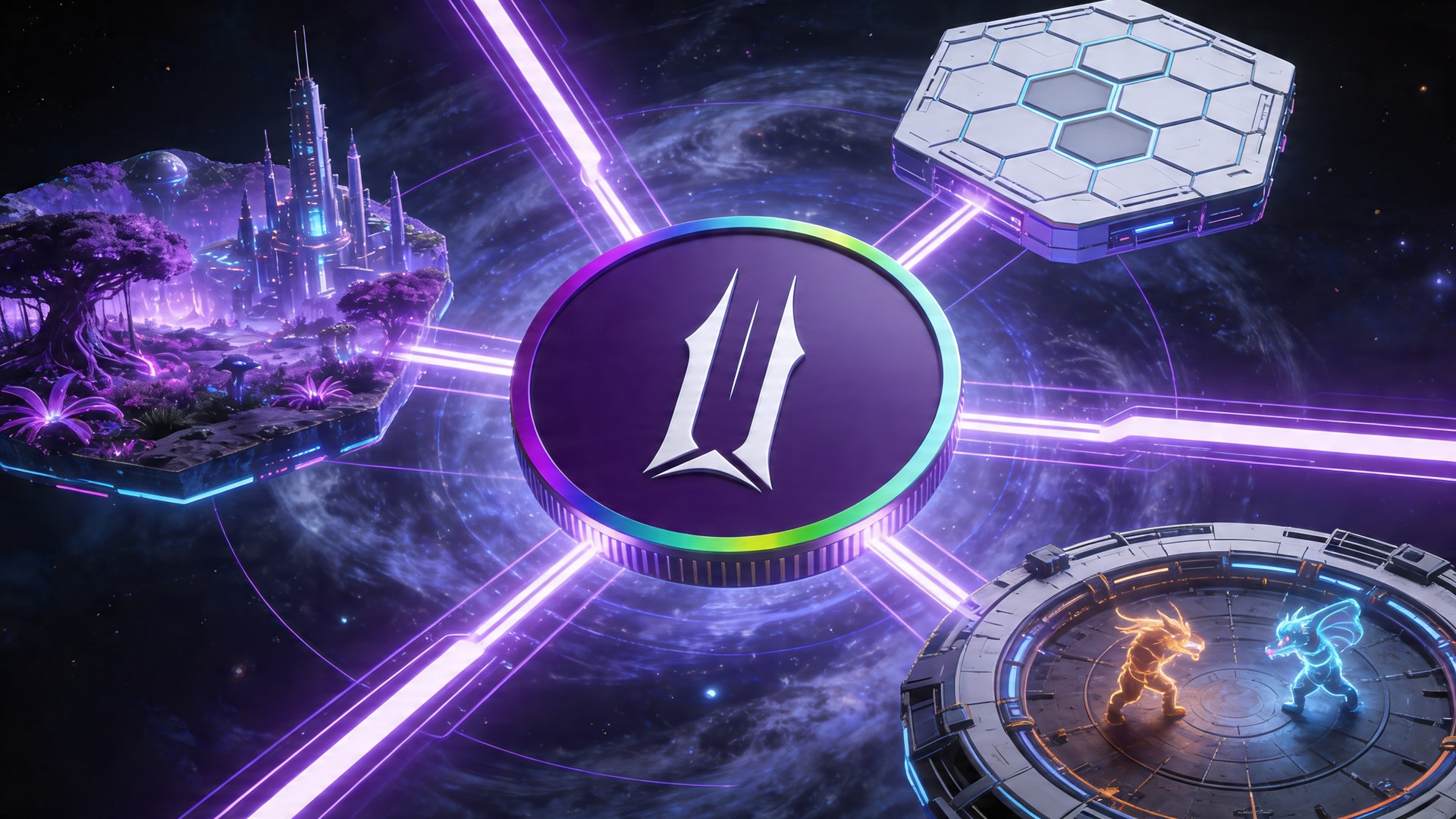
- It explains Illuvium as an interoperable blockchain gaming universe featuring an open-world exploration game, an industrial city builder, and an auto-battler, all built on Ethereum and Immutable X.
- The bull case focuses on its high-quality AAA graphics, the seamless integration of NFTs (Illuvials), and its potential to attract traditional gamers to Web3.
- The bear case highlights the massive development costs and delays associated with AAA games, the historical failure of "play-to-earn" models, and intense competition from traditional gaming studios.
- It presents detailed price prediction scenarios (bearish, neutral, bullish) for both 2026 and 2030, based on player adoption and the success of its game releases.
Blockchain games have spent years looking like financial experiments first and actual games second, making them a little untrustworthy for investors. Illuvium has tried to take the opposite route by building a connected sci-fi universe where players capture creatures, battle, craft, collect, and trade across multiple titles, giving the project a more ambitious starting point than most NFT gaming launches ever had.
At its core, Illuvium is a decentralized game franchise built around collectible creatures called Illuvials and a broader economy that links exploration, auto-battling, land management, and digital ownership. If you prefer using a crypto exchange, Bitunix already offers ILV/USDT, though the bigger question is whether the Illuvium universe can hold players’ attention once the early excitement wears off.
This analysis looks at Illuvium as both a game studio and a token economy. That means studying the connected game structure, the evolving role of Immutable infrastructure, the ILV token, and the outside forecasts now circulating for 2026 and 2030.
The Technology and Ecosystem
What gives Illuvium a chance to matter is that it is building an ecosystem. The franchise connects collection, combat, land management, and identity into one broader world, while the token layer tries to route part of that activity back to stakers.
Illuvium's own official material describes the connected structure clearly:
"Illuvium: Arena is an 8-player free-for-all autobattler set in the Illuvium universe, where players assemble powerful teams of Illuvials to outsmart and outlast opponents."
In the next sections, we will explore a little bit more of the technology involved in this ecosystem.
1. The Interoperable Universe
Rather than relying on a single game loop, Illuvium is built as a connected franchise of several linked experiences. The core structure still centers on Illuvium: Overworld for exploration and creature collection, Illuvium: Arena for auto-battler combat, and Illuvium: Zero for land and industrial management. Zero's 2025 FAQ explains that landowners produce resources and fuel that support the wider universe, while Arena's 2025 FAQ shows that owned Illuvials carry over into competitive modes and can provide strategic benefits in Leviathan mode. That interconnection remains one of the project's strongest design features, because time spent in one title can add value to the others.
Overworld also kept expanding its creature-collection side during 2025. In April 2025, Illuvium launched Automated Drone Runs on mainnet so players could collect Illuvials without manually roaming the map, and the same release tied those runs to weekly reward systems. That kind of update matters because it shows the team is still refining the collection loop instead of leaving the exploration side frozen in time.
2. Immutable X Integration
Illuvium's blockchain backbone has changed over time, and that matters for anyone writing about Immutable X. CoinMarketCap's current project profile still describes Illuvium as built on Immutable X, where players can mint and trade NFTs with zero gas fees and near-instant finality. But the more recent official story from late 2025 is migration. Illuvium said in December 2025 that it was moving assets and core services from the existing Immutable infrastructure to Immutable zkEVM, aiming for better scalability, smoother performance, and a more modern foundation for future gameplay systems. So, Immutable X helped make the original zero-gas NFT experience possible, while Immutable zkEVM became the next step in the infrastructure roadmap.
That shift is important for user experience. Illuvium's migration guide says assets move automatically for most players, but it also notes that marketplace listings need to be recreated after migration and that some token-based actions can return later rather than immediately. In other words, the infrastructure is improving, but it is still infrastructure in motion.
3. The ILV Token
The ILV token still sits at the center of governance and staking. Illuvium's May 2025 governance newsletter says voting power is derived from token stakers, and Staking V3, launched in November 2025 on Base, added a dual-reward system built around Revenue Distribution and Shards. The protocol says direct ILV rewards are triggered every time 150 ETH in revenue is generated, while Shards act as loyalty points that feed seasonal leaderboards and rewards.
The practical staking setup is more detailed than the old single-vault model. Illuvium's staking guide says users can stake in ILV or ILV/ETH vaults, lock for 30 to 365 days, earn up to a 2x lock multiplier, and combine that with an OG boost that can push the total multiplier as high as 3x. The same guide says protocol revenue comes from games, merchandise, and other activities and is then distributed to stakers. On the utility side, sILV2 and Fuel Crates remain usable in the MMO, which keeps sILV2 relevant as an in-ecosystem spending and redemption asset.
The Bull Case: Quality Over Hype
Any Illuvium price prediction that deserves attention has to separate game quality from token reflexes. Current outside models are not especially euphoric, with CoinCodex's price forecast placing ILV in a $3.12 to $4.87 range for 2026. Coinbase's 5% growth tool projects roughly $4.51 for May 2026 and $5.74 by 2031, suggesting a restrained long-term outlook rather than a breakout. Bitget's similar 5% model lands at $5.61 in 2030. Then there is CoinLore's price prediction, which stands far above the pack with a $184.56 target for 2030.
1. AAA Production Value
Illuvium's main bullish edge remains its quality, with its high-fidelity sci-fi world, cinematic visuals, tactical decision-making, and a completely free-to-play base mode that lets you start playing without ownership. That already puts it in a better position than many Web3 titles that still look and feel like browser-side experiments with a token attached. If an AAA blockchain game is ever going to attract players who usually live on Steam, console, or Epic, it has to meet them with real production value.
The size of the prize is also very real. Newzoo's 2025 market report summarizes the opportunity in a single snapshot:
"$188.8B in 2025 revenues. 3.6B players. Console leads the way in growth. Right now, the games market is steady but strategic."
That backdrop supports the upside case because Illuvium needs to win a tiny slice of a huge market. If the studio can persuade even a small percentage of mainstream players that digital ownership, collectible depth, and cross-game utility improve the experience rather than complicate it, ILV gets a much stronger narrative than most Web3 gaming tokens ever manage.
2. Sustainable Economics
Illuvium also deserves credit for moving away from the older pure play-to-earn logic that damaged so many earlier projects. You can play immediately without ownership or complicated setup, and Rewards Are Back, published in March 2025, tied rewards to ranked competition, raffles, Fuel drops, battle pass progression, and tournaments. The same rewards page lists weekly ILV distributions for multiple activities, while the 2025 Pro League schedule showed tournaments with prize pools ranging from $2,000 to $20,000.
Zero also adds another layer to that model: free-to-play users can learn the system through simulation plots, while owned land participates in the revenue-sharing side of the economy. That means the project is at least trying to balance accessibility for new players with stronger incentives for more committed participants.
3. Revenue Distribution
The strongest token bull case sits in staking. Illuvium's 2025 staking materials describe Revenue Distribution as real yield from protocol revenue, and the step-by-step guide says revenue from games, merchandise, and other activities accrues to stakers once the system passes the 150 ETH threshold and the Safety Pool is funded.
Staking V3 on Base lowered gas costs, added seasonal rewards, offered shard rates of 20 per day per $1,000 staked in the ILV vault and 80 per day per $1,000 in the ILV/ETH vault, and layered on multiplier systems for lock duration and long-term loyalty. If gameplay revenue grows, that system gives token holders a reason to stay involved. If gameplay revenue stays weak, the whole arrangement looks less impressive very quickly.
The Bear Case: The Gaming Graveyard
The downside case starts with the fact that ILV still trades at only about $4.50, with a market cap of $37.3 million on CoinGecko. It is also down more than 99% from its old cycle highs and only modestly above its February 2026 low on CoinMarketCap. That is the kind of chart that tells you the market has already punished missed expectations once.
Published forecast pages also leave room for a much weaker outcome. Changelly’s current model sees $3.83 to $4.79 in 2026 but then drops to an average of about $1.12 in 2030, with a $0.871 to $1.38 range for that year. With ILV currently trading around $4.63, that 2030 average would be roughly 76% lower than today’s price, which gives the bearish case a lot more weight than it might seem at first glance. Even CoinCodex, which is less pessimistic, still caps 2026 at $4.95. So, for the bearish case to happen, you just need mediocre retention, slow delivery, and a market that decides this remains a niche crypto studio.
1. Development Delays
AAA game development is expensive, slow, and full of false starts, and Illuvium has not escaped that reality. The project's June 2025 council minutes said Arena mobile and localization were still far off and not expected until 2026, while the December 2025 Immutable migration guide said Overworld would be taken offline separately as part of preparation for the upcoming MMO. The April 2025 governance newsletter also tied some future Arena development to player growth, which is a polite way of saying that scale still matters to what gets built and when.
That matters for ILV because token holders need shipped content, a reliable content cadence, and a game ecosystem that feels alive. Long delays are especially dangerous in gaming because attention tends to wander. Players have no shortage of alternatives, and the rest of the industry does not freeze while one studio catches up.
2. The Traditional Gaming Stigma
Mainstream gaming audiences still do not treat blockchain as an automatic plus. DappRadar's Q2 2025 blockchain gaming report described dozens of Web3 game shutdowns, lower funding, and weaker user activity. Its Q3 2025 report was even more direct, saying Web3 gaming still struggles to attract gamers. That is the broader market context Illuvium has to fight through. Better graphics help, but they do not erase the baggage that NFT gaming built for itself during the last cycle.
Traditional players also tend to care first about gameplay, social connection, and value for time, not token architecture. Bain's 2025 gaming report notes that younger players place particular value on social, creative elements, and gameplay. That is a reminder that quality alone is not enough. Illuvium still has to prove that its ownership layer improves the experience instead of adding friction.
3. High Barrier to Entry
Illuvium has made real progress on accessibility, but the barrier remains higher than in typical gaming. Arena is free to play and does not require ownership to start, which helps. Yet the broader ecosystem still involves wallets, migration steps, NFT ownership, token staking, relisting on marketplaces after chain migration, and, in some cases, small gas balances on the zkEVM for certain wallet setups. That remains a steeper learning curve than downloading a regular game and pressing play.
And once you widen the lens beyond Illuvium, the sector backdrop stays rough. DappRadar said blockchain gaming activity fell to 5.8 million daily unique active wallets in Q1 2025, down 6% quarter over quarter, while Q2 2025 brought more funding weakness and more closures. So the bear case is also about the possibility that the entire Web3 gaming segment still has not solved retention at scale.
Illuvium Price Prediction Scenarios for 2026 and 2030
A grounded Illuvium price prediction has to keep one foot in market data and one foot in execution reality. Right now, ILV trades around $4.50, with a market cap in the low tens of millions and volume that is respectable for its size but nowhere near top-tier gaming-token status. That means small changes in sentiment, delivery pace, or broader GameFi conditions can move the token more than many larger-cap assets.
The forecast spread reflects that uncertainty. CoinCodex keeps 2026 modest. Coinbase and Bitget, both using 5% annual growth rates, end up around the mid-$5 range by 2030. Changelly is more pessimistic long-term and drifts below $1.40 by 2030. CoinLore goes in the opposite direction and projects $184.56 in 2030, which looks more like an extreme upside curve than a base case. So the scenario table below is best read as a set of execution paths.
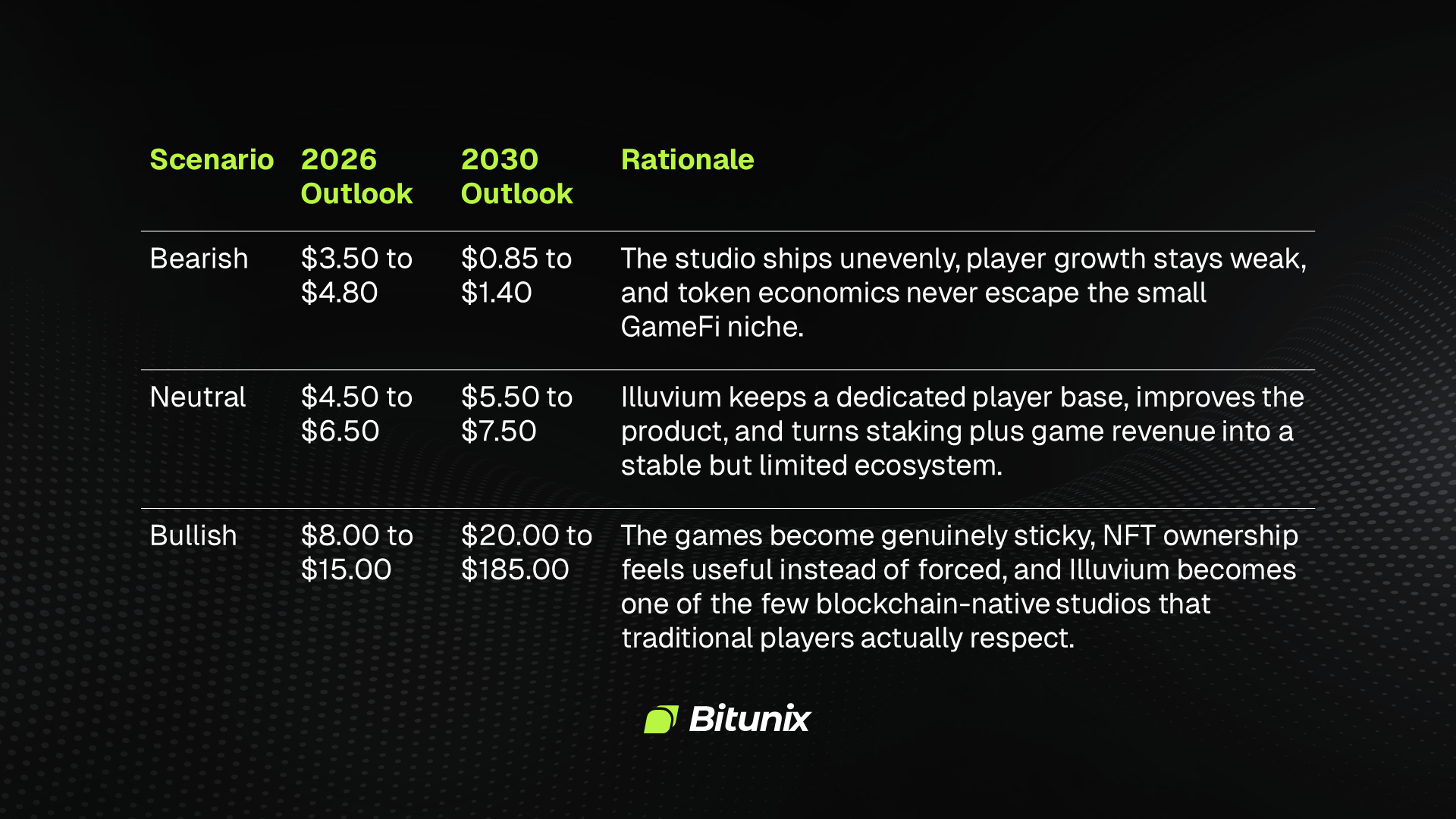
Illuvium scenario table comparing bearish, neutral, and bullish price outlooks for 2026 and 2030.
Conclusion: A Bet on the Future of Play
Illuvium remains one of the most serious attempts to merge higher-end game production with blockchain ownership. Its connected universe, staking design, and ongoing infrastructure upgrades make it more substantial than the average GameFi token. Arena's free-to-play access, Zero's resource economy, Overworld's collection loop, and the continuing move across Immutable infrastructure all show a project that is still actively trying to become a full ecosystem.
But ILV is still a long-term execution bet. The upside depends on the studio proving that Web3 gaming can be fun first, that NFT ownership can be useful rather than annoying, and that revenue-sharing mechanics can matter once the initial hype cools. If that happens, ILV has real room to re-rate. If it does not, the conservative forecasts will probably end up looking wiser than the moonshot ones. And if you want to follow the trade directly, Bitunix already supports ILV/USDT, so you can download the Bitunix app and register while the Illuvium story keeps unfolding.
FAQ
What is Illuvium (ILV)?
Illuvium is a blockchain-based gaming franchise and token economy built around collectible creatures called Illuvials. The ILV token supports governance and staking, while the games connect exploration, battling, land management, cosmetics, and digital ownership across one broader universe.
What are the three games in the Illuvium universe?
The three main gameplay titles are Overworld, Arena, and Zero. Overworld focuses on exploration and collecting Illuvials, Arena handles auto-battler combat, and Zero covers land, resource production, and industrial management that supports the wider ecosystem.
What are Illuvials?
Illuvials are the collectible creatures at the center of the Illuvium universe. Players capture or collect them, use them in combat, and, in some modes, bring owned versions into the Arena for added depth, cosmetic status, and competitive advantages.
How does Illuvium use Immutable X?
Illuvium originally relied on Immutable X to support gas-free NFT minting and trading with near-instant finality. Since late 2025, the project has been migrating assets and core services to the Immutable zkEVM to improve scalability and support future games.
What is the difference between ILV and sILV2?
ILV is the main governance and staking asset. sILV2 is the in-ecosystem reward and utility side of the token system, and Illuvium's 2025 governance notes say it remains usable in the MMO alongside other reward-linked assets.
How can I earn money playing Illuvium?
Players can earn through ranked rewards, tournament prizes, raffles, Fuel drops, and other event-based systems. In 2025, Illuvium listed weekly ILV rewards for Arena, Overworld, and Zero activities, plus tournament prize pools and battle pass rewards.
Is Illuvium a play-to-earn game?
Not in the simple old-cycle sense. Arena is free to play, and recent reward systems focus more on competition, rankings, progression, and ecosystem participation than on endlessly farming emissions.
How does staking ILV work?
Staking V3 runs on Base and offers two reward types: Revenue Distribution and Shards. You can stake ILV or ILV/ETH, choose a lock duration, earn multipliers, and receive protocol-linked rewards once revenue thresholds and Safety Pool conditions are met.
What are the risks of investing in ILV?
The main risks are delayed delivery, weak player retention, falling sector interest in Web3 gaming, infrastructure complexity, and the chance that the games never attract a large audience outside crypto-native players. The token also remains highly volatile and far below past cycle highs.
Where can I buy ILV tokens?
You can buy ILV on major centralized exchanges such as Binance, Bitunix, MEXC, KuCoin, and Coinbase, which offer fiat access and active ILV trading pairs. If you prefer on-chain trading, ILV is also available on Uniswap V3 as an ERC-20 token through a MetaMask-compatible wallet.
Glossary
- ILV token: The main Illuvium asset used for staking, governance, and ecosystem participation.
- sILV2: A utility and reward-linked token inside the Illuvium ecosystem that remains usable in the MMO.
- Illuvials: Collectible creatures that players use in battles, collection systems, and cross-game progression.
- Illuvium: Arena: The project's auto-battler game, built around team composition, synergies, and competitive modes.
- Illuvium: Overworld: The exploration and creature-collection side of the franchise, including Automated Drone Runs.
- Illuvium: Zero: The land and city-building game where players produce resources and support the wider ecosystem.
- Immutable X: The original Layer 2 infrastructure associated with Illuvium's gas-free NFT trading and minting.
- Immutable zkEVM: The newer infrastructure that Illuvium is migrating toward for better scalability and future game systems.
- NFT gaming: A gaming model where digital items such as creatures, cosmetics, or land exist as tokenized assets that players can own and trade.
- Revenue Distribution: Illuvium's staking reward mechanism that routes protocol revenue to stakers once threshold conditions are met.
- Shards: Off-chain loyalty points in Staking V3 used for seasonal leaderboards and reward distribution.
- OG Boost: A staking multiplier based on historical participation in earlier Illuvium staking versions.
- ILV/ETH vault: One of the Staking V3 vault options, designed for users staking liquidity-pair exposure rather than ILV alone.
- AutoDrone Runs: An Overworld collection mechanic that lets players obtain Illuvials faster without manual exploration.
- Web3 gaming: A segment of gaming that uses blockchain-based ownership, tokens, wallets, or on-chain systems as part of the player experience.
Disclaimer
This article does not provide:
(i) investment advice or investment recommendations;
(ii) an offer or solicitation to buy, sell, or hold digital assets;
(iii) financial, accounting, legal, or tax advice.
Digital assets, including stablecoins and NFTs, involve high risk and may fluctuate significantly. Consider whether trading or holding digital assets is appropriate for you given your financial situation. Consult a qualified legal, tax, or investment professional when needed. You are responsible for understanding and complying with applicable local laws and regulations.
About Bitunix
Bitunix is a global cryptocurrency derivatives exchange trusted by over 3 million users across more than 100 countries. At Bitunix, we are committed to providing a transparent, compliant, and secure trading environment for every user. Our platform features a fast registration process and a user-friendly verification system supported by mandatory KYC to ensure safety and compliance. With global standards of protection through Proof of Reserves (POR) and the Bitunix Care Fund, we prioritize user trust and fund security. The K-Line Ultra chart system delivers a seamless trading experience for both beginners and advanced traders, while leverage of up to 200x and deep liquidity make Bitunix one of the most dynamic platforms in the market.
Bitunix Global Accounts
X | Telegram Announcements | Telegram Global | CoinMarketCap | Instagram | Facebook | LinkedIn | Reddit | Medium