
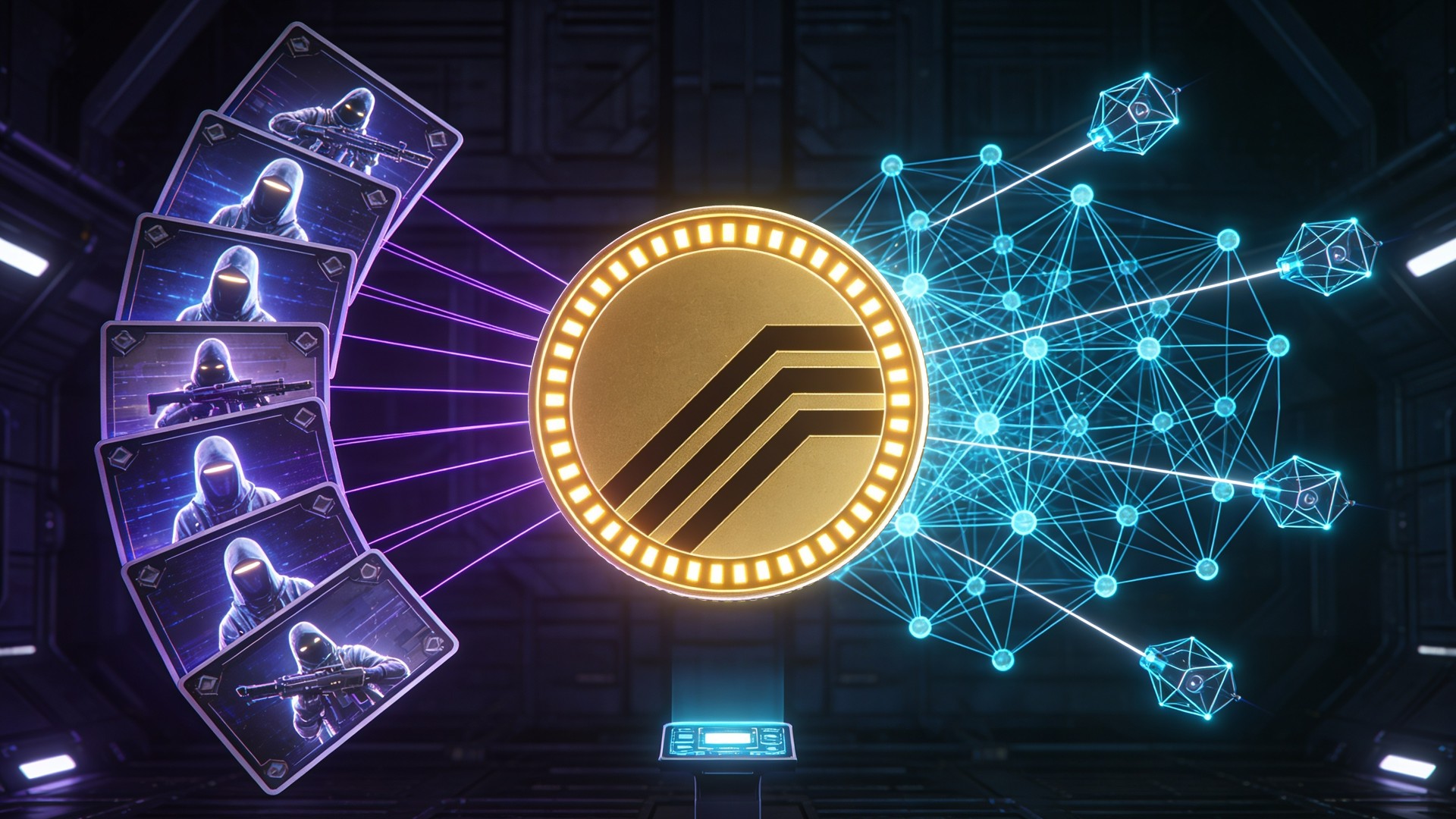
Article Summary
- This article provides a detailed price prediction and fundamental analysis for the Echelon Prime (PRIME) token.
- It explains the Echelon Prime Foundation as a Web3 gaming ecosystem designed to support the development of high-quality games, starting with the critically acclaimed Parallel Trading Card Game (TCG).
- The bull case focuses on the massive success and high production value of Parallel, the integration of AI agents in gaming (Parallel Colony), and the strong tokenomics of the PRIME token.
- The bear case highlights the intense competition in the Web3 gaming sector, the historical volatility of gaming tokens, and the challenge of retaining traditional gamers long-term.
- It presents detailed price prediction scenarios (bearish, neutral, bullish) for both 2026 and 2030, based on player adoption and ecosystem expansion.
Web3 games spent years chasing token rewards first and gameplay second, which is a good way to lose both gamers and investors. Echelon Prime took a different route by building around stronger game design, led by the Parallel TCG and supported by the PRIME token across gameplay, digital ownership, and governance. For readers who follow gaming assets on a crypto exchange, Bitunix is one place to check the PRIME/USDT pair.
At a technical and product level, Echelon is trying to support a broader gaming universe. Parallel sits at the center today, while Colony extends the same universe into AI-driven simulation play, and the PRIME token connects sinks, rewards, and user participation across that stack. This analysis looks at the ecosystem design, the token model, and the current 2025 to 2026 data that shape realistic 2026 and 2030 outcomes.
The Technology and Ecosystem
Echelon's ecosystem works because it has an actual game at the center. Parallel TCG is a sci-fi digital card game in open beta, and players can use PRIME through PRIME Sinks while also earning the tokens through gameplay. The public game site also frames Parallel as a fast-paced, free-to-play card battler built around factions, deck strategy, and competitive play.
Official token documentation makes the ecosystem design even clearer:
"PRIME is the utility token for Echelon and its ecosystem of games. PRIME powers token-gated products, services, and experiences called PRIME Sinks."
That quote is the cleanest summary of the PRIME token's job as the backbone for purchases, gated access, and token sinks across the Echelon Prime Foundation. The docs list an original total supply of 111,111,111.111 PRIME, a current supply of 100,000,000 after a 10% gameplay-pool burn in July 2025, and a token model that distributes PRIME through gameplay and sink distributions. On the gameplay side, players earn PRIME from ranked wins based on rank, NFT ownership, win streaks, and certain asset-linked modifiers, with emissions capped at five PRIME-emitting wins per day.
The sink structure is one reason PRIME looks more thought-out than a lot of older Web3 gaming assets. Echelon's documentation lists live sinks such as Echos, which let players replicate Parallel cards as NFTs using PRIME, with most of the spend routed away from immediate circulation. That creates repeated reasons to use the token instead of just farming and dumping it. For traders watching gaming tokens on Bitunix or elsewhere, that distinction is important. PRIME has a better chance of holding value when spending pressure grows alongside player activity.
The AI side is where Echelon tries to separate itself from the rest of Web3 gaming. Echelon's official Colony documentation says Parallel Colony is a simulation game where you partner with an AI Avatar to run a mining colony, and that each avatar controls an ERC-6551 wallet with digital possessions and PRIME. The same page says avatars create and trade with other semi-autonomous agents.
A December 2025 gaming report on Parallel said mobile Parallel TCG and Parallel Colony were both targeted for Q1 2026, while a March 2026 update around the Haven expansion highlighted 96 new playable cards. And in April 2026, Parallel's Haven drop went live with 3,682 packs at $30 each, the smallest edition size the game had used to date. Those numbers show the studio is still shipping content, expanding format depth, and testing scarcity in a way that resembles a live TCG business.
The Bull Case: Quality and Innovation
Current PRIME forecasts look more restrained than the old Web3 gaming boom, which is a useful starting point for realistically assessing upside. CoinCodex's price prediction places 2026 in a $0.2538 to $0.3716 range, while Kraken's model points to about $0.37 in 2026 and $0.45 in 2030. Bitget's forecast lands in a similar zone at roughly $0.3620 for 2026 and $0.4400 for 2030.
Compared with PRIME's current price of about $0.368, the published forecasts imply fairly limited near-term upside and a mixed long-term outlook: CoinCodex's 2026 range works out to roughly 31% downside to 1% upside, Kraken's targets imply about 0.5% upside in 2026 and 22% upside by 2030, and Bitget's model suggests about 1.7% downside in 2026 and 19.5% upside by 2030.
1. AAA Production Value
What makes the bullish case credible is that Parallel is free to play, open beta is live, the mobile launch was framed as a full release rather than a test build, and the studio spent 2025 and 2026 adding expansions, redesign work, and new formats. Recent gaming coverage captured that confidence well:
"The mobile version of the sci-fi trading card game is being positioned as a full release, not a test build or limited launch."
That line matters because quality is the bridge to mainstream TCG players. If Parallel feels polished enough to sit in the same conversation as digital card games people already respect, then the Web3 label stops being the entire story, and when a game can stand on its mechanics, art direction, and competitive depth, the PRIME token gets to ride on actual user demand.
2. Sustainable Tokenomics
The second bullish point is the token design. Many gaming tokens fail because they hand out too much supply and give players too few reasons to spend it. Echelon tried to avoid that trap with PRIME Sinks, limited daily emissions from gameplay, and token-consuming systems tied to cards, cosmetics, and access. Echos are one concrete example, since Echelon's docs say players use PRIME to spawn replicated NFT cards and route most of that spend away from simple circulation. The project also burned 10% of the original supply from the gameplay pool in July 2025, which reduced headline supply and signaled that the team was willing to adjust distribution.
This is the kind of structure that supports a stronger Echelon Prime price prediction over time. A token with gameplay rewards but no sinks usually behaves like a leaky bucket. A token with sinks, gated services, and competitive uses has a better shot at keeping value inside the ecosystem. It still needs players, of course. But if Parallel keeps growing and Colony becomes more than a curiosity, PRIME already has more internal demand routes than a lot of gaming tokens ever built.
3. The AI Narrative
The third bullish driver is narrative overlap between Web3 gaming and AI. Colony pairs players with AI Avatars that own wallets, hold ERC-1155 assets and PRIME, and trade with other semi-autonomous agents. That puts Echelon in a category that investors pay attention to even outside gaming. It is a bet on whether agent-based systems can make game economies feel more alive and more useful.
PC Gamer reported in March 2026 that blockchain gaming had all but vanished from the GDC agenda while AI dominated the conference floor and session lineup. That sounds bearish for Web3 gaming overall, and in one sense it is. But for Echelon, it creates a possible wedge. If blockchain alone is no longer the draw, then projects blending playable games with AI systems have a better chance of standing out than those still pitching ownership by itself.
The Bear Case: The Gaming Graveyard
A sober Echelon Prime price prediction also has to deal with the fact that gaming tokens die all the time, even when the underlying game looks promising for a while. The same forecast spread that gives bulls something to dream about also shows how unstable conviction remains. CoinCodex's 2026 ceiling is basically today's price, while its 2030 table rises sharply only in a more optimistic long-term sequence. Kraken and Bitget both stay far more conservative.
1. The Fickle Gaming Market
The first risk is that even good games fade. DappRadar's Q3 2025 report said Web3 gaming remained the leading product category, yet it also stressed that the sector still struggled to attract gamers. The core problem is that Parallel can have strong art, better onboarding, and a real tournament scene, but none of that guarantees a stable player base two or three years from now. Card games live on retention, meta evolution, and regular content cadence. Once the deckbuilding conversation cools off, token demand often cools off with it.
2. Intense Competition
Competition is another major risk because Parallel is entering a market where several ecosystems already have stronger distribution and deeper mindshare. Ronin still holds a meaningful position in blockchain gaming, Immutable keeps expanding its gaming infrastructure, and the broader Web3 gaming market remains crowded even in a weaker cycle.
Messari's Q1 2025 report on Immutable said Immutable zkEVM averaged roughly 498,000 daily transactions during the quarter, even after user growth softened. That is a reminder that Echelon is competing with ecosystems that already have real scale and distribution. If blockchain gamers only spend serious time in a few ecosystems, then PRIME has to fight for a very limited pool of attention.
3. Regulatory Scrutiny
In March 2026, the SEC and CFTC issued updated guidance clarifying that many crypto assets are not securities by default, which is more constructive than the earlier enforcement-heavy stance. But the same SEC material also states that governance tokens can vote on software upgrades and treasury expenditures, and that whether an asset falls under securities law can still depend on the surrounding arrangement. That leaves room for uncertainty around gaming ecosystems where tokens blend governance, rewards, gated access, and real-money trading. For a small gaming token, uncertainty alone can be enough to scare off capital.
Echelon Prime Price Prediction Scenarios (2026 & 2030)
Forecast models for PRIME are close enough in the near term to suggest a fairly narrow 2026 range, but they split much more clearly once you look further out. The short-term numbers stay near the mid-$0.30s, while the 2030 outlook changes a lot depending on whether Parallel keeps its audience, Colony becomes meaningful, and the Echelon ecosystem expands beyond one flagship game.
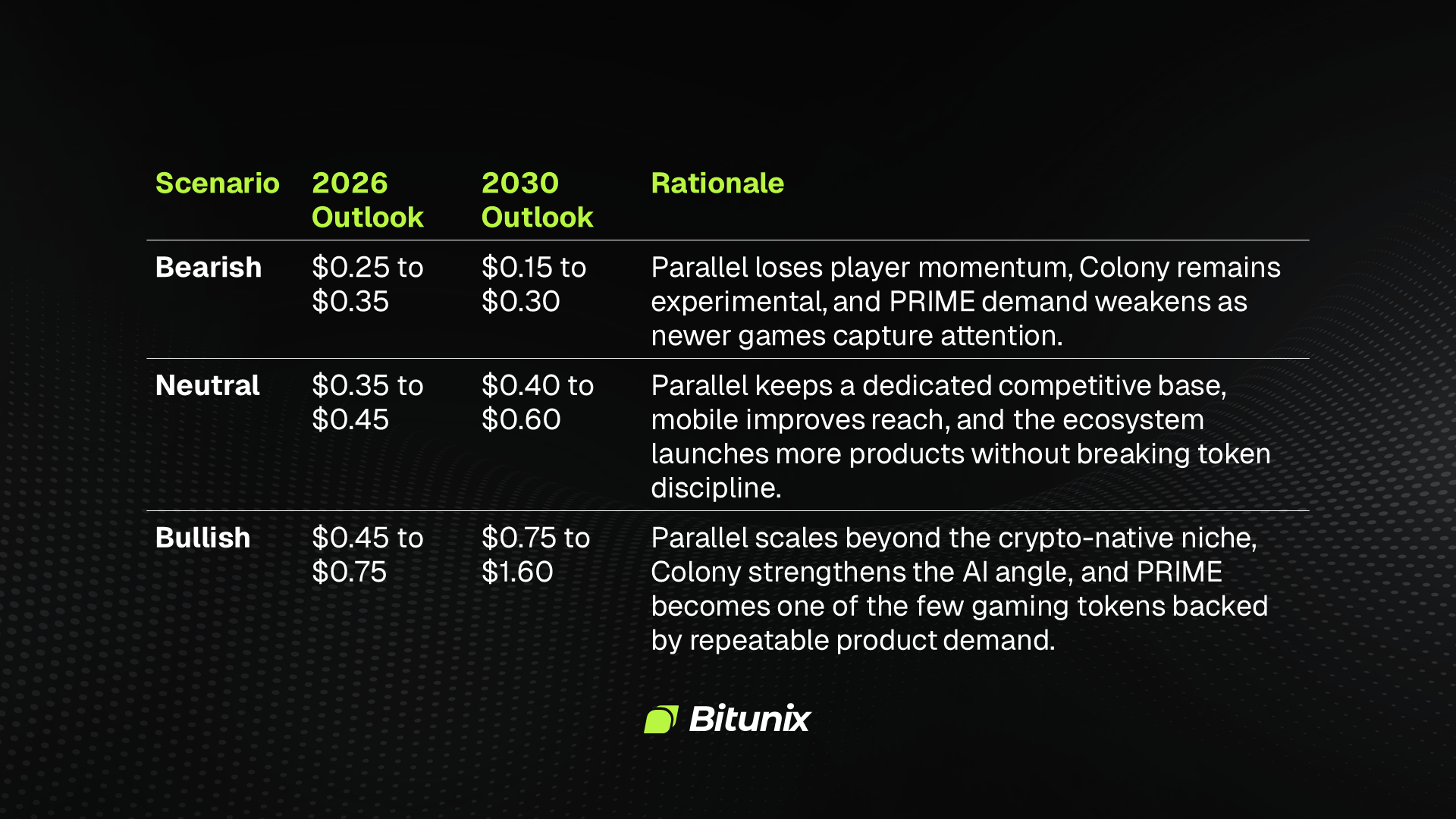
Echelon Prime price prediction scenario table comparing bearish, neutral, and bullish outlooks for 2026 and 2030.
Conclusion: A Bet on Quality Gameplay
What gives Echelon Prime a stronger foundation is the way the ecosystem was built around actual game design and long-term utility. Parallel has a real competitive structure, the PRIME token has actual sinks and capped reward channels, and Colony gives the ecosystem an AI gaming angle that goes beyond a standard NFT trading cards pitch. That combination makes the project worth paying attention to.
PRIME only makes sense as an investment if the Parallel universe keeps releasing strong games, retains player attention, and shows that its token model can support lasting demand without falling into the usual Web3 boom-and-bust pattern. For interested investors, Bitunix is one place to watch PRIME/USDT liquidity. You can download the Bitunix app and register to keep an eye on how the market prices the future of Web3 gaming.
FAQ
What is Echelon Prime (PRIME)?
Echelon Prime is a gaming ecosystem built around the PRIME token and a growing set of games led by Parallel. It combines gameplay rewards, token sinks, governance, and digital ownership into one broader structure.
What is the Parallel TCG?
Parallel TCG is a sci-fi digital trading card game in open beta. It is free to play, uses faction-based deckbuilding, and lets players connect blockchain features if they want NFT ownership and PRIME-linked competitive rewards.
How does the PRIME token work?
PRIME powers gameplay rewards, token-gated products, governance participation, and spend-based sinks across the Echelon ecosystem. Players can earn it through ranked play, but they also spend it on ecosystem actions that reduce or redirect circulating supply pressure.
What is Parallel Colony?
Parallel Colony is an AI-driven simulation game in the Parallel universe. You manage a mining colony with an AI Avatar that owns a wallet, holds digital assets, and can create and trade with other semi-autonomous agents.
How does Echelon integrate AI into its games?
Echelon integrates AI most clearly through Colony, where AI Avatars act as persistent in-game agents with wallets and assets. The idea is to make AI part of gameplay and economic interaction.
Can I earn PRIME by playing Parallel?
Yes. Ranked wins can generate PRIME, but emissions are limited and depend on factors such as rank, NFTs in your deck, win streak, and certain asset-linked modifiers.
What are the sinks for the PRIME token?
PRIME sinks are token-using products and experiences across the Echelon ecosystem. One example is Echos, where players spend PRIME to create replicated NFT cards. These sinks help create demand and reduce simple sell-pressure from gameplay rewards.
Who are Echelon Prime's main competitors?
Its biggest competitors are other blockchain gaming ecosystems that already have larger audiences, stronger infrastructure, or deeper funding, especially projects connected to Immutable and Ronin.
What are the risks of investing in PRIME?
The main risks are player churn, tough ecosystem competition, uneven regulation, and the possibility that AI expansion never turns into lasting demand. PRIME is also a small-cap token, so price swings can stay sharp even when the game news looks positive.
Where can I buy PRIME tokens?
PRIME trades on both centralized and decentralized venues. Recent market listings show active pairs on exchanges such as Kraken, Bitunix, Coinbase, and Gate, along with Uniswap pools for wallet-based trading. Availability depends on your region and platform rules.
Glossary
- AI Avatar: An in-game agent in Colony that can own assets, use a wallet, and interact with other agents.
- AI gaming: Games where artificial intelligence affects play directly through decision-making, simulation, or agent behavior.
- Deckbuilding: The process of choosing cards, balancing costs, and shaping a strategy before entering matches in Parallel TCG.
- Burn: A permanent token removal mechanism that reduces supply.
- Echelon Prime Foundation: The ecosystem organization behind PRIME and the broader Parallel game universe.
- ERC-1155: A token standard often used for game items and semi-fungible digital assets.
- ERC-6551: A token-bound account standard that lets NFTs or agents control wallets and assets.
- Gameplay Pool: The portion of PRIME supply allocated for player rewards.
- Governance: The process of voting on ecosystem decisions such as treasury use or protocol direction.
- NFT trading cards: Blockchain-based cards that players can own, trade, and sometimes use to boost rewards.
- Open beta: A playable public release stage before full launch where live testing and iteration continue.
- Parallel TCG: The flagship sci-fi card game in the Echelon ecosystem.
- PRIME Sinks: Token-using products, services, and experiences that create demand for PRIME.
- PRIME token: The ecosystem utility and governance token used across Echelon games.
- Web3 gaming: Games that combine blockchain-based ownership, tokens, or on-chain assets with game systems.
Disclaimer
This article does not provide:
(i) investment advice or investment recommendations;
(ii) an offer or solicitation to buy, sell, or hold digital assets;
(iii) financial, accounting, legal, or tax advice.
Digital assets, including stablecoins and NFTs, involve high risk and may fluctuate significantly. Consider whether trading or holding digital assets is appropriate for you given your financial situation. Consult a qualified legal, tax, or investment professional when needed. You are responsible for understanding and complying with applicable local laws and regulations.
About Bitunix
Bitunix is a global cryptocurrency derivatives exchange trusted by over 3 million users across more than 100 countries. At Bitunix, we are committed to providing a transparent, compliant, and secure trading environment for every user. Our platform features a fast registration process and a user-friendly verification system supported by mandatory KYC to ensure safety and compliance. With global standards of protection through Proof of Reserves (POR) and the Bitunix Care Fund, we prioritize user trust and fund security. The K-Line Ultra chart system delivers a seamless trading experience for both beginners and advanced traders, while leverage of up to 200x and deep liquidity make Bitunix one of the most dynamic platforms in the market.
Bitunix Global Accounts
X | Telegram Announcements | Telegram Global | CoinMarketCap | Instagram | Facebook | LinkedIn | Reddit | Medium