
Perpetual futures are the engine of the crypto trading world, pushing huge volume every single day. Yet many traders still treat them like a black box. You click “10x long Bitcoin”, watch the PNL jump around, and hope liquidation stays far away. This guide opens that box.
Perpetual futures now dominate crypto derivatives because they remove one of the biggest frictions in traditional futures contracts – expiry. Instead of rolling positions every month or quarter, you can hold the same contract indefinitely as long as you have enough margin. That simplicity, plus high leverage, is why they drive so much volume on major exchanges.
This article will break down the core mechanics of perpetual futures contracts, including the funding rate, leverage, and liquidation, providing traders with the essential knowledge to navigate this powerful market.
What Are Perpetual Futures?
At the core, a perpetual future is a derivative contract that tracks the price of an underlying asset such as BTC, ETH, or SOL. You trade the contract price, not the asset itself. Unlike a standard futures contract on a venue, there is no expiry date that forces settlement at a specific time. According to the CME Group: “A futures contract is a legally binding agreement to buy or sell a standardized asset on a specific date or during a specific month.”
You can stay long or short as long as your margin allows. The contract is cash settled through your futures account balance rather than through delivery of the actual coins.
Perpetual Futures Meaning for Traders
When people search for the meaning of perpetual futures, they usually want one key idea. A perpetual future is simply a way to bet on price going up or down, with leverage, without worrying about contract expiry or rolling dates. The funding mechanism, which we will cover in detail, keeps the contract aligned with the spot market over time.
So the practical perpetual futures meaning for you as a trader is this: it is a flexible, leveraged bet on price direction where you can open, adjust, and close positions whenever you want, while the exchange quietly handles price alignment in the background.
Perpetual vs Traditional Futures
Traditional futures contracts were built for commodities and financial assets in regulated markets. They have strict contract specs and fixed delivery or cash settlement dates.
To make the distinction clearer, here’s a simple side-by-side comparison of key features:
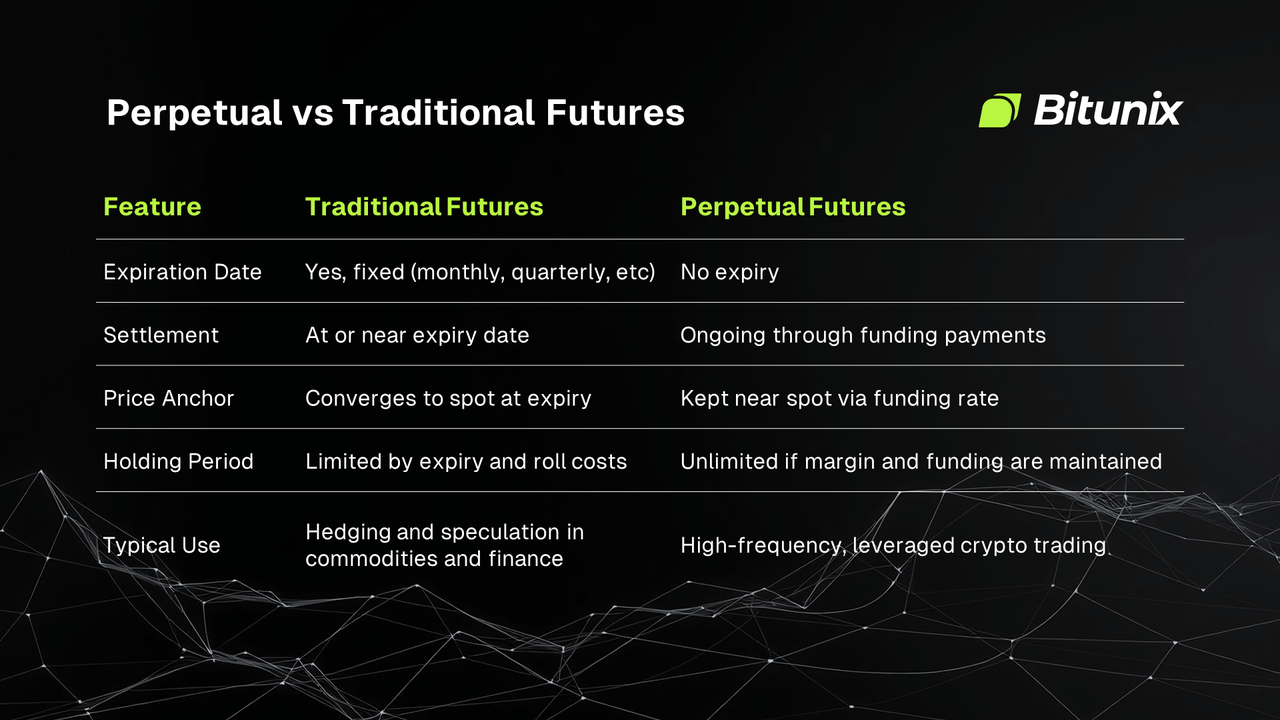
In short, traditional futures are built around fixed dates and rolling contracts, while perpetuals behave more like a leveraged spot position you can hold as long as your margin allows.
The Funding Rate: The Engine of Perpetuals
Perpetual futures do not expire. That creates a problem. Without a fixed settlement date, the contract price can drift away from the spot price of the underlying asset. The solution is the funding rate.
The funding rate is a periodic payment between long and short traders. It is not a fee paid to the exchange. Instead, the exchange simply matches who pays and who receives, based on the relationship between the perpetual contract price and the spot or index price.
How the Funding Rate Works
Most major exchanges calculate funding based on two things:
- The difference between the perpetual price and the index or spot price
- A base interest component defined in the contract specs
If the perpetual price trades above spot, the funding rate turns positive. Longs pay shorts at fixed intervals, such as every eight hours on some exchanges. If the perpetual trades below spot, funding usually becomes negative, and shorts pay longs.
You can think about it like a small tax on the crowded side of the trade.
Positive funding:
- Perp price above spot
- Longs pay shorts
- Incentivizes traders to short or close longs
- Brings the perp price back down toward spot
Negative funding:
- Perp price below spot
- Shorts pay longs
- Incentivizes traders to go long or close shorts
- Lifts the perp price back toward spot
This is why you often see funding spike when the market goes wild in one direction. Price dislocates from spot, funding becomes extreme, and that punishes traders who insist on staying on the crowded side.
Leverage and Margin: The Double-Edged Sword
Leverage is what makes perpetuals powerful and dangerous at the same time.
Leverage means you borrow capital from the exchange to control a position larger than your deposit. On Bitunix and other large platforms, you can see leverage up to triple-digit levels on some pairs, although responsible traders rarely go that high.
Simple Leverage Example
Say you deposit 100 USDT into your futures account.
- With 1x leverage, you can open a 100 USDT position
- With 5x leverage, you can open a 500 USDT position
- With 10x leverage, you can open a 1,000 USDT position
A 1 percent move on a 1,000 USDT position is a 10 USDT unrealized profit or loss. On a 100 USDT margin, that is a 10 percent swing.
Initial Margin vs Maintenance Margin
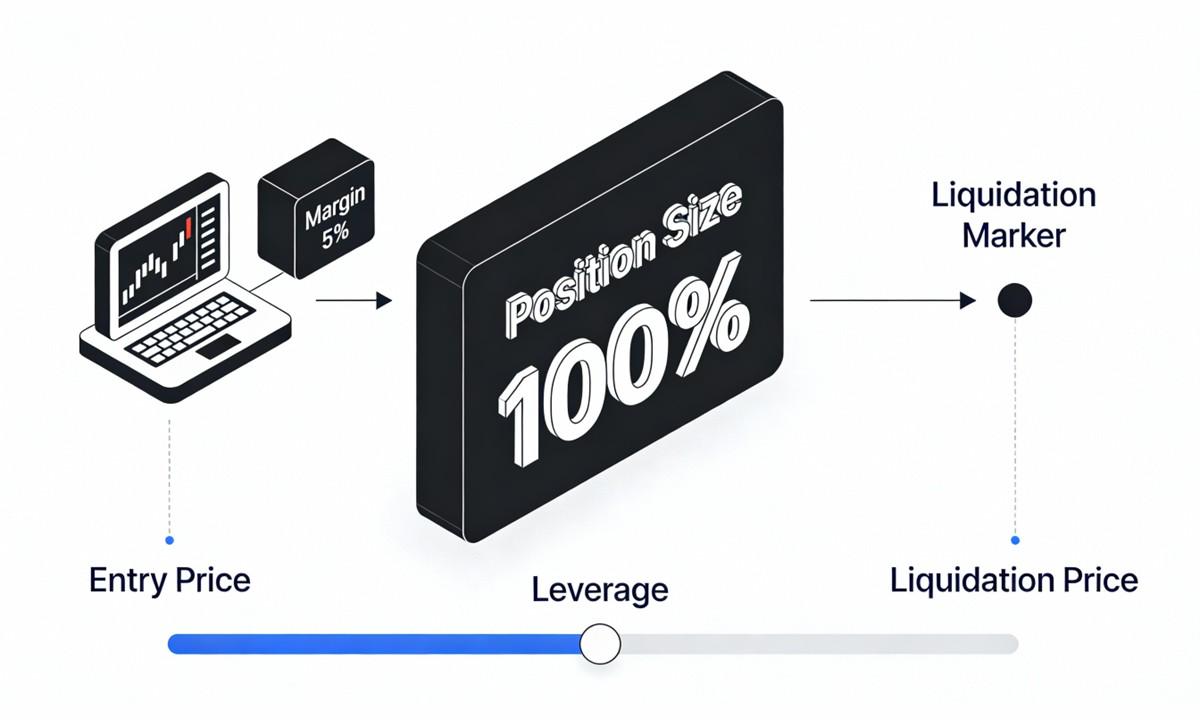
Two margin levels matter:
- Initial margin: The collateral you need to open a position. At 10x leverage, your initial margin for a 1,000 USDT position is roughly 100 USDT, plus fees.
- Maintenance margin: The minimum equity you must keep in your position to avoid liquidation. If your equity falls below this level due to losses or funding, the exchange starts the liquidation process.
Exchanges publish exact maintenance margin formulas in their contract specs. You do not need to memorize them, but you do need to understand that higher leverage shrinks your buffer above maintenance margin.
Liquidation: Managing Your Risk
Liquidation is the part every trader fears, but many still misunderstand.
What is Liquidation?
Liquidation is the forced closure of your position when your margin balance falls below the maintenance margin requirement. The exchange does this to protect borrowed funds and keep your account from going deeply negative. On Bitunix, liquidation is driven by the mark price, which is based on an index of spot prices rather than just the last traded futures price.
If your margin ratio falls to a critical level, the system starts closing your position. In cross margin, this can involve all positions that share the same margin pool.
The Liquidation Price
The liquidation price is the estimated price at which this forced closure will trigger. It depends on:
- Your entry price
- Your leverage
- Your margin mode (isolated or cross)
- Contract-specific parameters, such as maintenance margin rate and fees
Higher leverage pushes your liquidation price closer to your entry. A 1 percent move can wipe you out at extreme leverage. This is why responsible traders use moderate leverage, clear stop losses, and position sizing that matches their risk tolerance.
Bitunix and other exchanges offer calculators that show your estimated liquidation price, potential P&L, and ROI before you confirm a trade. Take advantage of this tool. It is much better to see a scary liquidation level before you open a trade than to discover it during a sudden wick.
How to Trade Perpetual Futures on Bitunix
Now let’s put the mechanics into a simple workflow. Bitunix offers both USDT-margined and coin-margined perpetual futures across many trading pairs, with competitive tiered fees and leverage up to 200x on some markets.
Here is a straightforward process you can follow:
1. Open and Fund Your Futures Account
- Log in to Bitunix on web or download the app
- Transfer funds from your spot wallet to your futures wallet, usually in USDT or a supported coin
- Check your available margin balance on the futures page
2. Choose the Contract and Margin Mode
- Click Futures in the top menu and open the perpetual futures trading interface
- Select a trading pair, for example BTCUSDT or ETHUSDT, from the list on the left
- Choose your margin modeIsolated margin keeps margin separate per positionCross margin uses a shared pool of margin across positions, which can help absorb volatility, but also links your risk across trades
3. Set Your Leverage
Use the leverage slider next to the order panel. For most traders, starting with 2x to 5x is far safer than jumping straight to 50x or up to 200x. The higher you go, the closer your liquidation price will sit to your entry.
4. Plan the Trade with the Bitunix Calculator
On the perpetual futures page, Bitunix provides a contracts calculator that helps you estimate:
- Initial margin
- Liquidation price
- Potential P&L and ROI based on entry and exit prices
You can calculate the liquidation price directly from the trading page, which makes it easier to adjust your size or leverage before you confirm.
5. Place the order and set your protection
Now, follow these steps:
- Pick an order type, such as Limit or Market
- Enter your position size using quantity, cost value, or nominal value units
- Confirm Long if you expect the price to rise or Short if you expect the price to fall
- Set take profit and stop loss levels to manage risk automatically
- Click Open and monitor your margin ratio, P&L, and funding payments
When you understand the perpetual futures meaning at this level, Bitunix becomes more than just another trading screen. It becomes a controlled environment where you manage margin, funding, and liquidation with intent rather than guesswork.
Ready to trade the most popular crypto product? Open a futures account on Bitunix and access deep liquidity with low fees.
Conclusion
Perpetual futures blend features from traditional futures contracts with innovations like the funding rate mechanism. You get:
- No expiry date and unlimited holding time while your margin holds
- A funding system that keeps the contract price in line with spot
- Flexible leverage to scale position size relative to your capital
With that power comes real risk. Leverage magnifies both profit and loss. Maintenance margin and liquidation rules do not care about your conviction. Funding can quietly drain your balance if you sit on the wrong side of the trade for too long.
If you treat perpetuals with respect, they become a sharp tool instead of a loaded trap. Know your funding exposure. Use reasonable leverage. Watch your liquidation price. And use platforms like Bitunix, where you get clear margin tools, calculators, and competitive fees to support your decisions.
Master the mechanics, manage your risk, and you give yourself a better chance of staying in the game long enough to let skill and discipline compound.
FAQ
Do I own the underlying crypto when I trade perpetual futures?
No. You trade a derivative contract that tracks the price of the underlying asset. Your profit and loss are settled in margin currency, such as USDT or the base coin, not in delivered spot crypto.
How is the funding rate calculated?
Each exchange uses its own formula, but most use a mix of interest rate assumptions and the premium or discount between the perpetual price and an index or spot price. The result is a periodic rate applied to your position value at each funding interval.
Can I lose more than my initial deposit when trading perpetuals?
On many exchanges, including Bitunix, the system tries to prevent large negative balances through liquidation and auto-deleveraging. However, in extreme volatility, losses can exceed your initial margin. That is why tight risk control and realistic leverage are essential.
What is the difference between an isolated margin and a cross margin?
Isolated margin ties collateral to one position. If that trade goes wrong, only the isolated margin is at risk. Cross margin uses a shared margin pool for multiple positions, which can help one profitable trade support another losing trade, but can also expose all positions if the pool drains.
How often is the funding rate paid?
Common intervals are every eight hours, although some contracts use different funding frequencies. You can check the specific schedule on the contract details page of your exchange.
Why is the perpetual futures price sometimes different from the spot price?
Because perp contracts are their own markets with their own order books, they can trade at a premium or discount to spot. Funding then nudges traders to take positions that reduce that gap over time.
What are the advantages of trading perpetuals over spot?
You can trade long or short with leverage, use less capital to express a view, and hedge spot holdings more precisely. You also avoid the need to borrow assets for shorting or to roll dated futures contracts.
What is a “short squeeze” or “long squeeze”?
A short squeeze happens when aggressive buying forces shorts to close positions, often triggering liquidations, which pushes the price even higher. A long squeeze is the opposite. In perp markets, high leverage and tight liquidation prices make squeezes more violent.
How can I reduce my risk of liquidation?
Use lower leverage, size positions modestly relative to your account, place stop losses, and avoid letting your margin ratio sit too close to the liquidation threshold—tools like the Bitunix liquidation calculator and clear margin dashboard help here.
Why is Bitunix a good platform for trading perpetual futures?
Bitunix offers USDT-M and Coin-M perpetual contracts across many markets, up to 200x leverage on some pairs, competitive tiered fees, and built-in tools such as a contracts calculator, cross and isolated margin modes, and advanced order types.
Glossary
- Perpetual futures: Derivative contracts that track an underlying asset and have no expiry date, settled continuously through margin and funding.
- Spot price: The current market price of an asset in the spot market, used as a reference for perpetual futures.
- Funding rate: A periodic payment between long and short traders that keeps the perpetual contract price close to the spot or index price.
- Index price: A reference price built from multiple spot exchanges, used to reduce the impact of outliers or manipulation.
- Mark price: A fair value price derived from the index and other inputs, used to calculate P&L and trigger liquidations.
- Leverage: The ratio between the size of your position and the margin you post, for example 10x leverage on a 100 USDT margin gives a 1,000 USDT position.
- Initial margin: The collateral required to open a new leveraged position.
- Maintenance margin: The minimum equity required to keep a position open. Falling below this level triggers liquidation.
- Liquidation: The forced closure of a position by the exchange when your margin falls below maintenance requirements.
- Long position: A position that profits when the underlying asset price rises.
- Short position: A position that profits when the underlying asset price falls.
- Cross margin: A margin mode where all positions share one margin pool, with P&L from one trade affecting the risk of others.
- Isolated margin: A margin mode where each position has its own margin, limiting risk to that position.
- Open interest: The total number of outstanding futures contracts that have not yet been closed or settled.
- Margin ratio: A risk metric that compares your account margin to maintenance margin, often used to indicate how close you are to liquidation.
About Bitunix
Bitunix is a global cryptocurrency derivatives exchange trusted by over 3 million users across more than 100 countries. At Bitunix, we are committed to providing a transparent, compliant, and secure trading environment for every user. Our platform features a fast registration process and a user-friendly verification system supported by mandatory KYC to ensure safety and compliance. With global standards of protection through Proof of Reserves (POR) and the Bitunix Care Fund, we prioritize user trust and fund security. The K-Line Ultra chart system delivers a seamless trading experience for both beginners and advanced traders, while leverage of up to 200x and deep liquidity make Bitunix one of the most dynamic platforms in the market.
Bitunix Global Accounts
X | Telegram Announcements | Telegram Global | CoinMarketCap | Instagram | Facebook | LinkedIn | Reddit | Medium