1. The Origin of the DAO Concept
In the traditional world, whether it is a multinational corporation or a small neighborhood association, operations usually depend on a strict hierarchical management structure and centralized decision-makers. However, with the maturation of blockchain technology, a new organizational form called a "DAO" (Decentralized Autonomous Organization) is redefining the way humans collaborate. It does not require a CEO, nor does it have a physical office. Instead, it writes the rules of the organization into code, realizing the true concept of "Code is Law."
The core idea of a DAO can be traced back to the decentralization ethos advocated in the early blockchain era. For example, Bitcoin operates through a consensus mechanism without a central institution, demonstrating the possibility of decentralized network collaboration and providing important inspiration for later decentralized organizational forms. In 2013, Vitalik Buterin introduced the concepts of smart contracts and decentralized applications (DApps) in the Ethereum whitepaper, making it possible to write organizational rules into code and execute them automatically on the blockchain, thereby laying the technical foundation for the birth of DAOs. After that, the "Decentralized Autonomous Organization" gradually came to be envisioned as a form of organization operating on the blockchain, with its assets and governance rules managed by smart contracts.
In 2016, with the launch of The DAO, the first large-scale DAO project on Ethereum, the DAO concept entered its first stage of large-scale experimentation. The project raised more than $150 million in a short period of time, but was later affected by the well-known The DAO Hack. Although the incident ultimately led the Ethereum community to carry out a hard fork, this experiment still had a profound impact on the crypto world’s imagination of organizational governance and laid an important foundation for the later development of DAOs.
2. How DAOs Work: Innovation in Technology, Structure, and Community
At the technical level, the core of a DAO is the smart contract. Rules such as the organization’s charter, compensation distribution, and membership eligibility are written into code and deployed on the blockchain from the very beginning. When members submit a proposed change, the system automatically calculates the voting results according to preset thresholds. Once the proposal passes, the smart contract automatically executes the corresponding action, such as disbursing funds from the treasury. The entire process does not require any human intermediary or administrative review, ensuring extremely high execution efficiency and immutability.
Compared with traditional companies, DAOs demonstrate the ultimate level of transparency and flatness. Decision-making in traditional companies is often controlled by a small number of board members, and financial reports may be delayed or even falsified. In a DAO, however, every decision-making process, treasury fund flow, and voting record is publicly available on-chain in real time for anyone to inspect. A DAO has no distinction between "superiors" and "subordinates." Any member who holds governance tokens has the right to speak, breaking the limitations of geography, nationality, and identity and enabling permissionless collaboration on a global scale.
Compared with traditional online communities such as Facebook groups, the essential difference of a DAO lies in "economic incentives" and "execution rights." Participation in traditional communities is often based on personal interest, and members usually have no substantial influence over the direction of the group. In a DAO, members generally hold the organization’s tokens, which means they are deeply aligned with the organization’s interests. A DAO is not merely a place for chatting and sharing information. It is an economic community with a shared ledger and actual authority over the use of assets, where the voting results of members can directly drive the movement of on-chain assets.
3. Common Tools for Creating a DAO
As the ecosystem has developed, creating and managing a DAO no longer requires writing complex smart contracts from scratch. Today, a variety of mature tools are available for developers to combine and use, which greatly lowers the barrier to operating an organization. At the foundational framework level, Aragon and DAOstack provide ready-to-use modular templates that cover core functions such as membership management, voting rule configuration, and treasury permission allocation. Developers can deploy a legally binding digital entity on-chain simply by selecting parameters through a graphical interface, much like setting up a guild in an online game.
At the decision execution level, DAOs must balance "governance participation" and "transaction costs." Snapshot is currently the most popular governance tool. It uses an off-chain signature mechanism that allows members to vote without paying expensive gas fees, greatly increasing voting participation among small and medium holders. To ensure that voting results can actually be translated into on-chain actions, many DAOs also integrate the Safe multisignature wallet, formerly known as Gnosis Safe. This is a financial-grade fund management tool that ensures treasury assets can only be used with joint authorization from multiple designated governance members.
In addition, to achieve more refined collaboration, modern DAOs are often equipped with a series of supporting tools. For example, Tally provides an intuitive on-chain voting tracking and delegation interface, making it easier for users to manage their voting power. Guild.xyz and Collab.Land are responsible for linking on-chain assets with social platforms such as Discord and automatically assigning community permissions based on the number of tokens held by members. The seamless integration of these tools enables a DAO to complete the entire process from fundraising to permission tiering to collective decision-making within minutes, making global collaboration as simple as creating a group chat.
4. Influential DAOs in Today’s Crypto World
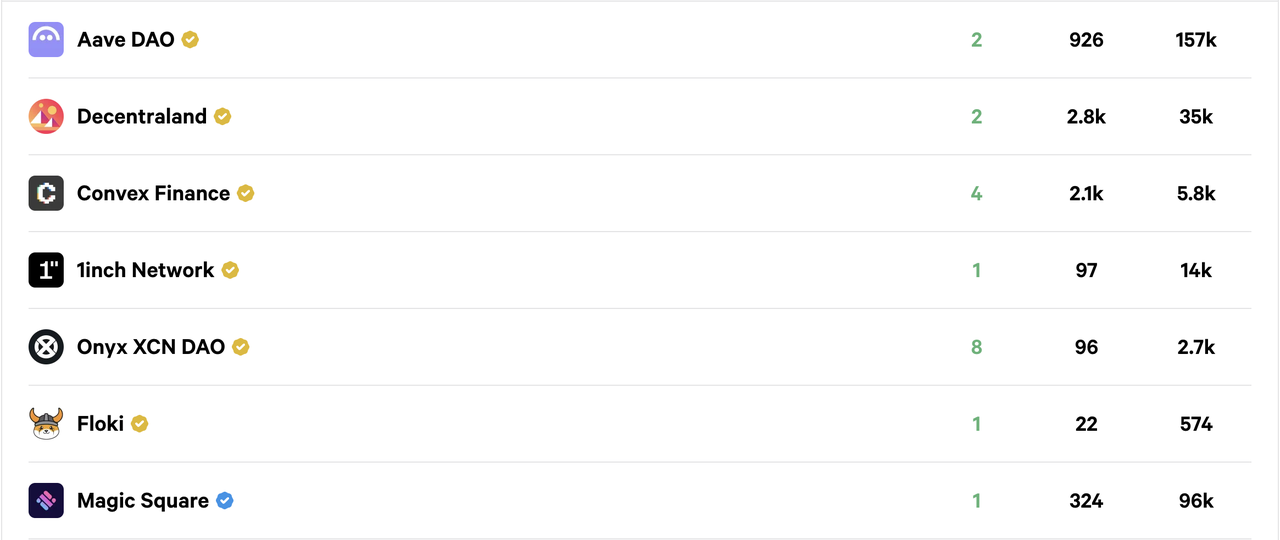
In today’s crypto ecosystem, DAOs have already demonstrated strong vitality in multiple sectors and have become a backbone of the decentralized world. For example, SKY, which is regarded as the "central bank" of the DeFi sector, maintains the exchange rate stability of the decentralized stablecoin DAI through collective voting by global members on interest rate parameters and collateral types. The scale of its governance often involves tens of billions of dollars. Meanwhile, the DAO of Uniswap, the largest decentralized exchange, controls vast protocol authority and treasury resources. Every governance discussion regarding fee distribution directly affects the sentiment of the broader secondary market.
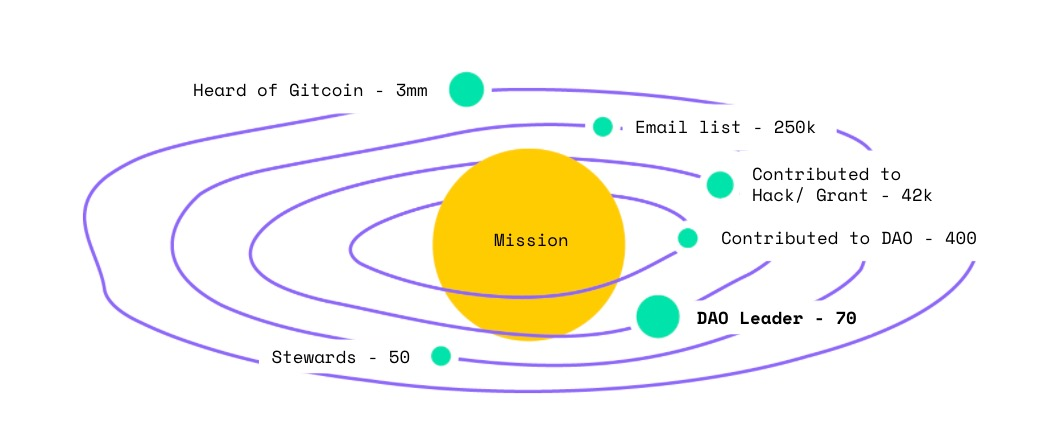
When it comes to promoting the sustainable development of the crypto ecosystem, Gitcoin is undoubtedly one of the most representative DAOs. It is widely recognized as the "public treasury" of the Ethereum ecosystem, with the core mission of funding open-source software and public goods. Gitcoin innovatively introduced the Quadratic Funding mechanism, which emphasizes the number of participants rather than simply the amount of money contributed, ensuring that small projects jointly valued by the community can also receive sufficient financial support. Through Gitcoin, thousands of developers have been able to obtain funding purely through community recognition without relying on traditional venture capital. This has not only nurtured a large number of Web3 infrastructure and open-source projects, but has also demonstrated to the world the enormous potential of collective intelligence in the field of public funding.
In addition to governance and public funding, DAOs are also gradually being applied to the investment sector. A representative example is The LAO. As an investment DAO jointly managed by the community, The LAO allows members to decide collectively through governance voting where funds should be allocated, making the decision-making process of traditional venture capital funds transparent and on-chain. Under this model, investment decisions no longer depend entirely on a small number of partners, but instead involve evaluation and decision-making by the entire community. This form of "collective investing" not only improves transparency in the investment process, but also explores a completely new model of capital organization for the Web3 world.
5. The Meaning of DAOs for Crypto: Empowering Users
The emergence of DAOs marks a crucial shift in crypto projects from being "developer-led" to being "community-led." Their core significance lies in truly returning control of projects to users. Holding tokens is not merely an investment. It also represents voting power. Users can initiate proposals and vote on adjustments to protocol parameters, the allocation of treasury rewards, and even the future strategic direction of the project. For example, holders of SKY can participate in governance votes for Sky, formerly MakerDAO, and decide key parameters such as collateral asset types and stablecoin interest rates. Community members holding UNI can submit proposals in Uniswap’s governance system regarding protocol upgrades and the use of treasury funds. AAVE holders can also participate in governance decisions regarding risk parameters and asset listings in the Aave protocol. This model allows every participant to become both a "shareholder" and a "decision-maker" in the project, achieving deep alignment of interests.
Conclusion
DAOs are gradually becoming important governance infrastructure in the crypto world. From adjusting DeFi protocol parameters to allocating treasury funds and deciding on the launch of new features, more and more crypto projects are handing governance power over to the community through DAOs. This model means that tokens are not only trading assets, but also represent voting rights and influence over the future direction of a protocol.
Of course, the governance model of DAOs is still evolving. Issues such as low voter participation, the concentration of governance power among large holders, and decision-making efficiency are all topics for which communities are currently exploring solutions. However, there is no denying that DAOs have already provided the crypto industry with a completely new way of organizing and collaborating.
Disclaimer
This article is not intended to provide:
(i) investment advice or investment recommendations;
(ii) an offer or solicitation to buy, sell, or hold digital assets;
(iii) financial, accounting, legal, or tax advice.
Holding digital assets, including stablecoins and NFTs, involves high risk and may fluctuate significantly. You should carefully consider whether trading or holding digital assets is suitable for you based on your financial situation. For your specific circumstances, please consult your legal, tax, or investment professionals. You are solely responsible for understanding and complying with all applicable local laws and regulations.
About Bitunix
Bitunix is a global cryptocurrency derivatives exchange trusted by over 3 million users across more than 100 countries. At Bitunix, we are committed to providing a transparent, compliant, and secure trading environment for every user. Our platform features a fast registration process and a user-friendly verification system supported by mandatory KYC to ensure safety and compliance. With global standards of protection through Proof of Reserves (POR) and the Bitunix Care Fund, we prioritize user trust and fund security. The K-Line Ultra chart system delivers a seamless trading experience for both beginners and advanced traders, while leverage of up to 200x and deep liquidity make Bitunix one of the most dynamic platforms in the market.
Bitunix Global Accounts
X | Telegram Announcements | Telegram Global | CoinMarketCap | Instagram | Facebook | LinkedIn | Reddit | Medium