
Article Summary
- This article provides a detailed price prediction and fundamental analysis for the Raydium (RAY) token.
- It explains Raydium as an automated market maker (AMM) and liquidity provider built on the Solana blockchain, known for its high speed and low transaction costs.
- The bull case focuses on Raydium's central role in the Solana DeFi ecosystem, its ability to share liquidity with central limit order books, and the overall growth of Solana.
- The bear case highlights intense competition from other Solana DEXs (like Orca and Jupiter), the inherent volatility of the Solana ecosystem, and regulatory risks facing DeFi platforms.
- It presents detailed price prediction scenarios (bearish, neutral, bullish) for both 2026 and 2030, based on DEX trading volume and Solana network adoption.
Decentralized exchanges are the plumbing of any serious on-chain economy, and on Solana, that plumbing runs heavily through Raydium. The platform operates as an automated market maker built for fast swaps, liquidity provision, perpetual trading, and token launches on a chain optimized for speed and low fees. For anyone using a crypto exchange, such as Bitunix, to trade RAY/USDT and other Solana infrastructure tokens, Raydium sits in one of the clearest positions on the board because it touches trading, liquidity, and launch activity simultaneously.
Raydium's appeal is that you can swap tokens, add liquidity to a liquidity pool, earn fees, and participate in launch activity, all within one Solana-native environment. The harder part is deciding whether that role remains durable as Solana DeFi grows more crowded and more professional. This article examines the use of current network data, competitive metrics, and public forecast models for 2026 and 2030.
The Technology and Ecosystem
Raydium's own documentation gives the cleanest short description of what the protocol does:
"Raydium is a decentralized exchange on Solana where you can swap tokens, trade perpetuals, and earn yield by providing liquidity."
That sentence gets the basics right, but it leaves out the deeper architectural point. Raydium was built to use Solana's speed for near-instant, low-cost trading through automated market maker (AMM) pools, while also offering multiple pool types and launch mechanisms for different market conditions. The current docs describe CPMM pools as the standard for new pool creation and say the legacy AMM v4 program remains the most deployed contract on Solana.
The shared-liquidity angle is one reason Raydium became important early. Its old AMM design used historical Serum integration, later OpenBook, to connect idle liquidity with central limit order book infrastructure. That history explains why Raydium built a reputation for deeper liquidity and better pricing than a simple isolated AMM could offer. A 21Shares fact sheet from April 2026 makes the same point in more investor-friendly language, describing Raydium as one of Solana's premier DEXs and noting that it combines order-book liquidity with auto-swaps to deliver efficient trading.
The RAY token sits at the center of that ecosystem. You can stake RAY to earn additional RAY rewards, while 12% of all trading fees across Raydium are used to buy back RAY programmatically. That gives the token more than one job, being tied to staking, fee-linked buybacks, and broader protocol alignment.
Raydium also has a launchpad side that is still relevant when you look at token utility and user behavior. While the current documentation puts more focus on LaunchLab, the older AcceleRaytor framework remains part of the bigger picture. It has already generated $2.5 million in direct fees, and a January 2026 Raydium review notes that larger staking commitments can give users priority access to new token launches. That means RAY has launched participation and broader ecosystem growth.
Raydium also remains large enough to matter in hard numbers. DeFi Llama currently shows Raydium AMM with about $1.034 billion in TVL, roughly $220.95 million in 24-hour DEX volume, about $1.026 billion in 7-day DEX volume, and around $24.98 million in staked value.
The Bull Case: The Solana Resurgence
A bullish Raydium price prediction starts with a market that still disagrees sharply on what RAY should be worth. CoinGecko's April 15, 2026, historical data put RAY at around $0.663, with a market cap of around $173.5 million and daily volume around $21.5 million.
From there, forecasts split. CoinCodex's price prediction models about $0.831 by the end of 2026 and $2.06 by the end of 2030, Kraken's 5% growth framework is much more conservative, at about $0.71 by the end of 2026 and $0.83 in 2030, MEXC's model stays in roughly the same zone, around $0.704 for December 2026 and $0.829 for 2030, and Changelly's price prediction is more optimistic, projecting around $1.40 to $1.72 for 2026 and $6.52 to $7.74 for 2030.
1. Solana Ecosystem Growth
Raydium's fate is deeply tied to Solana, and Solana is still a large, active trading environment. DeFi Llama's Solana chain dashboard shows about $15.728 billion in stablecoin market cap, roughly $1.694 billion in 24-hour DEX volume, and about $1.114 billion in 24-hour perpetuals volume. Those figures matter because Raydium only needs Solana to remain one of the main places where on-chain trading stays fast, cheap, and liquid. When capital and traders keep showing up, Raydium gets more room to capture volume.
2. The Meme Coin Catalyst
Raydium has leaned into the reality that meme coins drive exchange volume through LaunchLab and its broader role as a trading venue for new Solana tokens. Token Terminal's Q3 2025 dashboard said Raydium generated $25.06 million in revenue for the quarter, up from $12.41 million in Q2, and added that the surge was driven largely by LaunchLab, which generated $11.93 million. A March 2026 market analysis also described LaunchLab as Raydium's attempt to regain meme coin market share and pointed to a sharp token reaction after launch.
3. Yield Farming and Staking
Raydium's yield farming and staking model supports the bullish case by linking liquidity, fee generation, and token demand. Users can stake RAY for rewards, while the protocol sends most swap fees to liquidity providers and allocates a portion to RAY buybacks. That gives the token a clearer connection to actual platform activity.
That link matters because stronger Solana DeFi activity can raise trading volume, attract more capital into liquidity pools, and increase fee-funded buybacks simultaneously. In a bullish scenario, RAY benefits from a more direct value-capture loop tied to real usage on Raydium.
The Bear Case: The DEX Wars
A weaker outcome for RAY looks just as plausible because the current market does not give Raydium a clear monopoly on Solana trading. The lower-end models from Kraken and MEXC stay relatively close to the current price, and even CoinCodex's 2030 estimate of $2.06 only works if Raydium continues to compound usage meaningfully. Put differently, the bearish only needs Raydium to lose enough relative ground that the market treats it as one Solana DEX among several, rather than the default liquidity hub.
1. Intense Local Competition
Competition within Solana is one of the biggest risks to Raydium's outlook, as the protocol is competing for both trading volume and user attention in a very crowded local market. DefiLlama currently shows Raydium AMM at about $209.2 million in 24-hour DEX volume and roughly $6.1 billion over 30 days, which confirms it remains one of the chain's biggest liquidity venues. But Jupiter handled about $217.8 million in 24-hour aggregator volume and roughly $9.0 billion over 30 days, while Orca DEX processed around $156.9 million in 24-hour DEX volume.
That means Raydium is defending share against Jupiter, which controls routing and user order flow across Solana, and against Orca, which competes directly as another AMM for liquidity providers and traders. If either rival keeps pulling more volume or better execution, Raydium's fee generation, TVL growth, and long-term value capture for the RAY token all come under pressure.
2. Ecosystem Volatility
Raydium also inherits Solana's strengths and weaknesses. Solana's 2026 technical roadmap emphasizes predictable finality, execution integrity, and redundancy. That is encouraging, but it also tells you reliability remains a live issue for serious users and institutions. When a DEX depends heavily on a single chain, disruptions to network confidence, transaction quality, or liquidity behavior can quickly hit trading volume. Raydium is a direct beneficiary of Solana's upside, but that also means it stays exposed to Solana's operational risk.
3. Regulatory Scrutiny
Broader regulatory tightening is another risk for Raydium, as decentralized exchanges are moving into a market environment with greater oversight. Reuters reported in June 2025 that MiCA is already reshaping how crypto firms are supervised across Europe, with regulators arguing over licensing standards and investor protection under a framework that has applied across the EU since late 2024.
Reuters also reported in March and April 2026 that U.S. lawmakers and Treasury officials were pushing the Digital Asset Market Clarity Act as part of a broader effort to define how digital assets and crypto platforms should be regulated at the federal level. That shift does not target Raydium alone, but it does mean DEXs will face more pressure around disclosures, token governance, market structure, and consumer protections. For a protocol that depends heavily on active trading volume and speculative participation, stricter oversight can reduce activity, raise compliance pressure across the sector, and weigh on long-term growth.
Raydium Price Prediction Scenarios (2026 & 2030)
Putting the forecasts side by side makes the range of outcomes pretty obvious. The conservative camp assumes Raydium grows slowly and keeps fighting for a share, and the optimistic camp assumes Solana keeps expanding. Raydium stays central to that growth, and value capture from fees, staking, and buybacks becomes more meaningful.
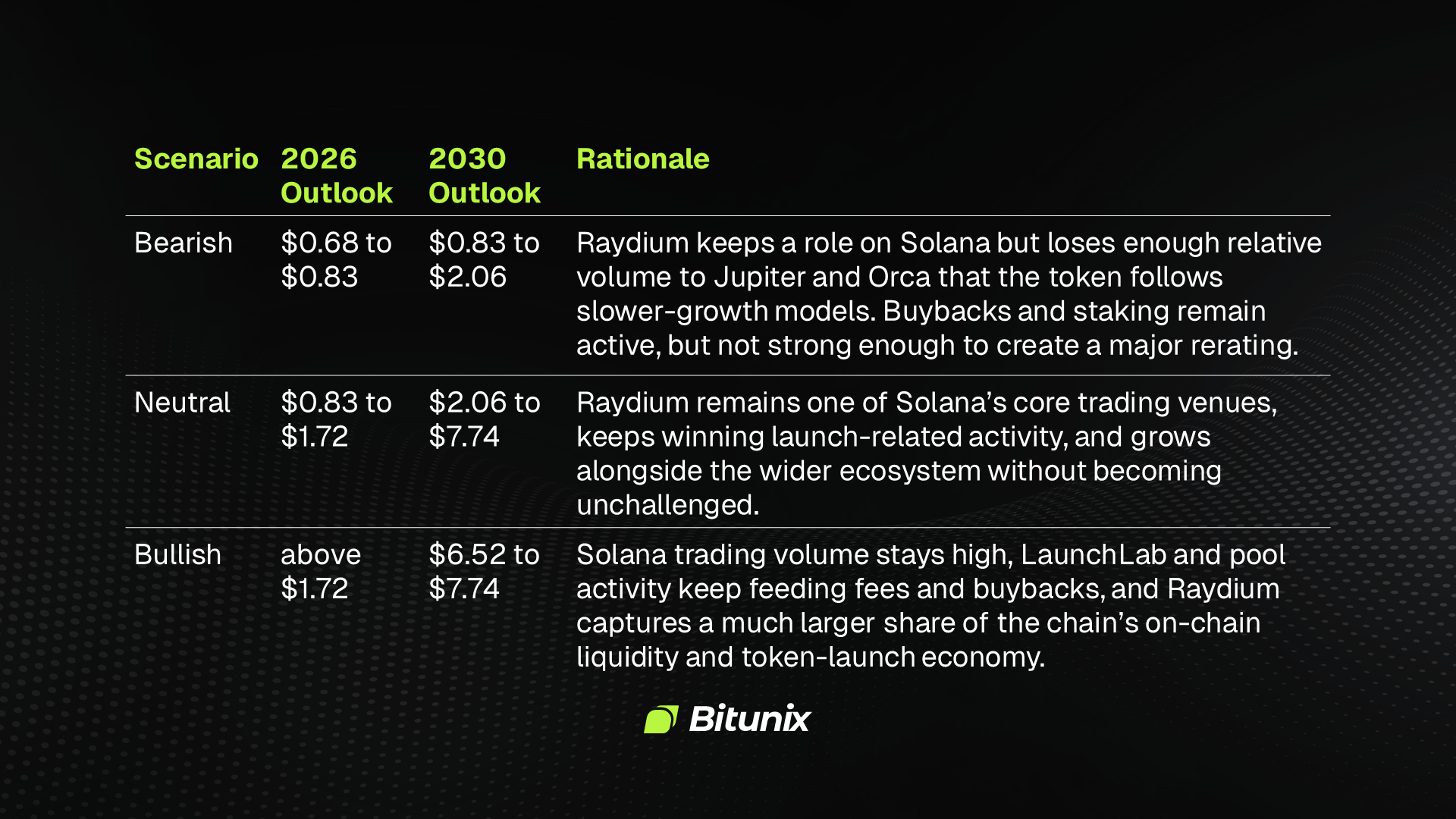
Raydium price prediction scenarios for 2026 and 2030, comparing bearish, neutral, and bullish outcomes based on Solana trading volume, competition, and fee-driven growth.
Conclusion: A Bet on Solana's Future
Raydium remains one of the most important pieces of Solana DeFi infrastructure because it combines AMM trading, liquidity pools, launch activity, staking, and fee-linked value capture into a single protocol. The current numbers still support that claim, with TVL above $1 billion, 30-day DEX volume above $6.1 billion, and the protocol continuing to generate real fees, revenue, and buybacks.
Investing in RAY is still a leveraged bet on Solana's future and on Raydium's ability to stay central inside that ecosystem. That can work well if Solana DeFi keeps growing and Raydium keeps capturing enough of the volume, meme-coin activity, and liquidity incentives that drive the chain. But it also means competition, regulatory pressure, and Solana-specific risk stay front and center.
If you want exposure, Bitunix offers RAY/USDT, so you can download the Bitunix app, register, and decide whether the current valuation looks compelling enough for a patient Solana infrastructure trade.
FAQ
What is Raydium (RAY)?
Raydium is a Solana-based decentralized exchange and automated market maker. It lets users swap tokens, provide liquidity, trade perpetuals, and join token launches. RAY is the protocol token tied to staking, fee-linked buybacks, and broader ecosystem participation.
How does an automated market maker work?
An automated market maker uses liquidity pools rather than matching individual buyers and sellers in a traditional order book. Prices adjust based on pool balances and formulas such as constant-product math, allowing users to trade directly against pooled liquidity.
Why is Raydium built on the Solana blockchain?
Solana provides Raydium with fast execution and low transaction costs, which suit high-volume on-chain trading. Raydium's docs also emphasize that it has become deeply integrated into Solana's liquidity infrastructure since 2021, making the chain central to its overall design.
What is the utility of the RAY token?
RAY is used for staking, fee-linked buybacks, and launch-related ecosystem participation. Staking earns additional RAY, while 12% of trading fees are used to programmatically buy back RAY. Historically, staking has also supported access to launch features like AcceleRaytor.
How does Raydium compare to Uniswap?
Both are AMM-based DEXs, but Raydium is native to Solana and benefits from that chain's speed and low fees. Raydium also has a history of order-book-linked liquidity through Serum integration and later OpenBook, which gives it a different market structure from Uniswap.
What is AcceleRaytor?
AcceleRaytor is Raydium's earlier launchpad model for helping new Solana projects raise capital and build initial liquidity. In current Raydium materials, LaunchLab receives more emphasis, but AcceleRaytor still matters for understanding how RAY became tied to token launches and ecosystem growth.
How can I earn yield on Raydium?
You can earn yield by providing liquidity to pools or by staking RAY. The docs also describe Burn & Earn, in which LP tokens can be permanently locked while users continue collecting trading fees via a Fee Key NFT.
Who are Raydium's main competitors on Solana?
Its biggest local competitors are Jupiter and Orca. Jupiter dominates routing and aggregator activity on Solana, while Orca remains a major AMM rival with similar current daily DEX volume.
What are the risks of investing in RAY?
The main risks are losing Solana DEX share to Jupiter or Orca, heavy dependence on Solana's ecosystem health, and broader regulatory pressure on decentralized trading platforms. Forecast models also vary widely, which shows the market still has low conviction about long-term outcomes.
Where can I buy RAY tokens?
You can buy RAY on major centralized exchanges such as Kraken, Bitunix, KuCoin, MEXC, and Crypto.com. Since RAY is native to Solana, you can also buy it on decentralized platforms like Raydium or Jupiter using a Phantom or Solflare wallet.
Glossary
- RAY token: Raydium's native token, used for staking, buyback-linked value capture, and ecosystem participation.
- Raydium DEX: Raydium's decentralized exchange on Solana for swaps, liquidity, perpetuals, and token launches.
- Solana DeFi: The decentralized finance ecosystem built on Solana, including DEXs, lending, perps, and launch platforms.
- Automated market maker: A trading system that uses liquidity pools and pricing formulas instead of a traditional matching engine.
- Liquidity pool: A pool of token pairs deposited by users so others can trade against that liquidity.
- Serum integration: Raydium's historical linkage to Serum order books, later OpenBook, which helped deepen liquidity and improve pricing.
- CPMM: Constant product market maker pools that use the x·y=k model for price discovery.
- CLMM: Concentrated liquidity market maker pools where liquidity providers choose price ranges for more capital efficiency.
- Impermanent loss: The value gap liquidity providers can experience compared with simply holding the underlying tokens.
- OpenBook: The decentralized order book infrastructure that followed Serum in Raydium's shared-liquidity history.
- AcceleRaytor: Raydium's earlier token launchpad model for new Solana projects.
- LaunchLab: Raydium's newer token launch platform built around bonding-curve style launches on Solana.
- Burn & Earn: Raydium's mechanism for permanently locking LP tokens while still collecting trading fees through a Fee Key NFT.
- TVL: Total value locked, or the value of assets deposited in a protocol.
- DEX aggregator: A service such as Jupiter that routes trades across multiple liquidity sources to find better execution.
Disclaimer
This article does not provide:
(i) investment advice or investment recommendations;
(ii) an offer or solicitation to buy, sell, or hold digital assets;
(iii) financial, accounting, legal, or tax advice.
Digital assets, including stablecoins and NFTs, involve high risk and may fluctuate significantly. Consider whether trading or holding digital assets is appropriate for you given your financial situation. Consult a qualified legal, tax, or investment professional when needed. You are responsible for understanding and complying with applicable local laws and regulations.
About Bitunix
Bitunix is a global cryptocurrency derivatives exchange trusted by over 3 million users across more than 100 countries. At Bitunix, we are committed to providing a transparent, compliant, and secure trading environment for every user. Our platform features a fast registration process and a user-friendly verification system supported by mandatory KYC to ensure safety and compliance. With global standards of protection through Proof of Reserves (POR) and the Bitunix Care Fund, we prioritize user trust and fund security. The K-Line Ultra chart system delivers a seamless trading experience for both beginners and advanced traders, while leverage of up to 200x and deep liquidity make Bitunix one of the most dynamic platforms in the market.
Bitunix Global Accounts
X | Telegram Announcements | Telegram Global | CoinMarketCap | Instagram | Facebook | LinkedIn | Reddit | Medium