
Article Summary
- This article provides a detailed price prediction and fundamental analysis for the Aurora (AURORA) token.
- It explains Aurora as an Ethereum Virtual Machine (EVM) implemented as a smart contract on the highly scalable NEAR Protocol, offering developers a seamless way to port Ethereum dApps.
- The bull case focuses on its incredibly fast transaction speeds, near-zero fees, the massive liquidity potential of the Rainbow Bridge, and the overall growth of the NEAR ecosystem.
- The bear case highlights the intense competition from native Ethereum Layer-2s (Arbitrum, Optimism), the reliance on NEAR's success, and the security risks associated with cross-chain bridges.
- It presents detailed price prediction scenarios (bearish, neutral, bullish) for both 2026 and 2030, based on developer adoption and Total Value Locked (TVL).
With its deep pool of developers, liquidity, and DeFi activity, Ethereum remains the default home for smart contract applications, even though routine user actions can still feel too expensive. Aurora links that ecosystem to the NEAR Protocol by offering an EVM environment on top of NEAR, where developers can deploy Solidity apps without rewriting them, and users get faster execution with lower costs. If you follow altcoins, such as the pair NEAR/USDT, on a crypto exchange, Bitunix is one place to keep Aurora on your radar, but the real investment case depends on whether Aurora can stay relevant while Ethereum's native scaling stack keeps getting stronger.
At a technical level, Aurora is an Ethereum Virtual Machine (EVM) running on NEAR, with ETH used for gas, and standard Ethereum tooling still supported. That design makes the pitch easy to understand. Developers get familiar infrastructure, and users get a cheaper, faster environment than mainnet Ethereum. This analysis looks at Aurora's architecture, the Rainbow Bridge, the AURORA token, and the current data that shape realistic 2026 and 2030 outcomes.
The Technology and Ecosystem
Aurora works because it takes the hardest part of migration off developers' plates. Instead of asking teams to learn a new virtual machine or rewrite contracts in a different language, Aurora lets them use MetaMask, Hardhat, Truffle, Foundry, and the same Solidity habits they already use on Ethereum. The network runs on NEAR, uses ETH as the base fee token, and typically charges very low fixed gas costs. Its current Virtual Chains page lists a block time of about 0.6 seconds, a finality of 1.2 seconds, and roughly $0.02 in transaction costs. The exact figure varies by use case, but the bigger point is that Aurora was built as an Ethereum scaling environment that feels familiar.
Aurora's own docs still describe the core product in very direct terms:
"Aurora is an Ethereum Virtual Machine EVM running on the NEAR Protocol, and one of the most exciting Ethereum scaling solution in the ecosystem."
The Rainbow Bridge is a trustless, permissionless protocol that connects Ethereum, NEAR, and Aurora and enables the transfer of ERC-20 assets between them. It's important to highlight that bridging from Ethereum usually takes up to 20 minutes, while transfers back to Ethereum can take 4 to 8 hours, or around 16 hours in the standard Aurora-to-Ethereum process unless a faster route is used. That makes Aurora useful for cross-chain DeFi, but it also reminds you that bridges add complexity, waiting time, and security risks.
The AURORA token is a fixed-supply governance token with 1 billion tokens created at genesis, deployed as an ERC-20 on Ethereum, and then bridged to NEAR and Aurora. The token is used by the AuroraDAO to align incentives among users, apps, and the protocol. There is also a buyback-and-burn design where NEAR earned by Aurora-related contracts can be used to purchase AURORA on the market and burn it. That does not make the token a direct fee coin for everyday gas, since ETH fills that role, but it does give the AURORA token a governance and treasury function that is more substantial.
Recent Aurora positioning also shows the team trying to widen the story beyond one EVM chain. Aurora's 2025 and 2026 materials focus heavily on Virtual Chains, ecosystem tooling, and user-facing products like HOT Wallet and Aurora Pass. The official site says Aurora is in general availability. A 2026 AuroraDAO proposal also highlighted HOT Wallet as one of the few products still generating real usage and retention during a weak market.
The Bull Case: Security and Efficiency
Any Aurora crypto price prediction that leans bullish must start with the gap between Aurora's user experience and its market position. Here is what current forecasts are predicting:
- CoinCodex's price prediction currently forecasts AURORA in a 2026 range of $0.01978 to $0.02882 and shows late-2030 values clustering around $0.00607 to $0.00906.
- TradersUnion's model is somewhat firmer for 2026, projecting a year-end price near $0.03884, but softer for 2030 at about $0.01538.
- CoinLore's forecast is far more optimistic, putting 2026 in a $0.0168 to $0.1075 range and 2030 in a much wider $0.1045 to $0.4073 range.
- With the token trading around $0.028 and carrying a market cap close to $19.8 million, you are looking at an asset where expectations are modest, and disagreement is huge.
1. Zero Friction for Developers
Teams already building on Ethereum do not want to abandon Solidity, retrain engineers, or rebuild their stack around a new wallet and tooling standard just to test another chain. Aurora lowers that switching cost by supporting MetaMask, Foundry, Truffle, Hardhat, and Remix. At the same time, its docs describe dApp development as broadly the same process developers already follow on any EVM chain.
Aurora also inherits NEAR's performance profile, with official materials pointing to roughly 1,000 TPS on the base infrastructure, while the main site advertises about 0.6-second block time and roughly 1.2-second finality. In the best-case scenario, those familiar tools and fast execution make Aurora an easy second deployment target for Ethereum teams, which is how new ecosystems usually win adoption in practice.
2. The NEAR Ecosystem Catalyst
Aurora's optimistic case also depends on its role inside the broader NEAR Protocol ecosystem. The Rainbow Bridge enables ERC-20 assets to move between Ethereum, Aurora, and NEAR, as it is a trustless, permissionless bridge for cryptographically verifiable information and token transfers across those environments. That matters because Aurora does not need to replace Ethereum to succeed. It only needs to become the familiar EVM doorway into NEAR for users and developers who want lower execution costs without learning a new smart contract model.
NEAR still has a real on-chain base to feed that thesis, with DefiLlama showing about $121.92 million in stablecoin market cap and roughly $45.62 million in seven-day DEX volume on the chain. In the best-case scenario, Aurora becomes the easiest way for Ethereum-native teams to access that activity, which would help it capture more TVL, users, and application launches.
3. Superior User Experience
The third bull case element is user experience, and this one ties directly to retention. Aurora keeps ETH as the base fee token, and its gas cost is constant rather than auction-based, with transactions typically costing around $0.02. Users do not need to buy an unfamiliar gas token, watch fees spike during congestion, or wait through slow finality just to swap or move assets.
Aurora pairs that fee model with an average block time of about 0.6 seconds and roughly 1.2-second transaction finality, which makes the chain feel closer to normal app behavior. A recent AuroraDAO proposal also argued that HOT Wallet was one of the few user-facing products in the ecosystem still generating repeat usage and community retention during a weak market, reinforcing the point that a cleaner UX can drive real behavioral changes.
The Bear Case: The Layer-2 Dominance
A bearish Aurora crypto price prediction relies on a very competitive market. DefiLlama's current chain dashboards show Aurora with about $3.06 million in DeFi TVL, versus roughly $1.688 billion on Arbitrum, $4.333 billion on Base, and $363.48 million on OP Mainnet. That is a massive gap. Aurora may offer a clean user experience, but the market has already chosen its favorite Ethereum-adjacent venues for scale, liquidity, and developer gravity.
1. The L2 Bloodbath
Aurora's weakest point becomes much easier to see when you place it next to the Ethereum scaling networks it competes with directly. The problem is not that Aurora lacks EVM compatibility or low-cost transactions. The problem is scale. DefiLlama's current chain dashboards show Aurora operating with far less DeFi liquidity, stablecoin depth, and trading activity than Arbitrum, Base, and even OP Mainnet, which makes it harder for Aurora to attract developers, users, and protocols in a market where liquidity usually follows liquidity.
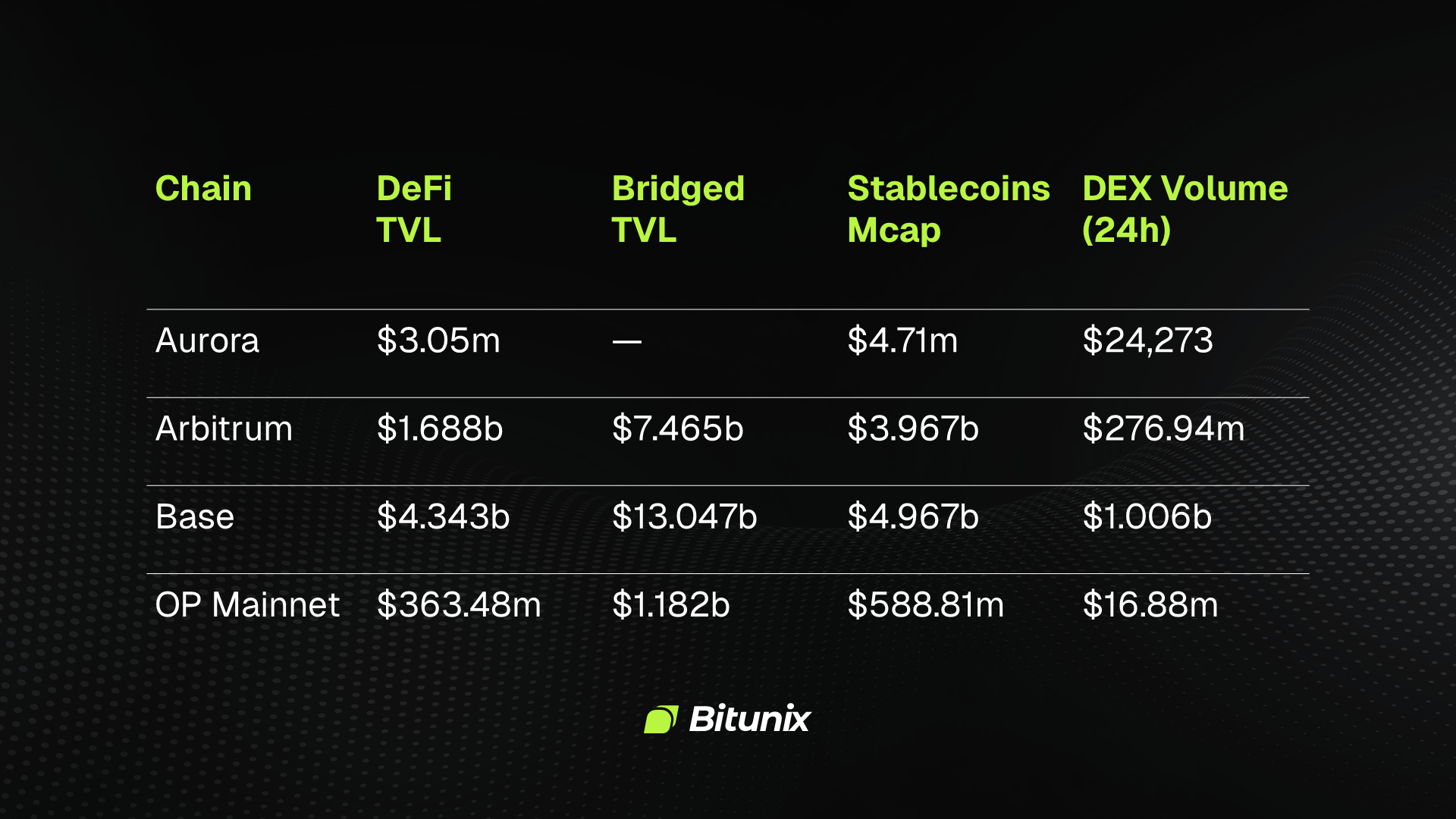
Chain-level comparison table showing how Aurora’s DeFi scale, liquidity, and trading activity compare with Arbitrum, Base, and OP Mainnet.
That gap is directly connected to the bearish case. When developers choose where to deploy, they usually care about existing liquidity, stablecoin availability, and active trading venues as much as they care about fees or tooling. Aurora can offer a cleaner bridge to NEAR and a familiar EVM environment, but if the biggest pools of capital and usage remain concentrated on larger L2s, the network risks losing market share before its interoperability pitch has time to compound.
2. Bridge Security Risks
The second bear case element is trust risk around bridge infrastructure. Aurora’s own docs present Rainbow Bridge as trustless and permissionless, and they explain that it can move ERC-20 assets between Ethereum, Aurora, and NEAR. They also note a practical drawback that investors should not ignore: transfers from Ethereum can take up to 20 minutes, while transfers back to Ethereum usually take 4 to 8 hours unless a faster path is used.
Those delays remind users that cross-chain infrastructure adds moving parts, waiting time, and extra attack surface. The broader security environment makes that worse. Chainalysis reported that crypto theft reached $3.4 billion in 2025, and in April 2026, it analyzed a roughly $292 million exploit involving KelpDAO's LayerZero bridge. In the worst-case scenario, Aurora does not even need its own core execution layer to break. A serious bridge incident, or even renewed fear around bridge security, can damage user trust fast enough to choke liquidity and cross-chain usage.
3. Dependency on NEAR
Aurora also carries a structural dependency that makes the downside case harsher than it looks at first glance. Aurora is not a fully separate Layer 1 with its own independent execution story. Aurora's documentation defines it as an EVM running on the NEAR Protocol, and the main site describes Virtual Chains as EVM-compatible chains that run as smart contracts on NEAR. That architecture is efficient when NEAR is healthy and growing, but it also means Aurora inherits a second layer of execution risk.
NEAR still has meaningful on-chain activity, with DefiLlama showing about $121.92 million in stablecoin market cap and $45.62 million in seven-day DEX volume. Still, Aurora depends on that broader ecosystem remaining attractive enough to justify building there in the first place. In the worst-case scenario, Aurora gets squeezed from both sides at once: Ethereum-native L2s dominate the scaling market, while any slowdown in NEAR weakens the base-layer ecosystem Aurora needs to justify its own existence.
Aurora Crypto Price Prediction Scenarios (2026 & 2030)
The published forecasts for AURORA are too scattered to justify one neat target, so the table below works better as a scenario map built around current valuation, TVL reality, and the spread between CoinCodex, TradersUnion, and CoinLore.
Aurora price prediction scenario table comparing bearish, neutral, and bullish outlooks for 2026 and 2030.
Conclusion: A Bet on Interoperability
Aurora still represents a clear and useful idea. It gives Ethereum developers a familiar execution environment on NEAR, keeps ETH as the gas token, and uses the Rainbow Bridge to connect liquidity across ecosystems. That is a real contribution, and it still solves practical problems around EVM compatibility, user onboarding, and cheaper execution on a different base layer.
The harder truth is that interoperability alone does not guarantee adoption when Arbitrum, Base, and Optimism already dominate the chain-level metrics that investors care about. Investing in AURORA is a long-term bet on the need for Ethereum-compatible environments beyond Ethereum itself, and on NEAR remaining strong enough to support that thesis. Ready to invest in cross-chain scaling solutions? Download the Bitunix app and register today to trade several altcoins with deep liquidity.
FAQ
What is Aurora (AURORA)?
Aurora is an Ethereum Virtual Machine on top of NEAR that lets developers deploy Ethereum-style apps while users interact with a faster and cheaper environment than Ethereum mainnet. The AURORA token mainly supports governance through AuroraDAO.
How does Aurora relate to the NEAR Protocol?
Aurora runs as smart-contract infrastructure on NEAR rather than as a completely separate Layer 1. It inherits much of its speed and execution model from NEAR while preserving Ethereum-style tooling and wallet compatibility.
What is EVM compatibility?
EVM compatibility means a chain or environment can run Ethereum-style smart contracts and work with familiar tools like MetaMask, Solidity, Hardhat, and Truffle. For developers, that usually means far less migration work.
How does the Rainbow Bridge work?
Rainbow Bridge connects Ethereum, NEAR, and Aurora by allowing cryptographically provable information and token transfers between chains. In practice, people mostly use it to bridge ERC-20 assets, though transfer times vary depending on the route.
What is the utility of the AURORA token?
The AURORA token is primarily a governance asset. Holders can influence AuroraDAO proposals, treasury direction, and protocol decisions. It also sits inside Aurora's tokenomics design, which includes planned buybacks and burns funded through NEAR-based revenue.
How does Aurora compare to Arbitrum or Optimism?
Aurora offers an EVM experience on NEAR, while Arbitrum and Optimism are native Ethereum scaling networks with much larger TVL and deeper liquidity today. Aurora is cheaper and flexible, but the bigger L2s have the stronger market position right now.
What are the gas fees like on Aurora?
Aurora documentation says fees are low, constant, and paid in ETH. Depending on the context cited in the docs, typical costs are described as pennies, around $0.02, or even lower in some observed setups.
Can I use MetaMask with Aurora?
Yes. Aurora supports MetaMask and other standard Ethereum-compatible tools and wallets, which is one reason it appeals to teams that already build in the Ethereum ecosystem.
What are the risks of investing in AURORA?
The biggest risks are weak adoption, bridge-related trust shocks, intense competition from native Ethereum L2s, and Aurora's dependence on NEAR's long-term success.
Where can I buy AURORA tokens?
AURORA trades on centralized exchanges and appears in market data listings for active pairs, such as AURORA/USDT. Availability depends on your region, the exchange's listing policy, and local eligibility rules.
Glossary
- AURORA token: Aurora's fixed-supply governance token, used for protocol direction, DAO proposals, and treasury-related decisions.
- AuroraDAO: The governance structure that reviews and votes on proposals related to the Aurora protocol and ecosystem.
- Block finality: The time it takes for a transaction to be considered final and very unlikely to be reversed.
- Bridge: Infrastructure that lets assets or data move between separate blockchain networks.
- Cross-chain DeFi: Decentralized finance activity that uses assets, liquidity, or applications across more than one blockchain.
- EVM compatibility: Support for Ethereum-style smart contracts, wallets, and developer tools.
- Ethereum scaling: Methods for increasing transaction throughput and lowering user costs for Ethereum-connected applications.
- Governance token: A token that gives holders voting power over protocol upgrades, treasury use, or ecosystem direction.
- MetaMask: A widely used Ethereum-compatible wallet that also works with Aurora.
- NEAR Protocol: The base blockchain underneath Aurora, providing the execution layer Aurora builds on.
- Rainbow Bridge: Aurora and NEAR's official bridge system for moving tokens and data between Ethereum, NEAR, and Aurora.
- Solidity: The main programming language used to write Ethereum-compatible smart contracts.
- Total Value Locked: The dollar value of assets deposited in DeFi protocols on a chain or platform.
- Virtual Chains: Aurora's customizable EVM-compatible chains that run as smart contracts on NEAR.
- TVL: Short form for Total Value Locked, often used to compare DeFi scale across chains.
Disclaimer
This article does not provide:
(i) investment advice or investment recommendations;
(ii) an offer or solicitation to buy, sell, or hold digital assets;
(iii) financial, accounting, legal, or tax advice.
Digital assets, including stablecoins and NFTs, involve high risk and may fluctuate significantly. Consider whether trading or holding digital assets is appropriate for you given your financial situation. Consult a qualified legal, tax, or investment professional when needed. You are responsible for understanding and complying with applicable local laws and regulations.
About Bitunix
Bitunix is a global cryptocurrency derivatives exchange trusted by over 3 million users across more than 100 countries. At Bitunix, we are committed to providing a transparent, compliant, and secure trading environment for every user. Our platform features a fast registration process and a user-friendly verification system supported by mandatory KYC to ensure safety and compliance. With global standards of protection through Proof of Reserves (POR) and the Bitunix Care Fund, we prioritize user trust and fund security. The K-Line Ultra chart system delivers a seamless trading experience for both beginners and advanced traders, while leverage of up to 200x and deep liquidity make Bitunix one of the most dynamic platforms in the market.
Bitunix Global Accounts
X | Telegram Announcements | Telegram Global | CoinMarketCap | Instagram | Facebook | LinkedIn | Reddit | Medium