
Article Summary
- This article provides a detailed price prediction and fundamental analysis for the Linea network and its anticipated token.
- It describes Linea as a zero-knowledge Ethereum Virtual Machine (zkEVM) Layer-2 network developed by Consensys, the company behind MetaMask.
- The bull case focuses on Linea's massive built-in user base via MetaMask integration, the superior security and finality of zk-Rollups, and the deep pockets of its parent company.
- The bear case highlights the intensely crowded Layer-2 market (Arbitrum, Optimism, Base, zkSync), the technical complexity of zkEVMs, and the uncertainty surrounding its token launch and tokenomics.
- It presents detailed price prediction scenarios (bearish, neutral, bullish) for both 2026 and 2030, based on network adoption and Total Value Locked (TVL).
Ethereum scaling has turned into a crowded race, but Linea has one advantage most rivals do not. It sits within the same product orbit as MetaMask, Infura, and Consensys, giving it a distribution that many chains would love to borrow. Linea is a Type 2 zkEVM built to feel familiar to Ethereum developers while lowering execution costs and keeping settlement tied to it. You can buy LINEA/USDT on Bitunix, which offers the pair through its crypto exchange platform.
This analysis focuses on the network as it exists now, including the zkEVM design, the role of the broader Consensys network, the current state of the Linea token, and the price ranges that external models are forecasting for 2026 and 2030.
The Technology and Ecosystem
What makes Linea interesting is that it aims to turn familiar Ethereum tooling into a lower-cost execution environment without requiring developers to learn a completely different stack. That pitch gets stronger when the chain can plug into tools people already use every day, especially MetaMask and Infura.
1. What is a zkEVM?
A zkEVM processes transactions off-chain, then posts validity proofs back to Ethereum so the chain can finalize state changes without relying on a long fraud-proof waiting period. L2Beat's rollup framework draws the core distinction clearly: optimistic systems accept state commitments unless challenged, while validity systems verify them with proofs. Linea's own 2026 release notes show the practical side of that design. After Alpha v2, it began aggregating multiple proofs into one final proof, which cut verification cost per batch dramatically, and its compression work pushed average transactions per batch from about 150 to about 1,500.
2. The Consensys Connection
Consensys gives Linea a distribution edge that most scaling chains have to build from scratch. MetaMask published a dedicated Linea ecosystem page in April 2025 and said users could explore Linea directly from MetaMask Web with no new wallet setup or extra configuration. Linea's own 2026 connection docs go further and note that MetaMask displays Linea across enabled networks by default. On the developer side, MetaMask's services documentation includes Linea in the Infura-backed network reference, indicating that the chain is already part of the toolset many Ethereum teams use to build and ship applications.
3. The Token Design After Launch
Linea is no longer a token rumor, because the token is live and its tokenomics directly shape the investment case.
Linea's own 2026 documentation puts it this way:
"ETH is the gas token, LINEA does not come with any governance rights, and there is no token allocation for insiders, investors, or team members."
That is a very different setup from the usual Layer-2 playbook. The official 2025 tokenomics post states that the total supply is 72,009,990,000 LINEA, with 85% dedicated to the ecosystem and 15% allocated to the Consensys treasury. In other words, the Linea token is designed as an ecosystem-growth asset. That can help adoption, but it also means you should not assume the token gets the classic governance premium that many altcoins chase.
The Bull Case: The Default Layer-2
Any Linea crypto price prediction worth reading has to start with the fact that the token is young, post-airdrop volatility is still shaping the chart, and most forecast tools are model outputs. Even so, the current published ranges are useful:
- CoinCodex's April 21 2026 model puts LINEA at $0.003232 by the end of 2026 and $0.008644 by 2030.
- Kraken's 5% growth calculator lands near $0.0035 by the end of 2026 and $0.0041 by 2030.
- Bitget's equivalent tool points to $0.004274 in 2030.
- CoinLore's longer-range model is much more aggressive, with a 2026 high near $0.00503 and a 2030 estimate around $0.0202.
- That spread is wide, but it still sketches a clear upside case if adoption sticks and the chain keeps gaining economic relevance.
1. The MetaMask Funnel
Linea has a built-in user acquisition advantage because it is closely tied to MetaMask, which is already one of the main entry points into Web3. In April 2025, MetaMask introduced a dedicated Linea network page in MetaMask Web, allowing users to explore the ecosystem, view token activity, and explore supported dApps without additional setup.
Linea's 2026 documentation also shows the network as visible by default in MetaMask, which lowers friction even more. That matters because most chains have to spend heavily to get users' attention, then ask them to add a new network, bridge assets, and learn a new interface. Linea removes part of that hassle. When a network is available inside a wallet people already use to hold assets, swap tokens, and interact with apps, it has a much better chance of turning curiosity into actual usage.
2. The zk-Rollup Endgame
Zero-knowledge rollups have a stronger long-term case because they verify transactions with cryptographic proofs instead of relying on a waiting period for fraud challenges. L2Beat classifies Linea as a ZK Rollup for that reason. In practice, that means Linea can offer faster finality and a more direct security model than optimistic systems like Arbitrum or Optimism.
Linea's 2026 upgrades added proof aggregation and improved compression, lowering verification costs and allowing more transactions to fit into each batch. If Ethereum scaling continues toward faster, more efficient, and more proof-based networks, Linea is built in the right direction.
3. Developer Familiarity
Adoption gets easier when builders do not have to rewrite everything from scratch. Linea's docs frame the network as Ethereum-compatible, and its 2025 year-end review says the chain integrated six Ethereum upgrades, including Pectra and Fusaka, in less than one calendar year.
The same post says Linea is moving in full synchrony with Ethereum, so builders can deploy with the newest EVM capabilities on day one. That is a real advantage for teams that want a scaling solution without signing up for a strange new execution environment. Developers usually follow the path of least pain, and Linea has been trying hard to be that path.
The Bear Case: The Crowded L2 Market
The downside case only needs a realistic look at the scoreboard, token supply, and user behavior after incentives cool off. The market already showed how brutal the launch phase could be. CoinGecko's current data places LINEA near $0.003397, while still showing the token down 92.7% from its all-time high of $0.04667 set on September 10, 2025. CoinGecko also tracks 44.7 billion tokens still locked, with another 1.38 billion LINEA scheduled to unlock on May 10, 2026. That is a lot of potential supply hanging over a chart that has not fully rebuilt credibility after launch.
1. The Layer-2 Bloodbath
Competition across Ethereum scaling is already intense, and Linea is entering a market where several rivals have a much larger lead in users, liquidity, and activity. Current L2Beat data places Arbitrum One and Base far ahead of Linea in total value secured, with OP Mainnet also maintaining a stronger position. The gap is just as visible in activity metrics, where Base and Arbitrum process far more user operations than Linea. That means good technology alone is not enough. To win meaningful market share, Linea has to pull developers, liquidity, and users away from networks that are already bigger, more active, and more deeply embedded in the Layer-2 economy.
2. Airdrop Mercenaries
Much of Linea's early excitement came from rewards, points, and token eligibility. That is normal in crypto, but it can also distort reality. Linea's official Ignition program in September 2025 targeted over $1 billion in TVL and distributed 1 billion LINEA tokens to reward liquidity providers.
Later that year, the official Linea recap said the TGE rewarded 750,000 wallets, with more than 92% of eligible wallets claiming the airdrop. Incentives are useful when you want to jump-start activity; they are less useful as proof of long-term loyalty. If a large share of users showed up for rewards first, some of that capital leaves the moment better opportunities arise elsewhere.
3. Centralization Concerns
Despite the technical progress, Linea still does not clear the decentralization bar that long-term bulls would like to see. L2Beat currently classifies it as Stage 0 and says 52.4% of its value secured comes with additional trust assumptions. Linea's 2026 release notes also show how much core infrastructure still depends on controlled upgrade paths, timelocks, verifier changes, and special finalization procedures tied to contract management. That means the chain is not yet the trust-minimized machine that the strongest zk-rollup narrative implies.
Linea Crypto Price Prediction Scenarios (2026 & 2030)
A useful Linea crypto price prediction has to balance today's tiny unit price with the token's still-young market structure. CoinGecko currently values LINEA at roughly $84.5 million in market cap, with about $10.1 million in 24-hour trading volume and a fully diluted valuation of around $244.3 million. Against that backdrop, the published 2030 targets range from conservative model outputs near $0.0041 to $0.0043 on Kraken and Bitget, to $0.008644 on CoinCodex, all the way to $0.0202 on CoinLore. That is a big spread, but it also tells you how early this market still is.
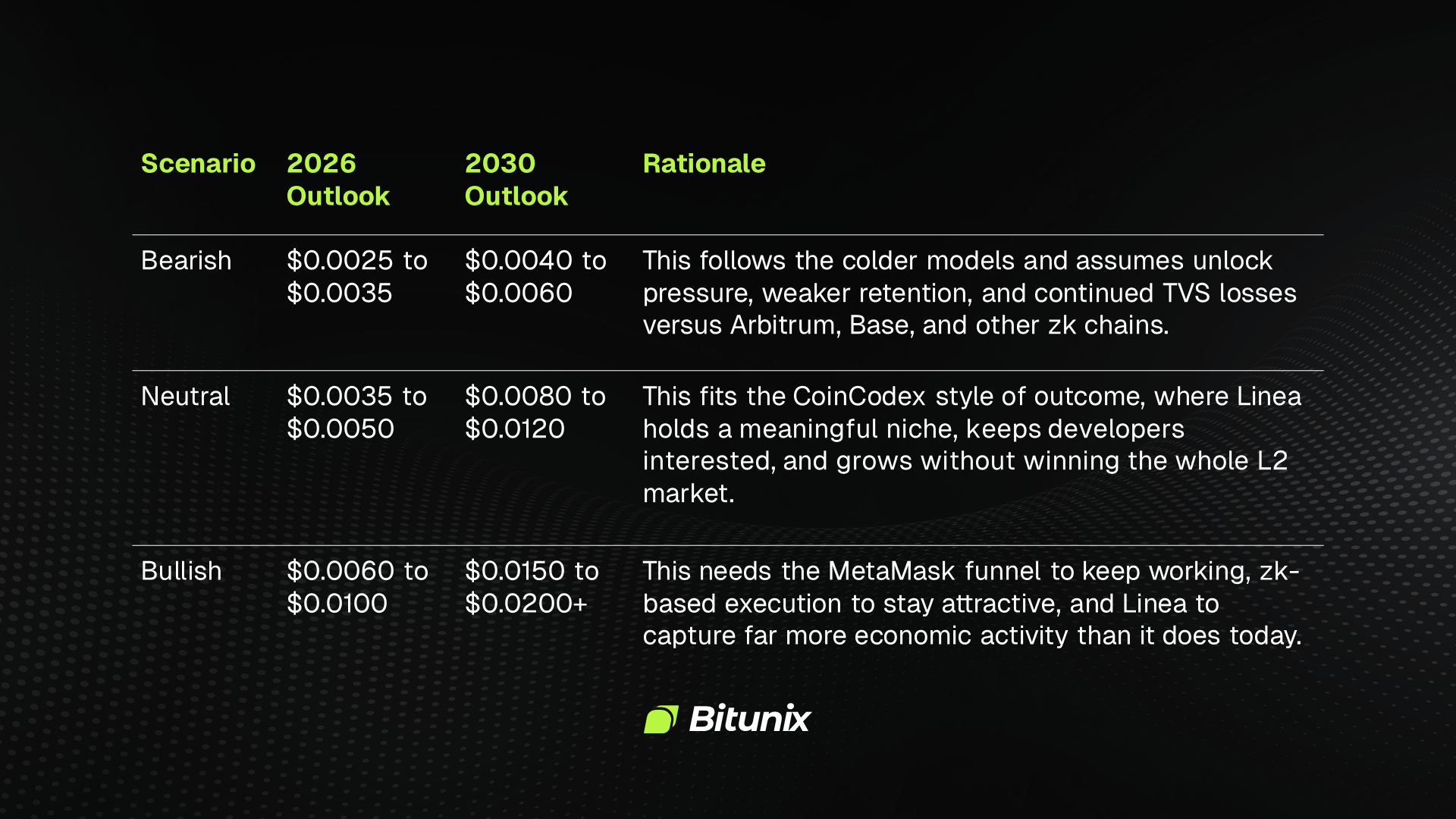
Linea scenario table comparing bearish, neutral, and bullish price outlooks for 2026 and 2030.
Conclusion: A Bet on Consensys
Linea remains one of the more technically serious scaling chains in the market. It has a real zkEVM, close ties to MetaMask and Infura, and a token model that tries to reward ecosystem growth, giving it a better foundation than many launch-and-forget Layer-2 projects.
But the investment case is still a hard one. Linea has to prove that zero-knowledge proofs, easier distribution through MetaMask, and developer familiarity can outweigh weaker current TVS, lower activity, and the baggage of a volatile token launch. If you believe Consensys can turn that stack into durable usage, LINEA has room to grow. If you do not, the conservative forecast bands still look more realistic. And if you want to follow the Ethereum scaling trade more broadly, download the Bitunix app, and register to track the top Layer-2 assets with deep liquidity while the Linea story keeps developing.
FAQ
What is Linea?
Linea is a ZK Rollup built by Consensys to scale Ethereum. It gives developers an Ethereum-compatible environment, uses ETH as gas, and relies on validity proofs to finalize activity while keeping settlement tied to Ethereum.
What is a zero-knowledge Ethereum Virtual Machine, or zkEVM?
A zkEVM is a network that executes EVM-compatible transactions off-chain and then proves their validity on Ethereum with cryptographic proofs. In Linea's case, proof aggregation and data compression are central to making that design cheaper and more efficient.
How does Linea differ from Arbitrum or Optimism?
The main difference is the proof system. Arbitrum and OP Mainnet are optimistic rollups that rely on challenge windows, while Linea is a validity rollup that uses proofs to verify state transitions. That gives Linea a different security and finality profile.
Who built the Linea network?
Linea was built by ConsenSys, the Ethereum software company founded by Joseph Lubin, one of Ethereum's co-founders. ConsenSys developed it as a zkEVM Layer-2 and connected it to its own ecosystem, including MetaMask, Infura, and Truffle, to make Ethereum scaling easier for developers and users.
Does Linea have a native token?
Yes. Linea has a native token called LINEA, launched in September 2025. It is an ecosystem incentive token, not the gas token, since ETH still pays transaction fees on the network. LINEA is mainly used for incentives, liquidity programs, and token burn mechanics.
How does Linea integrate with MetaMask?
Linea integrates with MetaMask very directly because both are part of the Consensys ecosystem. Users can access Linea as a pre-configured network, switch to it without manual setup, and use MetaMask to connect to dApps, bridge assets, and interact with the network more easily.
What are gas fees like on Linea?
Linea is designed to be much cheaper than the Ethereum mainnet by batching transactions, compressing data, and aggregating proofs. The protocol's 2026 release notes describe multiple upgrades aimed specifically at reducing L1 verification and data posting costs.
Is Linea fully decentralized?
No. L2Beat currently ranks Linea at Stage 0 and notes additional trust assumptions around part of its secured value. The chain has made technical progress, but it still has decentralization work left before it reaches the strongest trust-minimized standard.
What are the risks of investing in Linea?
The main risks are token unlock pressure, intense L2 competition, lower current activity than leading rivals, and the risk that incentive-driven users will leave once rewards cool down. Centralization and upgrade trust assumptions are part of that risk set, too.
How can I bridge assets to Linea?
Linea's docs list two main routes. The native bridge works for ETH and ERC-20s, especially larger moves, while the LI.FI-powered bridge aggregator is faster and is presented as the best option for most users. MetaMask Portfolio is also highlighted as an easy route.
Glossary
- zkEVM: A zero-knowledge Ethereum Virtual Machine that runs EVM-compatible transactions and proves their validity back to Ethereum.
- ZK Rollup: A Layer-2 design that posts state commitments to Ethereum and validates them with validity proofs.
- Validity proof: A cryptographic proof that shows a batch of transactions is valid without relying on a fraud challenge window.
- Optimistic rollup: A rollup that assumes submitted state is valid unless someone challenges it during a dispute period.
- Proof aggregation: A method Linea uses to combine many execution proofs into one proof to reduce verification cost on Ethereum.
- Data compression: A way to shrink L2 data before posting it to Ethereum so the chain spends less on L1 data availability.
- TVS: Total value secured, L2Beat's metric for the value held or secured on a Layer-2.
- UOPS: User operations per second, an activity metric L2Beat uses to compare how much execution load chains are handling.
- ETH gas token: The asset used to pay network transaction fees on Linea. Official docs say ETH, not LINEA, is the gas token.
- Token unlock: A scheduled release of previously locked tokens into circulation, which can increase sell pressure.
- Fully diluted valuation: A market cap estimate that assumes the full token supply is circulating.
- Airdrop: A token distribution to users, often based on past on-chain activity or campaign participation.
- Stage 0: L2Beat's label for an early decentralization stage where important trust assumptions still remain.
- Canonical bridge: The official bridge path for moving assets between Ethereum and Linea.
- Scaling solution: A system that increases Ethereum's transaction capacity or lowers cost without moving final settlement away from Ethereum.
Disclaimer
This article does not provide:
(i) investment advice or investment recommendations;
(ii) an offer or solicitation to buy, sell, or hold digital assets;
(iii) financial, accounting, legal, or tax advice.
Digital assets, including stablecoins and NFTs, involve high risk and may fluctuate significantly. Consider whether trading or holding digital assets is appropriate for you given your financial situation. Consult a qualified legal, tax, or investment professional when needed. You are responsible for understanding and complying with applicable local laws and regulations.
About Bitunix
Bitunix is a global cryptocurrency derivatives exchange trusted by over 3 million users across more than 100 countries. At Bitunix, we are committed to providing a transparent, compliant, and secure trading environment for every user. Our platform features a fast registration process and a user-friendly verification system supported by mandatory KYC to ensure safety and compliance. With global standards of protection through Proof of Reserves (POR) and the Bitunix Care Fund, we prioritize user trust and fund security. The K-Line Ultra chart system delivers a seamless trading experience for both beginners and advanced traders, while leverage of up to 200x and deep liquidity make Bitunix one of the most dynamic platforms in the market.
Bitunix Global Accounts
X | Telegram Announcements | Telegram Global | CoinMarketCap | Instagram | Facebook | LinkedIn | Reddit | Medium