
Article Summary
- This article provides a comprehensive explanation of trading psychology in the context of cryptocurrency trading.
- It breaks down the psychological factors that influence trading decisions and how emotions can lead to poor trading outcomes.
- The guide explores common psychological pitfalls such as fear, greed, overconfidence, and revenge trading.
- It highlights practical strategies for developing emotional discipline and maintaining a winning trader mindset.
- The article concludes with actionable advice for improving your trading psychology and achieving consistent results.
- Technical analysis, risk management, and trading strategies all matter, but psychology often decides whether a trader follows the plan or breaks it under pressure. A trader can understand chart patterns, indicators, and position sizing, yet still make poor decisions after a loss, a winning streak, or a sudden market move.
- Trading psychology is the study of how emotions, biases, habits, and mental patterns affect trading decisions. It explains why traders hold losing positions too long, close winning trades too early, increase size after a few wins, or panic when the market moves against them.
- Crypto makes this even harder because the market never closes. A crypto exchange like Bitunix gives traders access to spot and futures markets, charting tools, real-time alerts, and mobile account monitoring. Still, those tools work best when the trader uses them with a clear plan instead of reacting to every price move.
- This guide explains the key psychological factors that affect trading, the most common emotional traps, and practical strategies for building discipline.
What Is Trading Psychology?
When traders ask what is trading psychology, they are asking why people often make poor decisions even when they understand the market setup. Trading psychology studies how emotions, biases, habits, and pressure affect trading behavior, especially when money is at risk and the market is moving quickly.
A trader's brain naturally reacts to price movement as either a threat or an opportunity. A losing position can trigger fear, while a fast rally can trigger excitement or greed. These reactions are normal, but they become costly when they lead to emotional trading, such as closing a winning trade too early, ignoring a stop loss, chasing an entry, or increasing position size after a few wins.
Behavioral finance research supports this idea, as factors beyond logic and market data shape investment decisions. A 2026 Springer meta-analysis covering 37 empirical studies and 18,835 respondents examined how risk aversion, financial literacy, and overconfidence relate to investment decisions, demonstrating the close connection between psychology and financial behavior.
Cognitive biases are a major part of trader psychology because they distort how traders interpret information. Confirmation bias makes you look for evidence that supports your existing view, availability bias gives too much weight to recent events, and anchoring bias makes you fixate on one price level even after market conditions change.
Loss aversion also plays a major role, as traders often feel the pain of losses more strongly than the satisfaction from similar gains. This can lead to holding losing positions for too long, closing profitable trades too early, or avoiding valid setups after a recent loss. Over time, these reactions weaken consistency and make the trading plan harder to follow.
Discipline is the practical answer to these psychological pressures. A disciplined trader still feels fear, frustration, and excitement, but uses a written plan, predefined risk limits, and a review process to guide decisions.
Common Psychological Pitfalls in Trading
Most trading mistakes stem from predictable emotional patterns that recur again and again. Once you can name these patterns, you can build rules to manage them before they take over.
The table and sections below will explore some of these patterns:
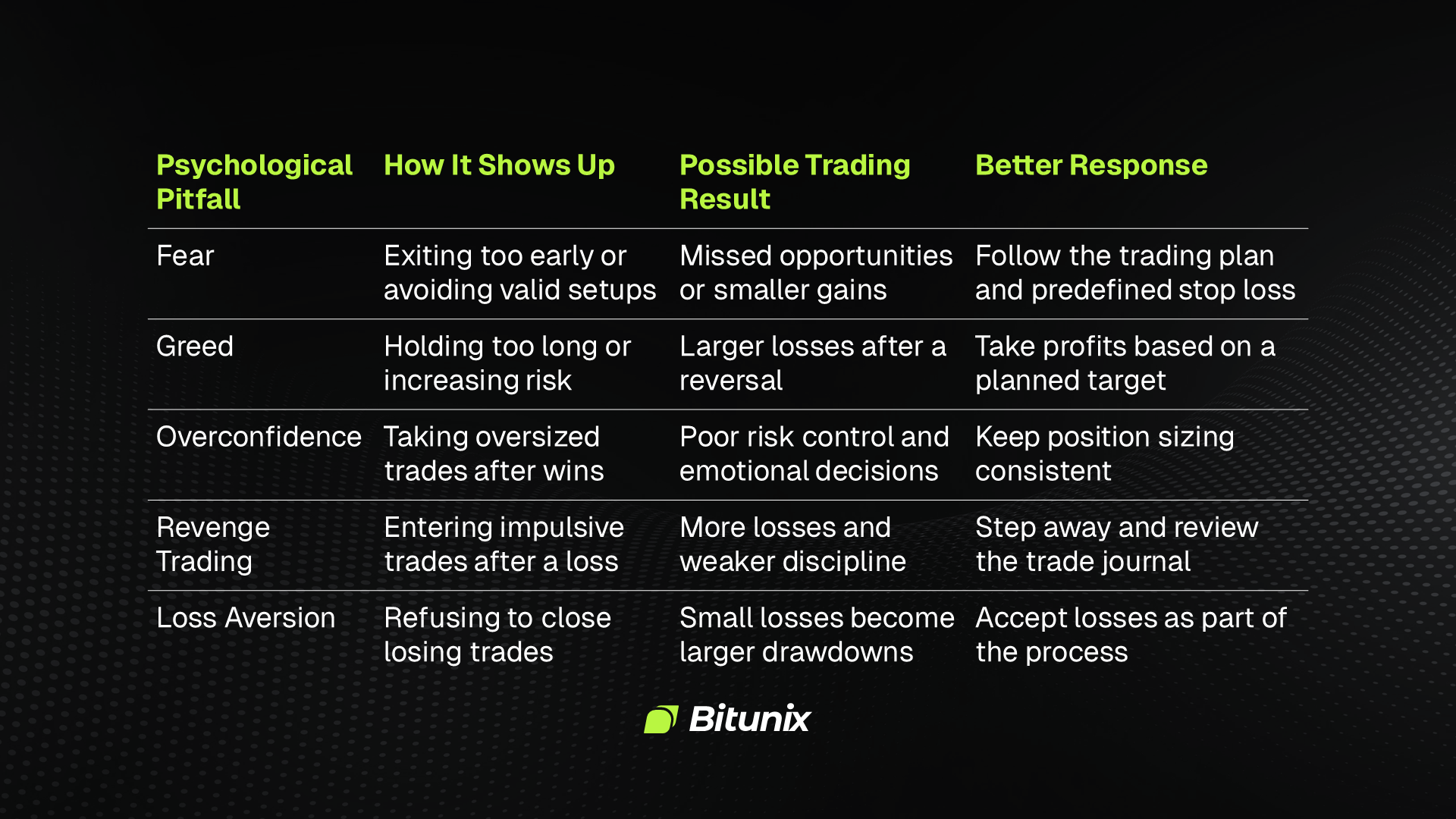
Common emotional trading mistakes and practical ways traders can respond with more discipline.
Fear
Fear affects trading decisions when the trader focuses more on avoiding loss than following the setup. It can make you close winning trades too early, skip valid entries, or move stops to avoid being wrong. The result is often inconsistent execution.
Behavioral finance research helps explain why fear becomes so powerful in crypto markets. A 2025 ScienceDirect study on cryptocurrency sentiment notes: "Emotional triggers such as fear and greed drive volatility, and the absence of a standardized sentiment framework presents challenges in forecasting market behavior and evaluating potential systemic risks."
Retail investor data shows how strongly emotions shape financial decisions. In May 2025, eToro reported that 54% of UK retail investors said personal experiences and emotions influence their investment choices, while fear of loss was the top emotional driver at 37%.
A trader who understands fear can respond with structure. That means defining risk before entry, placing a stop loss where the trade idea becomes invalid, and accepting that every good strategy still has losing trades.
Greed
Greed sets in when traders focus solely on the upside and forget about risk. It can lead to holding trades after the target has been reached, increasing position size without a reason, or chasing a market after the move has already happened.
Crypto markets make greed easy to justify because prices can move fast. A coin can rally hard in a short period, and traders start thinking they are missing the train. The problem is that late entries often come with poor risk-reward. You may be right about the direction and still enter at a bad price.
A simple profit-taking plan helps reduce greed. Before entering, decide where you will take partial profit, where you will exit fully, and what condition would make you stay in the trade. That way, the plan is already written before excitement takes over.
Overconfidence
Overconfidence usually appears after a few wins. The trader starts believing the market has become easy, increases size, ignores stop losses, or enters lower-quality setups. A winning streak can be useful, but it can also turn into a trap when it changes behavior.
The 2026 Springer meta-analysis found overconfidence important enough to study alongside risk aversion and financial literacy across a large sample of investment decision research. That is a useful reminder that overconfidence is a documented behavioral pattern in investing.
Revenge Trading
Revenge trading happens when a trader tries to recover a loss quickly instead of reviewing what happened. The next trade often comes from frustration, not analysis. It may be larger, rushed, and poorly planned, which creates the perfect recipe for another loss. This pattern becomes more dangerous in leveraged crypto markets. A trader loses, gets angry, increases size, and tries to win it back in one trade.
Reduced trading activity can also reflect fatigue and weaker sentiment. Reuters reported in April 2026 that Robinhood's cryptocurrency-related revenue fell 47% year over year to $134 million in Q1, linked to a broader crypto slump and lower trading volume growth.
A better response is to pause after a meaningful loss. Step away, write down the reason for the trade, review whether the plan was followed, and only return when the next setup meets your rules.
Developing a Winning Trading Mindset
A winning trading mindset is built through repeatable habits, not motivation or confidence alone. Traders need to accept losses, follow written rules, review their decisions, and keep learning as market conditions change. This mindset helps reduce emotional trading by giving you a clear process to follow when fear, greed, or frustration starts to affect your decisions.
1. Accepting Losses
Accepting losses is one of the hardest parts of trading because every loss feels personal, even when the trade followed the plan. A planned loss occurs when the setup meets your rules, the position size is controlled, and the stop loss is triggered, rendering the trade idea invalid.
The main problem starts when traders treat every loss as something to fix immediately. That reaction can lead to revenge trading, moving stop losses, or increasing risk on the next position. A better response is to review whether the trade followed your rules and separate normal losses from avoidable mistakes.
Recent crypto investor data shows why this matters. Security.org's 2026 Cryptocurrency Adoption and Sentiment Report found that 53% of people who had ever owned crypto reported a positive return, while 21% reported a net loss. That gap shows how varied outcomes can be, even in the same asset class, and why traders need a process that can handle both winning and losing periods.
2. Sticking to Your Plan
A written trading plan should define your setup criteria, entry rules, stop loss placement, position sizing, profit targets, and conditions for staying out of the market. When those rules are defined before the trade, you reduce the chance of changing your mind because of fear, greed, or short-term volatility.
A plan also makes your results easier to evaluate. If you followed the rules and the trade lost money, the loss may still be part of a valid process. If you ignore the rules and make money, the result can hide a bad habit.
The plan should be simple enough to use in real time. A long document with too many conditions often gets ignored when the market is moving quickly. A practical plan gives you clear answers before entry: why you are taking the trade, where the idea becomes invalid, how much you are risking, and how you will manage the position after entry.
3. Focusing on Process, Not Outcome
Process-focused trading means judging the quality of your decision before judging the result. A good trade can lose money if the market doesn't cooperate, while a poor trade can make money if timing or luck is on your side. If you only judge the outcome, you risk rewarding bad behavior and punishing disciplined execution.
The process review should be specific. Ask whether the setup matched your rules, whether the entry was planned, whether the stop loss made sense, whether the position size was correct, and whether you managed the trade according to your plan. These questions focus on actions you control instead of short-term profit and loss.
4. Continuous Learning
Continuous learning helps traders make better decisions because markets change, strategies weaken, and personal habits become clearer with review. Learning includes studying market structure, liquidity, volatility, and risk management, but it also means studying your own behavior under pressure.
A trader who reviews both charts and behavior can spot patterns that technical analysis alone misses. For example, you may notice that you overtrade after a loss, exit too early after a volatile move, or ignore your plan when social media sentiment becomes loud, giving you clear areas to improve.
The strongest trading mindset develops through repetition. You test ideas, track results, review mistakes, and adjust your rules when the evidence supports it. The goal is to become more consistent, more patient, and less reactive when the market changes.
Practical Strategies for Improving Trading Psychology
Improving trader psychology works best when you turn good intentions into habits. You need tools that slow you down, make your decisions visible, and help you notice emotional patterns before they become expensive.
Journaling
A trading journal helps you track both the trade and the mindset behind it. You should record the setup, entry, exit, stop loss, position size, result, and emotional state. That last part is important because many mistakes start before the order is placed.
Journaling can reveal patterns that memory hides. You may notice that you overtrade after a losing morning, exit too early after a large win, or increase size when social media becomes too loud. Once you see the pattern, you can create a rule for it. A useful journal does not need to be complicated. A simple spreadsheet or notes app works if you use it consistently.
Pre-Trade Routine
A pre-trade routine helps reduce emotional trading by slowing the decision down. Before entering, check your setup, confirm your risk, define your stop loss, take a deep breath, and make sure the trade fits your plan.
The routine works because it creates a pause between impulse and action. Many bad trades happen in that tiny space where a trader thinks, I should get in now. A checklist gives you a second to ask whether the trade is valid or just exciting.
Bitunix's drawing alert function, updated in May 2026, lets traders set alerts based on chart drawings such as channels and trend lines, which can support a calmer process by reducing the need to stare at the chart constantly.
Taking Breaks
Taking breaks protects traders from emotional fatigue. After hours of watching charts, the brain starts making faster and weaker decisions. You may still feel alert, but your patience and discipline often drop before you notice.
Breaks are especially useful after a large win, a large loss, or a series of trades. A big win can create overconfidence, while a big loss can trigger revenge trading. Both states deserve a pause. A simple break rule works well. For example, step away after three trades, after two losses in a row, or after any trade that creates strong emotion.
Meditation and Mindfulness
Meditation and mindfulness help traders notice emotions before acting on them. They do not make risk disappear, and they do not turn bad setups into good ones. They help you recognize when fear, greed, frustration, or impatience is driving the decision.
Mindfulness can be simple. Before entering a trade, check your body and thoughts. Are you tense? Are you rushing? Are you trying to recover? Are you afraid of missing out? These questions take seconds, but they can stop a poor trade. Traders who practice emotional awareness usually become better at waiting, and in trading, that is often the job.
Conclusion: The Path to Consistent Trading Success
Trading psychology is the often-overlooked factor that separates disciplined traders from reactive traders. Charts, indicators, and strategies help, but your decisions still pass through fear, greed, confidence, frustration, and hope.
By understanding your psychological patterns and building emotional discipline, you can improve your trading results over time. The goal is fewer impulsive decisions, better risk management, and a process you can repeat when the market becomes difficult.
Ready to improve your trading psychology? Download the Bitunix app and register to access trading tools, alerts, charting features, and mobile account monitoring that can support a more disciplined trading process.
FAQ Section
What exactly is trading psychology?
Trading psychology is the study of how emotions, biases, and mental habits affect trading decisions. It explains why traders sometimes ignore plans, move stop losses, chase entries, or hold losing positions too long, even when they understand the strategy.
Why is trading psychology important?
Trading psychology matters because execution often separates good plans from poor results. A trader can have a solid strategy and still lose money through fear, greed, overconfidence, or revenge trading. Emotional discipline helps you follow rules when the market becomes stressful.
What are common psychological pitfalls in trading?
Common psychological pitfalls include fear, greed, overconfidence, revenge trading, confirmation bias, and loss aversion. These patterns can lead to early exits, oversized positions, impulsive entries, and refusal to close losing trades when the original trade idea has already failed.
How does fear affect trading decisions?
Fear can make traders avoid valid setups, close winning trades too early, or move stops because they do not want to take a loss. The best response is to define risk before entry and to follow a written plan rather than reacting to price movements.
What is revenge trading, and how do I avoid it?
Revenge trading happens when a trader enters impulsive trades after a loss to recover quickly. You avoid it by stepping away after emotional losses, reviewing the trade journal, and returning only when the next setup meets your rules and risk limits.
How do I develop emotional discipline?
Emotional discipline comes from repeatable systems. Use a written trading plan, set fixed risk limits, follow a pre-trade checklist, journal each trade, and step away after emotional decisions. These routines help reduce impulsive trading and make disciplined behavior easier to repeat.
What is the importance of a trading plan?
A trading plan defines your setup, entry, stop loss, position size, target, and review process before emotions get involved. It provides clear rules when the market moves quickly and helps prevent random decisions driven by fear, greed, or frustration.
How does journaling help improve trading psychology?
Journaling helps you see patterns in both your trades and your behavior. By recording your setup, result, risk, and emotional state, you can identify when you overtrade, cut winners early, hold losers too long, or break rules under pressure.
Can meditation help with trading psychology?
Meditation can help trading psychology by improving emotional awareness and patience. It does not guarantee better trades, but it helps you notice fear, greed, and frustration before they turn into impulsive actions.
How long does it take to develop a winning trader mindset?
Developing a winning trader mindset takes time because it comes from repeated execution, review, and adjustment. Most traders improve gradually as they track mistakes, follow risk rules, and learn how they behave under pressure.
Glossary
- Trading psychology: The study of how emotions, biases, and mental habits affect trading decisions and results.
- Emotional trading: Trading driven by fear, greed, frustration, excitement, or impulse instead of a plan.
- Discipline: The ability to follow trading rules even when emotions push you to break them.
- Trading mindset: The mental approach a trader uses to handle risk, uncertainty, wins, and losses.
- Trader psychology: The emotional and cognitive patterns that influence how a trader behaves in markets.
- Confirmation bias: The habit of looking for information that supports an existing opinion while ignoring opposing evidence.
- Availability bias: The tendency to give too much weight to recent or memorable market events.
- Anchoring bias: The tendency to fixate on one price level or idea even after conditions change.
- Loss aversion: The tendency to feel losses more strongly than similar-sized gains.
- Fear: An emotional response that can lead traders to avoid risk, exit early, or ignore valid setups.
- Greed: An emotional response that can lead traders to chase prices, increase size, or hold too long.
- Overconfidence: A bias that causes traders to overestimate their skill after wins or favorable market moves.
- Revenge trading: Impulsive trading after a loss, usually driven by the desire to recover quickly.
- Trading journal: A record of trades, decisions, emotions, and results used for review and improvement.
- Pre-trade routine: A checklist or process used before entering a trade to confirm setup, risk, and mindset.
Disclaimer
This article does not provide:
(i) investment advice or investment recommendations;
(ii) an offer or solicitation to buy, sell, or hold digital assets;
(iii) financial, accounting, legal, or tax advice.
Digital assets, including stablecoins and NFTs, involve high risk and may fluctuate significantly. Consider whether trading or holding digital assets is appropriate for you given your financial situation. Consult a qualified legal, tax, or investment professional when needed. You are responsible for understanding and complying with applicable local laws and regulations.
About Bitunix
Bitunix is a global cryptocurrency derivatives exchange trusted by over 3 million users across more than 100 countries. At Bitunix, we are committed to providing a transparent, compliant, and secure trading environment for every user. Our platform features a fast registration process and a user-friendly verification system supported by mandatory KYC to ensure safety and compliance. With global standards of protection through Proof of Reserves (POR) and the Bitunix Care Fund, we prioritize user trust and fund security. The K-Line Ultra chart system delivers a seamless trading experience for both beginners and advanced traders, while leverage of up to 200x and deep liquidity make Bitunix one of the most dynamic platforms in the market.
Bitunix Global Accounts
X | Telegram Announcements | Telegram Global | CoinMarketCap | Instagram | Facebook | LinkedIn | Reddit | Medium